Zodiac · Topic guide
2027 Chinese Zodiac: Fire Goat Year, Tai Sui and 12 Signs
2027 is a Fire Goat (Ding Wei) year, from February 6, 2027 to January 25, 2028. Who the Tai Sui is, which signs clash, and a reading for all 12 signs.
By Daozhang Ma Published
In short
2027 is the Year of the Goat, and more precisely a Fire Goat year, written 丁未 (Ding Wei) in Chinese. By the lunar calendar it runs from February 6, 2027, to January 25, 2028. The god on duty for the year, the Tai Sui (太岁), is General Miao Bing, and the signs traditionally said to be at odds with him are the Goat itself, the Ox, the Dog and the Rat.
Those dates and names are the short answer. The longer one matters if your birthday, or your child’s due date, falls in early February, because the Chinese almanac changes years two days before New Year’s Day.
From here the page runs from the calendar to the temple: when the Goat year actually begins, what “Fire Goat” means, who Miao Bing is, which four signs clash with him and why, a traditional reading for all 12 signs, the lucky colors and numbers you will see quoted everywhere, and finally what people do about Tai Sui at a Taoist temple.
Daozhang MaMaoshan Taoist, Jintan, Jiangsu
The guide · 7 chapters
When the 2027 Year of the Goat starts: February 6 or February 4?
1 min read · 1 table
Both dates are correct; they answer two different questions. Chinese New Year, the first day of the first lunar month, falls on February 6, 2027, and that is the date nearly every zodiac chart, school project and greeting card goes by. The almanac and Chinese birth-chart (bazi) reckoning switch years at Lichun (立春), the “Beginning of Spring” solar term, which lands on February 4, 2027.
The lunar new year moves around between January 21 and February 20 because it follows the moon. Lichun barely moves, because it is fixed to the sun’s position, so it sits on February 3, 4 or 5 almost every year. Whenever those two dates fall on different days, someone born in the gap ends up with two answers.
For 2027 the gap is only two days, which keeps things simple:
| Birth date | Lunar New Year reckoning | Lichun (almanac) reckoning |
|---|---|---|
| January 1 – February 3, 2027 | Horse (Fire Horse, 2026 lunar year) | Horse |
| February 4 – 5, 2027 | Horse | Goat |
| February 6, 2027 – January 25, 2028 | Goat | Goat until about February 4, 2028 |
| January 26, 2028 onward | Monkey | Goat until Lichun 2028 |
So if you are asking about January 2027 birthdays: those babies are Horses by either count. If someone gives you a “Goat” answer for a January 2027 birthday, they have mixed up the calendar year with the lunar year.
Which count should you use? For everyday zodiac talk, the lunar new year is what people mean, and I would go by it. If you are reading a birth chart or an almanac, it uses Lichun, and the chart will already be set up that way. Neither is wrong; just keep to one when you compare two people.
The festival itself, with its dates and customs, has its own page on Chinese New Year 2027.
Why 2027 is a Fire Goat year (Ding Wei in the 60-year cycle)
3 min read · 2 photos · 1 table
The February 4 switch in the table above is the moment the year’s name changes from 丙午 (Bing Wu) to 丁未 (Ding Wei). Chinese years are named with two characters. The first comes from a set of ten heavenly stems; the second comes from the twelve earthly branches, which are the twelve animals. Ten stems and twelve branches line up again every sixty years, so each pairing comes around once in a lifetime.
Each stem is tied to one of the five elements of Chinese cosmology (wood, fire, earth, metal and water), in either its yang or its yin form. Ding is the yin side of fire, which is where “Fire Goat” comes from. Wei is the Goat branch.
One detail that most charts skip: the Goat branch itself belongs to earth, so a Fire Goat year is really fire sitting over earth. When people describe 2027 as “warm but steady,” that pairing is what they are pointing at, whatever you make of the reading.
Every Goat year carries one of five elements, and they rotate in a fixed order, so the same element returns every sixty years:
| Goat year | Stem and branch | Element |
|---|---|---|
| 1931, 1991 | Xin Wei 辛未 | Metal |
| 1943, 2003 | Gui Wei 癸未 | Water |
| 1955, 2015 | Yi Wei 乙未 | Wood |
| 1967, 2027 | Ding Wei 丁未 | Fire |
| 1979, 2039 | Ji Wei 己未 | Earth |
The last Fire Goat year was 1967, and the next one after 2027 is 2087. Keep in mind that a Goat year starts in late January or February, so someone born in January or early February 1967, or before January 28, 1979, belongs to the year before. The Goat as a sign, with its personality and match-making lore, gets its own page on the Year of the Goat.
Goat, sheep or ram: what the character 羊 covers
English speakers hit a translation snag here. The Chinese character 羊 (yáng) covers goats, sheep and rams alike. Chinese adds a word in front when it needs to be specific, 山羊 for the goat and 绵羊 for the sheep, but the zodiac sign is just 羊.
The one character explains why you will see “Year of the Goat,” “Year of the Sheep” and “Year of the Ram” for the same year, sometimes on the same shop shelf. None of them is a mistake. Chinese folk art often draws the animal woolly and gentle, closer to a sheep, while English usage from mainland China has leaned toward “Goat” in recent years.
I use “Goat” on this site because it is what most readers search for. If your family says “Sheep,” nothing in the tradition changes.
The last Goat year on paper: China’s 2003 stamps
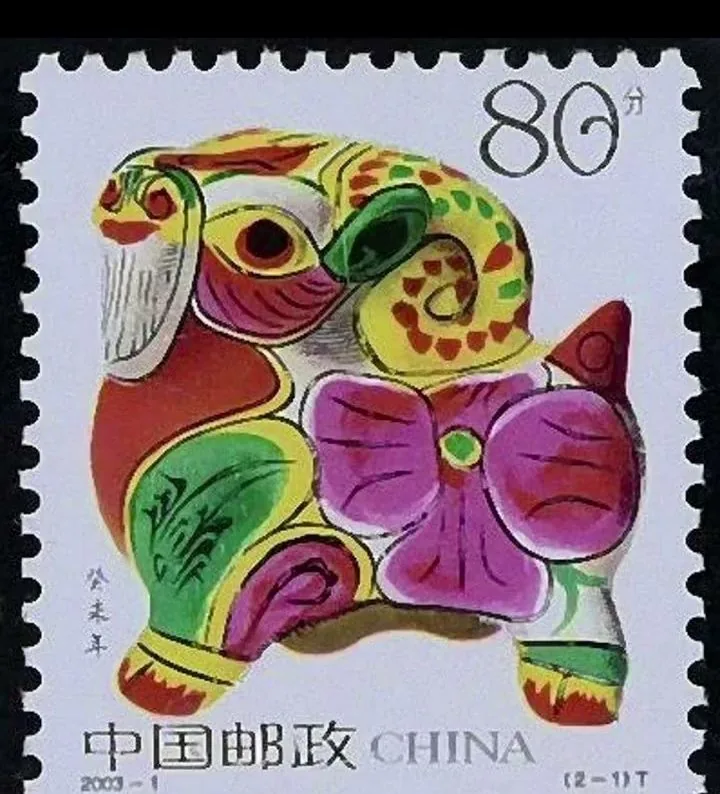
The Water Goat year of 2003, the Gui Wei year, is recent enough that you can still hold a piece of it. China Post issued its 2003-1 Year of the Goat set of two stamps for it.
The 80-fen stamp (a fen is a hundredth of a yuan) is a painted clay goat with a pink bow, the kind of folk toy sold at temple fairs. The second, 2-yuan stamp goes another way: a papercut frame around the single character 羊 in regular-script calligraphy. The papercut goat design is credited to the folk papercut artist Liu Jinglan.
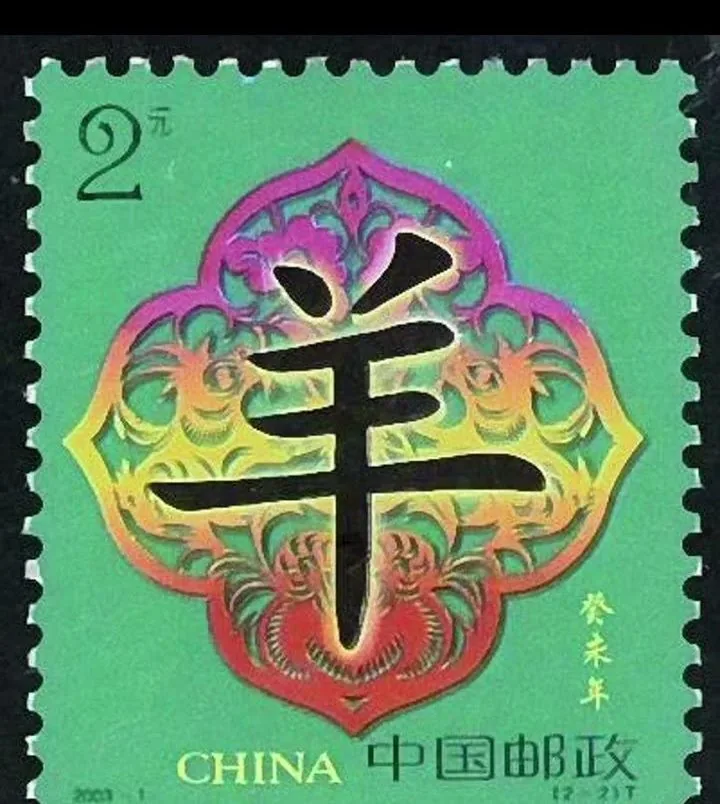
I like this pair as a reminder of how the cycle works. The animal is the same one that comes back in 2027; only the element changed, from water in 2003 to fire now. These are not 2027 stamps, which have not been issued yet.
The 2027 Tai Sui: General Miao Bing
2 min read · 5 photos
Each of those sixty stem-and-branch years has its own guardian general, and together they make up the Tai Sui, the “Grand Duke Jupiter” deities of Taoist tradition. The name comes from the old Chinese reckoning of years by Jupiter’s twelve-year path across the sky. Over time, each year in the sixty-year cycle gained a named general who governs it, and people pay their respects to whichever one is on duty.
For the Ding Wei year, that general is Miao Bing, written 缪丙 and titled 丁未太岁缪丙大将军, “Tai Sui of the Ding Wei year, General Miao Bing.” He takes over from General Wen Zhe, the Tai Sui of the Bing Wu (Fire Horse) year of 2026, and serves until the Monkey year of 2028 begins.
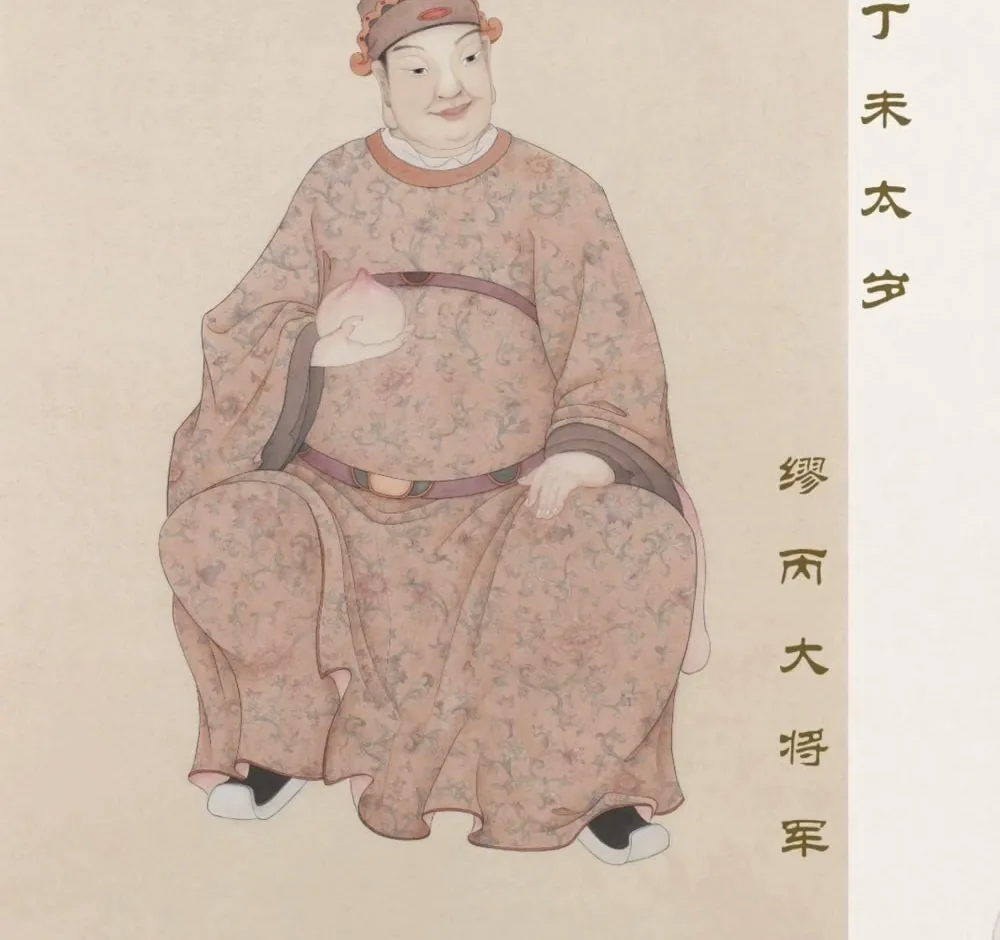
I have not found a reliable life story for Miao Bing, and I would not trust the ones circulating online without a source, so I will leave his biography out. What people usually picture is the image. Temples cast or carve each of the sixty generals, and painters make portraits of the one on duty for the coming year.
The portrait here is a modern gongbi painting, the fine-line Chinese style built up in layers, not a copy of a temple statue. It shows Miao Bing as a civil official rather than a warrior: round-faced, smiling, in an ornate cap and a robe covered in scrolling flowers, holding a peach.
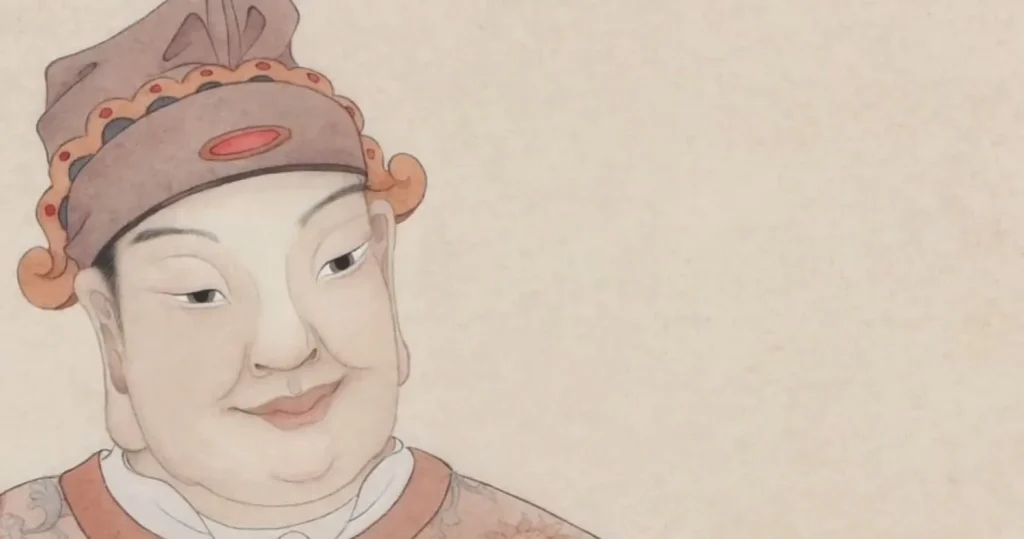
Gongbi work starts with a complete ink outline, down to the robe pattern, and only then moves on to color.
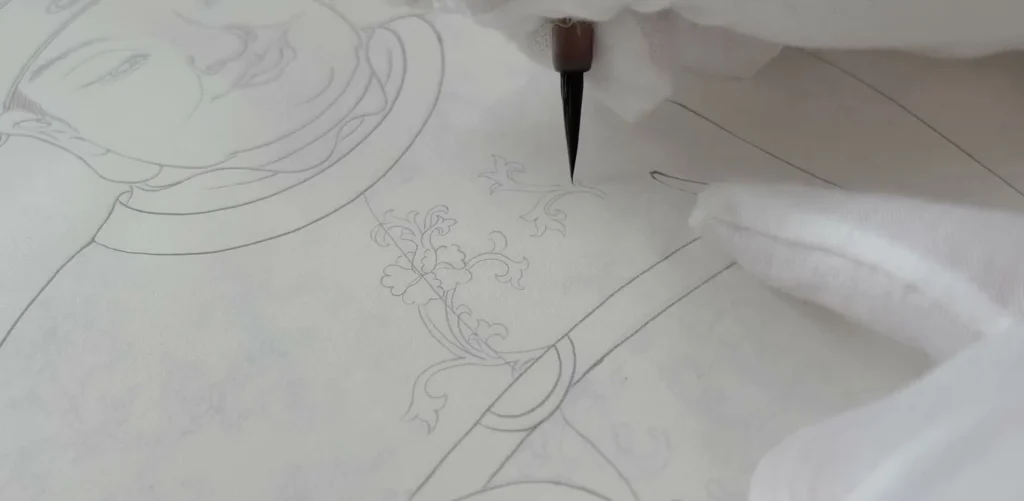
The first area to take color is the peach in his hand, the peach of longevity. In Chinese legend, the peaches from the orchard of the Queen Mother of the West gave long life to whoever ate them, so a peach in a god’s hand stands for a long life. It is a fitting thing for a year god to carry.
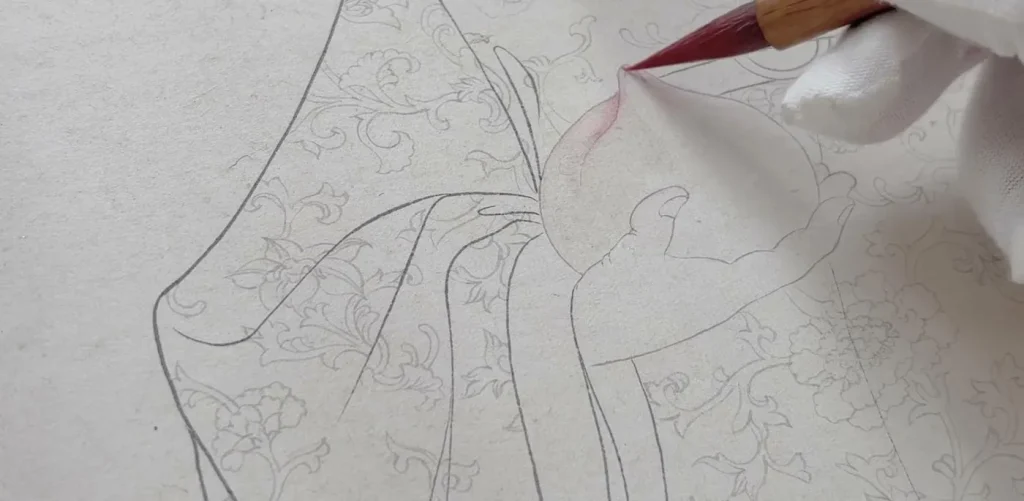
The robe’s scrolling flowers come after the peach, filled in with pale washes of pink and blue rather than solid paint, so the fine ink lines underneath stay visible.
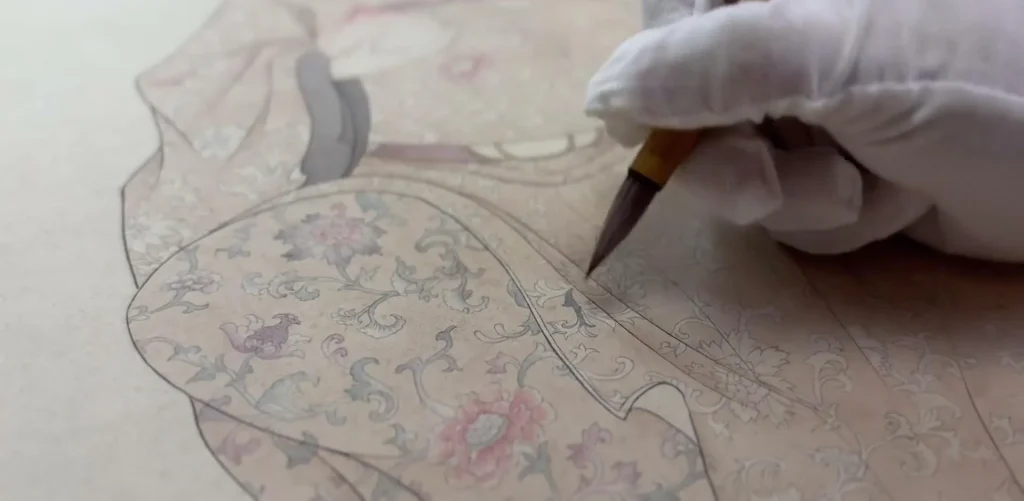
Do not expect every image of Miao Bing to look like this one. Temple statues of the Tai Sui generals vary from place to place, and many show them armored and mounted, as in the temple photos further down. What stays constant is the name and the year he governs. The Tai Sui tradition as a whole, all sixty generals and how the custom grew, is covered on our Tai Sui page.
Which signs clash with Tai Sui in 2027
2 min read · 1 table
Four signs stand in a traditional tension with the Ding Wei Tai Sui: the Goat, the Ox, the Dog and the Rat. Chinese tradition calls this 犯太岁 (fan Tai Sui), “offending the Grand Duke.” It does not mean bad luck is coming. It means your birth branch stands in one of the classic awkward relationships with the year’s branch, and tradition advises some extra care and a visit to the temple.
The four signs are not offending in the same way, and online lists that lump them together as “enemies” lose that. Each one comes from a different relationship between earthly branches:
| Sign | Relationship with the Goat (Wei) branch | Chinese term |
|---|---|---|
| Goat | Same branch as the year: “on duty with” Tai Sui | 值太岁 zhi |
| Ox | Direct opposition, plus punishment | 冲 chong, 刑 xing |
| Dog | Punishment, plus break | 刑 xing, 破 po |
| Rat | Harm | 害 hai |
The order in that table roughly follows how seriously tradition takes each one. The Goat’s own year and the Ox’s direct clash get the most attention; harm is the mildest.
Goat: the zodiac year of your birth (ben ming nian)
If you were born in a Goat year (1931, 1943, 1955, 1967, 1979, 1991, 2003 or 2015), 2027 is your 本命年 (ben ming nian), your own zodiac year. In Tai Sui terms you are “on duty with” the god, sharing the same branch, which tradition reads as a year when your affairs are more exposed and changes come easily.
The custom everyone knows is red: red underwear, a red string bracelet or a red belt worn through the year, ideally a gift from someone else rather than bought for yourself.
Red is the color Chinese tradition uses to ward off bad luck, the same reason doors are pasted with red paper at New Year, so in your own year you keep some of it on you. Older families add a visit to the temple early in the year.
People often assume their own year is supposed to be lucky. Tradition says the opposite, or at least says “be careful.” The customs, the reasoning behind them and what to do through the year have their own page on ben ming nian.
Ox, Dog and Rat: clash, punishment, break and harm
The Ox clash is the textbook one. Ox (Chou) and Goat (Wei) sit directly opposite each other on the twelve-branch wheel, the same way the Rat faces the Horse. Opposition, 冲, is read as pull in two directions: moves, job changes, things shaken loose. The Ox also forms part of a “punishment” triangle with the Goat and the Dog, which is why some almanacs mark the Ox twice.
The Dog’s tie is punishment and break, 破. Break is a minor relationship, read as things that do not quite hold together. The Rat’s tie is harm, 害, the six-harm pairing of Rat and Goat, read as small frictions and misunderstandings rather than upheaval.
This is also where the lists online start disagreeing. Some name only the Ox, some add the Dog, and some throw in a fifth sign such as the Tiger. The standard branch relationships give exactly the four above, and I would treat a list without the Rat or the Dog as incomplete. I have not found a basis in those relationships for adding the Tiger.
2027 Chinese zodiac for all 12 signs (traditional readings, for fun)
3 min read · 1 table
The same branch relationships extend to every sign, not just the four above. Each animal stands in harmony, tension or neutral ground with the Goat year, and that relationship is what a traditional reading for 2027 is built on.
Plenty of sites go further and promise specific money, love and career outcomes for each sign. I will not, because nothing in the tradition supports that level of detail and I would be making it up. Read what follows as folk tradition, for entertainment.
| Sign | Recent birth years | Relationship with the 2027 Goat year | Traditional reading |
|---|---|---|---|
| Rat | 1984, 1996, 2008, 2020 | Harm (害) | Small frictions; mind the details |
| Ox | 1985, 1997, 2009, 2021 | Clash and punishment (冲, 刑) | The most unsettled year of the twelve |
| Tiger | 1986, 1998, 2010, 2022 | No fixed relationship | Neutral; your own effort decides |
| Rabbit | 1987, 1999, 2011, 2023 | Triple harmony (三合) | Supportive year |
| Dragon | 1988, 2000, 2012, 2024 | No fixed relationship | Neutral |
| Snake | 1989, 2001, 2013, 2025 | Same seasonal group (三会) | Mildly supportive |
| Horse | 1990, 2002, 2014, 2026 | Six harmony (六合) | The Goat’s closest partner |
| Goat | 1991, 2003, 2015, 2027 | Own year (值太岁) | Changeable; take care |
| Monkey | 1992, 2004, 2016 | No fixed relationship | Neutral |
| Rooster | 1993, 2005, 2017 | No fixed relationship | Neutral |
| Dog | 1994, 2006, 2018 | Punishment and break (刑, 破) | Some friction; go steadily |
| Pig | 1995, 2007, 2019 | Triple harmony (三合) | Supportive year |
Each row covers a lunar year, so check the start date of your birth year if your birthday is in January or early February.
Horse, Rabbit and Pig: the Goat’s natural allies
The Horse holds the strongest tie. Horse (Wu) and Goat (Wei) form one of the six harmony pairs, 六合, the closest pairing two branches can have. Tradition reads a Goat year as friendly ground for Horse people: help comes more easily, and partnerships started this year are said to sit well.
The Rabbit and the Pig share a different bond, the triple harmony of Pig, Rabbit and Goat (亥卯未), one of four groups of three signs that pull in the same direction. In a Goat year, the other two members of the trio are traditionally said to have the wind behind them.
The Snake sits close to this group without belonging to it. Snake, Horse and Goat make up the summer seasonal group (巳午未), so I have marked the Snake as mildly supportive in the table rather than lumping it in with the allies.
Ox, Dog, Rat and Goat: the signs under Tai Sui’s eye
The Ox, Dog, Rat and Goat are the four Tai Sui signs from the section above, so I will not go back over the reasons. What changes is how to read them. Traditional advice for an unsettled year is practical rather than fearful: finish things before starting new ones, double-check agreements, and do not take large risks just to prove the year wrong.
For Goat people, the advice is about steadiness in your own year; for the Ox, about handling disruption; for the Dog and the Rat, about small misunderstandings before they grow. None of this is a prediction that something will go wrong. It is the same caution the tradition gives every year to whichever four signs are in that position.
If you are in one of these signs and would like to follow the custom, the last section of this page explains what people do at the temple.
Tiger, Dragon, Snake, Monkey and Rooster: the quieter middle
The Tiger, Dragon, Monkey and Rooster have no fixed harmony or clash with the Goat branch, and the Snake has only the loose seasonal tie. For these five, tradition says the year’s branch neither helps nor hinders much; how the year goes is left to your own choices and your birth chart as a whole.
That middle ground is where most “luckiest sign of 2027” articles do their guessing. One site will crown the Dragon, another the Tiger. Nothing in the branch relationships singles out any of these five, so I would not take those rankings seriously.
A full birth chart uses all four pillars of your birth (year, month, day and hour), not just the year animal. That is a much bigger job than a yearly reading, and it is why two people of the same sign can have quite different years.
Lucky colors and numbers for 2027, and why the lists disagree
1 min read
Lucky colors and numbers come from a different corner of zodiac lore than the branch readings above, and the lists you will find for 2027 do not agree with each other. One popular set gives the Goat lucky numbers 2 and 7; another gives 2, 3, 4, 7 and 9. Lucky colors usually include some mix of red, brown and purple, with green or gold added on some lists.
Two things are going on. First, most of these lists describe lucky things for people born in Goat years, a personality tradition, rather than anything belonging to 2027 as a year. Second, there is no single classical table they all copy from. Each tradition or writer has its own, and the internet has repeated all of them.
The one color with a solid basis for 2027 is red, for two reasons that have nothing to do with lucky-number tables. Ding is a fire stem, and fire’s color in the five-element scheme is red. Red is also the color worn by anyone in their own zodiac year.
If you want one color for the year, red is the defensible choice. Treat lucky numbers as a bit of fun, and do not lose sleep if your favorite site disagrees with mine.
What people do about Tai Sui at a Taoist temple
2 min read · 2 photos
Red bracelets and lucky colors sit at the folk end of the custom. The older practice happens at a Taoist temple, many of which keep a Tai Sui hall with all sixty generals ranged along the walls.
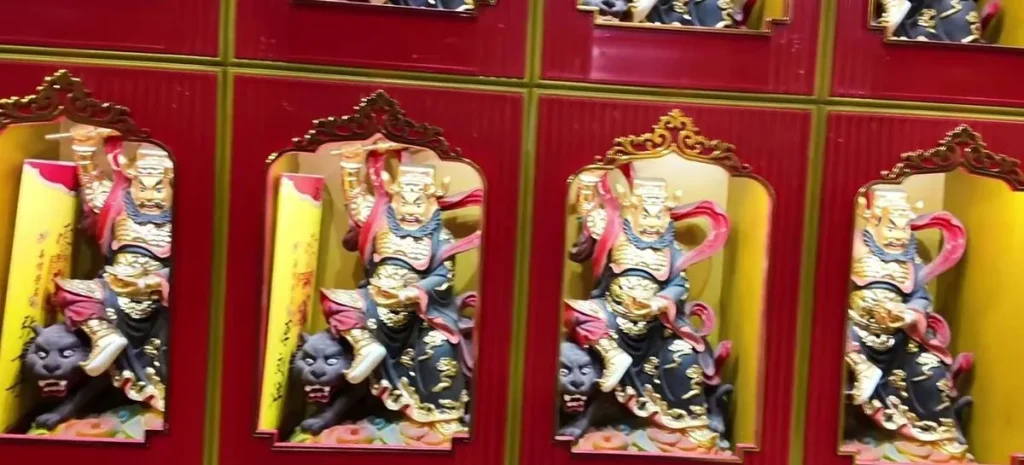
At Xuanmiao Temple in Suzhou, the Tai Sui Hall has the generals set in rows of red niches with gold frames, each statue painted and armored and riding a beast. People look for the general of their own birth year as well as the one on duty, and in 2027 that is Miao Bing.
The custom has two parts. 拜太岁 (bai Tai Sui) is simply paying respects: incense, a bow and a quiet word, usually early in the lunar year.
安太岁 (an Tai Sui), “settling the Grand Duke,” goes further: you register your name and birth date with the temple, which places it under the year’s Tai Sui for protection through the year. Near the end of the year, many temples hold a ceremony to thank and send off the outgoing Tai Sui before the next one takes over.
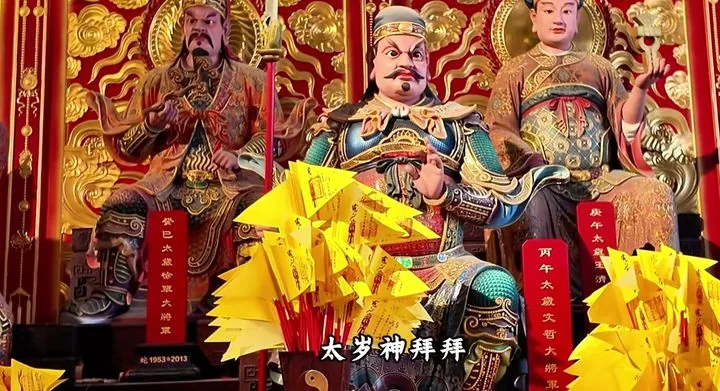
Up close, each statue has a red plaque with its year and title in gold, so you can find your own general by name. In front of these three stand bundles of small yellow triangular paper flags. One plaque reads Bing Wu, the 2026 Fire Horse year, so in 2027 the crowd will gather a few steps along, in front of Miao Bing.
The timing matters too. One year Xuanmiao Temple posted a notice that it would close at 2 p.m. on Lunar New Year’s Eve and reopen at 9 p.m., so the hall could be ready for the crowds who come to pray as the new year turns. If you plan to visit any temple around February 6, 2027, check its holiday hours first; that evening tends to be its busiest of the year.
Key terms in this guide
Full glossary →Related topics at this level
- Year of the RoosterRooster years are 1981, 1993, 2005 and 2017, and the next begins February 13, 2029. Dates, five elements, traits, matches and the da ji da li pun.
- Year of the DogDog years: 1994, 2006, 2018, and the next one starts February 3, 2030. Dates, five elements, traits, matches, and the dog that keeps the night watch.
- Year of the PigPig years run 1923 to 2043, with the next starting January 23, 2031. Exact dates, the five Pigs, which year is the Golden Pig, and the Pig's traditional traits.4 guides
More topics
- Chinese ZodiacThe 12 Chinese zodiac animals in order, how to find your sign and element from your birth date, and what the zodiac hours, months and clashes mean.1 guide
- Year of the RoosterRooster years are 1981, 1993, 2005 and 2017, and the next begins February 13, 2029. Dates, five elements, traits, matches and the da ji da li pun.
- Year of the DogDog years: 1994, 2006, 2018, and the next one starts February 3, 2030. Dates, five elements, traits, matches, and the dog that keeps the night watch.
- Year of the PigPig years run 1923 to 2043, with the next starting January 23, 2031. Exact dates, the five Pigs, which year is the Golden Pig, and the Pig's traditional traits.4 guides