Zodiac · Topic guide
Year of the Dog: Chinese Zodiac Dog Years, Elements, Traits
Dog years: 1994, 2006, 2018, and the next one starts February 3, 2030. Dates, five elements, traits, matches, and the dog that keeps the night watch.
By Daozhang Ma Published
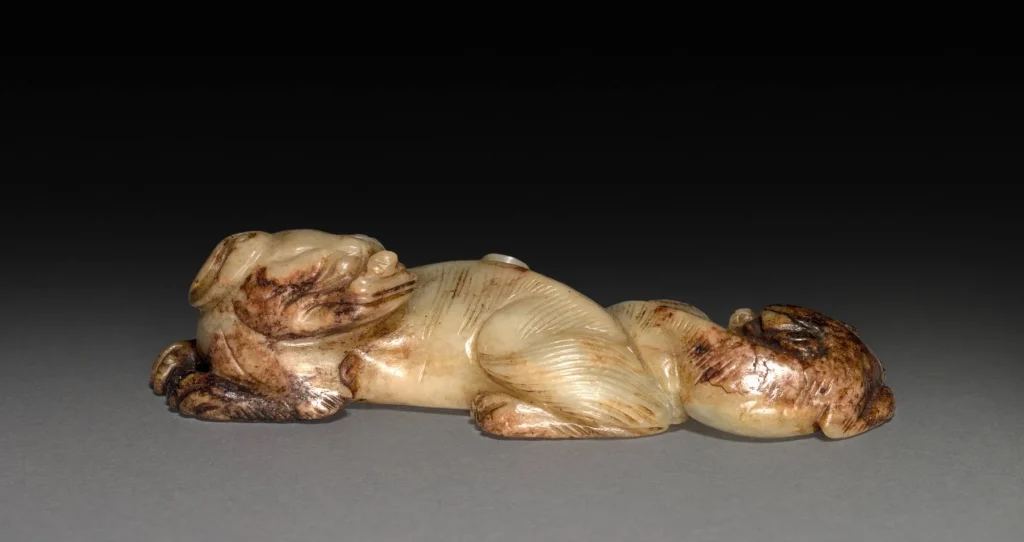
In short
The Year of the Dog is the eleventh year in the Chinese zodiac’s cycle of twelve. Recent Dog years are 1994, 2006 and 2018, and the next one runs from February 3, 2030 to January 22, 2031.
A Dog year starts at Chinese New Year, not on January 1, so a January or early February birthday may still belong to the Rooster year before it. Every Dog year also carries one of the five elements: 2018 was an Earth Dog year, and 2030 will be a Metal Dog year.
Behind the animal is the earthly branch Xu (戌, xū). Xu is yang earth. It governs the two hours from 7 p.m. to 9 p.m. and the ninth lunar month, the last month of autumn.
Traditional readings call the Dog loyal, upright and protective. I pass these on as inherited character types, shared for entertainment. Further down are the Dog’s matches, its Tai Sui years, the old saying about the dog that keeps the night watch, and three dogs made by Chinese craftsmen centuries apart.

Daozhang MaMaoshan Taoist, Jintan, Jiangsu
The guide · 9 chapters
Year of the Dog Dates, 1934 to 2042
2 min read · 1 table
Ten Dog years fall between 1934 and 2042, one every twelve years, and each starts and ends on a different day of the Western calendar. The table gives all ten with their first day, last day, element and stem-and-branch name.
| Dog year | Starts | Ends | Element | Stem and branch |
|---|---|---|---|---|
| 1934 | February 14, 1934 | February 3, 1935 | Wood | 甲戌 jiaxu |
| 1946 | February 2, 1946 | January 21, 1947 | Fire | 丙戌 bingxu |
| 1958 | February 18, 1958 | February 7, 1959 | Earth | 戊戌 wuxu |
| 1970 | February 6, 1970 | January 26, 1971 | Metal | 庚戌 gengxu |
| 1982 | January 25, 1982 | February 12, 1983 | Water | 壬戌 renxu |
| 1994 | February 10, 1994 | January 30, 1995 | Wood | 甲戌 jiaxu |
| 2006 | January 29, 2006 | February 17, 2007 | Fire | 丙戌 bingxu |
| 2018 | February 16, 2018 | February 4, 2019 | Earth | 戊戌 wuxu |
| 2030 | February 3, 2030 | January 22, 2031 | Metal | 庚戌 gengxu |
| 2042 | January 22, 2042 | February 9, 2043 | Water | 壬戌 renxu |
The Dog always follows the Rooster and comes before the Pig, so the year right before each row is a Rooster year and the year right after is a Pig year. The whole order of the twelve is laid out on my Chinese zodiac page, and every year from 1924 to 2043 sits in one table on the Chinese zodiac years chart.
The next Dog year is 2030, a Metal Dog year. Chinese New Year always lands between January 21 and February 20, and the 2042 Dog year opens on January 22, about as early as the New Year gets.
Born in January or Early February?
Check your birthday against the start date in the table before you call yourself a Dog. A baby born on January 20, 1982 arrived five days before the Water Dog year began, so that child belongs to the Rooster year of 1981. A baby born on February 10, 1983 is still a Water Dog, because that Dog year ran until February 12, 1983.
The rule is the same at both ends. Anyone born on New Year’s Day takes the new animal, and anyone born on New Year’s Eve keeps the old one, however late in the evening. A birthday of February 17, 2007 is a Fire Dog; February 18, 2007 is a Fire Pig. If you would rather not count days, the Chinese New Year zodiac calculator does it for you.
There is a second convention. When I read the almanac to pick a date for someone, the stem-and-branch year changes at Lichun (立春), the Start of Spring, which falls on February 3, 4 or 5. Bazi readers use that line. Everyday zodiac talk, red envelopes and greeting cards use Chinese New Year, and so does every table on this site. The two only disagree for people born between the two dates.
What the Year of the Dog Means: Xu, the Evening Watch and Late Autumn
2 min read · 1 photo
The Dog is the eleventh of the twelve animals, and its branch Xu stands for dusk, the end of autumn and the northwest. In Chinese culture the animal itself stands for loyalty and keeping one’s word.
Each of the twelve zodiac animals is the popular face of an earthly branch. Xu (戌) is the eleventh branch. Its element is earth, and by its odd-numbered place in the order it counts as yang. Xu covers 7 p.m. to 9 p.m., and it names the ninth lunar month, which in the solar-term calendar runs from around October 8 to early November. Xu is one of the four earth branches, each of which closes a season, and it closes autumn. Its direction is northwest.
The evening hours fit the animal. An old line says 犬守夜,鸡司晨 (quǎn shǒu yè, jī sī chén): the dog keeps the night watch, the rooster announces the dawn. Quan shou ye, keeping the night watch, is treated as the dog’s proper work, and the Xu hours are when that watch begins. On the mountain where I live, that is the hour the day’s work is put away and the gates are closed.
Folk tradition builds the Dog’s character from that job. The Dog is the sign you can trust with the door: plain-spoken, fair-minded, and attentive to whether a promise was kept.
In the usual telling of the race legend, the Dog was a strong swimmer but stopped to play and bathe in the river, and so finished eleventh. That is a story, not a record. The written trail looks different. On bamboo slips from the Qin state, 3rd century BC, found at Shuihudi in Hubei in 1975, the branches already have animals, but not today’s set: Xu is paired with the goat there. By the Eastern Han dynasty, in Wang Chong’s Lunheng, all twelve match the modern list and Xu belongs to the dog.
A pottery dog from that same dynasty shows how the animal looked to the people who made it.
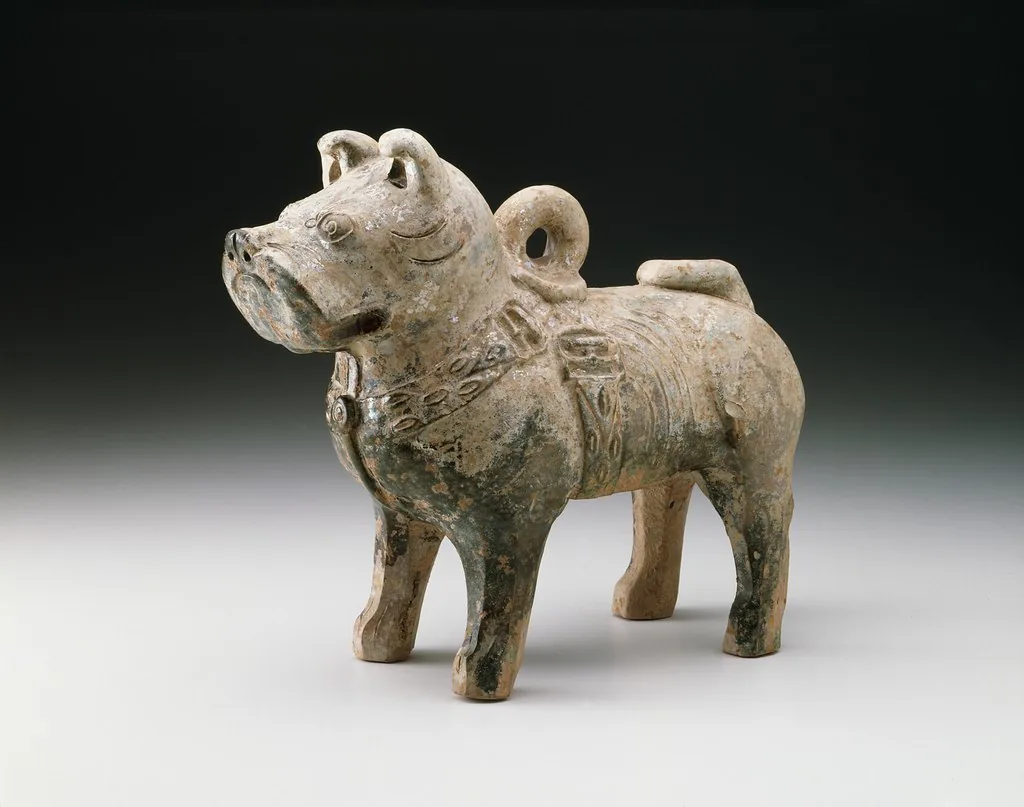
The dog stands square on four thick legs with its head up and its ears pricked. A loop rises from the back just behind the neck, and the short tail turns up at the rear. A band circles the neck and a second strap runs around the chest, and the two meet at a ring on the shoulder, so this is a working dog in harness. The green glaze has worn to patches over the clay.
The Five Dogs: Wood, Fire, Earth, Metal and Water
1 min read · 1 table
There are five kinds of Dog year, one for each element, and each kind comes back once every 60 years. The branch Xu never changes; the heavenly stem in front of it does.
| Kind of Dog | Stem | Years | Stem and branch |
|---|---|---|---|
| Wood Dog | 甲 jia, yang wood | 1934, 1994 | 甲戌 jiaxu |
| Fire Dog | 丙 bing, yang fire | 1946, 2006 | 丙戌 bingxu |
| Earth Dog | 戊 wu, yang earth | 1958, 2018 | 戊戌 wuxu |
| Metal Dog | 庚 geng, yang metal | 1970, 2030 | 庚戌 gengxu |
| Water Dog | 壬 ren, yang water | 1982, 2042 | 壬戌 renxu |
Ten stems and twelve branches step forward together, one place a year, and the pairing repeats after 60 years. Because both lists advance in step, a yang stem only ever meets a yang branch. Xu is a yang branch, so the Dog takes the five yang stems and never the yin ones. The element of the year comes from the stem. A year ending in 0 is a metal year, which is why 1970 and 2030 are Metal Dogs.
Xu keeps its own earth under every stem. In 戊戌 (wuxu), the Earth Dog years of 1958 and 2018, stem and branch share one element: earth over earth.
Popular lore gives each stem an image and reads the five Dogs through it: jia is a tall tree, bing is the sun, wu is a mountain, geng is a blade or raw ore, ren is a river. So a Wood Dog is described as upright and growing, a Fire Dog as warm and visible, an Earth Dog as steady, a Metal Dog as sharp-edged, a Water Dog as restless. Treat that as lore layered on the calendar, not as part of the calendar.
Dog Personality in Traditional Readings
1 min read
Traditional readings describe Dog-year people as loyal, principled, hardworking and kind, with a suspicious streak and a long memory. Every item on that list is an inherited character type, and none of it has been tested.
On the good side, the Dog is said to stand by its own people, to care about what is fair, to work plainly without showing off, and to be easy company. Readings often add that the Dog protects family and friends before it thinks of itself.
On the hard side, the same readings say the Dog doubts first and has to get to the bottom of everything. The Dog is said to hold a grudge, to dig in once it has decided what is right, and to act on impulse when provoked.
I have not seen research that checks these claims, and the tradition itself never rested on the birth year alone. A full chart also reads the month, the day and the hour. So take the portrait as a folk sketch. The same goes for the matches and Tai Sui years below: they are traditional lore, shared for entertainment.
Dog Compatibility: Tiger, Horse, Rabbit and the Dragon Clash
2 min read · 1 table
The Dog’s best matches in the traditional charts are the Rabbit, the Tiger and the Horse, and its hardest pairing is the Dragon. The charts work from the earthly branches, not from the elements of the birth years.
| Relationship | Partner sign | What the tradition says |
|---|---|---|
| Six harmony (六合) | Rabbit | Mao and Xu combine and turn to fire; the Dog’s closest single partner |
| Triple harmony (三合) | Tiger, Horse | Yin, Wu and Xu form the fire trio; read as teammates on the same side |
| Clash (冲) | Dragon | Chen and Xu sit opposite each other, earth against earth; the hardest pairing |
| Harm (害) | Rooster | You and Xu; friction that stays under the surface |
| Punishment (刑) | Ox, Goat | Chou, Xu and Wei form a three-way punishment: Chou punishes Xu, Xu punishes Wei |
| Break (破) | Goat | Xu and Wei; mild wear, and some lists leave the break out |
Triple harmony is a team of three. The Tiger opens the fire trio, the Horse sits at its center and the Dog closes it, which is why my pages on the Year of the Tiger and the Year of the Horse both name the Dog as a partner. Six harmony is the one-to-one bond, and marriage rhymes put Rabbit and Dog among the six best couples. Marriage charts list Tiger, Rabbit and Horse as the Dog’s luckiest matches and Goat, Dragon, Rooster and Ox as the ones to avoid.
The Dragon is the sign people mean when they ask about the Dog’s enemy. Chen and Xu are six places apart and face each other across the compass. Both are earth branches that close a season, so this is called a storehouse clash.
The Goat appears twice in the table, and that is not a copying mistake. Xu and Wei are both a punishment and a break. The names are not settled either. Branch tables file the Chou-Xu-Wei punishment under 恃势之刑, the punishment of relying on power. Popular pairing articles sometimes call the Dog and Goat pair 无恩之刑, the ungrateful punishment, a name the branch tables give to a different trio. I follow the branch tables in the chart above and note the other name as a popular variant. One popular reading of Dog and Goat is simply two honest people who each feel wronged by the other.
The Dog does not punish itself. That belongs to four other signs: Dragon, Horse, Rooster and Pig. A pair such as Snake and Dog has none of these six relationships, and my Snake and Dog compatibility page looks at how the tradition reads a neutral match. All twelve signs are set side by side on the Chinese zodiac compatibility chart. Old sources add that harmony is not always lucky and a clash is not always bad. Read all of it for fun.
Ben Ming Nian and Tai Sui in a Dog Year
1 min read
A Dog year is the ben ming nian (本命年) of everyone born in a Dog year, and by the usual reckoning five signs offend Tai Sui in it: Dog, Dragon, Rooster, Ox and Goat. All of this is folk custom.
Ben ming nian is the year your own animal returns, once every twelve years. It is also called sitting on Tai Sui, because the branch of the year is the same as the branch of your birth year. Tai Sui began as astronomy. The ancients tracked the years by Jupiter, which circles the sky in about twelve years, and they imagined a counterpart moving the opposite way to mark each year. Taoism later gave each of the sixty stem-and-branch years its own Tai Sui general.
To find who offends Tai Sui, take the year’s branch and read its row in the relationship table. For Xu that gives the Dog itself, the Dragon by clash, the Rooster by harm, the Ox and the Goat by punishment, and the Goat again by break. A saying sums up the worry: with Tai Sui sitting overhead, a year without a happy event may bring trouble instead. The old answer is red. People tie on a red cord or a red sash, or wear red socks, through their own year. The first lunar month is a busy stretch for a Taoist, since that is when many people come to pay respects to the Tai Sui of the year.
The current year, 2026, is a bingwu Fire Horse year that runs from February 17, 2026 to February 5, 2027. Next comes the dingwei Fire Goat year, from February 6, 2027 to January 25, 2028. Wei and Xu are a break and a punishment, so the lists for that year name the Dog as breaking and punishing Tai Sui. My 2027 Chinese zodiac guide covers that year sign by sign. The Dog’s next ben ming nian is 2030, and its next clash year is the Dragon year of 2036.
Dog Sayings: the Twelfth-Month Dog and the Wang Wang Pun
1 min read · 1 photo
The best-known Dog sayings are about guarding the house and its stores. The oldest are farm proverbs, and the newest is a pun on the sound of a bark.
A folk line says 腊月狗会把财门 (làyuè gǒu huì bǎ cáimén): the twelfth-month dog knows how to hold the gate of wealth. By the twelfth lunar month the harvest is in the granary and the household is waiting for the New Year, so families kept a dog to watch the grain against thieves. From that comes the idea that the Dog holds on to what a family has. It is paired with a second line, 正月猪,腊月狗, first-month pig and twelfth-month dog, a folk pairing that counts those as the good months for the two animals.
The pun is a folk habit, not a classical source. A dog’s bark is written 汪汪 (wāng wāng), which sounds close to 旺 (wàng), meaning thriving. Dog-year greetings lean on that word, as in 狗年旺旺, a thriving Year of the Dog. A related folk saying, 狗来富, holds that a dog walking in at the door is a sign of money coming.
A small dog on the lid of a Song dynasty jar sits the way a watchdog sits.
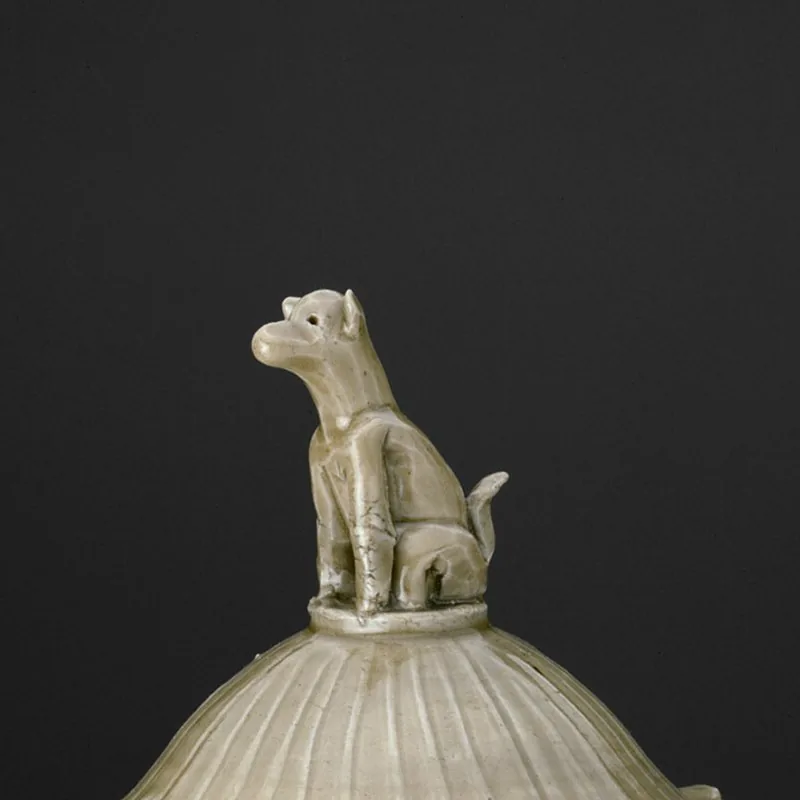
The dog sits upright on a small ring at the top of the lid. Its front legs are straight, its head is raised and turned to one side, and its ears stand up. The tail curves out behind. Below it the lid spreads in ribs, and the whole piece wears a pale olive-green glaze with fine crackle on the legs. The potter made it the knob you lift the lid by.
The Dog in Legend and on Small Objects
1 min read · 1 photo
Two dogs of legend and one household taboo round out the picture, and a Qing dynasty snuff bottle shows the dog as a pet. The legends are popular stories, told here as stories.
The most famous dog in Chinese legend is Xiaotian Quan (哮天犬), the hunting hound of the god Erlang Shen, which turns up in Investiture of the Gods and in later retellings of Journey to the West. The other is the tiangou (天狗), the heavenly dog. In folk belief a lunar eclipse is the heavenly dog eating the moon, and people beat gongs and drums to scare it off.
The taboo comes from Kitchen God belief. Chicken feathers and dog bones are not to be thrown into the stove and burned, because that is said to offend the god who lives there.
By the Qing dynasty the dog on an object is often a lapdog.
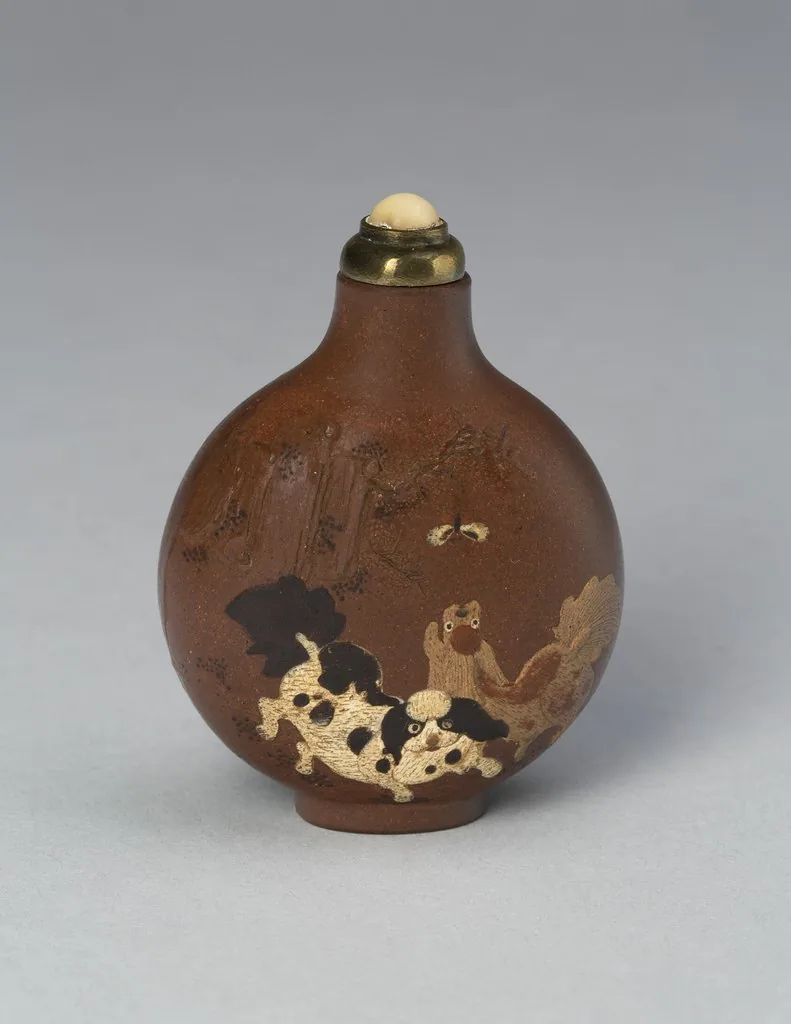
The bottle is a flattened round shape in brown, with a metal collar and a pale stopper. Two small dogs are set into the surface in lighter colors. One is white with black patches and crouches low with its front legs stretched out. The other is tan and sits up beside it with a feathery tail. A small butterfly hovers above them, and faint trunks and a branch are cut into the brown behind.
I paint Taoist figures, so with a piece like this I look at the line first. A good dog, in jade, clay or ink, shows what the animal is doing from its outline alone: watching, sitting, playing. If you want a Dog piece for someone born in a Dog year, my guides to Chinese zodiac gifts and feng shui items cover what people traditionally choose and where they put it.
Year of the Dog FAQ
1 min read
What does the Year of the Dog mean in the Chinese zodiac? It is the eleventh year of the twelve-year cycle, tied to the earthly branch Xu. Xu is yang earth, the hours from 7 p.m. to 9 p.m. and the ninth lunar month. The animal stands for loyalty and keeping watch.
Which years are Dog years? 1934, 1946, 1958, 1970, 1982, 1994, 2006, 2018, 2030 and 2042. Each one starts at Chinese New Year, so check the start date if you were born in January or February.
If 2018 was the Year of the Dog, what is 2019? The Earth Dog year ended on February 4, 2019, and the Earth Pig year followed. Anyone born in 2019 on or before February 4 is still an Earth Dog.
What does the Dog symbolize in Chinese culture? Loyalty, honesty and guarding the home. The old line says the dog keeps the night watch and the rooster announces the dawn. Folk sayings add that the Dog holds on to a family’s wealth.
Who is the Dog compatible with, and what is its enemy sign? The charts pair the Dog with the Rabbit in six harmony and with the Tiger and Horse in triple harmony. The Dragon is the clash sign, the one usually called the enemy. This is lore for fun, not a rule for choosing people.
When is the next Year of the Dog? It runs from February 3, 2030 to January 22, 2031. It is a gengxu (庚戌) Metal Dog year, the first since 1970, sixty years earlier.
The Dog sits eleventh among the twelve, at dusk and at the end of autumn, with the watch still ahead of it. The dates and elements on this page are calendar facts; the character, the matches and the Tai Sui years are traditional stories. More guides to the calendar and its customs are on the Zodiac & Tradition home page.
Key terms in this guide
Full glossary →Related topics at this level
- Year of the GoatGoat years include 1991, 2003 and 2015; the next starts February 6, 2027. Dates, the five Goats, sheep or ram, traits, matches and san yang kai tai.
- Year of the MonkeyMonkey years include 1992, 2004 and 2016, and the next opens January 26, 2028: dates, the five Monkeys, traits, matches and the Hou pun.
- Year of the RoosterRooster years are 1981, 1993, 2005 and 2017, and the next begins February 13, 2029. Dates, five elements, traits, matches and the da ji da li pun.
- Year of the PigPig years run 1923 to 2043, with the next starting January 23, 2031. Exact dates, the five Pigs, which year is the Golden Pig, and the Pig's traditional traits.4 guides
- 2027 Chinese Zodiac2027 is a Fire Goat (Ding Wei) year, from February 6, 2027 to January 25, 2028. Who the Tai Sui is, which signs clash, and a reading for all 12 signs.
More topics
- Chinese ZodiacThe 12 Chinese zodiac animals in order, how to find your sign and element from your birth date, and what the zodiac hours, months and clashes mean.1 guide
- Year of the GoatGoat years include 1991, 2003 and 2015; the next starts February 6, 2027. Dates, the five Goats, sheep or ram, traits, matches and san yang kai tai.
- Year of the MonkeyMonkey years include 1992, 2004 and 2016, and the next opens January 26, 2028: dates, the five Monkeys, traits, matches and the Hou pun.
- Year of the RoosterRooster years are 1981, 1993, 2005 and 2017, and the next begins February 13, 2029. Dates, five elements, traits, matches and the da ji da li pun.
- Year of the PigPig years run 1923 to 2043, with the next starting January 23, 2031. Exact dates, the five Pigs, which year is the Golden Pig, and the Pig's traditional traits.4 guides
- 2027 Chinese Zodiac2027 is a Fire Goat (Ding Wei) year, from February 6, 2027 to January 25, 2028. Who the Tai Sui is, which signs clash, and a reading for all 12 signs.