Zodiac · Topic guide
Year of the Rooster: Chinese Zodiac Years, Dates, Traits
Rooster years are 1981, 1993, 2005 and 2017, and the next begins February 13, 2029. Dates, five elements, traits, matches and the da ji da li pun.
By Daozhang Ma Published
In short
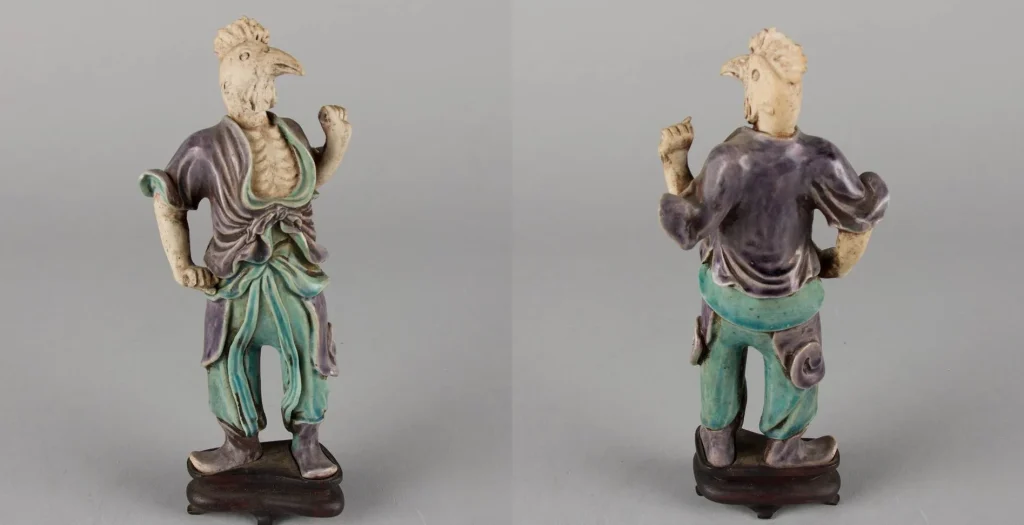
Every Year of the Rooster has a Chinese name ending in 酉, read You, the branch that stands tenth in the Chinese zodiac after the Monkey and ahead of the Dog. 2017 was the latest, with 2005, 1993 and 1981 before it. Babies born from February 13, 2029 through February 2, 2030 will be the next Roosters. The Chicken of the Chinese zodiac is the same sign as the Rooster, with the same years.
Chinese New Year turns the count over, so the 2017 year waited until January 28 to begin and the 2005 one until February 9. Before those days the Monkey was still in charge. Fire came with 2017 and Earth comes with 2029, since the stem in each year’s name brings an element.
On the old clock the Rooster has dusk, 5 p.m. to 7 p.m. In the farming year it has the You month of the solar-term calendar, when autumn is half over. You is counted as yin Metal.
Sharp, tidy and hardworking are the words the old matching books use for a Rooster. Read them for entertainment, as a character type that got handed down. This page also explains why a painted rooster reads as great luck, and where the line about the rooster keeping the dawn comes from.

Daozhang MaMaoshan Taoist, Jintan, Jiangsu
The guide · 9 chapters
Year of the Rooster Dates, 1933 to 2041
1 min read · 1 table
Find your birth year in the left column and read across: the day the Rooster year began, the day it ended, its element and its two-character name. The rows are twelve years apart, from 1933 down to 2041.
These ten rows are lifted from my year-by-year table of Chinese zodiac years, where the Rooster shares the page with the other eleven animals of the Chinese zodiac.
| Rooster year | Starts | Ends | Element | Stem and branch |
|---|---|---|---|---|
| 1933 | January 26, 1933 | February 13, 1934 | Water | 癸酉 guiyou |
| 1945 | February 13, 1945 | February 1, 1946 | Wood | 乙酉 yiyou |
| 1957 | January 31, 1957 | February 17, 1958 | Fire | 丁酉 dingyou |
| 1969 | February 17, 1969 | February 5, 1970 | Earth | 己酉 jiyou |
| 1981 | February 5, 1981 | January 24, 1982 | Metal | 辛酉 xinyou |
| 1993 | January 23, 1993 | February 9, 1994 | Water | 癸酉 guiyou |
| 2005 | February 9, 2005 | January 28, 2006 | Wood | 乙酉 yiyou |
| 2017 | January 28, 2017 | February 15, 2018 | Fire | 丁酉 dingyou |
| 2029 | February 13, 2029 | February 2, 2030 | Earth | 己酉 jiyou |
| 2041 | February 1, 2041 | January 21, 2042 | Metal | 辛酉 xinyou |
As I write, the year in progress is bingwu (丙午), a Fire Horse year that began on February 17, 2026 and ends on February 5, 2027. A Goat year and a Monkey year follow it. The Monkey year opens on January 26, 2028, and when it ends the 2029 Rooster year takes over.
Born in January or Early February?
January 23, 1993 is the kind of date that catches people out. The Water Rooster year opened that day, so a birthday of January 20, 1993 falls three days short and belongs to the Monkey. At the far end the same year kept going until February 9, 1994, which leaves February 5, 1994 inside it.
New Year can land on any day from January 21 to February 20. If your birthday sits inside that stretch, put it beside the start and end columns, or let the Chinese New Year zodiac calculator do the comparison.
There’s a second way of counting, used for bazi charts and printed in the almanac. It changes the year at Lichun (立春), the Start of Spring, which falls on February 3, 4 or 5. The two counts disagree only for birthdays between New Year’s Day and Lichun. Take January 30, 1993: the everyday count says Rooster, and the bazi count still says Monkey. Neither is wrong. The tables on this site follow New Year, which is what people mean when they ask your sign.
What the Year of the Rooster Means: You, Dusk and Mid-Autumn
1 min read · 1 photo
A Rooster year is a You year, and You is a place on the clock and the compass as much as an animal. It’s the tenth earthly branch, it counts as yin Metal, and it points due west.
On the clock, You covers 5 p.m. to 7 p.m. The folk explanation for the pairing is that this is when chickens go back to the roost for the night. In the solar-term calendar, You is also a month, roughly September 8 to October 7, the middle month of autumn. Zi, Wu, Mao and You are the four branches that sit in the middle of a season, one each for winter, summer, spring and autumn.
I read the almanac to choose days, and there You turns up as an hour and a month far more often than as a year.
The place in the order comes with a story. In the usual telling of the race legend, the Rooster crossed the river on a raft with the Goat and the Monkey and came in after both of them, which made it tenth. That’s a folk tale, not a record.
What the bird stands for is easier to pin down. The Shuowen Jiezi, an old dictionary, defines the chicken as zhi shi chu (知时畜), the domestic animal that knows the hours. A proverb that lists each animal’s job says quan shou ye, ji si chen (犬守夜,鸡司晨): the dog keeps the night watch and the rooster announces the dawn. So the Rooster stands for keeping time, hard work and early rising.
A Ming painting shows the bird by itself.
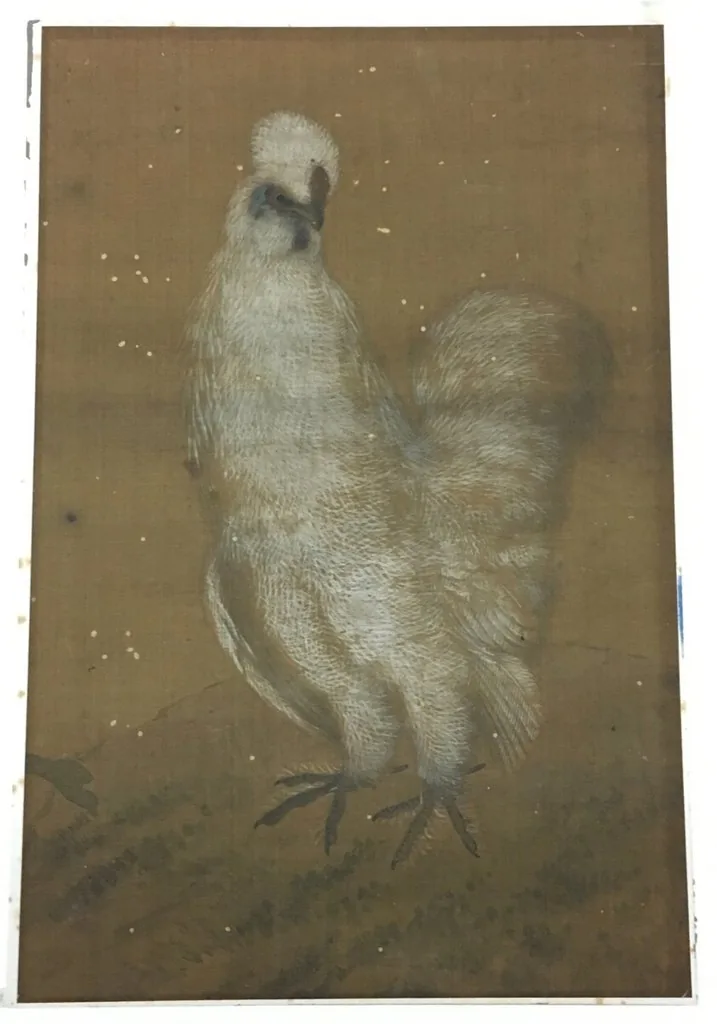
The feathers are white and drawn one fine stroke at a time. A round crest sits on top of the head, the face is mostly white feathers with darker patches round the eye and at the beak, and the tail rises behind the body in a single soft plume. Both dark feet are planted on a strip of grass, and the brown silk around the bird is left empty.
The Five Roosters: Wood, Fire, Earth, Metal and Water
1 min read · 1 table
1981 was a xinyou (辛酉) year, and the name comes back in 2041. Pair up the table the same way and you get 1933 with 1993, 1945 with 2005, 1957 with 2017 and 1969 with 2029, always sixty years apart.
What changes from one Rooster year to the next is the first character, the heavenly stem, which brings the element. You, the second character, is the Rooster every time. Run down the table and you meet Gui, Yi, Ding, Ji and Xin, then the same five again, and every one of them is a yin stem. Stems and branches are matched by parity in the usual reckoning, which is why a yin branch like You never draws a yang stem.
| Kind of Rooster | Stem | Years | Stem and branch |
|---|---|---|---|
| Wood Rooster | Yi (乙) | 1945, 2005 | 乙酉 yiyou |
| Fire Rooster | Ding (丁) | 1957, 2017 | 丁酉 dingyou |
| Earth Rooster | Ji (己) | 1969, 2029 | 己酉 jiyou |
| Metal Rooster | Xin (辛) | 1981, 2041 | 辛酉 xinyou |
| Water Rooster | Gui (癸) | 1933, 1993 | 癸酉 guiyou |
You itself is Metal whichever stem arrives. In a Xin year the stem is Metal too, so 1981 and 2041 are the years when both halves of the name share one element.
In the traditional imagery Yi is flowers and vines, Ding is a lamp or candle flame, Ji is a tilled field, Xin is jewelry and jade, and Gui is rain and dew. I’d take them as pictures and leave it there.
Rooster Personality in Traditional Readings
1 min read
Capable, exact and well turned out is the short version of what traditional readings say about people born in a Rooster year. The longer list has four strengths and three weak spots.
On the good side, the Rooster is said to be shrewd and able, careful with details, clean and fond of dressing well, and hardworking with a strong sense of duty. On the other side, the readings call the Rooster talkative and quick to find fault, a perfectionist who asks a lot of other people, and someone who minds about face and likes to compare.
The list comes from matching books, not from research, and I can’t point to a study behind any item on it. Your birth year is one pillar, too, and the month, the day and the hour each add another. Treat the list, and the matches and Tai Sui notes after it, as traditional lore shared for entertainment.
Rooster Compatibility: Snake, Ox, Dragon and the Rabbit Clash
2 min read · 1 table
Chen and You make the Rooster’s best-known pair: the Dragon is called its number-one partner, and matching tables put that six-harmony match among the best. The Snake and the Ox come from a different rule, the trio of Si, You and Chou. Wood, Fire or Earth in the year’s name changes nothing here. You is what gets matched, in 1957 and 1993 alike.
| Relationship | Partner sign | What the tradition says |
|---|---|---|
| Triple harmony (三合) | Snake, Ox | Si, You and Chou form the Metal trio; read as a team on the same side |
| Six harmony (六合) | Dragon | Chen and You join and turn to Metal; the marriage rhymes rank it a top match |
| Clash (冲) | Rabbit | Mao and You face each other east and west, Wood against Metal |
| Harm (害) | Dog | You and Xu; the old line says the pair never runs out of quarrels |
| Self-punishment (自刑) | Rooster | You meets You; Metal on Metal is said to turn hard, with plenty of sharp words |
| Break (破) | Rat | Zi and You; a mild one, and some lists leave break out |
Tradition reads both kinds of harmony, the trio and the pair, as help. The Snake’s side of the Metal trio is on the Year of the Snake page. Matching tables sum it up as best with the Ox, the Dragon and the Snake, and to be avoided with the Rabbit, the Dog and another Rooster.
When people ask for the Rooster’s enemy, they mean the clash sign, the Rabbit. The two branches sit opposite each other on the circle, and the Year of the Rabbit page lists the Rooster the same way.
The Dog is the harm sign. The saying is you xu xiang hai, kou she bu duan (酉戌相害,口舌不断), harm between You and Xu means the arguing doesn’t stop, and a marriage rhyme speaks of the golden rooster and the jade dog as a pair that can’t escape it. The Year of the Dog page has the Dog’s half.
The Rooster is one of four signs, with the Dragon, the Horse and the Pig, that punish themselves. Two Roosters together are read as too much Metal.
Break is weaker than a clash, and the sources disagree about it. Only some lists include it at all. One popular guide even files the Rat twice, as a fit since Metal feeds Water, and as a misfit under break. I give both readings and leave the choice open.
Signs outside the table have no branch tie to You. The Goat is one of them, and I’ve written that pair up in Goat and Rooster compatibility. For the full grid of twelve, see the Chinese zodiac compatibility chart. A chart sorts types, not people, so read it for fun.
Ben Ming Nian and Tai Sui in a Rooster Year
1 min read
Roosters born in 2017 turn twelve in 2029 and those born in 1969 turn sixty, and for all of them it is a ben ming nian (本命年), the year when the sign comes round again. The same year is called zhi Tai Sui, being on duty with Tai Sui, since the branch of the year and the branch of the birth year are the same.
The name goes back to counting years by the sky: about every twelve years the Year Star, which is Jupiter, finishes a lap, and to fit that lap to the stem-and-branch count an imagined twin was set moving the other way. That twin is Tai Sui.
A Rooster year troubles four signs, by the usual reckoning. The Rooster itself is on duty and, being a self-punishing branch, falls under punishment too. The Rabbit is the clash, the Dog the harm, and the Rat the break in those lists that keep break. Fan Tai Sui, offending Tai Sui, is the folk name for landing in any of those spots.
The custom most people know is wearing red in your own year: a red string, a red belt, red socks or red underwear, handed down from the older generation. One modern explanation is that doing something gives a feeling of certainty in the face of the unknown. The proverb behind the worry runs: Tai Sui sits on your head, and if no happy event comes, trouble may. A ben ming nian isn’t a cursed year, though, and confirmation bias goes a long way to explain why people remember it as a rough one.
For the Rooster, the clash year is a Rabbit year, and 2035 is the next. The Goat year of 2027 leaves You alone: Wei appears in none of the six rows of the Rooster’s table. The 2027 Chinese zodiac page goes through that year sign by sign.
Da Ji Da Li: the Rooster Pun and the Golden Rooster
1 min read · 1 photo
Ji (鸡), the word for chicken, sounds close to ji (吉), the word for lucky, and folk usage has made the most of it. In folk usage, the greeting for a Rooster year is da ji da li (大吉大利), word for word great luck, great profit. In the usual telling, one big rooster on a New Year print or a card is read aloud as da ji, great luck.
The bird has a second folk role, as a guard. Ritual chants call it the jin ji (金鸡), the golden rooster, and describe it as wearing a golden crown and coming down from heaven, a bird that evil spirits run from. Those chants belong to funeral rites, and I’ll leave the rites there. What carries over to everyday belief is the simple idea that a rooster keeps bad things away.
Roosters show up in the New Year countdown too. A rhyme that counts off the last days of the twelfth lunar month has the line er shi qi, zai gong ji (二十七,宰公鸡): on the twenty-seventh, kill the rooster. It’s the day for getting the New Year food ready.
A Qing scroll in Chicago has three birds in it.
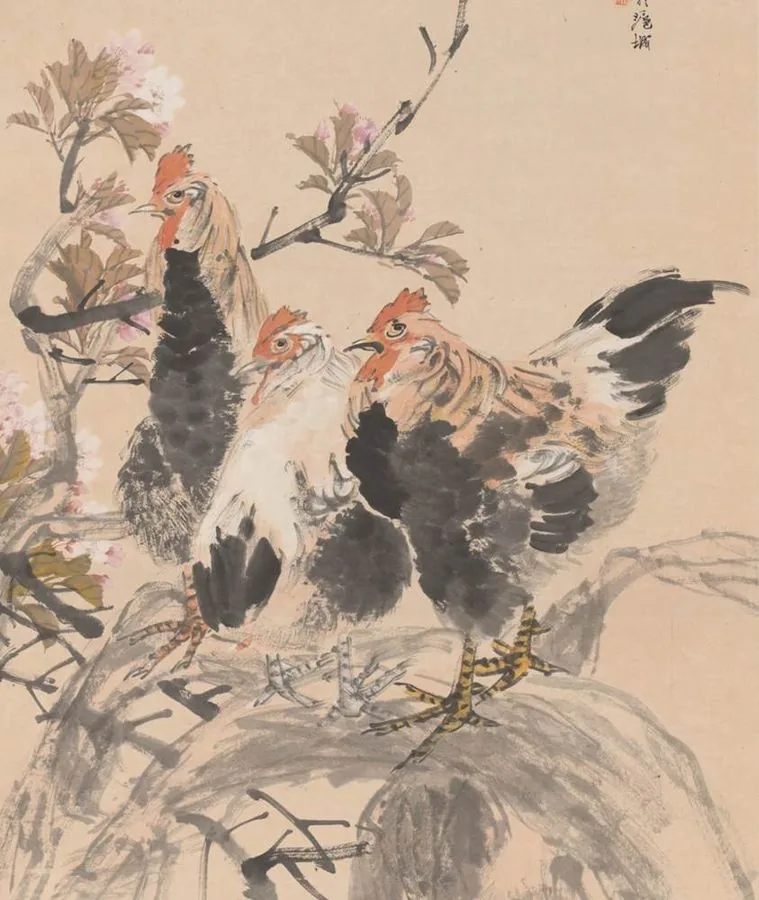
All three have red combs and stand close together on a gray rock. The one in the middle has a white breast, and the other two are washed in black ink with tan necks. The largest tail is a few broad black strokes, and the bird at the front right stands on yellow feet with dark bars. Branches with pink and white blossoms cross the top and the left edge.
Ink Roosters, Dough Roosters and a Chicken-Headed Ewer
1 min read · 1 photo
Ink and steamed dough are two materials the Rooster gets made in. Painters do the comb in bright red and the tail in dark, stiff strokes, so the bird looks caught in the middle of a crow. Pictures like that get painted to mark a Rooster year.
The dough version is a steamed bun shaped like the bird. The comb is rolled out of strips of dough, two black beans make the eyes, and scissors snip a ring of pointed feathers all round the body before it goes into the steamer.
The bird also turns up as part of a pot.
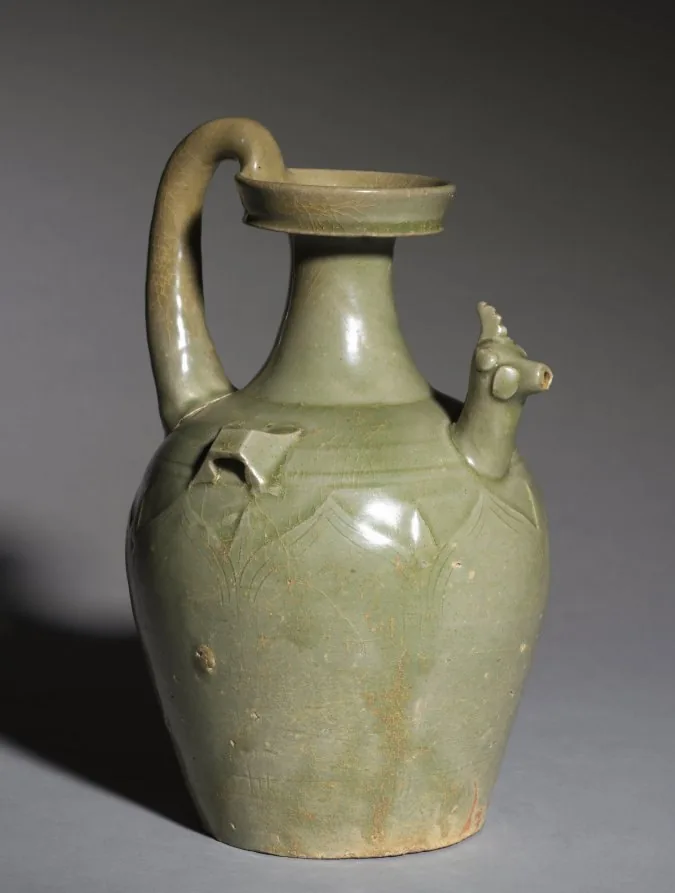
The glaze is a gray green with a fine crackle. On one shoulder a small head with a notched comb, round eyes and an open beak forms the spout. On the opposite side a handle rises from the shoulder and curves over to meet the rim of the dish-shaped mouth. A band of incised pointed petals runs round the shoulder.
Year of the Rooster FAQ
2 min read
What is the Rooster sign in Chinese astrology? Anyone born in a year whose name ends in 酉, read You, has the Rooster for a sign. Between the Monkey and the Dog, that sign holds place ten, and the calendar ties it to dusk, to the west and to mid-autumn, with Metal for its element.
Which years are Rooster years? Ten of them sit in the table on this page: 1933, 1945, 1957, 1969, 1981, 1993, 2005, 2017, 2029 and 2041. Every one of them waits for Chinese New Year to begin. The earliest opening day among them is January 23, in 1993, and the latest is February 17, in 1969.
Why is the Rooster also called the Chicken or the Cock? The Rooster, the Chicken and the Cock are English names for one sign, because the Chinese name, ji (鸡), is the word for the bird in general, and Chinese adds a word when it needs to say which, as in muji (母鸡), a hen. The sinologist Victor Mair notes that ji on its own could be chicken, hen, rooster, cock or cockerel. The Hong Kong Observatory’s English-language calendar tables and the Metropolitan Museum of Art’s zodiac figures say Rooster, while the Cleveland Museum of Art titles a Northern Wei tomb figure Cock.
What kind of Rooster year is 2029? An Earth Rooster. Its name is jiyou (己酉): the stem Ji supplies Earth and the branch You supplies the Rooster. It begins on February 13, 2029, ends on February 2, 2030, and repeats the name of 1969.
What does the Rooster symbolize in Chinese culture? Keeping time. The Shuowen Jiezi defines the chicken as the domestic animal that knows the hours, and the proverb gives the dog the night watch and the rooster the dawn. Folk usage adds luck, since ji for chicken sounds like ji for lucky.
Who is the Rooster compatible with, and what is its enemy sign? The Rabbit is the one people call the Rooster’s enemy, since Mao and You clash. On the friendly side the matching tables name the Dragon, You’s six-harmony partner, along with the Snake and the Ox from the Metal trio. All of that is traditional matchmaking, passed on here as entertainment.
When is the next Year of the Rooster? Jiyou (己酉) comes round again on February 13, 2029, having last named 1969. Ji is an Earth stem, which makes the newcomer an Earth Rooster, and February 2, 2030 is its final day.
Dusk in the calendar and dawn in the proverb: the Rooster keeps time at both ends of the day. Check the dates and elements against an almanac if you like, and take the traits, matches and Tai Sui list as lore. The Zodiac & Tradition home page leads to the other eleven animals.
Key terms in this guide
Full glossary →Related topics at this level
- Year of the HorseHorse years run from 1930 to 2026, and the current one lasts until February 5, 2027. Exact dates, the five Horses, traits, matches and the horse's lucky puns.
- Year of the GoatGoat years include 1991, 2003 and 2015; the next starts February 6, 2027. Dates, the five Goats, sheep or ram, traits, matches and san yang kai tai.
- Year of the MonkeyMonkey years include 1992, 2004 and 2016, and the next opens January 26, 2028: dates, the five Monkeys, traits, matches and the Hou pun.
- Year of the DogDog years: 1994, 2006, 2018, and the next one starts February 3, 2030. Dates, five elements, traits, matches, and the dog that keeps the night watch.
- Year of the PigPig years run 1923 to 2043, with the next starting January 23, 2031. Exact dates, the five Pigs, which year is the Golden Pig, and the Pig's traditional traits.4 guides
- 2027 Chinese Zodiac2027 is a Fire Goat (Ding Wei) year, from February 6, 2027 to January 25, 2028. Who the Tai Sui is, which signs clash, and a reading for all 12 signs.
More topics
- Chinese ZodiacThe 12 Chinese zodiac animals in order, how to find your sign and element from your birth date, and what the zodiac hours, months and clashes mean.1 guide
- Year of the HorseHorse years run from 1930 to 2026, and the current one lasts until February 5, 2027. Exact dates, the five Horses, traits, matches and the horse's lucky puns.
- Year of the GoatGoat years include 1991, 2003 and 2015; the next starts February 6, 2027. Dates, the five Goats, sheep or ram, traits, matches and san yang kai tai.
- Year of the MonkeyMonkey years include 1992, 2004 and 2016, and the next opens January 26, 2028: dates, the five Monkeys, traits, matches and the Hou pun.
- Year of the DogDog years: 1994, 2006, 2018, and the next one starts February 3, 2030. Dates, five elements, traits, matches, and the dog that keeps the night watch.
- Year of the PigPig years run 1923 to 2043, with the next starting January 23, 2031. Exact dates, the five Pigs, which year is the Golden Pig, and the Pig's traditional traits.4 guides
- 2027 Chinese Zodiac2027 is a Fire Goat (Ding Wei) year, from February 6, 2027 to January 25, 2028. Who the Tai Sui is, which signs clash, and a reading for all 12 signs.