Zodiac · Topic guide
Year of the Goat: Chinese Zodiac Years, Sheep or Ram, Traits
Goat years include 1991, 2003 and 2015; the next starts February 6, 2027. Dates, the five Goats, sheep or ram, traits, matches and san yang kai tai.
By Daozhang Ma Published
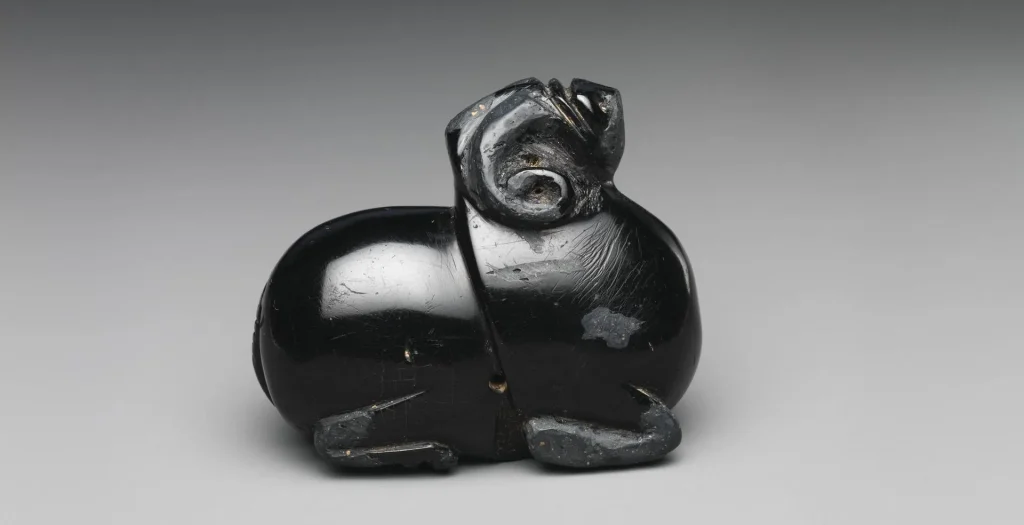
In short
Goat years in the Chinese zodiac are 1931, 1943, 1955, 1967, 1979, 1991, 2003 and 2015, and the next Year of the Goat runs from February 6, 2027 to January 25, 2028. The sign is written with one character, 羊 (yáng), which covers goats and sheep alike, so the same year also appears in English as the Year of the Sheep or the Year of the Ram.
The latest one opened on February 19, 2015, one of the later New Year dates, and until that day the Horse still held the year. That 2015 Goat was Wood. The one before it, starting February 1, 2003, was Water.
Summer’s last month, from Minor Heat to the Start of Autumn in the solar-term calendar, belongs to the Goat, and so do the early-afternoon hours from 1 to 3 p.m. The branch behind both is Wei (未), yin earth, which makes the Goat the eighth of the twelve animals, after the Horse and before the Monkey.
A folk saying, “ten goats, nine incomplete,” is used to call Goat years unlucky, yet matchmaking writers paint the people born in them as warm-hearted, approachable and patient. Both are lore, and I pass on the trait words as folk types, for entertainment. The goat has a good name too, and this page traces it to a dictionary that reads 羊 as “auspicious” and an envoy, Su Wu, who herded rams on an empty northern shore.
Daozhang MaMaoshan Taoist, Jintan, Jiangsu
The guide · 10 chapters
Year of the Goat Dates, 1931 to 2039
1 min read · 1 table
January 24 opened the 1955 Goat year and will open the 2039 one, eighty-four years apart, and no Goat year in the table starts earlier. Every row runs from a Chinese New Year’s Day to the eve of the next, and the coming 2027 Fire Goat hands over to the Monkey on January 26, 2028.
| Goat year | Starts | Ends | Element | Stem and branch |
|---|---|---|---|---|
| 1931 | February 17, 1931 | February 5, 1932 | Metal | 辛未 xinwei |
| 1943 | February 5, 1943 | January 24, 1944 | Water | 癸未 guiwei |
| 1955 | January 24, 1955 | February 11, 1956 | Wood | 乙未 yiwei |
| 1967 | February 9, 1967 | January 29, 1968 | Fire | 丁未 dingwei |
| 1979 | January 28, 1979 | February 15, 1980 | Earth | 己未 jiwei |
| 1991 | February 15, 1991 | February 3, 1992 | Metal | 辛未 xinwei |
| 2003 | February 1, 2003 | January 21, 2004 | Water | 癸未 guiwei |
| 2015 | February 19, 2015 | February 7, 2016 | Wood | 乙未 yiwei |
| 2027 | February 6, 2027 | January 25, 2028 | Fire | 丁未 dingwei |
| 2039 | January 24, 2039 | February 11, 2040 | Earth | 己未 jiwei |
Born in January or Early February?
A baby born on February 10, 2015 is a Horse, not a Goat. New Year came nine days later that year, on February 19, and the 2014 Horse year ran until February 18. A January 30, 1955 birthday went the other way: the Wood Goat year was already six days old.
If your birthday sits in late January or February, set it beside the Starts column. The Chinese New Year zodiac calculator runs the same check for any date, and when a Chinese zodiac year starts explains why the line falls at New Year rather than on January 1.
What the Year of the Goat Means: Wei, Early Afternoon and Late Summer
1 min read · 1 photo
The Sanming Tonghui (三命通會), the Ming-dynasty astrology compendium, settles the pairing in four characters, wei shu yang (未屬羊), “Wei belongs to the goat.” Wei is the eighth earthly branch and points southwest, and since it holds 1 to 3 p.m. and the sixth month, from Minor Heat to the Start of Autumn, the Goat sits where the hot season ends.
The same book calls Wei a walled garden: it is the storehouse of wood, built like a wall that keeps a bed of flowers safe.
How the Goat came to be eighth is a folk tale, not a record. In the usual telling of the great race, the Goat, the Monkey and the Rooster reached the river together and shared one wooden raft across it, and they came ashore in that order, eighth, ninth and tenth.
A small pottery model from the Eastern Han shows a flock in its pen.
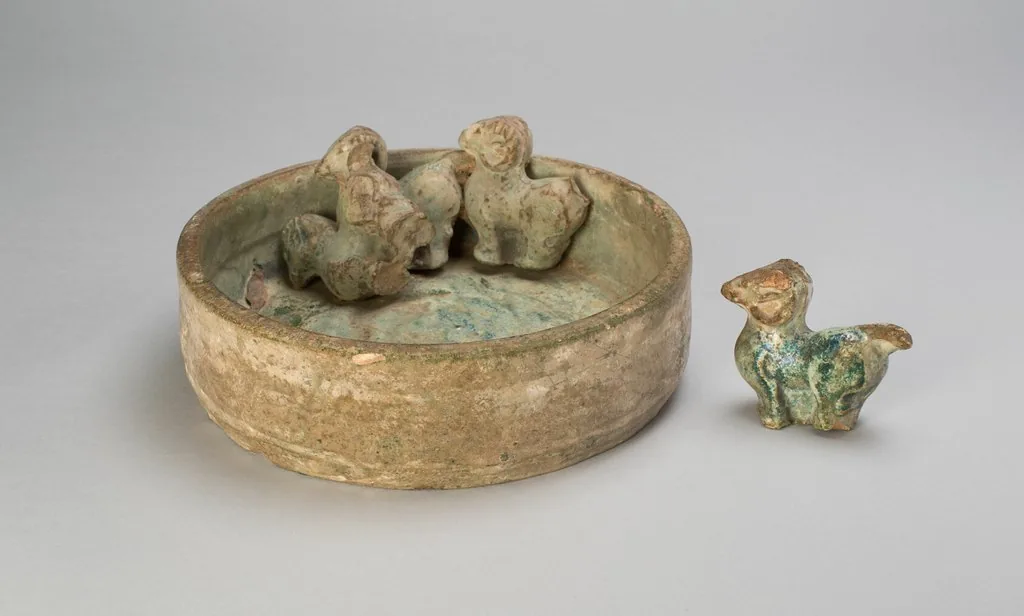
The pen is a low round wall of pottery, its green glaze worn thin and gone yellow-brown over most of the outside. Three or four little animals crowd inside it: two show their curled horns clearly, and another is half hidden behind them. One more stands alone to the right of the pen, greener than the rest, with the same tight curl of horn and a short raised tail.
Goat, Sheep or Ram? One Character, 羊
2 min read · 1 photo
Goat, Sheep and Ram all translate this sign fairly, because Chinese writes it with a single character, 羊 (yáng), that names the whole family of goats and sheep. The zodiac’s character doesn’t pick one animal, so English speakers have had to.
The Shuowen Jiezi (說文解字), the second-century dictionary of Chinese characters, says the character is drawn from the animal’s “head, horns, feet and tail.” The Erya, an early Chinese word list, puts yang and xia yang (夏羊) under a single heading, “the yang kind,” each with separate words for male and female. Later commentators disagree about which of the two was the goat, and I won’t settle it for them.
Shanyang (山羊), “mountain yang,” is the goat in modern Chinese, and mianyang (绵羊), “cotton yang,” is the sheep. Neither word appears in the zodiac, which keeps the bare 羊.
Where you grew up may decide which animal you picture. Victor Mair, a Chinese-language scholar at the University of Pennsylvania, told Quartz in 2015 that people in the south of China tend to think of the zodiac yang as a goat and people in the north as a sheep, adding that this is not a hard and fast rule.
Neighboring countries had to choose. Japanese reads the eighth branch as hitsuji, and Japanese dictionaries give hitsuji as the sheep, with the goat under a different word, yagi. Vietnamese calls the sign Mùi, and the Vietnamese press also writes tuổi dê, using dê, the goat.
A ram, if you’re wondering, is a sheep: Dictionary.com defines it as a male sheep, and Cambridge as an adult male sheep. “Year of the Ram” is therefore one more way of saying Sheep. This site says Goat, the word most readers type, and the dates, the branch and the pairings stay the same whichever animal your family names.
A Qing porcelain bowl paints its animal plainly enough to take a side.
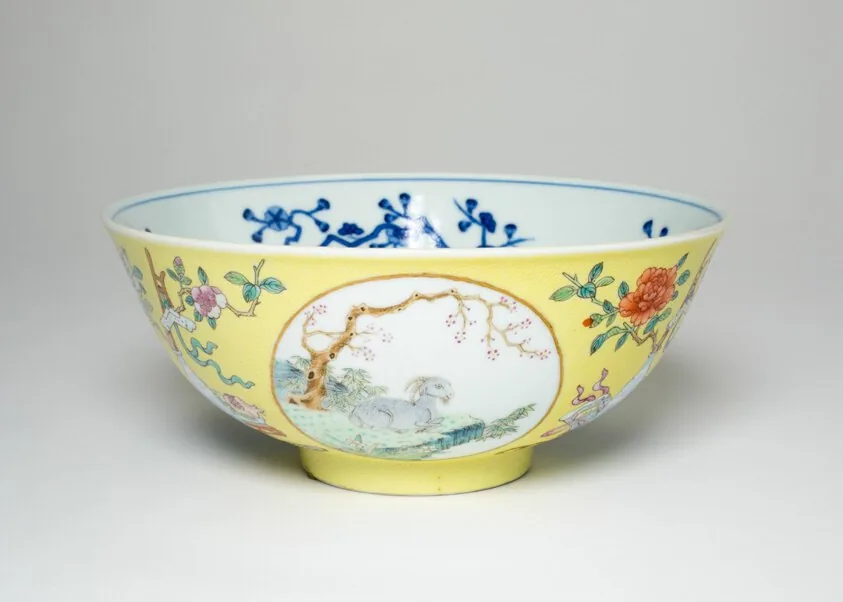
In the white roundel on the yellow side of the bowl, a gray-white animal lies on a patch of green ground with its head turned right. It has curved horns and a small tuft of beard under the chin. An old tree with pink blossoms leans over it, with bamboo leaves and a rock to the left. Sprays of flowers fill the yellow on either side of the roundel, a large red bloom among them, and blue branches run around the inside of the rim.
The Five Goats: Wood, Fire, Earth, Metal and Water
1 min read · 1 table
Earth Goats, the jiwei years 1979 and 2039, are the only kind whose stem and branch share an element, since Wei is earth and the stem ji is earth too. Wei pairs only with the five yin stems, yi, ding, ji, xin and gui, so there are five kinds of Goat, and each comes round every sixty years.
| Kind of Goat | Stem | Years | Stem and branch |
|---|---|---|---|
| Wood Goat | 乙 yi | 1955, 2015 | 乙未 yiwei |
| Fire Goat | 丁 ding | 1967, 2027 | 丁未 dingwei |
| Earth Goat | 己 ji | 1979, 2039 | 己未 jiwei |
| Metal Goat | 辛 xin | 1931, 1991 | 辛未 xinwei |
| Water Goat | 癸 gui | 1943, 2003 | 癸未 guiwei |
Beyond the element, the stem’s traditional image is the only thing the sources behind this page add about the five Goats. Yi is flowers and climbing vines, ding is a lamp or candle flame, ji is farmland and gardens, xin is jewelry and polished stone, and gui is rain and dew. Those sources give no separate personality list for a Metal or Water Goat, so neither do I.
Goat Personality in Traditional Readings
1 min read
Grateful in the heart, but unable to say so out loud: that one line from the matchmaking pieces sums up the Goat they describe, and the rest of their portrait is just as gentle.
Goat-born people are said to be warm-hearted and kind, approachable and well liked, reserved, careful to think things through, and able to put up with a great deal. The same pieces call them sentimental and easily saddened, too worried about what others think, and insecure.
All of this is folk typing, shared for entertainment. Nobody I know of has checked it against real Goat-born people, and in a birth chart the year is only one of four pillars anyway.
Lucky numbers and colors are a modern add-on. English zodiac sites agree on 2 and 7 for the Goat, then split on colors and directions, green, red and purple on one list and brown, red and purple on another. I haven’t found an old table behind any of them.
Goat Compatibility: Horse, Rabbit, Pig and the Ox Clash
2 min read · 1 table
Ox and Goat are one of the two heaviest pairings on the whole branch chart, because Chou and Wei clash, and Wei also punishes Chou. At the other end the Horse is the Goat’s closest match, its six-harmony (六合) partner, with the Rabbit and the Pig close behind in the wood trio. The Chinese zodiac compatibility guide lays out the grid for all twelve signs.
| Relationship | Partner sign | What the tradition says |
|---|---|---|
| Six harmony (六合) | Horse | Wu and Wei combine; one marriage rhyme counts Horse and Goat among its six top-grade matches |
| Triple harmony (三合) | Rabbit, Pig | Hai, Mao and Wei form the wood trio |
| Clash (冲) | Ox | Chou and Wei stand opposite; with the punishment below, Ox and Goat are one of the two heaviest pairings on the chart |
| Punishment (刑) | Ox, Dog | Chou, Xu and Wei make the punishment of relying on power (恃势之刑); Wei punishes Chou, Xu punishes Wei |
| Harm (害) | Rat | Zi and Wei harm each other; the Sanming Tonghui calls it the harm of powerful houses |
| Break (破) | Dog | Xu breaks Wei; not every list includes break, so it counts as mild |
Wu and Wei turn up again, read from the Horse’s side, on the Year of the Horse page. Hai, Mao and Wei appear in the tables on the Year of the Rabbit and Year of the Pig pages.
Asked for the Goat’s enemy sign, the charts answer the Ox: clash and punishment together, the heaviest entry on the Goat’s row. The Dog comes next, with a punishment plus a mild break, and the Rat has a single harm. The Goat enemy sign page sets out that ranking, and the Dog pairing has a page of its own, Dog and Goat compatibility.
Several English zodiac sites add the Tiger to the Goat’s worst matches, and one Chinese marriage table adds the Dragon. Neither has a branch behind it. Yin and Wei share no harmony, clash, harm, punishment or break, and neither do Chen and Wei, so on the chart both pairs are neutral.
The three English sites I read explain the Tiger only by temperament, the bold Tiger against the Goat who wants a quiet life, and the Chinese table that lists the Dragon gives no reason at all.
The Goat compatibility page goes through the best and worst matches one by one, and the pairings the old sayings disagree on. Read every line of it, and of the table above, as matchmaking lore rather than a ruling on a real couple.
Ben Ming Nian and Tai Sui in a Goat Year
1 min read
In the dingwei year that opens on February 6, 2027, the Goat sits “on duty with” Tai Sui (值太岁), and the Ox both clashes with Tai Sui and is punished, since Wei punishes Chou. For the Goat-born it is a ben ming nian (本命年), their own branch come back, running until January 25, 2028; the Chinese zodiac guide explains what that means for any sign.
Two more signs complete the usual list. The Dog is in punishment, since Xu punishes Wei, and in break as well, and the Rat is in harm through Zi and Wei. That makes four animals offending Tai Sui (犯太岁) in 2027, with the Ox carrying the heaviest load.
The charts stop at that list. They don’t promise anyone a good or bad year, and the 2027 Chinese zodiac page goes through the year sign by sign.
When Goat-born people ask me for a day in the first month of 2027, I cross off the Ox days before I look at anything else. February 15, 2027 is one, and its almanac line reads chong yang (冲羊), “clashes the Goat.”
February 12, 2021 opened the last Ox year, xinchou, which ran to January 31, 2022 and was the Goat’s most recent clash year. The next, guichou, runs from January 31, 2033 to February 18, 2034.
San Yang Kai Tai: 羊, 祥 and the Goat in Chinese Lore
2 min read · 1 photo
The goat stands for good luck in Chinese lore because yang (羊), goat, was read as xiang (祥), auspicious. The Shuowen Jiezi defines the character in one word, xiang, and New Year greetings still play on the animal’s name.
The reading shows up on metal as well as in books. A bronze knife from the Yuanjia reign of the Eastern Han carried the wish da ji yang (大吉羊), “great luck, goat,” and when the Song scholar Hong Kuo recorded it in his Li Xu, he noted that the inscription uses the goat to mean good fortune.
San yang kai tai (三阳开泰), “three yang open into Tai,” began with the Book of Changes, not with goats. The Tai hexagram (泰) has three solid yang lines at the bottom, and the Qian Zao Du, a Han-era companion text to the Changes, calls Tai the hexagram of the first month. At the Ming New Year’s Day audience, as the History of Ming records it, the address read to the emperor on the officials’ behalf included san yang kai tai, wan wu xian xin, “the three yang open into Tai, and all things are made new.”
Because yang the line and yang the goat sound alike, painters swapped in three goats. By 1881 a Shanghai paper, the Shenbao, was listing a colored “three goats bring Tai” picture in its price notices for paintings. In a Goat year the banner I buy for my own door is a san yang kai tai, and I don’t have to explain the pun to anyone who reads it.
The History of Han has a shepherd story of its own. It says Su Wu (苏武), held by the Xiongnu, was sent to an empty shore of the Northern Sea to herd rams and told he could go home when the rams gave milk. He kept the envoy’s staff of the Han court in his hand while he herded, waking and sleeping, until every tassel had fallen from it.
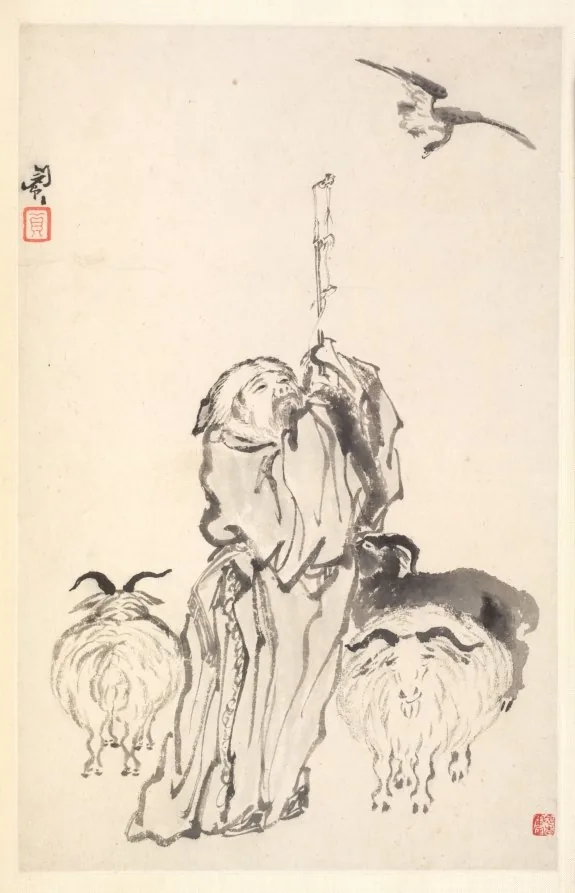
The man stands with his head tipped back and both hands raised on the staff, and a bird with spread wings comes down toward him from the upper right. Three sheep stand around his feet: a long-haired white one on the left with horns curving outward, a dark one behind him on the right, and a white one in front facing out of the picture. A signature and a red seal sit at the upper left, and another seal at the lower right.
The staff is two thin ink lines running straight up, with a few short strokes hanging near the top, while the robe below it is laid in with broad pale washes. That pull between fine line and loose wash is what I study when I paint Taoist pictures of my own.
Guangzhou’s old name, the City of Five Rams, has its own goats. Pei Yuan’s Guangzhou Ji, quoted in the Taiping Yulan encyclopedia, says five rams were painted on the beam of the governor’s hall with bags of grain beside them, and another account in the same book has five immortals riding five rams of different colors and bringing the five grains.
Steamed-bun goats are shaped from dough with curled horns, a little beard and a resting pose, then steamed and dotted with color and leaves.
Why Some Families Call Goat Years Unlucky
2 min read
The idea that a Goat year is unlucky rests on folk sayings, not on the branch chart. The best known is shi yang jiu bu quan (十羊九不全), literally “ten goats, nine incomplete,” and I haven’t found an early printed source for it.
One English site turns it into a claim that only one Goat-born person in ten finds happiness, which is not what the words say. “Incomplete” is all the saying offers, and anyone who turns that into a verdict on Goat babies is adding to it.
Two more sayings aim at women. Nan pa shu ji, nü pa shu yang (男怕属鸡,女怕属羊) means “men fear being born a Rooster, women fear being born a Goat.” Another goes yang nan xi yang yang, yang nü shou kong fang (羊男喜洋洋,羊女守空房): a Goat man is full of joy, while a Goat woman keeps an empty room. Neither comes from the branch chart, and the Goat and Rooster page meets them from the Rooster’s side.
A story repeated in Chinese media says the “ten goats” line didn’t exist before the Xianfeng reign and was spread in the late Qing to attack Empress Dowager Cixi, who was a Goat. The 2014 report that tells it gives no Qing source, and neither does the English retelling I read. The calendar part is true: Cixi was born in 1835, a yiwei Goat year, and Zeng Guofan and Li Hongzhang were also born in Goat years. The rest is hearsay.
Folklorists have said as much in public. In a 2014 People’s Daily Online report, Liu Kuili, president of the China Folklore Society, said that people who named the years after animals plainly did not mean to make one year bad and another good. Ye Chunsheng, a professor at Sun Yat-sen University and the society’s vice president, called the idea “laughable” and pointed out that the goat was tied to good words like xiang, auspicious, and mei, beautiful.
That’s where I come down too. These sayings are folk prejudice, not part of the stem-and-branch system, and a Goat woman’s dates come out of the almanac exactly as anyone else’s do.
Year of the Goat FAQ
2 min read
Is 2027 the Year of the Goat? It is, but only from Chinese New Year on February 6. The first five weeks of 2027 still belong to the Horse, and babies born from February 6 through January 25, 2028 share the dingwei sign of 1967, the Fire Goat.
Is the Chinese zodiac sign a Goat or a Sheep? Both are correct. The zodiac writes the sign as 羊, a character that covers goats and sheep, and leaves it at that. “Ram” also works, since a ram is a male sheep.
What does the Goat symbolize in Chinese culture? Good fortune. The Shuowen Jiezi defines 羊 as 祥, auspicious, a Han bronze knife wished for “great luck, goat,” and New Year pictures turn the phrase san yang kai tai into three goats.
What is the Goat’s enemy sign, and who suits it best? The Ox. Chou sits across from Wei, a clash with a punishment on top. For a good match the charts name the Horse first, since Wu and Wei combine, then the Pig and the Rabbit from the Hai, Mao and Wei trio. I pass these on as lore, for fun.
Is the Chinese Goat the same as Capricorn or Aries? No. The Chinese Goat comes from the lunar year of your birth, while Capricorn, the sea-goat, and Aries, the ram, are Western signs set by the month and day you were born. A Goat-year baby can carry any of the twelve Western signs.
What does shi yang jiu bu quan mean? Shi yang jiu bu quan (十羊九不全) is a folk saying, literally “ten goats, nine incomplete,” used to call Goat years unlucky. It has no basis in the branch chart, and two officers of the China Folklore Society dismissed it publicly in 2014.
One character covers the goat and the sheep, and an old dictionary reads it as good fortune, which is a kinder start than the sayings in the last section suggest. Any almanac will confirm the dates and stems in the tables; the traits, the pairings and the unlucky talk are lore. The Zodiac & Tradition home page has the other eleven signs and the festivals.
Key terms in this guide
Full glossary →Related topics at this level
- Year of the DragonDragon years are 1988, 2000, 2012 and 2024, and the next starts January 28, 2036. Dates, five elements, traits, matches and the Longtaitou festival.
- Year of the SnakeSnake years are 1929 to 2025, and the next starts February 15, 2037. Exact dates, the five element Snakes, traditional traits and matches, and snake legends.
- Year of the HorseHorse years run from 1930 to 2026, and the current one lasts until February 5, 2027. Exact dates, the five Horses, traits, matches and the horse's lucky puns.
- Year of the MonkeyMonkey years include 1992, 2004 and 2016, and the next opens January 26, 2028: dates, the five Monkeys, traits, matches and the Hou pun.
- Year of the RoosterRooster years are 1981, 1993, 2005 and 2017, and the next begins February 13, 2029. Dates, five elements, traits, matches and the da ji da li pun.
- Year of the DogDog years: 1994, 2006, 2018, and the next one starts February 3, 2030. Dates, five elements, traits, matches, and the dog that keeps the night watch.
More topics
- Chinese ZodiacThe 12 Chinese zodiac animals in order, how to find your sign and element from your birth date, and what the zodiac hours, months and clashes mean.1 guide
- Year of the DragonDragon years are 1988, 2000, 2012 and 2024, and the next starts January 28, 2036. Dates, five elements, traits, matches and the Longtaitou festival.
- Year of the SnakeSnake years are 1929 to 2025, and the next starts February 15, 2037. Exact dates, the five element Snakes, traditional traits and matches, and snake legends.
- Year of the HorseHorse years run from 1930 to 2026, and the current one lasts until February 5, 2027. Exact dates, the five Horses, traits, matches and the horse's lucky puns.
- Year of the MonkeyMonkey years include 1992, 2004 and 2016, and the next opens January 26, 2028: dates, the five Monkeys, traits, matches and the Hou pun.
- Year of the RoosterRooster years are 1981, 1993, 2005 and 2017, and the next begins February 13, 2029. Dates, five elements, traits, matches and the da ji da li pun.
- Year of the DogDog years: 1994, 2006, 2018, and the next one starts February 3, 2030. Dates, five elements, traits, matches, and the dog that keeps the night watch.