Feng Shui · Topic guide
Feng Shui Items: Meanings, Placement and Pieces for Good Luck
Feng shui items are objects placed to guard a home or invite luck. Here's what the pixiu, money toad, bagua mirror, gourd and coins mean, and where each goes.
By Daozhang Ma Published
In short
Feng shui items are objects that Chinese tradition places in a home or shop to do one of two jobs: block something harmful, or invite something wanted, usually money, safety, study or a good marriage. The best known are the pixiu, the three-legged money toad, Chinese coins, the bagua mirror, guardian lions and the gourd.
Each one has a set job and a set place. A pixiu faces the door, a bagua mirror hangs outside above it, and a gourd goes by a bed. Shops tend to sell them all as “good luck,” which is how a house ends up with a mirror in the wrong room and a toad facing the wrong way.
I’ve been a Taoist on Maoshan for 22 years, and people carry these pieces up the mountain every month. So I’ll take them one at a time: what each is, the story behind it, where tradition puts it, and what I’d say about it myself.
Daozhang MaMaoshan Taoist, Jintan, Jiangsu
The guide · 11 chapters
What counts as a feng shui item: cures, enhancers and lucky symbols
1 min read
A feng shui item is any object used on purpose to change how a place is read, and the tradition sorts them into three loose kinds. Cures answer a problem, enhancers add to something already good, and lucky symbols carry a wish through a picture or a pun.
- Cures (化煞 hua sha, “dissolving sha”): the bagua mirror, guardian lions, the gourd and strings of old coins. Sha is the harsh qi said to strike a house head-on.
- Enhancers (招财 zhao cai, “calling wealth”): the pixiu, the money toad and the money bowl.
- Lucky symbols (吉祥物 jixiang wu): fish, mandarin ducks, elephants and the Laughing Buddha.
The order matters. In the classical view the building comes first, and an object only patches what walls, doors and furniture can’t fix. I explain that side in my guide to feng shui, from the compass to the old courtyard house, and I’d read it before buying anything.
Many of these pieces are older than their feng shui use. The gourd was a Taoist emblem, the lion a temple guard and the carp an exam wish long before any of them sat on a shelf marked “wealth corner.”
Feng shui items at a glance: what each one is for
1 min read · 1 table
The quickest way to tell feng shui items apart is by job and place. This table lists 14 common pieces, with the job tradition gives each and where it usually goes.
| Item | Chinese | Traditional job | Usual place |
|---|---|---|---|
| Pixiu | 貔貅 pixiu | Guards money | Living room or shop, head toward the door |
| Money toad | 金蟾 jin chan | Brings in customers | Near the entrance or cash desk |
| Chinese coins | 铜钱 tong qian | Steadies money, softens sha | Door frame, threshold, wallet |
| Laughing Buddha | 布袋 Budai | Contentment and plenty | Facing the main door |
| Money bowl | 聚宝盆 ju bao pen | Gathers wealth | Wealth corner or shop counter |
| Lucky cat | 招财猫 zhao cai mao | Beckons customers | Shop front |
| Bagua mirror | 八卦镜 bagua jing | Turns back sha | Outside, above the door |
| Guardian lions | 石狮 shi shi | Guard the gate | A pair, flanking the entrance |
| Dragon turtle | 龙龟 long gui | Support and long life | Behind a desk or at the back |
| Gourd | 葫芦 hulu | Health and safekeeping | Bedside or by a door |
| Wenchang tower | 文昌塔 Wenchang ta | Study and exams | On a student’s desk |
| Mandarin ducks | 鸳鸯 yuanyang | A faithful marriage | Bedroom, always as a pair |
| Elephant | 象 xiang | Good fortune, steadiness | Entry or study |
| Wind chime | 风铃 feng ling | Softens a harsh spot | By a door or window |
Read the “usual place” column as custom, and don’t treat it as law. Schools disagree on details, and a Flying Star reader will put the same toad in a different corner each year.
Feng shui items for wealth: pixiu, money toad and Chinese coins
2 min read · 1 photo
The three classic feng shui items for wealth are the pixiu, the money toad and old coins, and tradition gives them different work. The pixiu keeps money, the toad pulls business in, and coins hold things steady. Buying all three for one shelf misses the point.
The pixiu (貔貅) is a winged beast with a dragon’s head. In the story most often told, the Jade Emperor sealed its body as a punishment, so gold and silver go in and nothing comes out. That’s why it’s given the job of holding on to what a household already has. Its head points toward the door or a window, and tradition keeps it out of the bedroom.
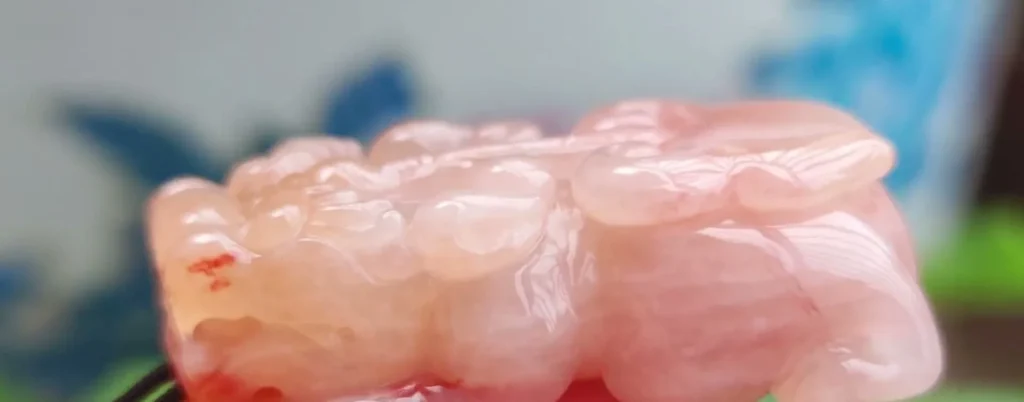
The money toad (金蟾 jin chan) has three legs and usually sits on a pile of coins. It comes from the legend of Liu Hai, a Taoist immortal who lured a three-legged toad out of a well with a string of coins. An old rhyme says that when Liu Hai teases the toad, every step hooks up money (刘海戏金蟾,步步钓金钱).
Shopkeepers are the toad’s main buyers. One common rule says a toad with a coin in its mouth faces into the room, so the money comes in, and a toad with an empty mouth faces out to fetch it. I’ve heard shop owners argue over which is right, and that tells you it’s custom rather than doctrine.
Coins are the quiet ones. A Chinese cash coin is round with a square hole, the old picture of a round heaven over a square earth. The “five emperors’ coins” (五帝钱 wu di qian) are five coins from the Qing reigns of Shunzhi, Kangxi, Yongzheng, Qianlong and Jiaqing, tied on red cord.
Tradition hangs that string on the door frame or lays it under the threshold, and its job is to steady money and soften sha. Nobody claims it brings a windfall. Nearly every set sold today is a modern copy, which is fine as long as nobody charges you an antique price for it.
Laughing Buddha, lucky cat and money bowl: the cheerful feng shui items
1 min read
The Laughing Buddha, the lucky cat and the money bowl are the friendliest feng shui items, and they’re also the three most often misread. None of them is a cure. They’re wishes for plenty, set where guests and customers will see them.
The Laughing Buddha isn’t the historical Buddha. He’s Budai (布袋), a Chinese monk of the tenth century whose name means “cloth sack,” after the bag he carried. Later tradition took him as a form of Maitreya, the Buddha to come. His round belly and open laugh stand for contentment, and the sack for plenty.
People usually set him facing the main door, at about table height, so he greets whatever comes in. A statue holding gold ingots is the “wealth” version, and one with children climbing on him is for family. Out of respect, tradition keeps him off the floor and out of the bathroom.
The lucky cat with the raised paw is Japanese. Its name there is maneki-neko, the beckoning cat, and it reached Chinese shop counters through restaurants and trade. Chinese shopkeepers call it zhao cai mao (招财猫), “the cat that calls wealth,” and they’ve adopted it without fuss. I’d only ask that nobody call it ancient Chinese feng shui.
The money bowl (聚宝盆 ju bao pen) takes its name from a folk tale about a basin that multiplied whatever was dropped into it. In a home it’s a bowl filled with coins, stones or ingot shapes and kept in the wealth corner. I think of it as a savings jar with a story attached, and that’s a fair use of it.
Protective feng shui items: bagua mirrors, guardian lions and dragon turtles
2 min read · 1 photo
Protective feng shui items are meant to stop sha before it reaches the house, so nearly all of them work at the edge: the gate, the door or the wall behind your back. The bagua mirror, a pair of guardian lions and the dragon turtle are the three you’ll meet most.
The bagua mirror (八卦镜) puts a small round glass at the center of an octagon, and each of the eight sides carries one trigram. It hangs outside, above the front door, facing whatever is aimed at the house: a road running straight at the door, a sharp roof corner, a lamp post.
Three kinds are sold. A flat mirror simply sends the line back, a convex one is said to scatter it, and a concave one is said to draw it in and shrink it. Tradition is firm that the mirror never hangs indoors and never points at a neighbor’s door, since it’s meant to answer a threat and not to pick a fight.
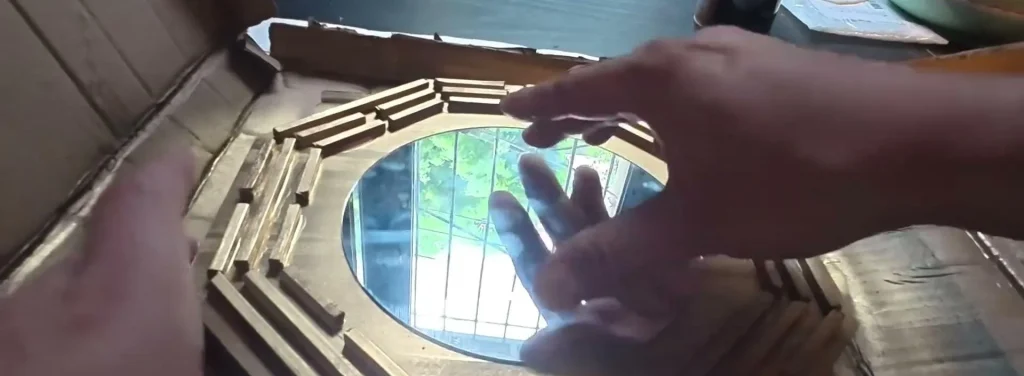
The one in this photo is a homemade copy caught halfway through assembly, with the glass going into its wooden frame. It shows the layout well, though a finished mirror would have painted trigrams and a hook on the back.
Guardian lions (石狮 shi shi) stand in pairs at a gate. Americans often call them foo dogs or fu dogs, but they’re lions, and the pair is a male with a paw on a ball and a female with a paw on a cub. Small indoor pairs copy the big stone ones outside temples and banks, and they face out, toward the street.
The same idea of an animal that wakes up and guards runs through the lion dance, where a new lion’s eyes are dotted with a brush before it performs. A pair on a bookshelf is a much quieter relative of that lion.
The dragon turtle (龙龟 long gui) has a dragon’s head on a turtle’s body. Its turtle half stands for the Black Tortoise, the animal that guards the north and the back of a site. So the dragon turtle sits behind a person, on a shelf at the back of an office or toward the rear of the house.
Gourds, Wenchang towers and other feng shui charms
1 min read · 1 photo
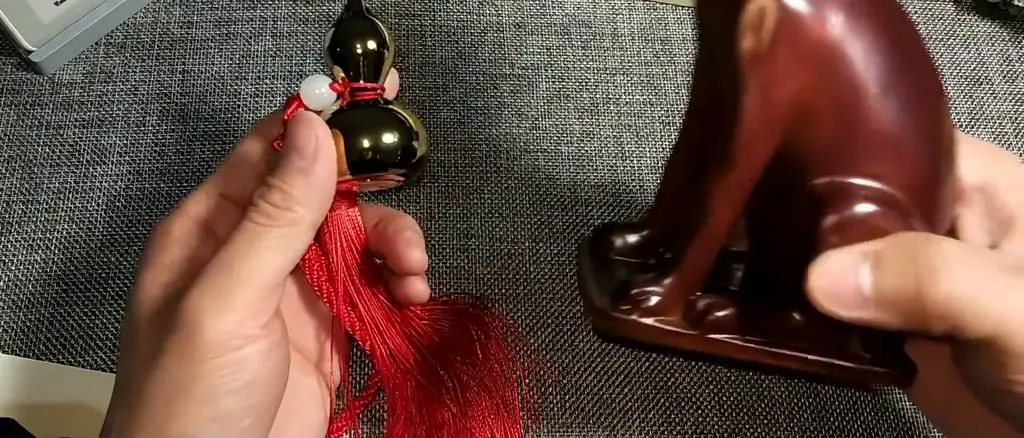
The gourd is the feng shui charm with the deepest Taoist roots, and it’s the one I’d keep if I could keep only one. English feng shui shops often spell it wu lou. In Mandarin it’s hulu (葫芦), which sounds close to fu lu (福禄), good fortune and rank.
A bottle gourd has a narrow waist and a small mouth, so the old reading is that it takes things in and holds them. Li Tieguai, one of the Eight Immortals, carries his medicine in one, which is why the gourd also stands for health. Families hang a small brass one by a bed or beside a door.
The Wenchang tower (文昌塔) is a small pagoda, usually of seven or nine tiers, named for Wenchang, the god of literature and examinations. Parents set one on a child’s desk before exam season. One common rule puts it at the student’s left hand when the desk itself can’t be moved to a better spot.
Smaller charms follow the same logic of a wish you can carry: a red-string bracelet, a jade pendant, a carved zodiac animal. I’ve written about the red cord worn in a person’s own zodiac year in my Chinese zodiac gift guide, and those pieces sit halfway between jewelry and feng shui.
A new gourd or pixiu sometimes comes up Maoshan in its owner’s pocket for kaiguang (开光, “opening the light”), the consecration rite. I’ve performed it many times. It makes the piece sacred to its owner, and I tell everyone the same thing afterward: the rite adds meaning, and it doesn’t add money.
Feng shui items for love and family: mandarin ducks, elephants and carp
1 min read
Feng shui items for love and family are nearly all animals, and most of them work through a pun or a habit of the animal itself. Mandarin ducks stand for a married couple, the elephant for good fortune, and the carp for a child who rises in the world.
Mandarin ducks (鸳鸯 yuanyang) swim in pairs, and Chinese poetry has used them for devoted couples for well over a thousand years. Tradition says they pair for life. So they’re sold as a pair and kept as a pair, usually in the bedroom, and a single duck is considered a poor gift.
The elephant works by sound. Xiang (象), elephant, is a near match for xiang (祥) in jixiang (吉祥), “auspicious.” A common design shows an elephant carrying a vase, which reads as “peace and good signs” because vase, ping (瓶), sounds like the word for peace. Chinese feng shui items speak in puns like these all the time.
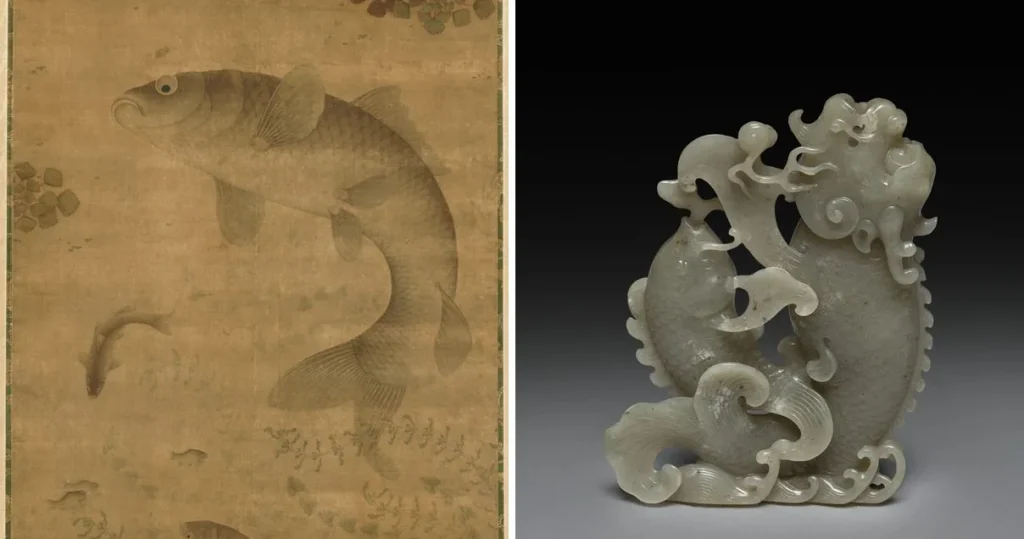
Carp carry the best story. Legend says a carp that swims up the Yellow River and leaps the Dragon Gate turns into a dragon, and the phrase “the carp leaps the Dragon Gate” (鲤鱼跳龙门) became the stock wish for passing the imperial exams. Fish also sound like surplus, since yu (鱼) matches yu (余).
That’s why a jade carving of a carp growing a dragon’s head, like the Qing piece at the top of this page, was a gift for a student rather than a toy. Live fish do the same job in a tank, and the placement rules for those are a subject of their own.
Crystals, wind chimes and the salt water cure: the newer feng shui items
1 min read
Crystals, wind chimes and the salt water cure are real parts of feng shui practice today, but they’re newer than the pixiu and the gourd, and it’s worth knowing which school each comes from. Most of what’s sold as feng shui crystals entered through modern Western practice.
The faceted crystal ball hung in a window is the clearest case. It’s tied to Black Sect feng shui, the Western school that grew up in the United States in the late twentieth century, and you won’t find it in the classical manuals. Hung in a sunny window it throws small rainbows around a room, which is reason enough for many people.
Wind chimes have older roots, since bells hang from the eaves of Chinese temples and pagodas. Their feng shui use is mostly a Flying Star method: a metal chime with six hollow rods is hung where the year’s troublesome earth-type stars land, because metal is said to drain earth in the five-element cycle.
Wooden and bamboo chimes get a softer job, such as marking a doorway or slowing a long corridor. Whether a chime is metal or wood matters more than its tune in this system, so check the material before the sound.
The salt water cure is a glass of salt and water with six Chinese coins in it, also from Flying Star practice. It’s set in the year’s afflicted corner and left alone, and the crust that grows up the glass is read as trouble being drawn off. Chemistry explains the crust well enough, and I’d treat this one as a ritual.
Where to place feng shui items, and how many to own
1 min read · 1 table
Where to place feng shui items comes down to four habits that most schools share: face the right way, stay off the floor, keep the piece clean and own fewer than you think. Two or three pieces per home is the number the tradition’s own teachers repeat.
| Rule | What it means in practice |
|---|---|
| Face the right way | Pixiu, lions and an empty-mouthed toad look out toward the door; a coin-holding toad looks in |
| Keep them raised | A shelf or table at waist height or above, never the bare floor |
| Keep them clean | Dust is read as neglect, and a chipped piece is retired |
| Respect the room | No Buddha, pixiu or deity figure in a bathroom; mirrors stay outside |
| Don’t crowd | Two or three pieces in a home, each with its own job |
Start with the problem and choose the item afterward. If the front door looks down a long straight road, that’s a bagua mirror question. If you simply want a shop to feel welcoming, a toad or a cat by the counter is plenty.
Bathrooms and kitchens get the fewest objects in any school, because water and fire already dominate those rooms. If you’re working on a bathroom, the colors that suit it will do more than any figurine.
Living things count as items too. A stalk of lucky bamboo in water is the gentlest piece on this whole page, and my notes on New Year plants cover which ones are safe around children and pets.
Feng shui things to avoid when buying and keeping items
1 min read
The main feng shui things to avoid with items are buying on a promise, mixing jobs and keeping broken pieces. Most of the bad experiences I hear about start with a seller who guaranteed a result.
- Guaranteed results. No object can promise money, health or a spouse. Anyone who says a statue will fix a debt or an illness is selling, and you should walk away.
- Paying for “antique” coins. Real Qing coins exist, but most sets are new castings. Pay the price of a replica unless a dealer can document the piece.
- Doubling up. Three wealth items on one shelf don’t triple anything. Tradition reads a crowded shelf as greed.
- Mirrors used as decor. A bagua mirror is a tool for outside the door. Indoors it’s considered harmful.
- Chipped and cracked pieces. A damaged item is thanked and retired, not glued and kept on duty.
Everything here is traditional belief, offered for interest. None of it should decide a medical, legal or financial question, and a run of bad luck is a reason to check the roof and the budget before the shelf.
What I’ve seen work is plainer. A person who chooses one piece with care, puts it where they’ll see it every morning, and dusts it now and then is paying attention to their home, and that habit is worth more than the object.
Feng shui items questions: money, the front door and old pieces
1 min read
Which feng shui items attract money?
Tradition names the pixiu, the three-legged money toad, strings of Chinese coins and the money bowl. The pixiu is said to keep money and the toad to bring in customers. All of these are symbols, and none of them is a financial plan.
What should I put at the front door for good luck?
Inside, most people choose a Laughing Buddha or a pair of small guardian lions facing the door. Outside, a bagua mirror goes above the door only if something sharp or straight is aimed at it. A clear, well-lit entry does more than either.
How do you discard feng shui items?
Common practice is to wipe the piece clean, thank it, wrap it in red paper or cloth and take it out separately from kitchen garbage. Some people bury it or leave it at a temple. A cracked or chipped piece isn’t kept in use.
Do feng shui items need to be blessed?
No, because the meaning of these pieces comes from their stories and their placement, and neither depends on a rite. Many families simply rinse a new piece and set it in place on a day they’ve picked from the almanac. Consecration is a Taoist or Buddhist rite for those who want it.
Can I mix feng shui items from different traditions?
You can, and most Chinese homes already do, with a Japanese cat beside a Taoist gourd. I’d just give each piece one job and one place.
A feng shui item is a wish given a shape, and the old ones have lasted because the stories behind them are good. The festivals, zodiac years and customs that share those stories are the rest of what I write about at Zodiac & Tradition.
More topics
- Feng ShuiFeng shui means wind and water. Here's where it came from, how a luopan and an old Chinese house are read, and which feng shui tips fit a modern home.4 guides