Zodiac · Topic guide
Year of the Horse: Chinese Zodiac Years, Horoscope, Traits
Horse years run from 1930 to 2026, and the current one lasts until February 5, 2027. Exact dates, the five Horses, traits, matches and the horse's lucky puns.
By Daozhang Ma Published
In short
The Year of the Horse is the seventh year in the Chinese zodiac’s cycle of twelve, and the recent Horse years are 1954, 1966, 1978, 1990, 2002, 2014 and 2026. The current one is a Fire Horse year that runs from February 17, 2026 to February 5, 2027.
Horse years open on Chinese New Year, not on January 1, so a birthday in January or early February can still belong to the Snake, the sign before it. Each Horse year also takes one of five elements, which is why 2014 was a Wood Horse and 1990 a Metal Horse.
The branch behind the Horse is Wu (午), a yang Fire sign. Wu rules the two hours around noon and the month of midsummer, so the Horse stands at the hottest, brightest point of both the day and the year.
Traditional readings call the Horse warm, restless and hard to fence in. I treat those words as a character type handed down in the lore, shared for entertainment. Further down the page come the objects: paper-cut horses, the lucky puns built on the word ma, and carved figurines.
Daozhang MaMaoshan Taoist, Jintan, Jiangsu
The guide · 9 chapters
Year of the Horse Dates, 1930 to 2038
1 min read · 1 table
A Horse year begins on Chinese New Year’s Day and ends on the eve of the next one. That festival moves between January 21 and February 20, so the start and end dates tell you more than the year number does.
| Horse year | Starts | Ends | Element | Stem and branch |
|---|---|---|---|---|
| 1930 | January 30, 1930 | February 16, 1931 | Metal | 庚午 gengwu |
| 1942 | February 15, 1942 | February 4, 1943 | Water | 壬午 renwu |
| 1954 | February 3, 1954 | January 23, 1955 | Wood | 甲午 jiawu |
| 1966 | January 21, 1966 | February 8, 1967 | Fire | 丙午 bingwu |
| 1978 | February 7, 1978 | January 27, 1979 | Earth | 戊午 wuwu |
| 1990 | January 27, 1990 | February 14, 1991 | Metal | 庚午 gengwu |
| 2002 | February 12, 2002 | January 31, 2003 | Water | 壬午 renwu |
| 2014 | January 31, 2014 | February 18, 2015 | Wood | 甲午 jiawu |
| 2026 | February 17, 2026 | February 5, 2027 | Fire | 丙午 bingwu |
| 2038 | February 4, 2038 | January 23, 2039 | Earth | 戊午 wuwu |
After 2026 the Horse doesn’t return until February 4, 2038, an Earth Horse year. Anyone born between January 1 and February 16, 2026 is a Wood Snake, because the 2025 Snake year was still running.
The other eleven animals follow the same pattern, and their start and end dates are listed year by year in the Chinese zodiac years chart. For how the animals, branches and elements fit together as one system, start with the Chinese zodiac guide.
Birthdays Before Chinese New Year
Look at the table before you call yourself a Horse. A baby born on January 25, 1990 is a Snake, since the Horse year only opened on January 27. A baby born on February 10, 1991 is still a Metal Horse, because that year ran on until February 14.
A bazi (八字) birth chart draws the line at a different place. Chart readers change the year at Lichun (立春), the solar term that opens spring around February 4, so a chart and a family calendar can disagree about a late-January birthday.
For an everyday answer, the Chinese New Year date is the one to use. If you’d rather not count days yourself, the Chinese New Year zodiac calculator walks through finding the sign from a full birth date.
What the Year of the Horse Means: Wu, Noon and Midsummer
1 min read
The Horse gets its meaning from Wu (午), the seventh of the twelve earthly branches. In the five elements system Wu belongs to Fire, the Wu hour runs from 11 a.m. to 1 p.m., and its direction on the old compass is due south.
That hour is still in everyday Chinese. Noon is zhongwu (中午), “middle Wu”, morning is shangwu (上午), “before Wu”, and afternoon is xiawu (下午), “after Wu”. Anyone who speaks Chinese names the Horse’s branch several times a day without thinking about the zodiac at all.
The month points the same way. The Wu month is the fifth month of the lunar calendar, roughly early June to early July, and it holds the summer solstice. So the Horse stands for yang at full strength: the sun overhead, the longest days and the most heat.
The Great Race legend tells it as a story. In the best-known version the Horse was about to finish sixth when the Snake, coiled round its leg, slid out at the bank and startled it. The Horse reared, the Snake crossed first, and the Horse took seventh place.
Outside the calendar, the horse in Chinese culture stands for speed, stamina and getting somewhere, because for most of history it was the fastest way to carry a message or a person. That’s why horse motifs lean toward quick success, and they turn up on small everyday things as well as on New Year prints.
The Five Horses: Wood, Fire, Earth, Metal and Water
1 min read · 1 table
Wu stays fixed, but the heavenly stem paired with it changes each time, and the stem decides which of five kinds of Horse a year produces. Each pairing comes back once every 60 years.
| Kind of Horse | Stem and branch | Last two years | Next |
|---|---|---|---|
| Wood Horse | 甲午 jiawu | 1954, 2014 | 2074 |
| Fire Horse | 丙午 bingwu | 1966, 2026 | 2086 |
| Earth Horse | 戊午 wuwu | 1918, 1978 | 2038 |
| Metal Horse | 庚午 gengwu | 1930, 1990 | 2050 |
| Water Horse | 壬午 renwu | 1942, 2002 | 2062 |
All five stems are yang, because Wu is a yang branch and the 60-year cycle only joins yang with yang. The Horse’s own element stays Fire whichever stem arrives.
That makes 2026 the Horse at its most concentrated. Its stem is Bing (丙), yang Fire, sitting over Wu, which is Fire as well, so the almanac reads a bingwu year as Fire sitting on Fire. The previous bingwu year was 1966, and the next won’t arrive until 2086.
The readings shade each kind a little. Wood Horses are said to be the most sociable, Fire Horses the boldest, Earth Horses the steadiest, Metal Horses the most stubborn and Water Horses the most adaptable. Those shades are popular lore, and charts word them differently.
Horse Personality in Traditional Readings
1 min read
Under the five shades sits one shared Horse character. Folk readings describe people born in Horse years as warm, outgoing and fond of freedom, the sort who dislike being managed and can’t sit still for long.
The same readings add a quick temper that burns out fast. A Horse is said to flare up, say it all, and forget the quarrel by evening, without holding a grudge. Horses are also said to care about face, spend generously and collect friends easily, so the diary fills up before the savings do.
I’ve never seen a study that tests whether Horse-year people really are more restless, and the Chinese articles that repeat these traits present them as folk sayings. Within the system, a reader also weighs the month, day and hour of birth, so the year animal is only the opening line.
Everything from here on works the same way. Matches, clashes and Tai Sui are traditional lore, shared for entertainment, and I wouldn’t plan a marriage or a move around them.
Horse Compatibility: Tiger, Dog, Goat and the Rat Clash
1 min read · 1 table
Matches come from the branch, not from the element, so a Fire Horse and a Water Horse share the same friends and rivals. Six relationships cover what a Horse chart shows.
| Relationship | Partner sign | What the tradition says |
|---|---|---|
| Triple harmony (三合) | Tiger, Dog | Yin, Wu and Xu form the fire trio, said to pull together |
| Six harmony (六合) | Goat | Wu and Wei make the Horse’s closest pair |
| Clash (冲) | Rat | Zi sits directly opposite Wu on the branch circle |
| Harm (害) | Ox | Chou and Wu rub along with hidden distance |
| Self-punishment (自刑) | Horse | Two Wu branches together turn on themselves |
| Break (破) | Rabbit | Wu and Mao are listed as a mild break |
The Tiger and the Dog sit with the Horse in the fire trio, and the old charts call a trio like-minded, good for working side by side. The Goat, also called the Sheep, is the Horse’s one-to-one partner, and a country saying has the pair sharing a trough. The Year of the Tiger page covers the same trio from the Tiger’s side.
The Rat holds the clash, because Zi and Wu face each other across the branch circle, midnight against noon. The Ox brings the quieter harm relationship, which the charts describe as hidden distance and misunderstandings more than open quarrels.
Then comes the oddity. The Horse is one of four signs, with the Dragon, Rooster and Pig, that punish themselves, so two Horses together count as a self-punishment pair. The old line says two quick tempers meet and neither gives way. Every pair of signs is laid out in the Chinese zodiac compatibility chart.
Ben Ming Nian and Tai Sui in a Horse Year
1 min read
For anyone born a Horse, every Horse year is a ben ming nian (本命年), the year of your own animal. Almanacs call it zhi Tai Sui (值太岁), meeting Tai Sui face to face, and Tai Sui is the deity said to preside over each year in turn.
Tai Sui began as astronomy. Early Chinese astronomers counted years by Jupiter, which takes about twelve years to circle the sky, and then imagined a twin body moving the opposite way. That invented counterpart is Tai Sui, and over time the count was tied to the twelve animals.
In any Horse year, four signs are said to offend Tai Sui, each through its branch. The Horse meets it, the Rat clashes with it, the Rabbit has the break and the Ox the harm. An old saying warns that with Tai Sui sitting overhead, a year without a happy event may bring trouble.
I read that saying as advice to stay steady, and I’m not writing a forecast for 2026 here. Yearly readings on this site begin with the Goat, the Horse’s six-harmony partner, and the 2027 Chinese zodiac forecast goes through the signs one by one.
Custom answers a ben ming nian with something red, often a red string or a red belt given by a relative at New Year. When I go through the almanac each winter for clash signs, the year I mark for Horses after this one is 2032, the next Rat year.
Horse Paper-Cuts and the Ma Shang Pun
1 min read · 2 photos
The horse’s luckiest feature is its name. Ma (马) means horse, and ma shang (马上), literally “on horseback”, is the everyday Chinese phrase for “right away”. Put anything on a horse’s back and the picture reads as a wish for that thing to come at once.
The classic version is ma shang feng hou (马上封侯), a monkey riding a horse. Hou (猴), monkey, sounds like hou (侯), a marquis, so the picture wishes someone a quick promotion to high rank. I’d call it the best-known lucky motif the horse has.
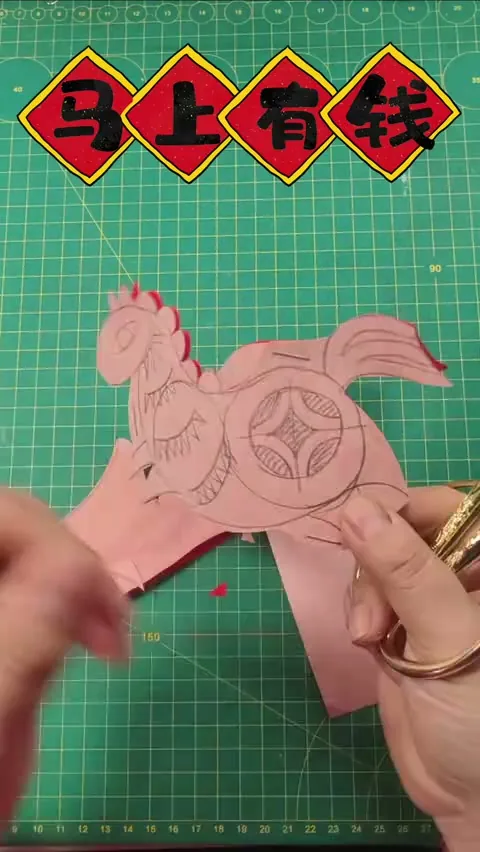
The modern version is blunter. The banner above this half-cut horse says ma shang you qian (马上有钱), “money right away”, and the round shape drawn on the body is an old Chinese coin with its square hole. The coin sits where a rider would, on the horse’s back and flank.
The cutting order shows clearly in this photo. The outer outline of this horse is already trimmed, with the pencil drawing still on the paper, and the inner pattern is still to open: the coin, the eye, the lines of the tail.
I buy the paper-cuts for my own windows and don’t cut them, so in a Horse year I’m the customer at the stall, turning sheets over to find one with a clean mane. A ragged row of teeth along the neck is the first thing I notice.
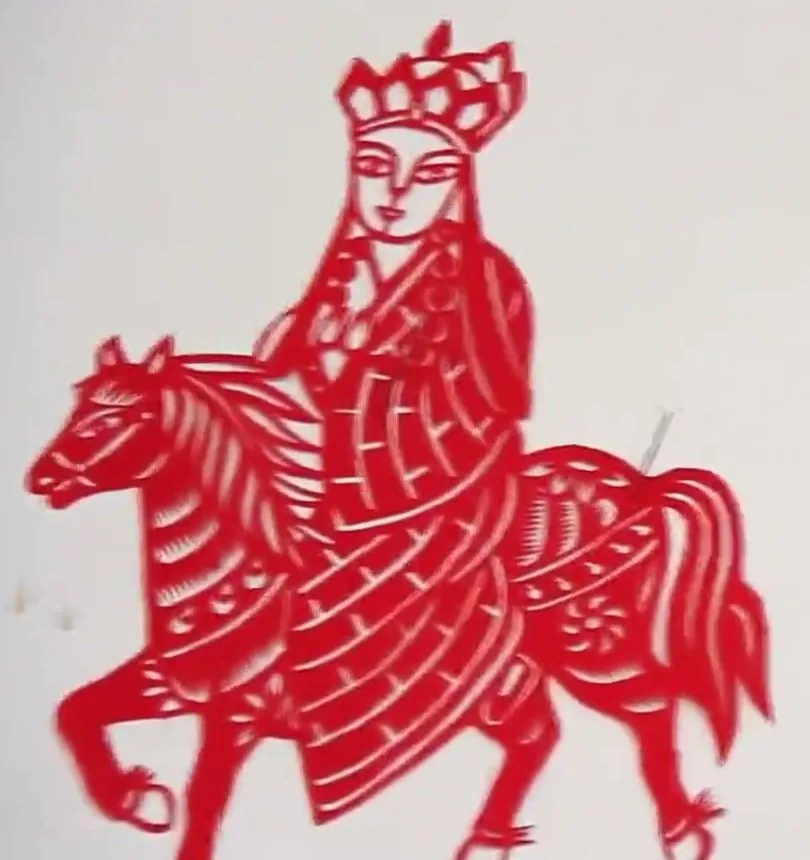
Horses also turn up as mounts in paper-cuts of opera and legend figures. This rider wears a crown and sits on a prancing horse with a patterned body and a long, flowing tail. I read a mounted figure in a set like this as someone of rank, with the horse doing half the work of saying so.
Horse Figurines and Carvings
1 min read · 1 photo
A horse figurine is the same wish in three dimensions. People give one for a new job, an exam or a shop opening, often with the phrase ma dao cheng gong (马到成功), “success the moment the horse arrives”.
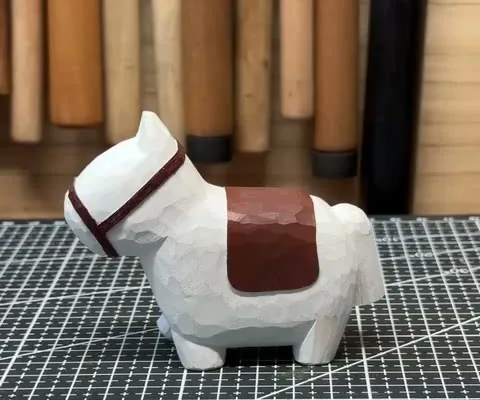
This small carved horse is finished the plain way. The knife facets are left showing along the neck and body, the coat is painted white, and a brown patch marks the saddle with a dark red band for the bridle. Nothing about it is polished, and that’s part of the appeal.
If I were choosing one, I’d look at the legs and the set of the head before the paint. In my own Taoist pictures horses mostly appear as mounts, and the legs are where I go wrong most often, because a horse standing on four stiff posts looks like a table.
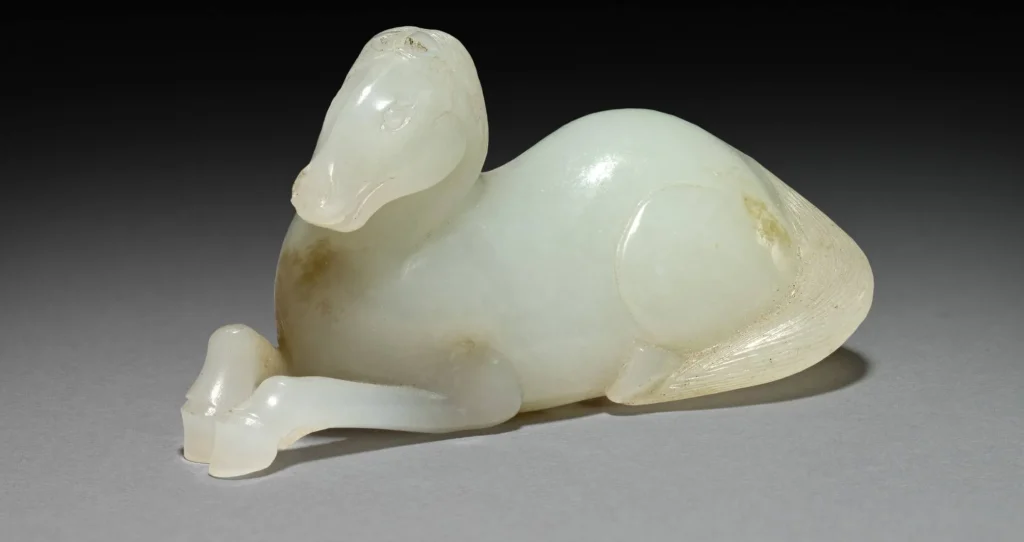
Posture carries its own reading. A galloping horse suits the ma dao cheng gong wish, while a horse lying down with its head turned back, a pose often seen in jade, is calmer and suits a desk or a shelf.
Year of the Horse FAQ
1 min read
Is 2026 the Year of the Horse? Yes. 2026 is a Fire Horse year, bingwu (丙午), and it runs from February 17, 2026 to February 5, 2027. The dates follow Chinese New Year, so a baby born in January 2026 is a Snake, not a Horse.
Which years are Horse years? The Horse years since 1930 are 1930, 1942, 1954, 1966, 1978, 1990, 2002, 2014 and 2026, and the next is 2038. They fall twelve years apart because twelve animals take turns, and each one starts on Chinese New Year instead of January 1.
What zodiac animal goes with May 31, 1978? May 31, 1978 is an Earth Horse birthday. That Horse year ran from February 7, 1978 to January 27, 1979, so a late-May date falls well inside it. The stem that year was Wu (戊), Earth, a different character from the branch Wu (午).
What does the Horse symbolize in Chinese culture? The Horse stands for speed, energy and quick success. Its branch, Wu, marks noon and midsummer, the peak of yang, and its name gives the pun ma shang, “right away”, which is why coins and monkeys get placed on a horse’s back.
Who is the Horse compatible with? In the traditional charts the Horse matches best with the Tiger and the Dog, its triple-harmony partners, and with the Goat, its six-harmony partner. The Rat is the clash sign. A chart describes types, not people, so treat it as lore for fun.
When is the next Year of the Horse? After 2026, the next Horse year begins on February 4, 2038 and ends on January 23, 2039. Its stem and branch are wuwu (戊午), so 2038 is an Earth Horse, sixty years after the Earth Horse of 1978.
The Horse is the zodiac’s noon: Fire, summer and a wish that good things arrive right away. You’ll find the other eleven animals and the festivals they travel with from the Zodiac & Tradition home page.
Key terms in this guide
Full glossary →Related topics at this level
- Year of the RabbitRabbit years include 1999, 2011 and 2023, and the next begins February 8, 2035. Dates, five elements, traits, matches and the Jade Rabbit in the moon.
- Year of the DragonDragon years are 1988, 2000, 2012 and 2024, and the next starts January 28, 2036. Dates, five elements, traits, matches and the Longtaitou festival.
- Year of the SnakeSnake years are 1929 to 2025, and the next starts February 15, 2037. Exact dates, the five element Snakes, traditional traits and matches, and snake legends.
- Year of the GoatGoat years include 1991, 2003 and 2015; the next starts February 6, 2027. Dates, the five Goats, sheep or ram, traits, matches and san yang kai tai.
- Year of the MonkeyMonkey years include 1992, 2004 and 2016, and the next opens January 26, 2028: dates, the five Monkeys, traits, matches and the Hou pun.
- Year of the RoosterRooster years are 1981, 1993, 2005 and 2017, and the next begins February 13, 2029. Dates, five elements, traits, matches and the da ji da li pun.
More topics
- Chinese ZodiacThe 12 Chinese zodiac animals in order, how to find your sign and element from your birth date, and what the zodiac hours, months and clashes mean.1 guide
- Year of the RabbitRabbit years include 1999, 2011 and 2023, and the next begins February 8, 2035. Dates, five elements, traits, matches and the Jade Rabbit in the moon.
- Year of the DragonDragon years are 1988, 2000, 2012 and 2024, and the next starts January 28, 2036. Dates, five elements, traits, matches and the Longtaitou festival.
- Year of the SnakeSnake years are 1929 to 2025, and the next starts February 15, 2037. Exact dates, the five element Snakes, traditional traits and matches, and snake legends.
- Year of the GoatGoat years include 1991, 2003 and 2015; the next starts February 6, 2027. Dates, the five Goats, sheep or ram, traits, matches and san yang kai tai.
- Year of the MonkeyMonkey years include 1992, 2004 and 2016, and the next opens January 26, 2028: dates, the five Monkeys, traits, matches and the Hou pun.
- Year of the RoosterRooster years are 1981, 1993, 2005 and 2017, and the next begins February 13, 2029. Dates, five elements, traits, matches and the da ji da li pun.