Chinese New Year’s Calendar: Lunar Months and 2027 Dates
By Daozhang MaMaoshan Taoist, Jintan, Jiangsu

In short
How does the Chinese New Year’s calendar work, and why won’t its New Year stay on one date? It’s the traditional Chinese lunisolar calendar: every month starts on a new moon, a year holds 12 or 13 of those months, and the extra month keeps the count in line with the sun. An ordinary year runs about 354 days and a leap year about 384. The next New Year’s Day on this calendar is February 6, 2027.
I pick dates from this calendar for people who come up to Maoshan, so I read it page by page, not only at the holiday. I’ll start with how the months get built, then go through the leap months up to 2033, the two points where a year turns over, and what each line on a household tear-off page is telling you.
How the Chinese New Year’s calendar builds a year from big and small months
A Chinese calendar month begins on the day of a new moon, counted on Beijing time, and the moon needs about 29.5 days to come back around. A calendar can’t hand out half a day, so each month gets either 29 or 30. Almanacs call a 30-day month big (大) and a 29-day month small (小), and they print that word right in the month’s heading.
No fixed pattern decides which is which, the way January always gets 31 days. Each new moon is calculated, and the big and small months fall where they fall. Two big months can sit side by side, as the second and third months did in 2021.
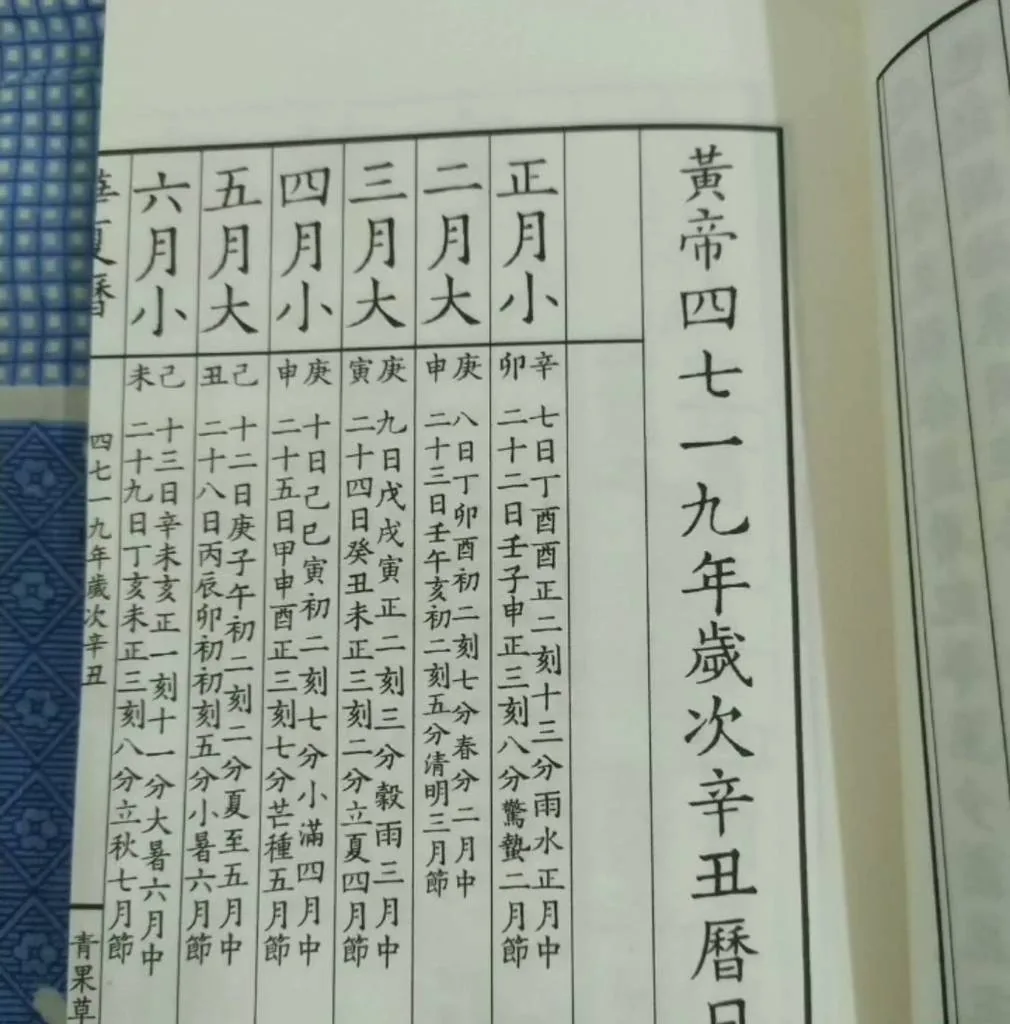
That 2021 book isn’t an official almanac, so I went through all 12 of its headings against the Hong Kong Observatory’s conversion tables. Every one matched: six big months, six small ones, and a closing line that gives the total in large characters.
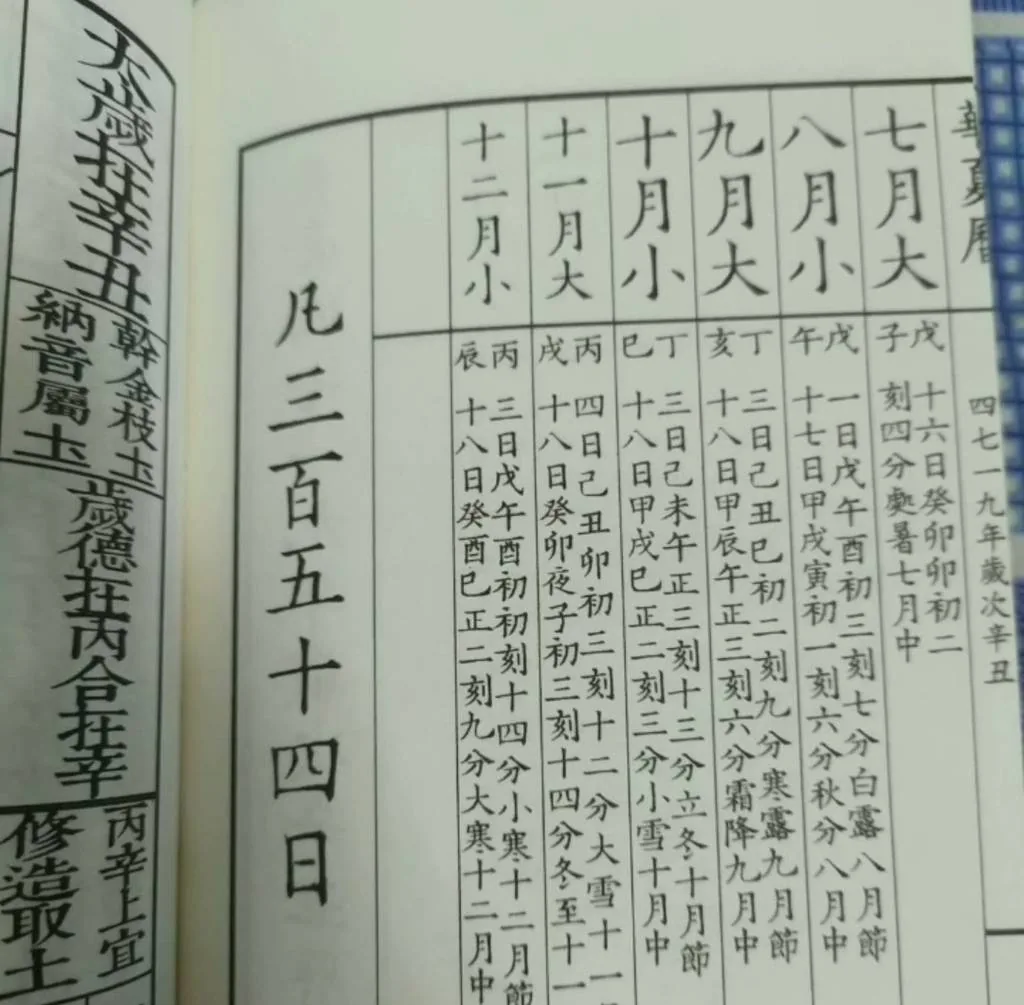
The sun enters through the 24 solar terms, markers on its yearly path that come about 15 days apart. Every other one is a principal term (zhongqi, 中气), and the winter solstice is the one that anchors everything: it has to fall in the 11th month. Count forward from there and the 12th month comes next, then the first. That’s why New Year usually lands on the second new moon after the solstice. My Lunar New Year guide picks up from that day and covers what families actually do with it.
Why leap months appear in the Chinese calendar, and where the next ones fall
Twelve big and small months come to about 354 days, while the sun’s year runs about 365, so the calendar drops 11 days behind every year. A leap month pays that back, roughly seven times in 19 years. When the stretch from one 11th month to the next holds 13 months instead of 12, the first month without a principal term becomes the leap month. It borrows the name of the month before it, and the months after it carry on as usual.
The year 2020 shows the rule at work. Grain Buds, a principal term, came on May 20, and the summer solstice came on June 21. The month between them, May 23 to June 20, held neither, so it became the leap fourth month.
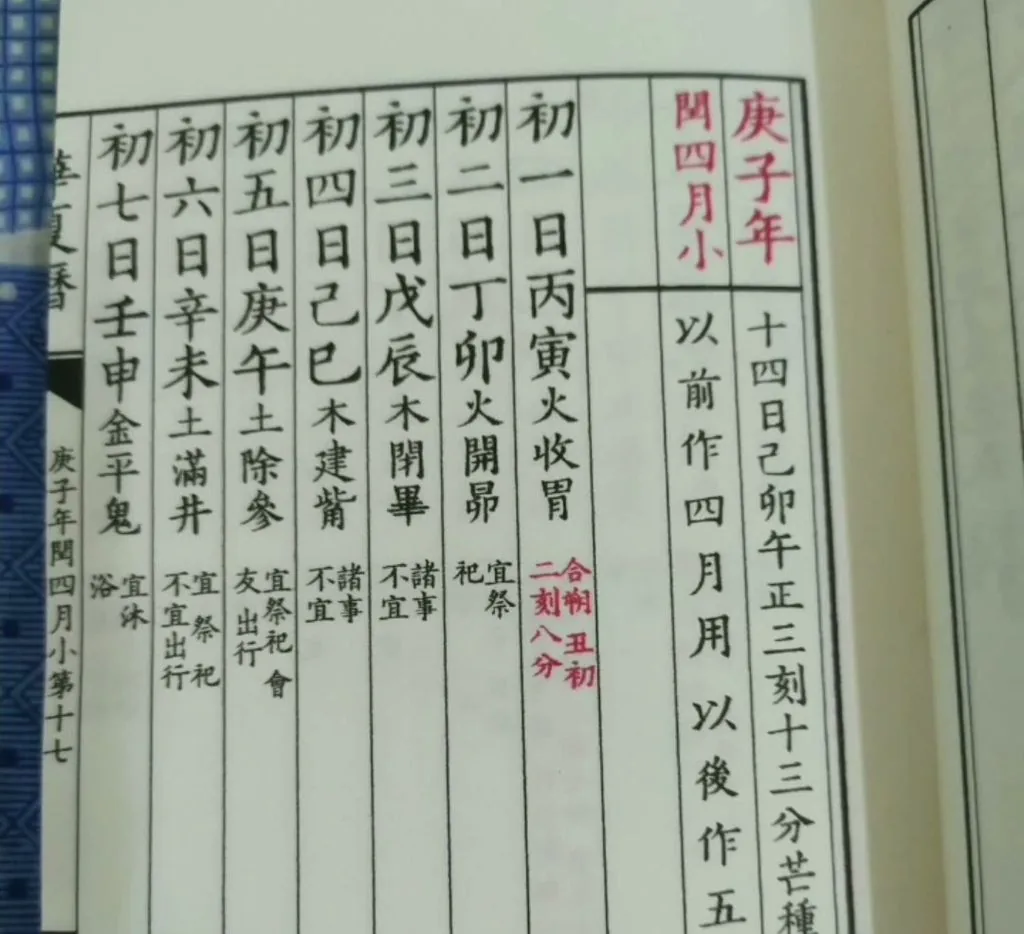
That side column is a practical note for anyone choosing days. Grain in Ear, a lesser solar term, fell on the 14th day of the leap month, June 5, so the almanac splits the month at that point.
Leap months are also why a year’s length swings by a whole month. Here is every lunar year from 2025 through 2033, with dates from the Hong Kong Observatory’s tables. I also compared the New Year dates against a second published list, and they agree.
| Lunar year | Starts | Length | Leap month |
|---|---|---|---|
| Wood Snake | January 29, 2025 | 384 days | Leap 6th, from July 25, 2025 |
| Fire Horse | February 17, 2026 | 354 days | None |
| Fire Goat | February 6, 2027 | 354 days | None |
| Earth Monkey | January 26, 2028 | 384 days | Leap 5th, from June 23, 2028 |
| Earth Rooster | February 13, 2029 | 355 days | None |
| Metal Dog | February 3, 2030 | 354 days | None |
| Metal Pig | January 23, 2031 | 384 days | Leap 3rd, from April 22, 2031 |
| Water Rat | February 11, 2032 | 355 days | None |
| Water Ox | January 31, 2033 | 384 days | Leap 11th, from December 22, 2033 |
The last row is the one I’d circle. A leap month that late in the year is rare, and this one begins the day after the solstice of December 21, 2033. With an extra month sitting between the solstice and the holiday, New Year then falls on the third new moon after it, February 19, 2034, which is why “usually” has to stay in that rule of thumb.
If 2027 is the year you’re planning around, my Chinese New Year 2027 page sets out that one season day by day.
Two year boundaries in the Chinese calendar: New Year and Lichun
The animal names in that table change on New Year’s Day, but an almanac keeps a second line where the year turns. Lichun (立春), the Beginning of Spring, is the solar term that comes around February 4, and almanacs and birth charts start the year there. For most people that only matters with a birthday in January or early February, and the chart of Chinese zodiac years gives the lunar cutoff for each year.
Since New Year moves and Lichun barely does, some lunar years miss Lichun altogether. The Goat year runs from February 6, 2027, to January 25, 2028, so it slips between the Lichun of February 4, 2027, and the one on February 4, 2028. Folk custom calls that a no-spring or widow year, and some families won’t hold a wedding in one. The Monkey year after it catches two, on February 4, 2028, and February 3, 2029, and that double spring gets called lucky for marriage.
I expect questions about this all through 2027. My answer to couples doesn’t change much: I’d rather look at the actual day they’ve picked than judge them by a label on the whole year.
Each year also carries a name from a separate 60-year cycle of paired characters, a heavenly stem and an earthly branch. That’s where geng-zi (庚子) for 2020 and xin-chou (辛丑) for 2021 come from, and the branch is the part that supplies the animal: zi for Rat, chou for Ox.
How to read a tear-off Chinese calendar page, line by line
All of those rules come already worked out on the calendar most homes actually hang up, the tear-off block with one page per day. People often call it a wannianli (万年历), a perpetual calendar, and that’s the wrong word. A perpetual calendar covers many years, while this lasts one, so the right name is lao huangli (老黄历), the old almanac. It’s the daily cousin of the tongshu (通书), the yearly almanac in book form.
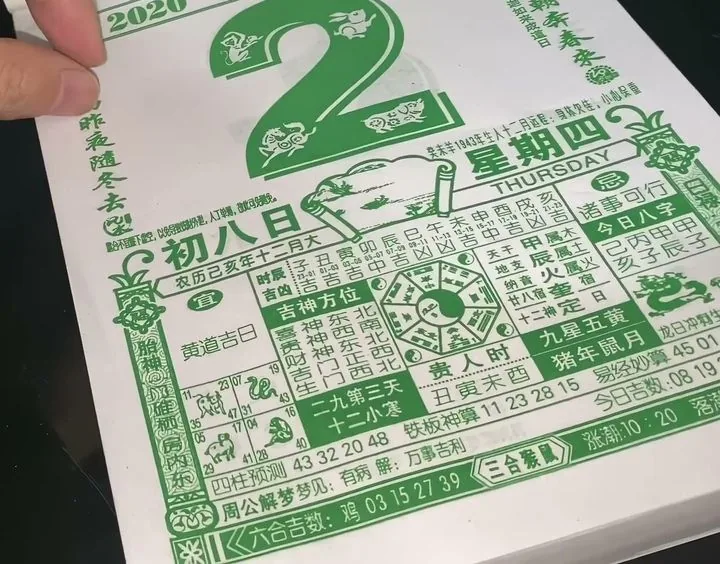
Most blocks crowd the same set of details onto a page, so you only need to learn the layout once:
- The big numeral is the solar date, with the Western year nearby and the weekday to its right.
- The lunar line gives the day of the lunar month, then the year’s name and whether the month is big or small.
- Good for and avoid (宜 and 忌) say what the day suits, or that all matters are permitted.
- The hour row marks each of the 12 two-hour periods as lucky or unlucky.
- The direction box shows where the gods of joy and wealth sit that day.
- The animal tag names the year and the month, such as Pig year, Rat month.
That animal tag holds a small surprise. The page for January 2, 2020, says Rat month and the page for January 24 says Ox month, though both sit inside the same lunar 12th month. The tag follows the solar terms, and it changed at Minor Cold on January 6, so one block is quietly running two kinds of month at once.
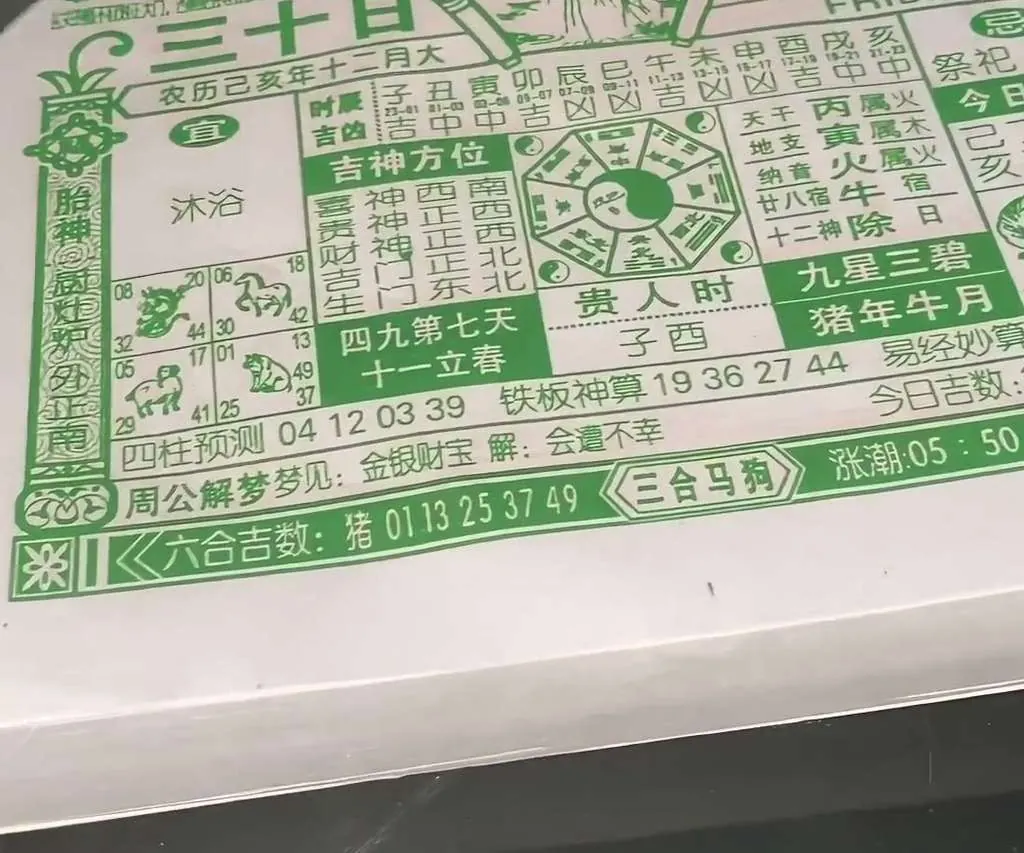
The page to turn to at New Year is the last one of the old year. In that block it was January 24, 2020, the 30th of a big 12th month, and New Year’s Day came the next morning. A small 12th month stops at the 29th, as the next one will on February 5, 2027.
What a 2027 Chinese calendar covers, and how to check its dates
Reading a page is one thing, and buying the right block is another, because a tear-off follows the solar year and not the lunar one. A 2027 block opens on January 1 in the last weeks of the Horse and turns to the Goat on February 6. It ends on December 31, the fourth day of the 12th lunar month, so the Goat’s final weeks are in the 2028 block. Many Chinese grocery stores in the US stock these toward the end of the year.
The pages above come from 2020 and 2021 books, and I’m not showing a 2027 copy here. The way to read one doesn’t change, though. I keep a tear-off on the wall and a tongshu on the desk: the block tells me the day at a glance, and the book gives me the whole year when someone asks about a date months away.
When a date really matters, check it somewhere public. The Hong Kong Observatory’s yearly tables are free, and each one marks the first day of every lunar month. China’s own rules for the calendar sit in a national standard, GB/T 33661-2017. For a festival, the lunar date is the fixed part, and my Chinese festivals calendar lists each one with its lunar date and its 2027 date. The rest of the zodiac and festival pages are on the Zodiac and Tradition home page.
FAQ about the Chinese New Year’s calendar
Is the Chinese calendar lunar or solar? The Chinese calendar is both. Months follow the moon, while the solar terms and leap months hold the year to the sun, which is why it’s called lunisolar.
How many days are in a Chinese calendar year? From 2025 through 2033, an ordinary Chinese calendar year has 354 or 355 days and a leap year has 384. Over longer spans you’ll also meet 353, 383 and 385.
Does China still use the Chinese calendar? China runs daily life and business on the Gregorian calendar. The Chinese calendar still sets the traditional festivals, including Spring Festival, and many families still use an almanac to pick days for weddings and moving house.
Written by

Daozhang MaMaoshan Taoist, Jintan, Jiangsu
Daozhang Ma is a Maoshan Taoist who has practiced for 22 years and is skilled at writing talismans and painting Taoist pictures. He runs Zodiac & Tradition.
About Daozhang Ma