Red Decorations for Chinese New Year: Outdoor and DIY Ideas
By Daozhang MaMaoshan Taoist, Jintan, Jiangsu
In short
A Chinese New Year home goes red in seven ways: couplets on the door posts, fu characters on the door, door gods on the gate, lanterns overhead, paper-cuts, Chinese knots and the small blessing strips that reach the rest of the yard. Red stands for joy and good fortune, and the old story says the beast Nian feared it. A folk rhyme sets the pasting for the 28th day of the 12th lunar month, which is February 4, 2027, though many families wait for the afternoon of New Year’s Eve.
For the Chinese name and meaning of every piece, start with the full list of Chinese New Year decorations. This page stays with the red itself: why it’s used, how it looks on a real gate, what you can make at home and what lasts outdoors, plus the little strips I rarely see explained in English.
Why Chinese New Year decorations are red, and when families skip it
Red does three jobs at once at New Year. In the five-element scheme it belongs to fire, so it reads as warmth and rising energy. In everyday life it’s the color of weddings, births and shop openings. And in the Nian story it’s a weapon, because the beast was driven off by red, fire and noise.
I come at it from a different side. I write charms in cinnabar, a red mineral ink, on yellow paper, and in that work the red strokes carry the meaning while the paper only holds them. So when a doorway goes red I don’t just see something pretty. I see a household drawing a line at its threshold, though plenty of my neighbors would simply tell you it looks cheerful.
The exception matters if you’re decorating for someone else. Families in mourning traditionally leave red couplets off the door for a period, and some regions use white, blue or yellow paper instead. How long that lasts varies from place to place, so ask the family before you show up with a roll of red.
Red couplets and banners frame every door
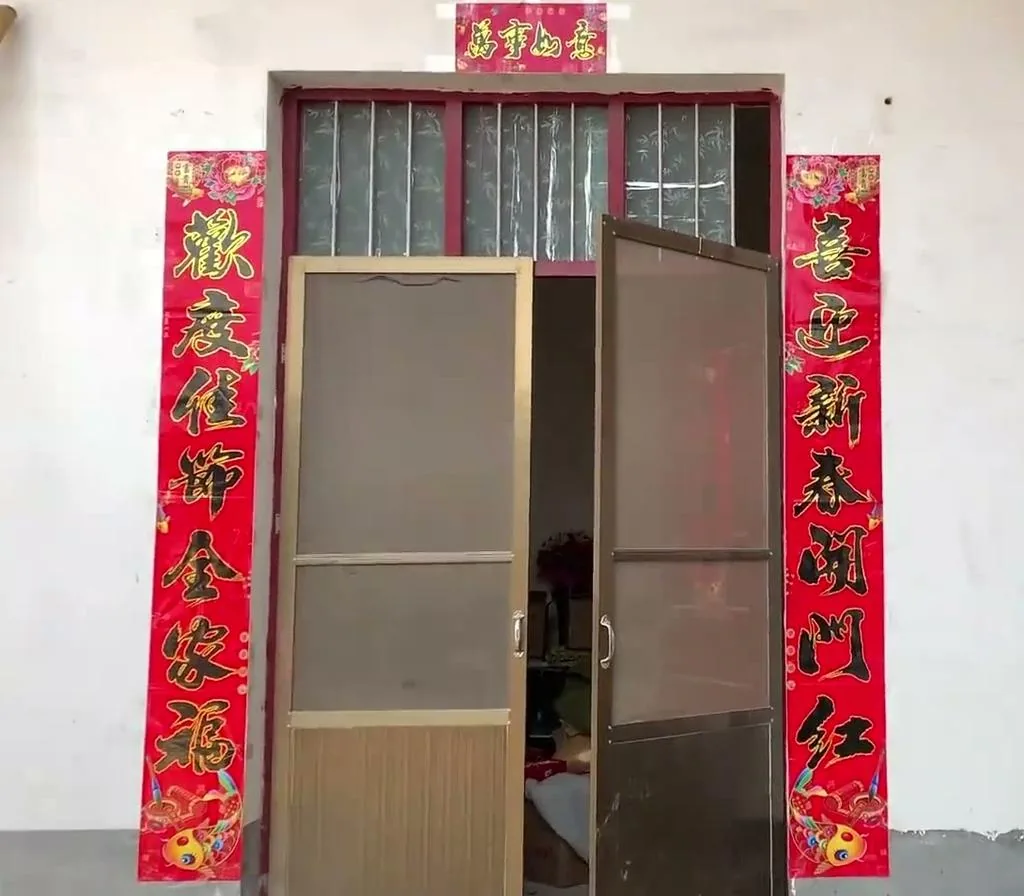
That line at the threshold starts with couplets, the tallest red thing on any house. A set is two long vertical lines for the door posts plus a short horizontal banner above the frame. Printed sets usually run black characters edged in gold on a red ground, with flowers at the ends.
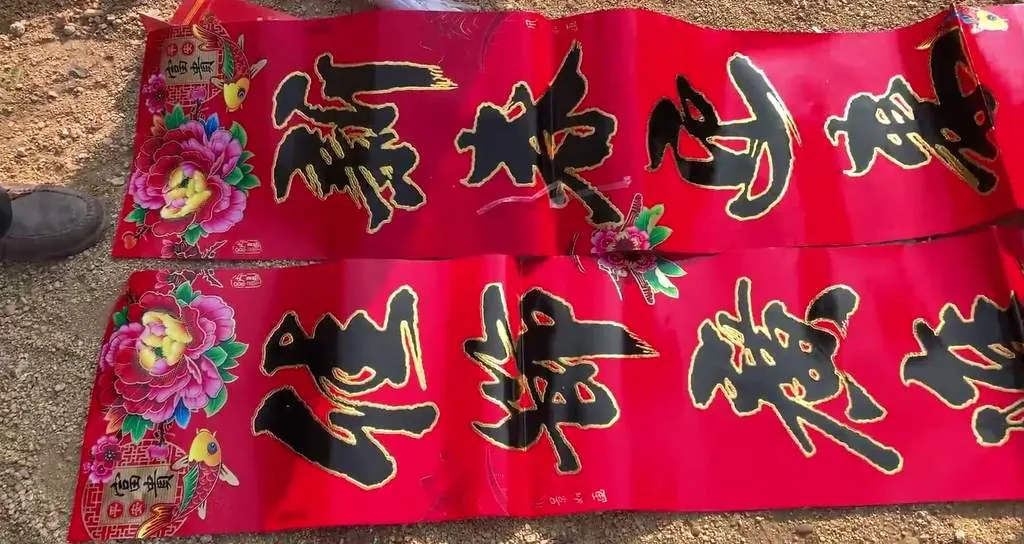
Village households used to write their own and now mostly buy them ready-made, and the glue changed along with the brushwork. Couplets once went up with flour paste stirred on the stove. Today a roll of clear tape does the job, and it’s what I’d use on a painted American door too, since cooked paste is a chore to scrape off in spring.
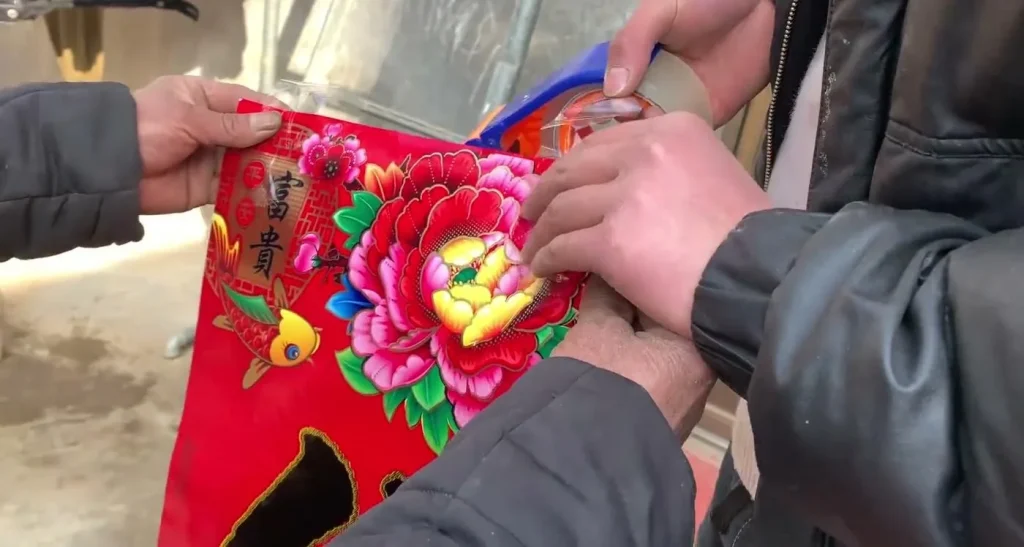
Every door that counts gets its own set, so a courtyard house needs at least two, one for the gate and one for the house door. The second set is often simpler. Hanging your own raises two more questions, which line goes on which side and what gets taped first, and how to put up spring couplets answers both.
Red fu characters on the gate leaves
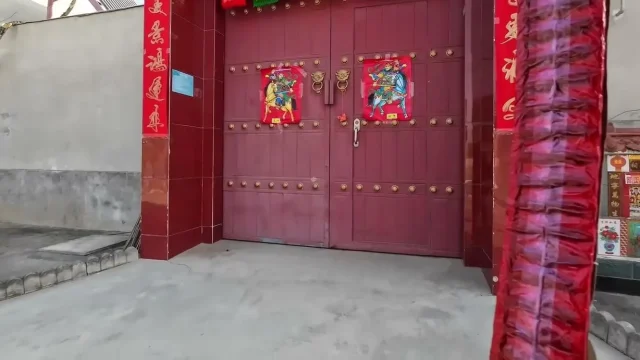
Once the posts are covered, the flat faces of the gate are still bare, and that’s where the fu character (福, “good fortune”) goes. On a double gate it’s usually a pair, one on each leaf at about eye level. The square is turned onto its point, which makes a red diamond that shows up well from the road.
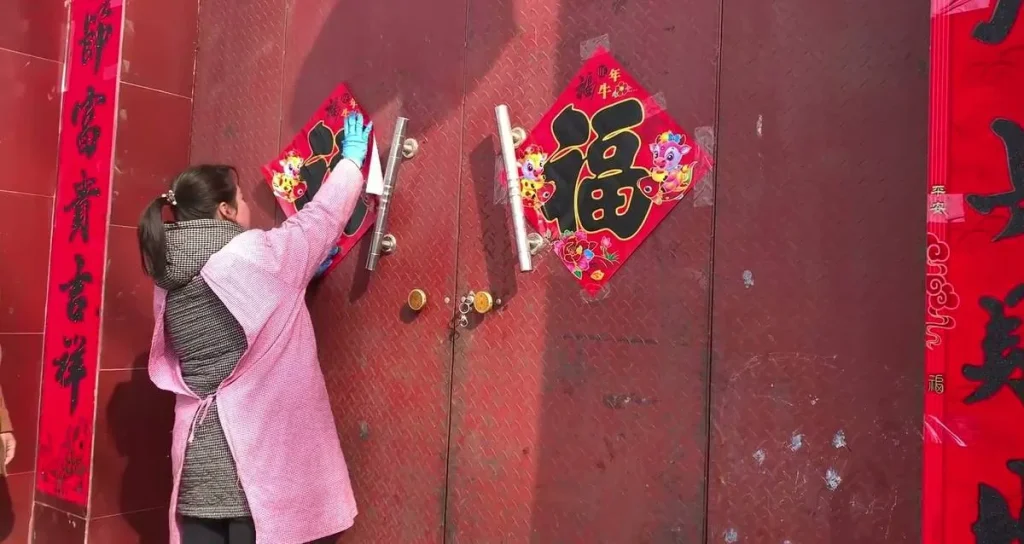
Both of those are upright, and that’s the safe choice for a main gate. An upside-down fu mostly belongs on inner doors, for reasons laid out in the Lunar New Year guide.
Door gods and lanterns finish the red gate
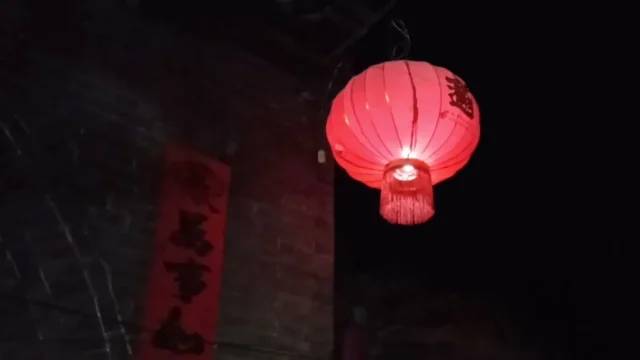
A gate with couplets and fu is nearly done, and the last touches go overhead and on the leaves. A red lantern at each upper corner pulls the eye up, so the frame reads as one red shape from across the lane. That’s the difference between a door with some paper on it and a gate that’s been dressed.
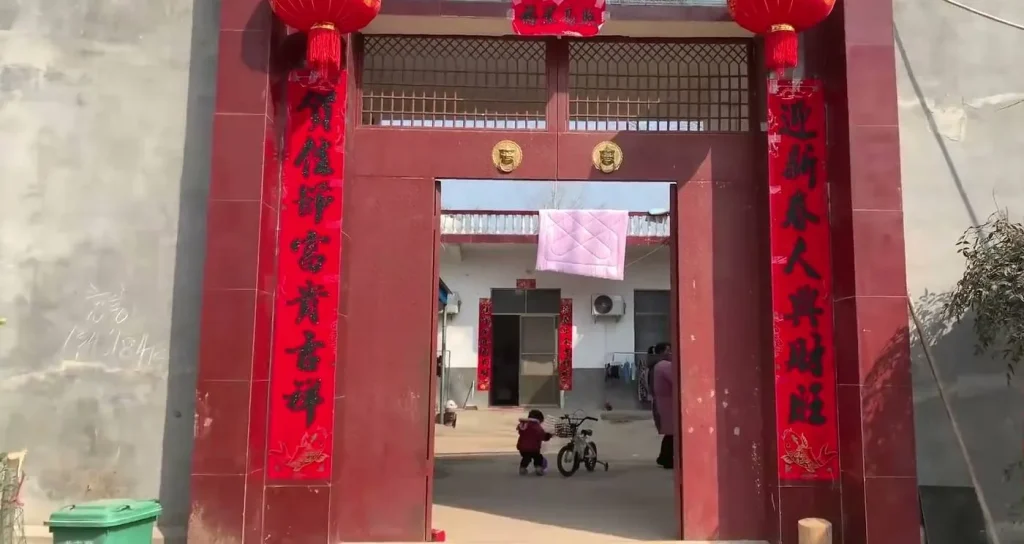
Why there are two of them, and which night they’re first switched on, comes down to the customs around red lanterns at the gate.
Door gods are the one piece here that isn’t mostly about the color. The print below has no name on it, so I can’t tell you who the two riders are meant to be. I read them as door gods from the way they’re drawn and used: two armored men on horseback, facing each other, on a sheet taped up on a door. Higher up, the same sheet carries printed wishes for safe comings and goings and for quick success.
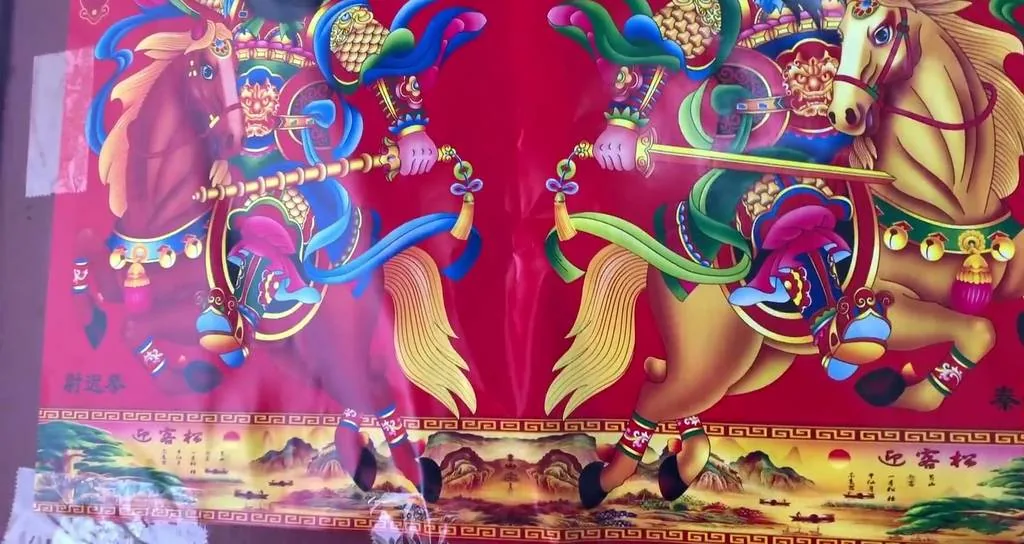
Red here is only the background, and the figures do the guarding. That’s why I’d keep a print like this on the main gate or the back door and never use it to fill a blank wall.
Red paper lanterns for beams and porches
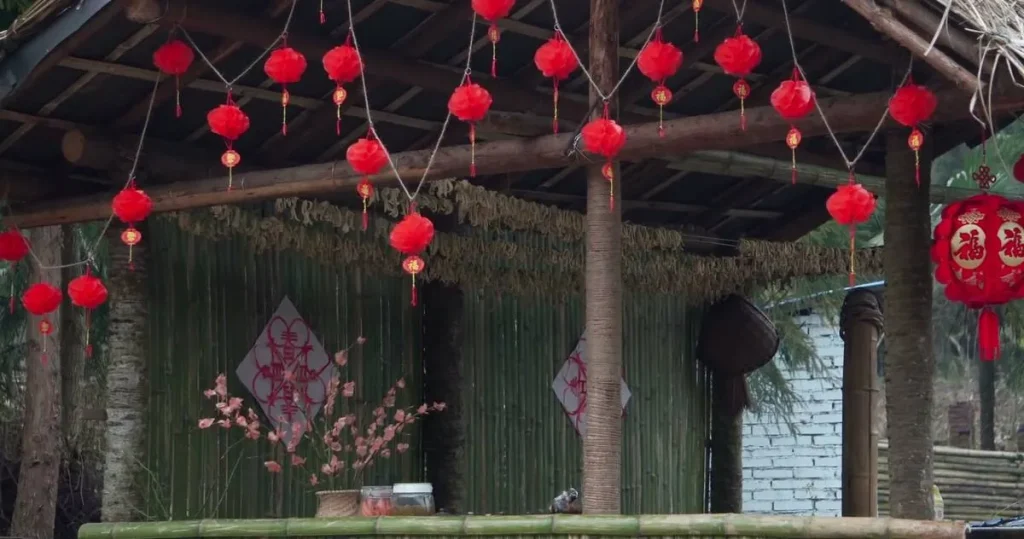
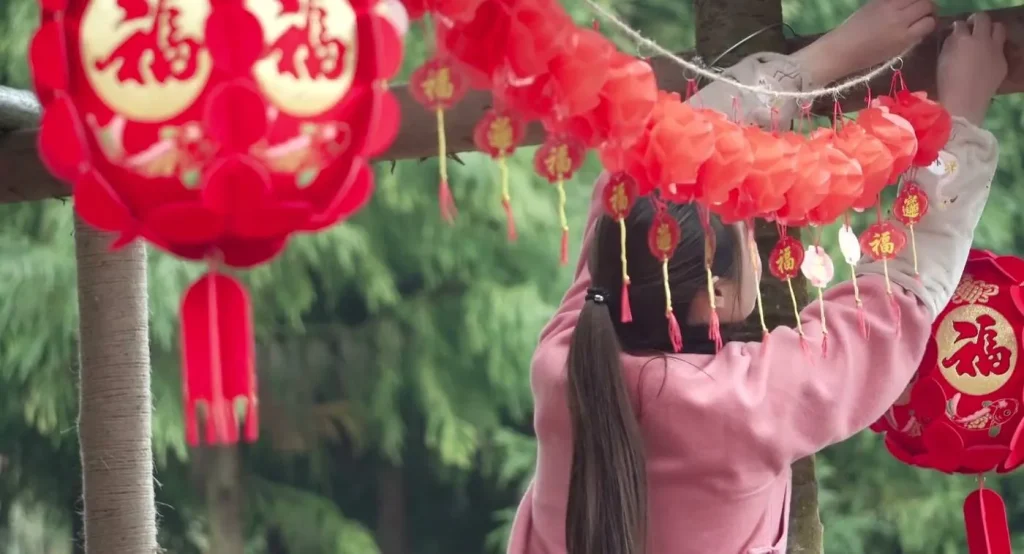
Away from the gate, the red gets lighter and cheaper. Honeycomb paper lanterns on a cord are the easy way to fill a beam or a porch, and each one usually has a small Fu tag and a thin tassel hanging below it.
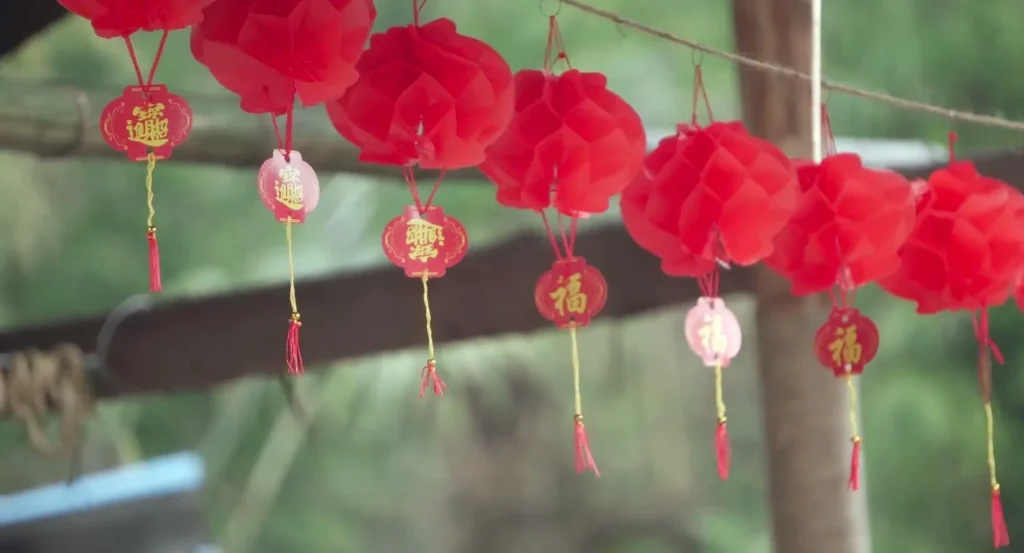
A round Fu lantern breaks up the row. One or two big ones among the small lanterns give you a focal point, and you can tie the whole lot to a beam with ordinary string. Tags and lanterns are all paper, though, so they need a roof over them.
DIY red decorations: paper-cuts and Chinese knots
Lanterns are easiest to buy, while a paper-cut is the red piece most worth making at home. I buy the ones for my own windows and don’t cut them, so take this as the household method rather than my bench notes. All it needs is thin paper, a pencil and sharp scissors.
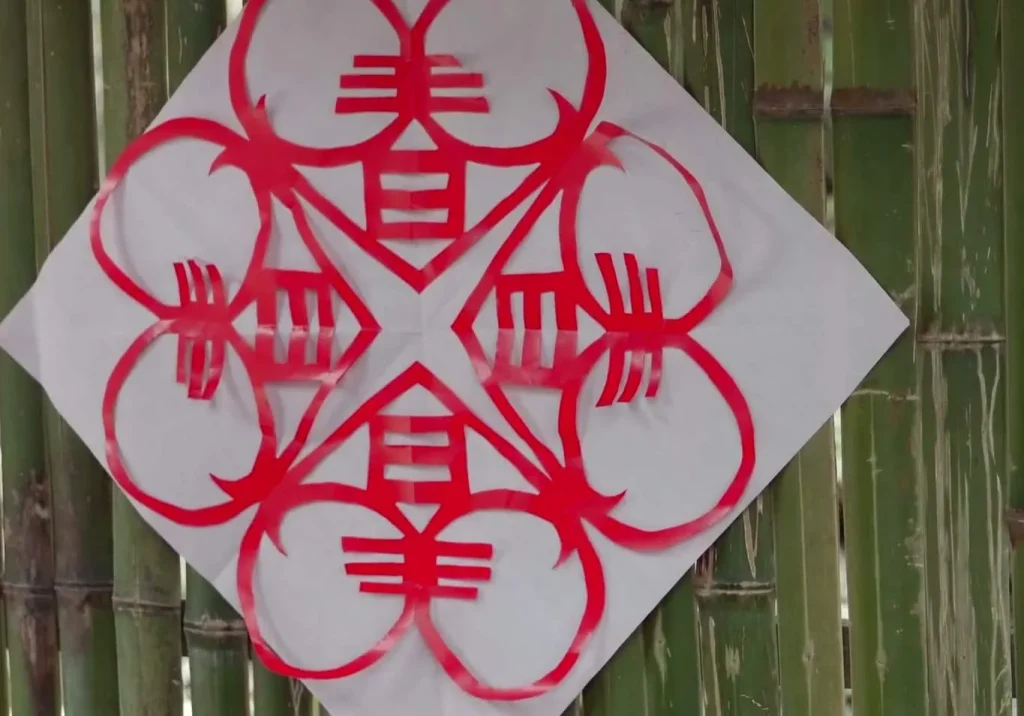
- Fold a square of thin paper corner to corner into a triangle, then in half, then in half again, until you’re holding a narrow triangle. A sheet about 12 inches (30 cm) across is my estimate of a comfortable size.
- In pencil, draw only half of the pattern, with the middle of the character on a folded edge. Each half opens into a whole character, which gives the four repeats shown below, while a full character drawn here would come out as eight. Keep every part connected to a fold or it will fall away.
- Cut along the pencil lines, then open the paper flat.
- Paste the cut onto a white paper square turned to a diamond, so the red stands out.
- Stick the diamond to a window or a wall. Bamboo, wood or brick all work once the white backing is on.
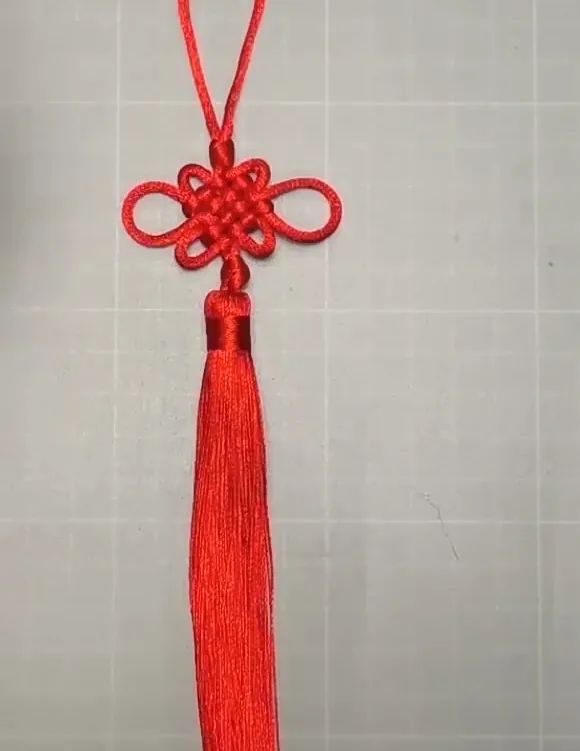
Chinese knots take more patience. The red one below is a two-loop panchang knot, er hui pan chang jie (二回盘长结), named for its coiled, unbroken line. Three-loop and four-loop versions exist and get a lot harder, so the two-loop is the place to begin. If you’d rather buy one, a red knot with a long tassel suits a hook by the door.
Small red blessing strips for the rest of the yard
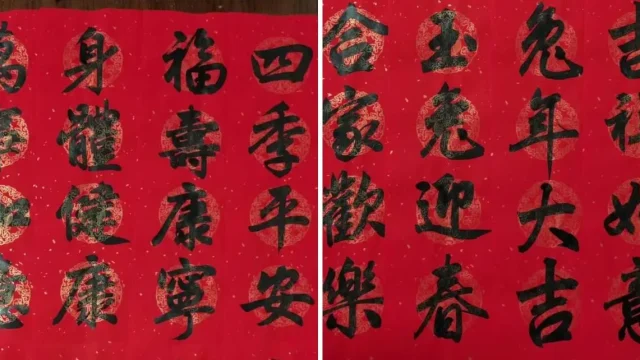
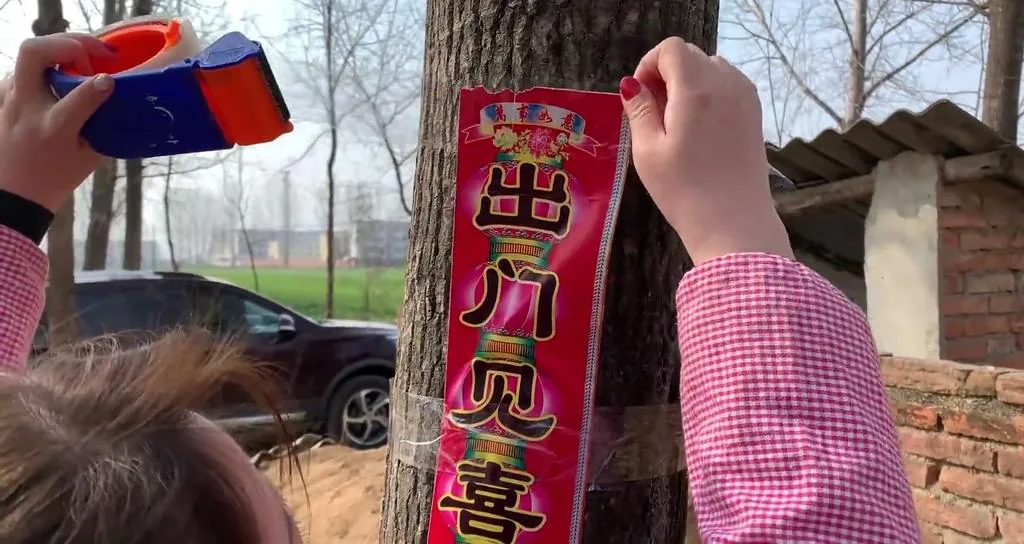
Couplets and knots dress the doors, but a village yard has plenty more that deserves a wish, and that’s what the small strips are for. One Chinese name for them is chuntiao (春条), “spring strips.” They carry four characters each, and you put each one wherever its words make sense.
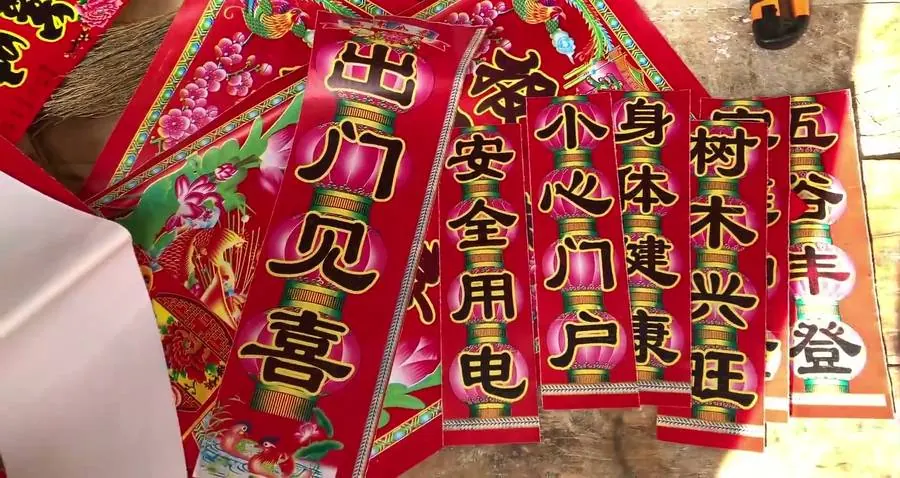
| Strip | Meaning | Natural spot |
|---|---|---|
| 出门见喜 chu men jian xi | Joy on stepping out the door | Outside the gate |
| 身体健康 shen ti jian kang | Good health | The parents’ room |
| 安全用电 an quan yong dian | Use electricity safely | Beside a socket |
| 小心门户 xiao xin men hu | Mind the door | The door itself |
| 树木兴旺 shu mu xing wang | Thriving trees | A tree in the yard |
| 五谷丰登 wu gu feng deng | A plentiful harvest | Where the grain is kept |
Nobody polices those spots. The strip shown below went on a tree outside the gate even though the pack had one that names trees. The electricity strip is my favorite, a New Year blessing that doubles as a safety notice.
Bark is the awkward surface. Tape won’t grip it, so run the tape all the way around the trunk until it sticks to itself. A strip looks about 3 to 4 inches wide (8 to 10 cm), going by the hand beside one, so a single loop near the top is plenty.
An American house can borrow the idea without a village yard. If you can’t find printed strips, cut red paper to size, write the wish by hand or print it, and put one by the garage door, the fridge or the mailbox.
Outdoor red decorations for Chinese New Year: what holds up
Strips on a tree are the extreme case, because everything outside takes weather. Red paper outdoors is meant to wear out, and the household simply replaces it next year. It’s still worth knowing which pieces need shelter.
- Couplets and fu: these can face the weather, and they’ll fade by summer. An overhang helps.
- Paper lanterns and tags: keep them under a porch roof, since the first rain will ruin them.
- Fabric or nylon lanterns: these are the ones to choose for an open yard.
- Lit lanterns: check that the cord and bulb are rated for outdoor use.
- Chinese knots: tassels fade and fray, so keep the good ones indoors or under cover.
Wind does more damage than rain where I live. On Maoshan a February gust gets under any loose corner, so I tape all four edges of a couplet instead of just the top and bottom. A flapping corner is always the first thing to tear.
When the red goes up, and in what order
The rhyme I mentioned at the top goes er shi ba, tie hua hua (二十八,贴花花), “on the 28th, paste the flowers.” In 2027 that’s February 4. Plenty of families stick with New Year’s Eve instead, which is February 5. Either way, the job takes one household most of a day, and here’s the order one village courtyard followed:
- Unroll the couplets and check the set.
- Get the ladder out and hang the lanterns at the top of the gate.
- Put up the banner, then the gate couplets and the fu. That’s this household’s order; other families hang the banner last, as the couplets guide linked above does.
- Move on to the house door and do its couplets and banner.
- Finish with the small strips around the yard.
I like that order because the ladder work is over early and the fiddly bits come last, when there’s more help around. Lanterns and knots come down after the Lantern Festival on February 20, 2027, while the paper stays until it fades, so next year’s red goes over the same spot.
Written by
Daozhang MaMaoshan Taoist, Jintan, Jiangsu
Daozhang Ma is a Maoshan Taoist who has practiced for 22 years and is skilled at writing talismans and painting Taoist pictures. He runs Zodiac & Tradition.
About Daozhang Ma