Zodiac · Topic guide
Year of the Ox: Chinese Zodiac Years, Elements, Traits
Ox years are 1973, 1985, 1997, 2009 and 2021, and the next begins January 31, 2033. Dates, five elements, traits, matches and the spring ox custom.
By Daozhang Ma Published
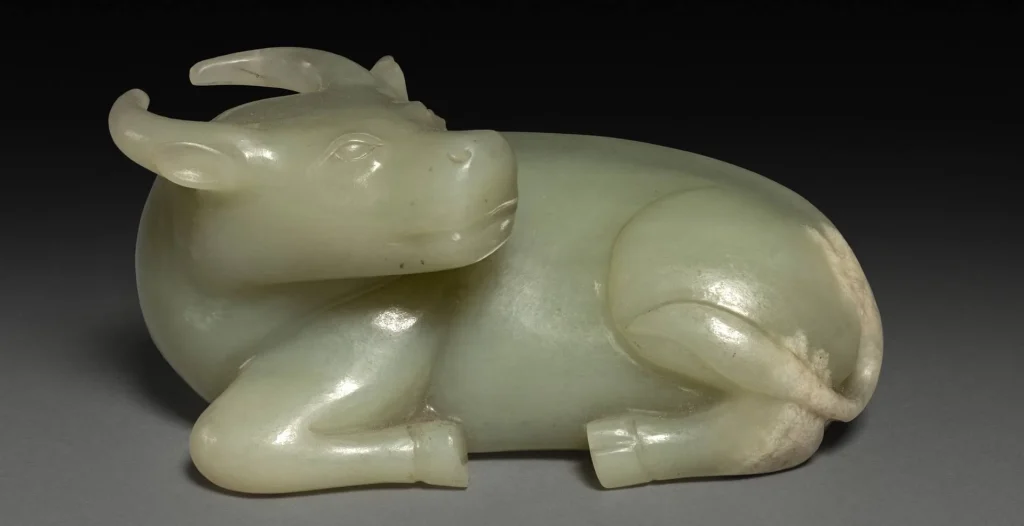
In short
The Year of the Ox comes second in the Chinese zodiac, one place behind the Rat and one ahead of the Tiger. It last came round in 2021, and before that in 2009, 1997, 1985 and 1973. You’ll wait until January 31, 2033 for the next, which lasts to February 18, 2034.
February 12 was the first day of the 2021 Ox year, and anyone born earlier that winter is a Rat. The line moves every year because it follows Chinese New Year. Five elements also take turns with the animal: 2021 was a Metal Ox year, 2009 an Earth Ox, and 2033 will be a Water Ox.
The dead of night, 1 a.m. to 3 a.m., and the twelfth lunar month at the tail of winter share one calendar sign with the Ox. That sign is the earthly branch Chou (丑), counted as yin Earth.
The rest of this page goes through the five kinds of Ox, the signs it gets along with, its Tai Sui years, and the sayings and the old spring custom that grew up around the plow ox. The character sketch comes from traditional readings, which describe Ox-born people as steady, dependable and stubborn, and it’s lore that I share for entertainment.
Daozhang MaMaoshan Taoist, Jintan, Jiangsu
The guide · 9 chapters
Year of the Ox Dates, 1925 to 2033
1 min read · 1 table
January 24, 1925 is where my table starts and February 18, 2034 is where it stops. Between those two days sit ten Ox years, twelve years apart, and each row shows the Chinese New Year’s Day that opened the year and the New Year’s Eve that closed it.
The Ox is one of the twelve animals of the Chinese zodiac, and the same 120-year span for all twelve is laid out in my Chinese zodiac years chart.
| Ox year | Starts | Ends | Element | Stem and branch |
|---|---|---|---|---|
| 1925 | January 24, 1925 | February 12, 1926 | Wood | 乙丑 yichou |
| 1937 | February 11, 1937 | January 30, 1938 | Fire | 丁丑 dingchou |
| 1949 | January 29, 1949 | February 16, 1950 | Earth | 己丑 jichou |
| 1961 | February 15, 1961 | February 4, 1962 | Metal | 辛丑 xinchou |
| 1973 | February 3, 1973 | January 22, 1974 | Water | 癸丑 guichou |
| 1985 | February 20, 1985 | February 8, 1986 | Wood | 乙丑 yichou |
| 1997 | February 7, 1997 | January 27, 1998 | Fire | 丁丑 dingchou |
| 2009 | January 26, 2009 | February 13, 2010 | Earth | 己丑 jichou |
| 2021 | February 12, 2021 | January 31, 2022 | Metal | 辛丑 xinchou |
| 2033 | January 31, 2033 | February 18, 2034 | Water | 癸丑 guichou |
Look at 1985. Its February 20 start is the latest Chinese New Year anywhere in that 120-year chart, so most of February 1985 still belonged to the Rat, the sign that always runs the year before an Ox year. The Tiger takes over when each Ox year ends.
Born in January or Early February?
February 10, 1985 looks like an Ox birthday and isn’t one. Chinese New Year fell ten days later that year, so a child born that day is a Wood Rat. A child born on February 1, 1986 is a Wood Ox, because the 1985 Ox year kept going until February 8, 1986.
Only birthdays from January 21 to February 20 need this check, since Chinese New Year never falls outside those dates. My Chinese New Year zodiac calculator works the sign out from a birth date if you’d like to skip the table.
Bazi readers draw the line somewhere else. They change the year at Lichun (立春), the Start of Spring solar term, which falls on February 3, 4 or 5. By that count the February 10, 1985 baby is already a Wood Ox. The almanac I use for choosing dates prints the change of year on the Lichun line too. Both counts are in use and neither is wrong. Everyday talk, red envelopes and the tables on this site follow Chinese New Year.
What the Year of the Ox Means: Chou, the Small Hours and Late Winter
1 min read · 1 photo
The Ox stands for patient, heavy work, and it holds the second of the twelve places. Its branch, Chou, covers 1 a.m. to 3 a.m. and the twelfth lunar month, which by the solar terms runs from about January 6 to about February 3.
Chou is one of four Earth branches, and each of the four closes a season. Chou closes winter, which is why bazi writers call it cold, wet earth. On the compass it sits in the northeast.
The race story explains the ranking. In that legend the Ox was the steadiest swimmer and should have come first. The Rat crossed the river on the Ox’s back, jumped off at the bank and took first place, and the Ox had to settle for second.
Off the page, the ox was the animal that plowed. An old line puts it as “the ox plows the field, the horse carries the goods,” so the Ox came to stand for diligence and for carrying a load without fuss.
This bronze ox from the Qing dynasty is a mirror stand.
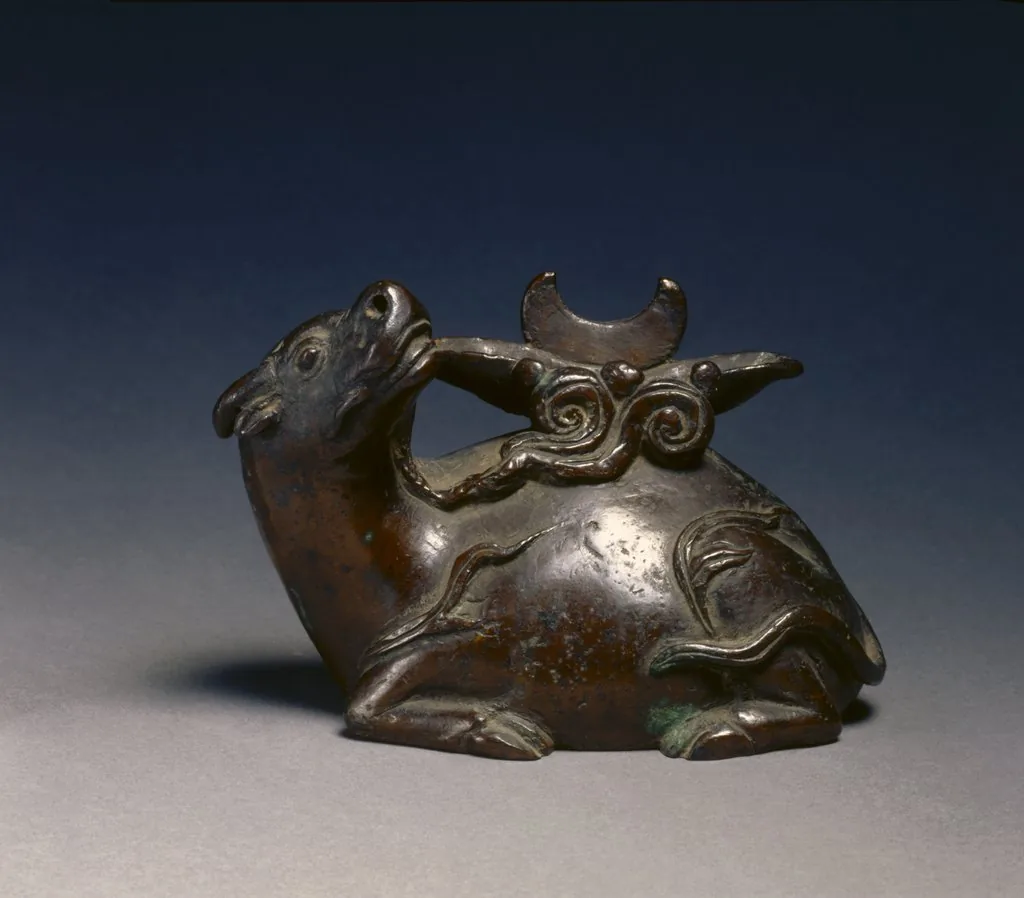
The ox lies with its legs folded under its body and its head raised and tipped back, and its mouth holds a bar that runs back to the scrolls. A crescent-shaped rest rises from its back above a band of curling scrolls, and the tail sweeps forward along the flank. The bronze has gone a dark reddish brown.
The Five Oxen: Wood, Fire, Earth, Metal and Water
1 min read · 1 table
An Ox year’s name is two characters long, and Chou (丑) is always the second. The first is a heavenly stem, and the stem is where the year’s element comes from. Xinchou (辛丑), for instance, is the Metal Ox, and it sits twice in the table above, at 1961 and at 2021. All five kinds of Ox are sixty years apart in the same way.
Only five of the ten stems ever stand in front of Chou: Yi, Ding, Ji, Xin and Gui. Stems and branches move forward one place a year, side by side, so odd always meets odd and even meets even. In the usual reckoning that leaves a yin branch such as Chou with the yin stems only, and a yang Ox year isn’t in the cycle.
| Kind of Ox | Stem | Years | Stem and branch |
|---|---|---|---|
| Wood Ox | Yi (乙) | 1925, 1985 | 乙丑 yichou |
| Fire Ox | Ding (丁) | 1937, 1997 | 丁丑 dingchou |
| Earth Ox | Ji (己) | 1949, 2009 | 己丑 jichou |
| Metal Ox | Xin (辛) | 1961, 2021 | 辛丑 xinchou |
| Water Ox | Gui (癸) | 1973, 2033 | 癸丑 guichou |
Chou’s own element is Earth whichever stem arrives. In a Jichou year, 1949 or 2009, the stem is Earth as well, so stem and branch match.
Yi is grass and climbing vines, Ding a lamp flame, Ji farmland, Xin jewelry, and Gui rain and dew. I pass that on as popular lore, shared for entertainment, and I wouldn’t lean on it.
Ox Personality in Traditional Readings
1 min read
Traditional readings describe Ox people as honest and down-to-earth, steady and patient, responsible, and true to their word. On the other side of the ledger, the same readings call them stubborn, rigid, and poor at showing what they feel.
One detail comes up again and again. An angry Ox is said not to argue but to go quiet and stay quiet.
All of that is a folk portrait, and I know of no research behind it. Bazi doesn’t stop at the birth year either: a chart has four pillars, for year, month, day and hour, and the Ox year fills only one of them. The same caution covers the matches and the Tai Sui section below. It’s traditional lore, and I share it for entertainment.
Ox Compatibility: Snake, Rooster, Rat and the Goat Clash
2 min read · 1 table
The Rat that beat the Ox in the race is, on the branch charts, the Ox’s closest partner, because Zi and Chou join in six harmony. The Snake and the Rooster complete the list of friends, and the Goat stands opposite as the clash sign. Your element makes no difference here, since the charts are built from the branches alone.
The grid for all twelve signs is on my Chinese zodiac compatibility page. The Ox’s own row looks like this.
| Relationship | Partner sign | What the tradition says |
|---|---|---|
| Triple harmony (三合) | Snake, Rooster | Si, You and Chou form the Metal trio, and the three are treated as one camp |
| Six harmony (六合) | Rat | Zi and Chou combine and are said to turn to Earth; folk matchmaking rhymes rank the pair as a top match |
| Clash (冲) | Goat | Chou and Wei sit opposite each other on the branch circle |
| Harm (害) | Horse | Chou and Wu; the old line says ox and horse harm each other, hard work for little thanks |
| Punishment (刑) | Dog, Goat | Chou, Xu and Wei make the punishment of relying on power; Chou punishes Xu, and Wei punishes Chou |
| Break (破) | Dragon | Chen and Chou; mild, and some lists leave break out altogether |
The two harmony rows are the Ox’s good matches. If you want to see them from the other side, I’ve written up the Year of the Snake and the Year of the Rat.
People who ask for the Ox’s enemy sign are asking about the Goat. Chou and Wei clash, and the pair also falls inside the punishment of relying on power (恃势之刑, shi shi zhi xing). The old line for it, 丑未相刑,持势相争, pictures two parties who each believe they’re in the right and won’t give way.
That’s why the Goat shows up in two rows of the table, and it isn’t a slip. Folk articles also write this punishment’s name two ways, 恃势 and 持势, and list its three branches in different orders. They all mean the same group of Ox, Dog and Goat. The Horse and the Dog are counted as lesser trouble than the Goat.
A chart compares branches, not the two people in front of you. Even the folk summary these rows come from ends by calling them custom, for reference only, and I’d read them the same way, for fun.
Ben Ming Nian and Tai Sui in an Ox Year
2 min read
2033 is the next Ben Ming Nian (本命年) for anyone born in an Ox year. The term means the year of one’s own sign, so it comes round with every Ox year, twelve years apart. Its other traditional name is zhi Tai Sui (值太岁), sitting in Tai Sui’s seat: the year’s branch is Chou, and so is the branch of the birth year.
Behind the name Tai Sui is an old method of numbering years. One circuit of the sky costs Jupiter roughly twelve years, and old China knew the planet as the Year Star (岁星). An invisible twin was then pictured traveling the other way round, and the years were marked by that twin, Tai Sui. Taoism has sixty Tai Sui generals, one for every stem-and-branch year, with a single general on duty at a time.
A sign is said to offend Tai Sui when its branch matches, clashes with, harms, punishes or breaks the branch of the year. Take Chou’s row from the table above and, by the usual reckoning, five signs are on the list in an Ox year: the Ox itself, the Goat by clash and punishment, the Horse by harm, the Dog by punishment and the Dragon by break. Lists that leave break out name four.
The custom for a Ben Ming Nian is to wear red: a red string, a red belt, red socks or red underwear. Behind it sits a saying that runs, roughly, “Tai Sui sits overhead; without a happy event, expect trouble.” Where I live on Maoshan, people come to pay their respects to Tai Sui in the first lunar month, usually between the 8th and the 15th.
As for the years close at hand, 2026 is a Bingwu (丙午) Fire Horse year that runs from February 17, 2026 to February 5, 2027. The Dingwei (丁未) Goat year follows, from February 6, 2027 to January 25, 2028. Wei is Chou’s clash branch, so that Goat year is the Ox’s next clash year, and the charts add punishment because Wei punishes Chou. The rest is on my 2027 Chinese zodiac page.
None of this makes a Ben Ming Nian a cursed year. The plainest advice I’ve read for it is six characters long and means stay steady, don’t drift.
Old Yellow Ox, Niu Qi Chong Tian and Other Ox Sayings
1 min read · 1 photo
Chinese sayings about the ox praise the worker and tease the mule-headed. These are the ones you’re most likely to meet.
- Lao huangniu (老黄牛), “old yellow ox.” It’s what people call someone who gets on with the work quietly, doesn’t complain and doesn’t grab the credit.
- Ba tou niu dou la bu huilai (八头牛都拉不回来), “eight oxen couldn’t drag you back.” This one is for a person whose mind is made up and can’t be turned.
- Niu qi chong tian (牛气冲天), literally “the ox’s vigor charges up to the sky.” By common account it’s the usual greeting for an Ox year, a wish that someone’s run of strength keeps climbing. In everyday speech, niu on its own also works as an adjective meaning impressive.
The ox has a place in a festival story too. Qixi, the seventh day of the seventh lunar month, tells of the Cowherd (牛郎, Niulang) and the Weaver Girl.
This fan painting from the Southern Song shows the animal out on the grass.
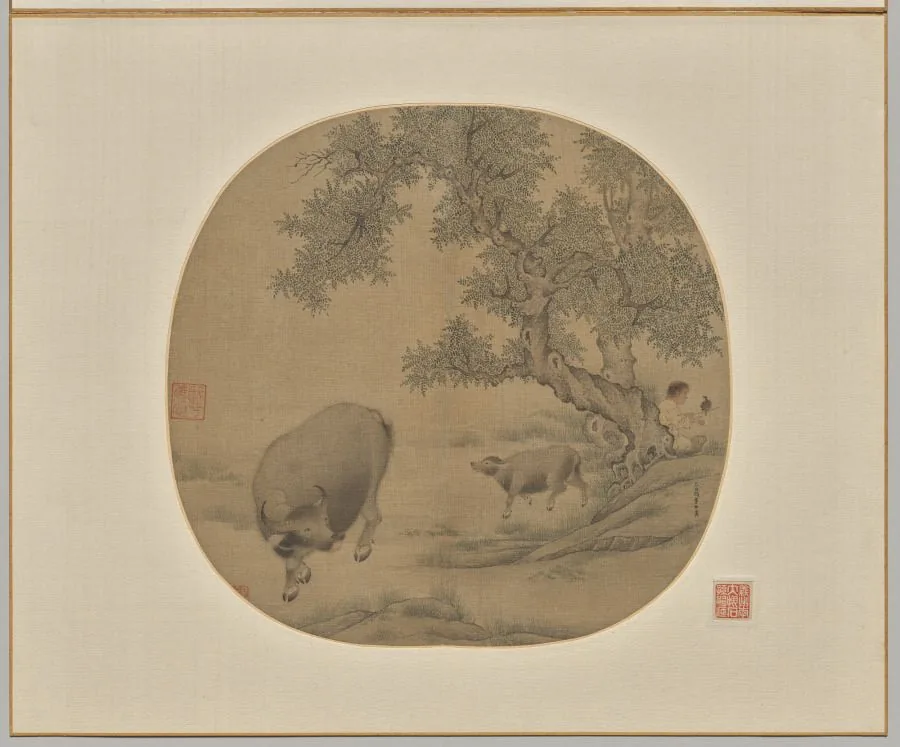
A big water buffalo walks toward you at the lower left with its head down and its horns curving outward. A calf trots after it across the grass. On the right, a small figure sits on the bank under an old twisted tree, and a red seal sits at the left edge of the painting, with another on the mount at the lower right.
The Spring Ox and Ox Figures in Bronze
1 min read · 1 photo
The ox has its own day in the folk calendar, at Lichun, the Start of Spring. In the usual telling, people made an ox out of clay or paper and whipped it that day. The custom is called da chunniu (打春牛) or bian chunniu (鞭春牛), “beating the spring ox.” It was meant to hurry the plowing along and to welcome spring, and folk usage gives Lichun the nickname da chun, “beating spring,” for the same reason. By the same account, spring-ox pictures are an old subject for New Year prints.
This gilt bronze ox from the Tang dynasty shows the animal lying down.
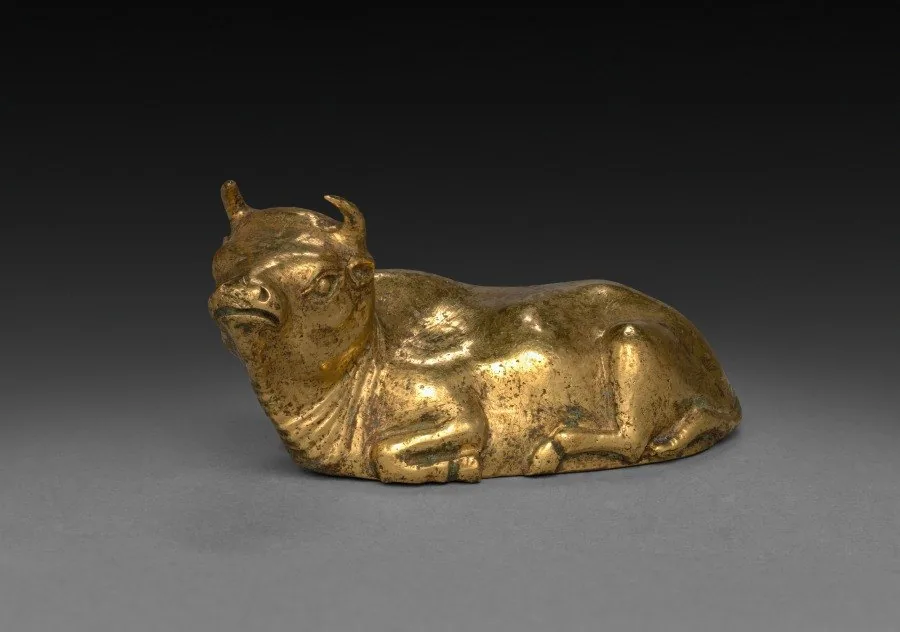
It lies with all four legs folded and its head lifted and turned to one side. The horns are short and curve inward, and loose skin hangs in folds under the neck. Because I paint, I look first at how the legs are folded. Here each hoof is tucked under the body and still easy to read.
Set it beside the Qing mirror stand further up: both lie with legs folded under them, though the heads are held differently.
Year of the Ox FAQ
2 min read
Is the Ox the second animal of the Chinese zodiac? Yes, right behind the Rat. Patient work is what the tradition attaches to it, since the ox was the animal that plowed. Its years carry Chou (丑), a yin Earth branch whose name also covers 1 a.m. to 3 a.m. on the clock and the twelfth lunar month.
Which years are Ox years? Count twelve from 2021 in either direction and you get 1925, 1937, 1949, 1961, 1973, 1985, 1997, 2009, 2021 and 2033. A January or February birthday in any of them still needs the start date from the table, since none of these years opens on January 1.
If 2021 was the Year of the Ox, what is 2022? A baby born in January 2022 is still a Metal Ox, because that Ox year didn’t close until January 31, 2022. From February 1 the year belongs to the Tiger, the sign after the Ox in the fixed order.
What does the Ox symbolize in Chinese culture? Work in the fields, first of all. The ox pulled the plow, so it stands for diligence and carrying a load. A quiet hard worker gets called an old yellow ox, and a stubborn one is said to need more than eight oxen to turn around.
Who is the Ox compatible with, and what is its enemy sign? Rat, Snake and Rooster are the three friendly signs on the Ox’s chart, the first by six harmony and the other two by triple harmony. Opposite them stands the Goat, the clash sign, with the Horse and the Dog as lesser trouble. Treat all of it as lore for fun.
When is the next Year of the Ox? Not until 2033. That year is guichou (癸丑), a Water Ox like 1973 six decades before it, and it opens on January 31, 2033 and closes on February 18, 2034.
Check a birthday against the first table and you have the two things about an Ox year that are plain calendar fact, the dates and the element. Everything about character and matches is the tradition’s storytelling, and I’d enjoy it as that. The other eleven signs are a click away on the Zodiac & Tradition home page.
Key terms in this guide
Full glossary →Related topics at this level
- Chinese Zodiac YearsEvery Chinese zodiac year from 1924 to 2043 with its animal, element and exact start and end dates, plus how January and February birthdays are counted.2 guides
- Chinese Zodiac CompatibilityCheck any two Chinese zodiac signs: trines, secret friends, clashes, harm and punishment for all 12 animals, plus how to work out a pair by hand.12 guides
- Year of the RatRat years run 1924 to 2044, with the next starting February 11, 2032. Exact dates, the five Rats, Rat traits and matches, and the Rat's Wedding in New Year folk art.6 guides
- Year of the TigerTiger years run 1926 to 2046, with the next starting February 19, 2034. Exact dates, the five Tigers, traits and matches, and China's cloth tigers.4 guides
- Year of the RabbitRabbit years include 1999, 2011 and 2023, and the next begins February 8, 2035. Dates, five elements, traits, matches and the Jade Rabbit in the moon.
- Year of the DragonDragon years are 1988, 2000, 2012 and 2024, and the next starts January 28, 2036. Dates, five elements, traits, matches and the Longtaitou festival.
More topics
- Chinese ZodiacThe 12 Chinese zodiac animals in order, how to find your sign and element from your birth date, and what the zodiac hours, months and clashes mean.1 guide
- Chinese Zodiac YearsEvery Chinese zodiac year from 1924 to 2043 with its animal, element and exact start and end dates, plus how January and February birthdays are counted.2 guides
- Chinese Zodiac CompatibilityCheck any two Chinese zodiac signs: trines, secret friends, clashes, harm and punishment for all 12 animals, plus how to work out a pair by hand.12 guides
- Year of the RatRat years run 1924 to 2044, with the next starting February 11, 2032. Exact dates, the five Rats, Rat traits and matches, and the Rat's Wedding in New Year folk art.6 guides
- Year of the TigerTiger years run 1926 to 2046, with the next starting February 19, 2034. Exact dates, the five Tigers, traits and matches, and China's cloth tigers.4 guides
- Year of the RabbitRabbit years include 1999, 2011 and 2023, and the next begins February 8, 2035. Dates, five elements, traits, matches and the Jade Rabbit in the moon.
- Year of the DragonDragon years are 1988, 2000, 2012 and 2024, and the next starts January 28, 2036. Dates, five elements, traits, matches and the Longtaitou festival.