Zodiac · Topic guide
Year of the Dragon: Chinese Zodiac Years, Elements, Traits
Dragon years are 1988, 2000, 2012 and 2024, and the next starts January 28, 2036. Dates, five elements, traits, matches and the Longtaitou festival.
By Daozhang Ma Published
In short
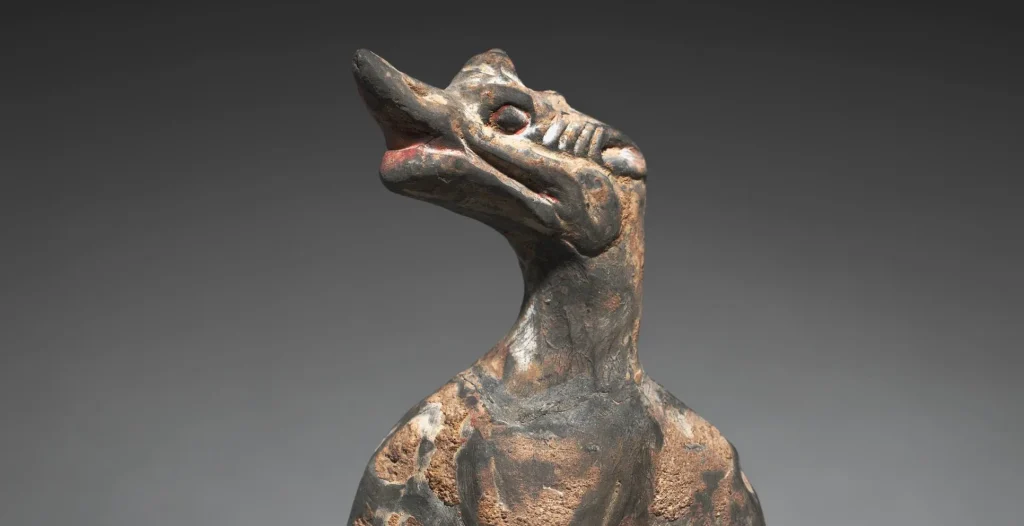
The Year of the Dragon is the fifth stop in the Chinese zodiac, the turn that falls between the Rabbit and the Snake and the only one named for a creature nobody has seen. The most recent one opened on February 10, 2024 and closed on January 28, 2025. Before it came 2012, 2000, 1988 and 1976, and the wait for the next lasts until January 28, 2036.
Wood was the element of 2024 and Water the element of 2012, because every Dragon year borrows one of the five elements from the first character of its name. Neither year opened on January 1. The 2024 Dragon had to wait for Chinese New Year on February 10, so anyone born in the first weeks of that year is a Rabbit.
From 7 to 9 in the morning the old Chinese clock is in the Dragon’s hour, and the third lunar month, the last month of spring, is the Dragon’s month. Both carry the name Chen (辰), the earthly branch behind the animal, which the usual reckoning counts as yang Earth.
Traditional readings call Dragon-year people confident, generous and proud. I pass those on as inherited character types, shared for entertainment, and I treat the matches and the Tai Sui lore further down the same way. This page also covers Longtaitou, the day the dragon raises its head, and why a dragon and a phoenix turn up together at weddings.
Daozhang MaMaoshan Taoist, Jintan, Jiangsu
The guide · 9 chapters
Year of the Dragon Dates, 1928 to 2036
2 min read · 1 table
January 23, 1928 is the earliest Dragon New Year in my table and January 28, 2036 is the one still to come, with eight more between them. All ten are listed below with first day, last day, element and stem-and-branch name.
| Dragon year | Starts | Ends | Element | Stem and branch |
|---|---|---|---|---|
| 1928 | January 23, 1928 | February 9, 1929 | Earth | 戊辰 wuchen |
| 1940 | February 8, 1940 | January 26, 1941 | Metal | 庚辰 gengchen |
| 1952 | January 27, 1952 | February 13, 1953 | Water | 壬辰 renchen |
| 1964 | February 13, 1964 | February 1, 1965 | Wood | 甲辰 jiachen |
| 1976 | January 31, 1976 | February 17, 1977 | Fire | 丙辰 bingchen |
| 1988 | February 17, 1988 | February 5, 1989 | Earth | 戊辰 wuchen |
| 2000 | February 5, 2000 | January 23, 2001 | Metal | 庚辰 gengchen |
| 2012 | January 23, 2012 | February 9, 2013 | Water | 壬辰 renchen |
| 2024 | February 10, 2024 | January 28, 2025 | Wood | 甲辰 jiachen |
| 2036 | January 28, 2036 | February 14, 2037 | Fire | 丙辰 bingchen |
The Dragon is one of the twelve animals of the Chinese zodiac, and it always takes over from the Rabbit and hands on to the Snake. The dates here match my year-by-year chart of Chinese zodiac years, which covers the other eleven animals too. Right now the calendar is in a bingwu (丙午) Fire Horse year that runs from February 17, 2026 to February 5, 2027, so the Dragon is ten years off.
Born in January or Early February?
January 25, 1977 looks like a Snake birthday on a Western calendar, and it isn’t one. The Fire Dragon year of 1976 was still running that day and didn’t close until February 17, 1977, which makes that baby a Fire Dragon.
The opposite mistake happens at the front end. February 5, 2024 falls five days short of the Wood Dragon’s first day, so that birthday stays with the Water Rabbit of 2023.
Chinese New Year always lands between January 21 and February 20. A birthday from February 21 through January 20 never needs checking, and for the rest my Chinese New Year zodiac calculator does the comparison for you. A baby born on New Year’s Day itself belongs to the new animal, and one born on New Year’s Eve, however late at night, belongs to the old one.
A second rule exists, and I use it when I draw up a Bazi chart. There the year changes at Lichun (立春), the start of spring, which falls on February 3, 4 or 5. The two rules only disagree for people born between Lichun and the New Year. A baby born on February 8, 2024 is a Rabbit by the festival count and a Dragon in a Bazi chart. Everyday use, from red envelopes to birthday cards, follows the festival, and so do the tables on this site.
What the Year of the Dragon Means: Chen, Morning and Late Spring
1 min read · 1 photo
Fifth place puts the Dragon after the Rabbit’s dawn and before the Snake’s mid-morning, in the hours when the day is fully under way. Its branch, Chen, covers 7 to 9 a.m., the southeast, and the third lunar month, which runs from about April 5 to May 5 and closes out spring. You can read the pages for the Year of the Rabbit and the Year of the Snake for the neighbors on either side.
Chen is one of four Earth branches, and each of them sits at the end of a season. The old manuals call Chen wet earth and a storehouse of water. That fits the animal, since the dragon of Chinese folklore moves through cloud and brings the rain. It also explains why Chen joins the Rat’s branch and the Monkey’s branch to form a water trio, which matters in the compatibility section below.
Of the twelve animals, the dragon alone is imaginary. Chinese sources add that when someone says “I’m a Dragon,” listeners tend to hear a lucky sign. In the culture at large the dragon stands for two things, the emperor’s authority and rain that arrives on time. Dragon patterns were used on ritual objects long before the first empire, and for centuries a dragon on a robe was reserved for the emperor.
Painters have always had to decide how much of a dragon to show. This Qing dynasty ink painting shows very little.
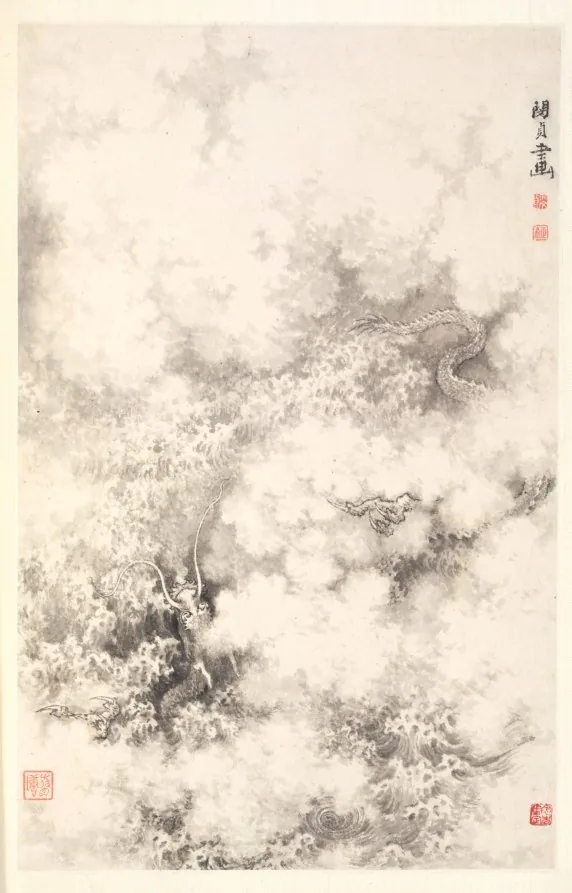
The head is at lower left, with two long whiskers curling upward. A clawed foot reaches out near the middle, and one scaly length of body arches at upper right. Cloud and breaking waves cover everything else, and the inscription sits at top right with red seals beneath it, plus one more red seal in each of the two bottom corners. I paint Taoist pictures myself, and with a dragon the cloud takes me longer than the scales do.
The Five Dragons: Wood, Fire, Earth, Metal and Water
1 min read · 1 table
Jiachen (甲辰), the Wood Dragon year that opened in 2024, had last come around in 1964, a gap of sixty years. Each of the other four Dragons keeps the same interval, which is why 1976 and 2036 are both Fire Dragons and 1952 and 2012 are both Water Dragons.
Only five heavenly stems ever stand in front of Chen: Jia, Bing, Wu, Geng and Ren. Those are the yang stems. By the usual reckoning stems and branches advance one step a year together, so a yang branch like Chen never meets a yin stem, and the stem’s element becomes the element of the year.
| Kind of Dragon | Stem | Years | Stem and branch |
|---|---|---|---|
| Wood Dragon | Jia 甲 | 1964, 2024 | 甲辰 jiachen |
| Fire Dragon | Bing 丙 | 1976, 2036 | 丙辰 bingchen |
| Earth Dragon | Wu 戊 | 1928, 1988 | 戊辰 wuchen |
| Metal Dragon | Geng 庚 | 1940, 2000 | 庚辰 gengchen |
| Water Dragon | Ren 壬 | 1952, 2012 | 壬辰 renchen |
Chen’s own element stays Earth whichever stem arrives. That makes wuchen, the Earth Dragon of 1928 and 1988, the one year in the set where stem and branch share an element.
Tradition also gives each stem a picture. Jia is a tall tree, Bing the sun, Wu a mountain, Geng a blade or raw ore, and Ren a great river. The pictures belong to the stems, and I leave them at that.
Dragon Personality in Traditional Readings
1 min read
Traditional readings give the Dragon four strengths: confidence, a big and decisive way of doing things, warmth and generosity, and a gift for leading. The same readings list the faults. A Dragon is said to be proud, to care a great deal about saving face, to swing with its moods and to drop a project halfway.
I haven’t seen a study that tested any of these claims, and I don’t expect one. Descriptions this broad fit most people a little, which is the reason a zodiac portrait so often feels like it was written about you. A full chart also looks at the month, day and hour of birth, and the year animal is only one of those four parts.
Everything in this section is traditional lore, shared for entertainment, and the same goes for the matches and the Tai Sui customs that follow.
Dragon Compatibility: Rat, Monkey, Rooster and the Dog Clash
2 min read · 1 table
An old saying has it that when Dragon and Rat join forces their edge can cut through metal, with the Dragon steering and the Rat keeping the accounts. That pairing comes from the branches Chen and Zi, and every other Dragon match is read from the branches as well. The year’s element plays no part, so a Wood Dragon and a Fire Dragon get identical lists.
| Relationship | Partner sign | What the tradition says |
|---|---|---|
| Triple harmony (三合) | Rat, Monkey | Shen, Zi and Chen form the water trio. The three are read as one team. |
| Six harmony (六合) | Rooster | Chen and You combine and turn to Metal. Matchmaking rhymes rank this pair in the top class. |
| Clash (冲) | Dog | Chen and Xu sit opposite each other on the circle of branches, six places apart. |
| Harm (害) | Rabbit | Mao and Chen are neighbors that are said to get along on the surface only. |
| Self-punishment (自刑) | Dragon | Chen meeting Chen. Two Dragons are said to magnify each other’s faults. |
| Break (破) | Ox | Chen and Chou. Mild, and some lists leave it out. |
The Rooster and the two trio partners are the Dragon’s lucky signs in the folk lists. You can meet one of them on my Year of the Rat page. The trio reads as three signs in one camp.
The Dog is the sign people mean when they ask about the Dragon’s enemy. Chen and Xu are both Earth branches, and manuals file their meeting under the storehouse clashes. The Year of the Dog page shows the same pairing from the other side.
Two details vary from book to book, and I won’t pick a winner. Self-punishment applies to four branches only, Chen, Wu, You and Hai, which are the Dragon, Horse, Rooster and Pig, and some authors tack it onto the end of the three punishments while others list it alone. Break appears as a full set of six in one school and is missing from charts that stop at harmony, clash, punishment and harm.
For all twelve signs side by side, see my Chinese zodiac compatibility chart. The folk writers who publish these lists often end by saying they’re custom and only for reference, and I’d say the same.
Ben Ming Nian and Tai Sui in a Dragon Year
1 min read
A Dragon’s ben ming nian (本命年) is any Dragon year, the year when the branch of the calendar matches the branch of your birth. Tradition calls this sitting with Tai Sui. The next one runs from January 28, 2036 to February 14, 2037.
Behind the name is the planet Jupiter. Its trip around the sky lasts roughly twelve years, which suited a calendar built on twelve branches, so the old sky-watchers counted years by it. Tai Sui is the invented twin they set running in the reverse direction as a year marker. In Taoist temples that marker turned into sixty generals, one for each stem-and-branch year, who take the duty in turn.
Offending Tai Sui is the umbrella term for five relationships with the year’s branch: same branch, clash, punishment, harm and break. By the usual reckoning that puts four signs on the list in a Dragon year. The Dragon is there twice over, since Chen is a self-punishing branch. The Dog clashes, the Rabbit is harmed and the Ox is broken. For a Dragon the clash years are Dog years, and the next of those is 2030.
The custom most people know is wearing red in your own year: a red cord at the wrist, a red belt, red socks or red underwear. A folk rhyme warns that with Tai Sui sitting overhead, a year without a happy event may bring trouble. Temples hold Tai Sui rites between the eighth and fifteenth days of the first lunar month, and those are busy days on the mountain where I live.
I don’t write single-year forecasts for years before 2027. The Goat year of 2027, dingwei (丁未), runs from February 6, 2027 to January 25, 2028, and the charts show no relationship between Wei and Chen, so the Dragon is off that year’s list. My 2027 Chinese zodiac page has the details. An Earth Monkey year follows on January 26, 2028, and Shen is one of the Dragon’s trio partners.
Longtaitou: The Day the Dragon Raises Its Head
2 min read · 1 photo
The second day of the second lunar month is Longtaitou (龙抬头, lóng táitóu), which means the dragon raises its head. The name has an astronomical side. Around the spring equinox the star group called Jiao, the horn of the Azure Dragon constellation, climbs above the eastern horizon at dusk.
The legend is about rain. In the usual telling, the Dragon King (龙王, Lóngwáng) couldn’t bear to watch a drought and sent rain without permission. The Jade Emperor pinned the Dragon King under a mountain, and the release came on the second day of the second month.
The Dragon King is the god of rain, rivers, lakes and seas in folk religion and in Taoist temples, and villages prayed to this god when the fields dried out. On this celadon plate the dragon sits among clouds.
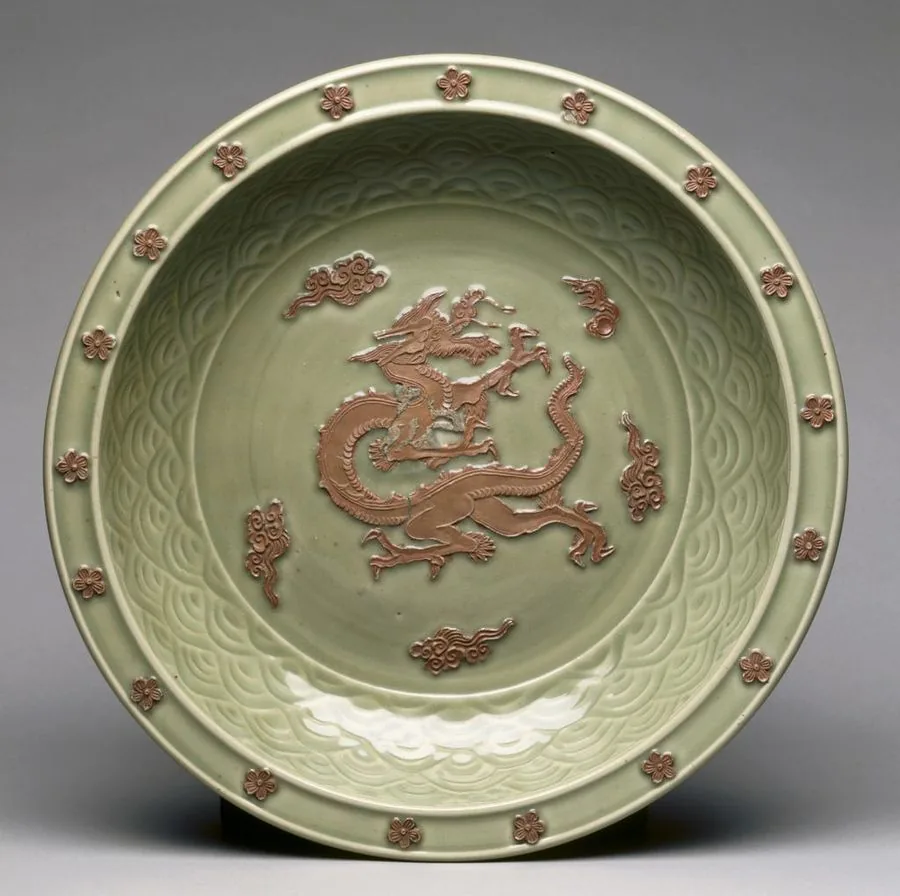
The dragon and the clouds around it are left in reddish-brown clay against the pale green glaze. The body bends in an S, the claws are spread, and a carved wave pattern rings the inner wall. Small five-petaled flowers in the same brown dot the rim.
Longtaitou customs are simple and cheerful:
- A haircut. The rhyme says that if you trim the dragon’s head on the second of the second month, you’ll have spirit all year. Barbers where I live in Jiangsu are busy that morning.
- Dragon lanterns. Families light them and parade them.
- Knocking the dragon’s head. That is the name for tapping the roof beam on this day.
- Leading the money dragon. Water is sprinkled in a line from the riverbank all the way home.
A children’s rhyme sums up the hope behind the day: the dragon lifts its head, the big barn fills and the small barn overflows.
The dragon dance started out as a rain rite too. It can be traced to the Han dynasty, when Dong Zhongshu’s Chunqiu Fanlu recorded clay dragons made to call rain. The dancers’ dragon was often stored in a Dragon King temple, and its eyes are dotted before it performs. If you mix it up with the lion, my comparison of the dragon dance and the lion dance sorts out which is which.
Dragon and Phoenix, the Dragon Gate and Dragons on Objects
1 min read · 1 photo
Two dragon phrases are worth knowing by heart. Long feng cheng xiang (龙凤呈祥) means the dragon and the phoenix bring good fortune together, and it belongs at weddings. Yu yue longmen (鱼跃龙门) means the carp leaps the Dragon Gate, and people say it for a success won in a single bound.
In the wedding phrase the phoenix stands for the bride’s good fortune and a happy marriage. Qing dynasty wedding brocades used the dragon and phoenix as their main pattern.
Dragons also sit in famous places. In the Hall of Supreme Harmony in the Forbidden City, a gold dragon coils in the center of the ceiling well above the throne. Its head points down and it holds a ball in its mouth that people call the Xuanyuan mirror. Legend says the ball would drop on any usurper who took the seat.
Dragon boats carry a carved dragon head on the prow. The races at the Duanwu festival are said to go back to rites of the ancient Yue people for a water god or dragon god. In the dragon dance, one performer runs ahead with a pearl on a pole and the dragon chases it. The pearl stands for wisdom.
Pairs of dragons are much older than any of these. This jade plaque dates to the Eastern Zhou.
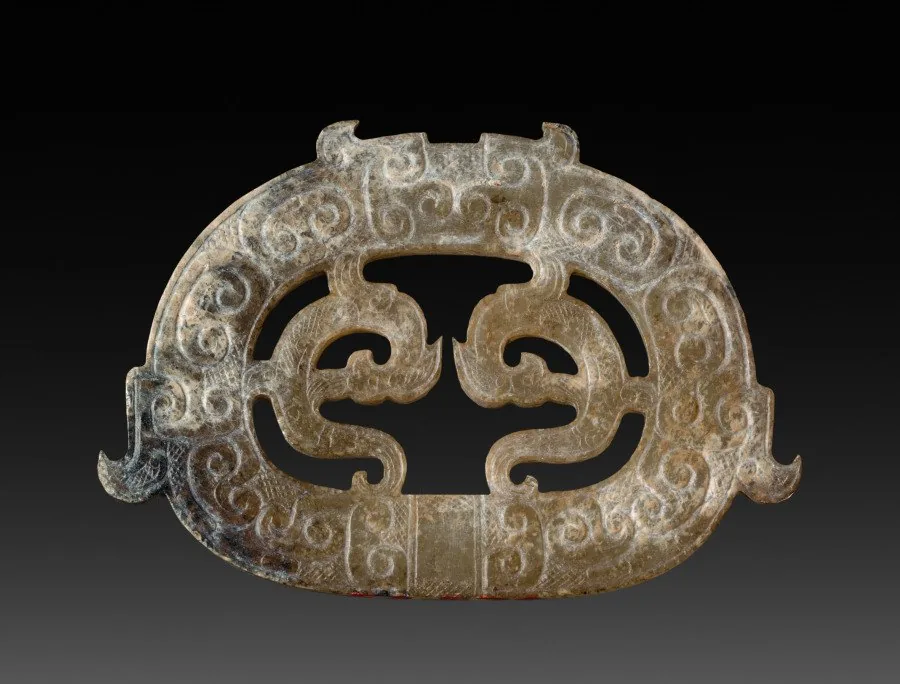
Two dragons are cut right through the stone and meet nose to nose in the middle. Their bodies curl back into the frame, and raised scrolls cover the whole surface. When I look at a dragon piece I go to the head first, because the head tells me whether the carver had a dragon in mind or only a pattern.
Year of the Dragon FAQ
2 min read
What does the Year of the Dragon mean in the Chinese zodiac? It means the year of the one animal in the cycle that nobody has ever seen, and it comes fifth, between the Rabbit and the Snake. Chen (辰) is the branch behind it, a yang Earth branch that also marks 7 to 9 a.m. and the third lunar month, when spring ends.
Which years are Dragon years? Count back twelve at a time from 2024 and you get 2012, 2000, 1988, 1976, 1964, 1952, 1940 and 1928. Going forward, 2036 comes next. None of them opened on January 1, so a January or February birthday needs the dates in the table.
Is someone born in January 1977 a Dragon or a Snake? A Dragon. The Fire Dragon year of 1976 didn’t close until February 17, 1977, and the Fire Snake took over on February 18. Only birthdays from that day on are Snakes.
What does the dragon symbolize in Chinese culture? Rain and rule. The dragon was the emperor’s emblem, and as the Dragon King it is the god villages asked for rain. At weddings it’s paired with the phoenix in the phrase long feng cheng xiang.
Who is the Dragon compatible with, and what is its enemy sign? The Rooster comes first as the six-harmony partner, then the Rat and the Monkey, which share the water trio with Chen. Opposite Chen sits Xu, so the Dog is the clash sign that people call the enemy. It’s old matchmaking lore, and I share it for fun.
When is the next Year of the Dragon? January 28, 2036 is the day it opens, and it closes on February 14, 2037. The year is named bingchen (丙辰), with a Fire stem, so the Fire Dragon of 1976 will have waited sixty years to come back.
Nobody has ever seen a dragon, yet it has a fixed seat in the calendar: Chen, fifth in the cycle, the last month of spring. Every date and element in the tables above can be checked against a calendar. Personality, matches and Tai Sui customs are another matter, traditional lore that I pass on for entertainment only. The Zodiac & Tradition home page lists the other guides.
Key terms in this guide
Full glossary →Related topics at this level
- Year of the OxOx years are 1973, 1985, 1997, 2009 and 2021, and the next begins January 31, 2033. Dates, five elements, traits, matches and the spring ox custom.
- Year of the TigerTiger years run 1926 to 2046, with the next starting February 19, 2034. Exact dates, the five Tigers, traits and matches, and China's cloth tigers.4 guides
- Year of the RabbitRabbit years include 1999, 2011 and 2023, and the next begins February 8, 2035. Dates, five elements, traits, matches and the Jade Rabbit in the moon.
- Year of the SnakeSnake years are 1929 to 2025, and the next starts February 15, 2037. Exact dates, the five element Snakes, traditional traits and matches, and snake legends.
- Year of the HorseHorse years run from 1930 to 2026, and the current one lasts until February 5, 2027. Exact dates, the five Horses, traits, matches and the horse's lucky puns.
- Year of the GoatGoat years include 1991, 2003 and 2015; the next starts February 6, 2027. Dates, the five Goats, sheep or ram, traits, matches and san yang kai tai.
More topics
- Chinese ZodiacThe 12 Chinese zodiac animals in order, how to find your sign and element from your birth date, and what the zodiac hours, months and clashes mean.1 guide
- Year of the OxOx years are 1973, 1985, 1997, 2009 and 2021, and the next begins January 31, 2033. Dates, five elements, traits, matches and the spring ox custom.
- Year of the TigerTiger years run 1926 to 2046, with the next starting February 19, 2034. Exact dates, the five Tigers, traits and matches, and China's cloth tigers.4 guides
- Year of the RabbitRabbit years include 1999, 2011 and 2023, and the next begins February 8, 2035. Dates, five elements, traits, matches and the Jade Rabbit in the moon.
- Year of the SnakeSnake years are 1929 to 2025, and the next starts February 15, 2037. Exact dates, the five element Snakes, traditional traits and matches, and snake legends.
- Year of the HorseHorse years run from 1930 to 2026, and the current one lasts until February 5, 2027. Exact dates, the five Horses, traits, matches and the horse's lucky puns.
- Year of the GoatGoat years include 1991, 2003 and 2015; the next starts February 6, 2027. Dates, the five Goats, sheep or ram, traits, matches and san yang kai tai.