Chinese New Year Dress: Outfits and Lunar New Year Clothes
By Daozhang MaMaoshan Taoist, Jintan, Jiangsu
In short
The classic Chinese New Year dress is the qipao, also called the cheongsam: a fitted dress with a high stand collar, a curved opening across the chest and knotted cloth buttons. Most people in China simply wear new clothes for the holiday, and the qipao, the Tang suit for men and the older hanfu are the traditional choices on top of that.
What matters most is that the outfit is new, festive in color and not all black or all white. The qipao gets the most room here, collar to hem, then its patterns and colors. After that come the Tang suit, the Chinese New Year shirt, hanfu, kids’ clothes and a test for any dress: can you sit through a long dinner in it?
Why Lunar New Year clothes are always new
The custom behind every Chinese New Year outfit is older than any single style. Families buy new clothes before the holiday and put them on for the first time on New Year’s Day, so the year starts with nothing worn and nothing old carried over. Children used to wait all winter for that one new jacket.
That is why the most common Lunar New Year clothes in China today are ordinary: a new sweater, a new coat, new shoes. A traditional dress is a step up from that, worn for the family dinner, for visiting relatives or for photos, not something you are expected to wear for all fifteen days.
I’d put “new” ahead of “traditional” when you’re short on time. A new red sweater does the job of the custom better than a borrowed qipao that doesn’t fit.
The qipao: the traditional dress for Chinese New Year
Among traditional dresses for Chinese New Year, the qipao is the one most people picture. Its name means “banner gown,” after the robes worn by the Manchu bannermen of the Qing dynasty. The fitted version we know took shape in 1920s Shanghai, when tailors cut the loose robe closer to the body.
Qipao vs cheongsam: one dress, two names
There is no difference between a qipao and a cheongsam. Qipao (旗袍) is the Mandarin name. Cheongsam is the Cantonese reading of chang shan (长衫), “long garment,” and it became the usual English word because the dress reached the West largely through Hong Kong. In Hong Kong and among older overseas families you’ll hear cheongsam, and in mainland China qipao.
From jacket sets to fitted dresses
Before the one-piece dress took over, a woman’s best New Year outfit was often a two-piece set: a short jacket with a stand collar worn over a skirt or trousers. Both styles still turn up at New Year, and the jacket set is easier to wear over winter layers.
The three details that make a dress a qipao
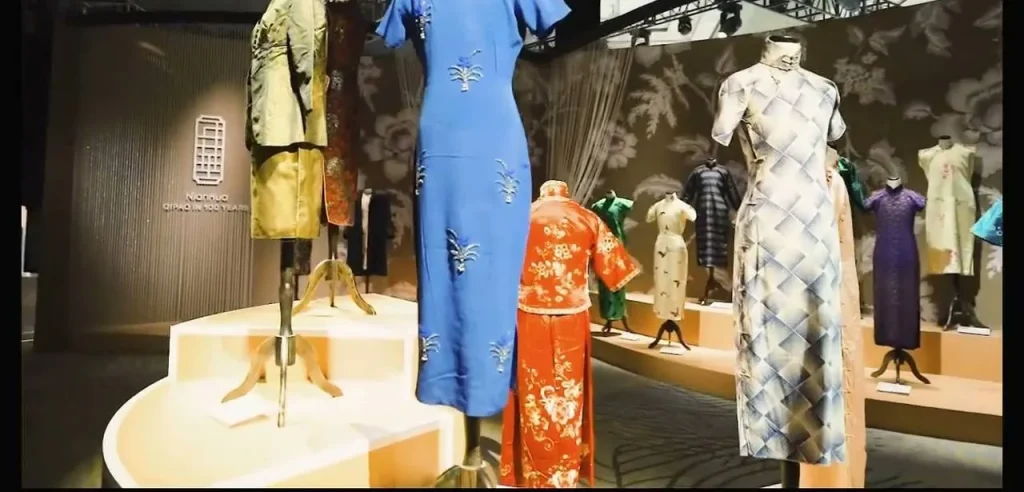
The first detail is the mandarin collar, a band that stands straight up around the neck. The second is the opening, which runs from the collar across the chest to under the right arm instead of straight down the front. The third is the pankou (盘扣), knotted fabric buttons that close that opening. Side slits at the hem let you walk in a narrow skirt.
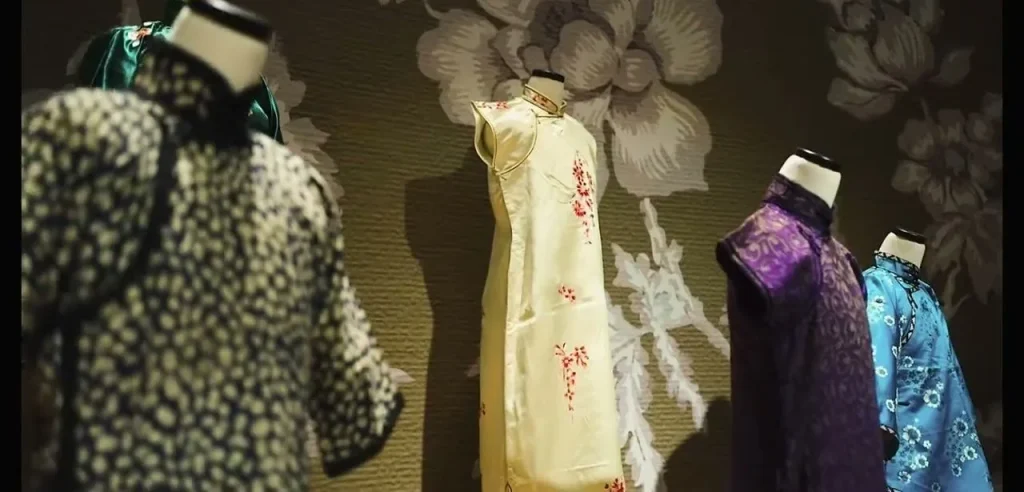
Sleeve length and hem length change a lot from one qipao to the next. Long sleeves and a hem near the ankle read formal and suit a winter dinner. Short sleeves and a knee-length hem look more modern, and you can wear them with a cardigan or a coat on top.
Qipao fabrics, from satin to lace
Satin and brocade are the traditional festive fabrics, with a sheen that catches the light at a dinner table. Cotton prints are for everyday wear. Lace qipao are a newer idea and a good pick if you want something lighter and less shiny.
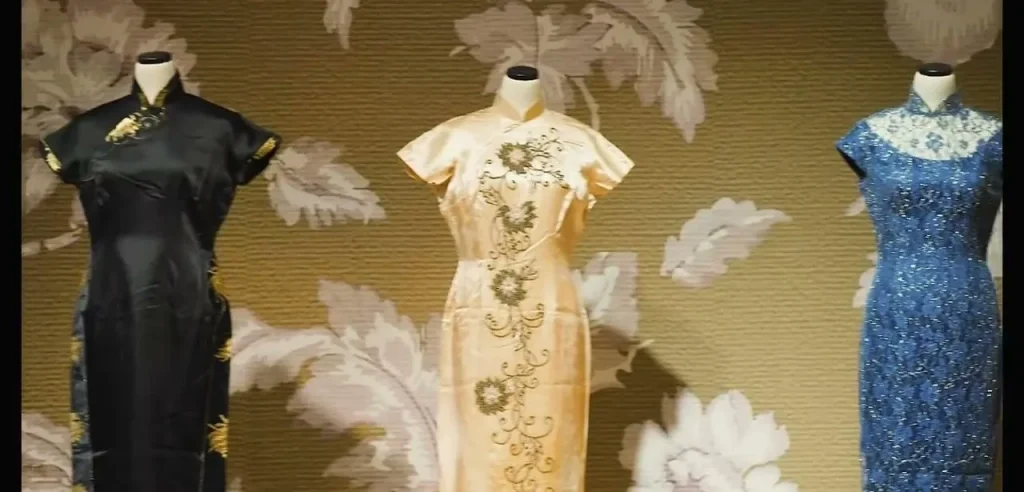
Lace works because it is sheer only where the lining stops. The body stays covered while the collar and sleeves turn light and airy, which suits a warm restaurant better than heavy satin.
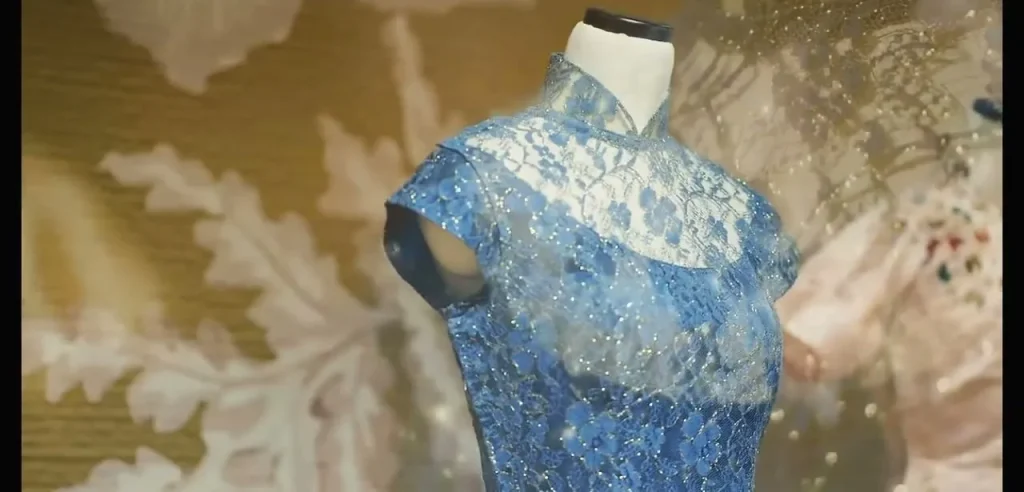
Patterns on a Chinese New Year dress and what they stand for
The pattern on a New Year qipao is where the wish for the year goes. Each motif stands for a specific hope, so it’s worth knowing what you’re wearing before a relative asks.
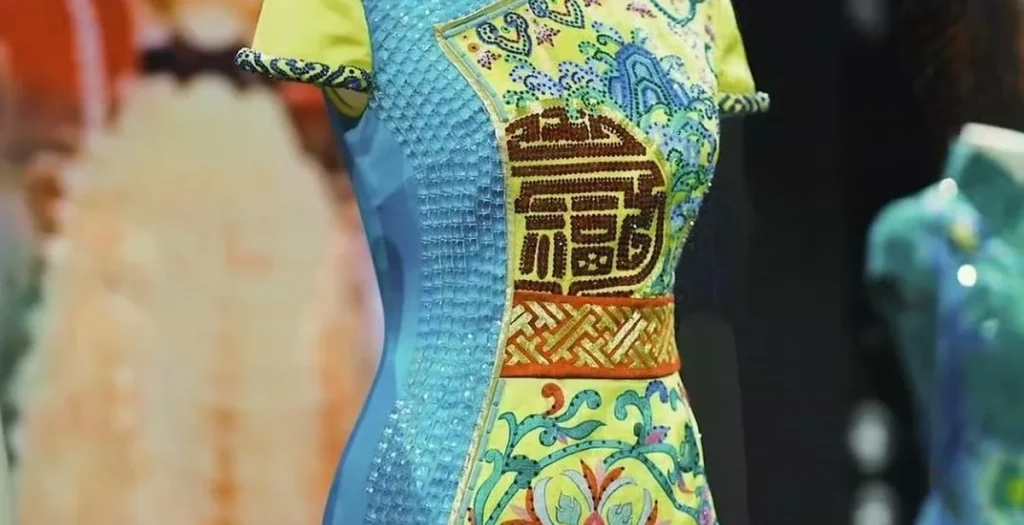
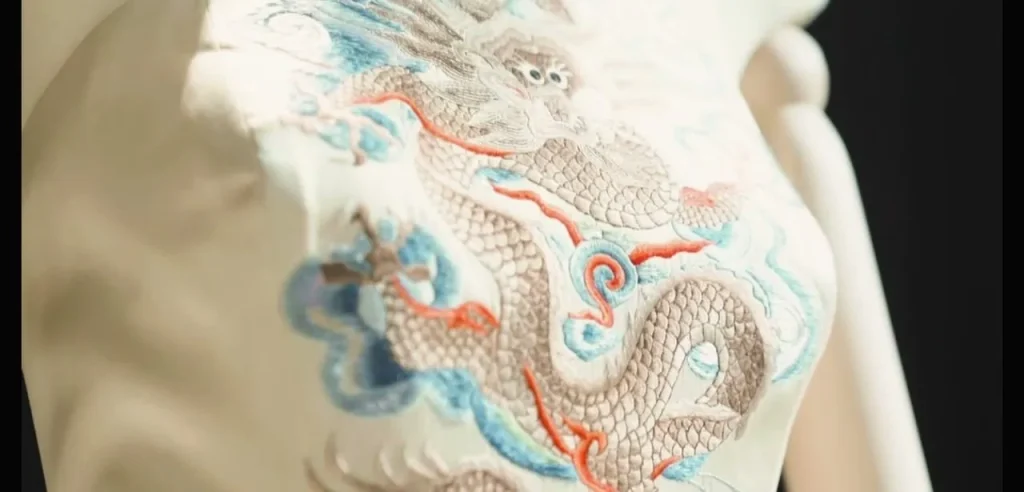
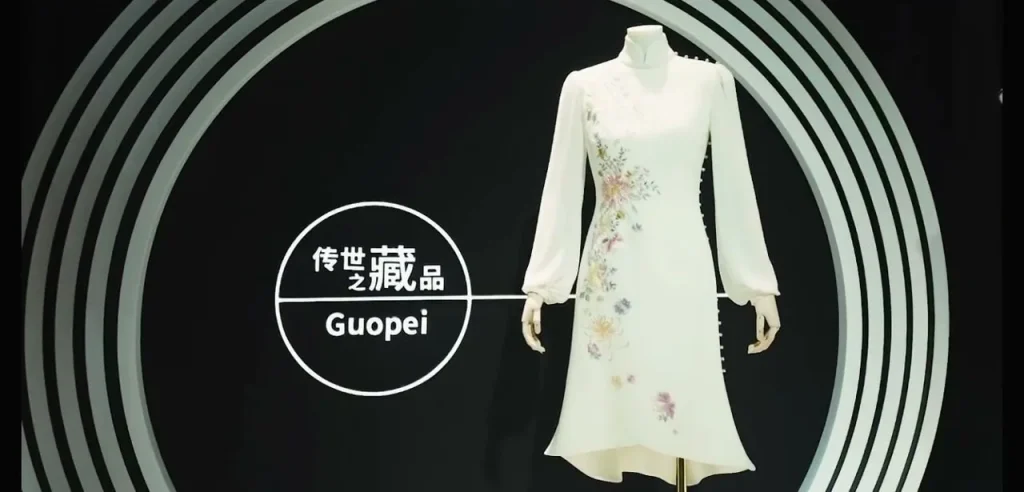
The dragon is the strongest motif and once belonged to the emperor. On a New Year dress it stands for power and good luck, and in a Dragon year it doubles as a nod to the zodiac. Guo Pei, the Beijing couturier best known in the West for the yellow cape gown Rihanna wore to the 2015 Met Gala, put one on a qipao for the 2008 Olympics.
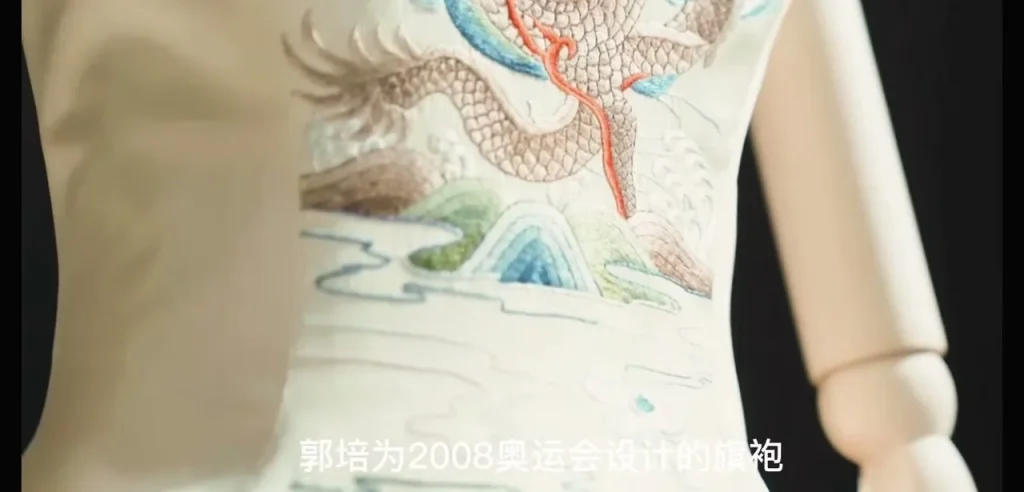
The stitching is what lifts a dress like this above a printed copy. A print gives the outline of a dragon, but embroidery builds up each scale in thread, so it catches the light differently as you move.
Peonies stand for wealth and rank, plum blossoms for getting through winter, and bats for good fortune, because the word for bat, fu (蝠), sounds like fu (福), luck. The character 福 itself shows up too, sometimes as a large panel on the chest of a gala dress.
Blue-and-white patterns borrow from Chinese porcelain. They are less loud than red and gold, and many people like them for New Year photos.
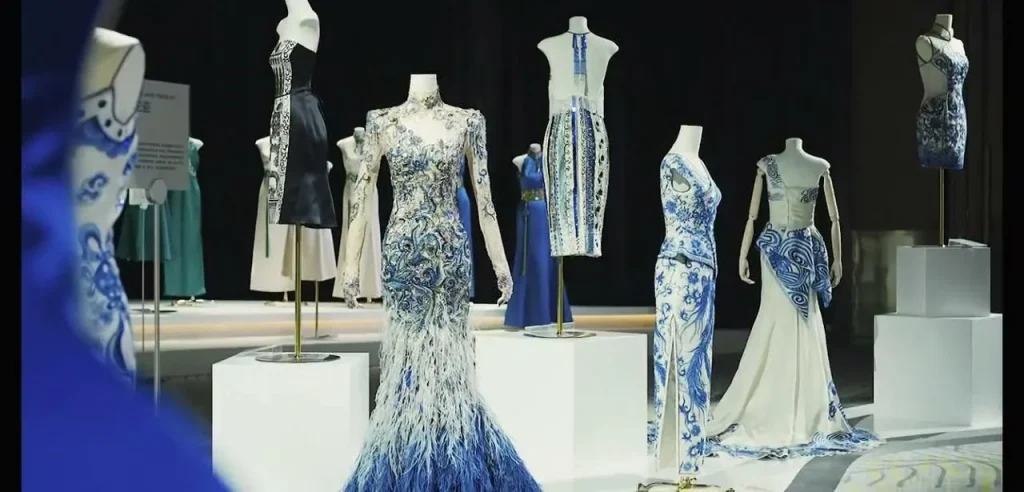
The same pattern can be done quietly or loudly. As a print it stays soft, and in beadwork it turns into something you’d wear to a gala.
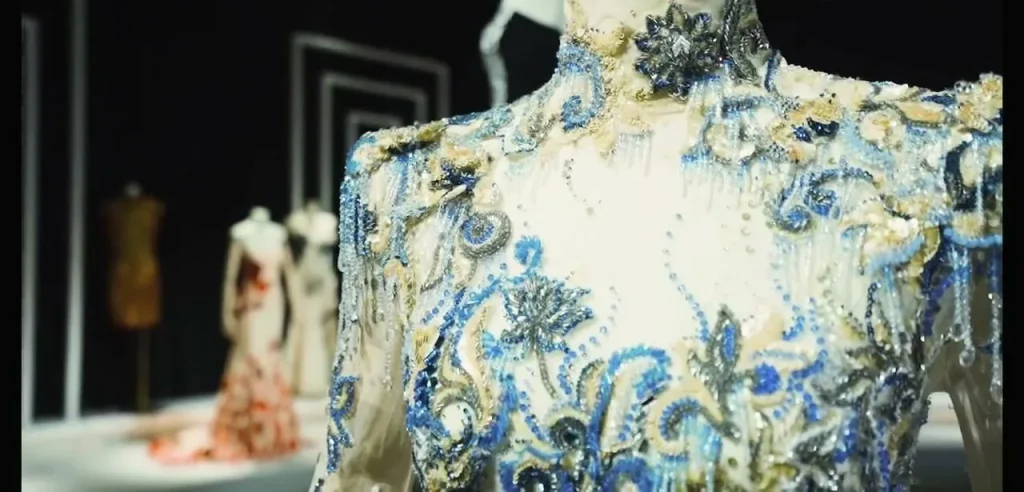
Lunar New Year dress colors beyond red
Red is the first choice for a Lunar New Year dress, and gold on red is the most festive pairing of all. Dense gold thread on a red qipao is the look many brides choose for their wedding, and it carries over well to the New Year dinner.
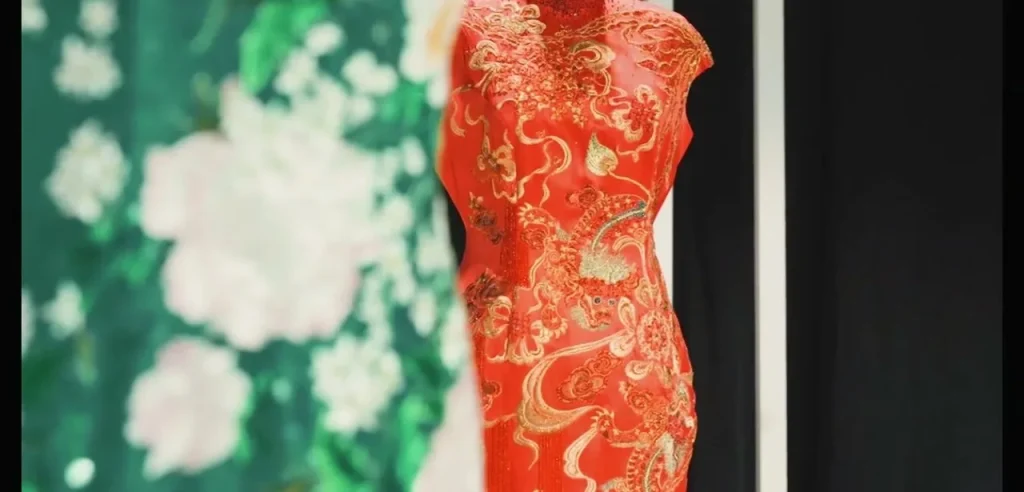
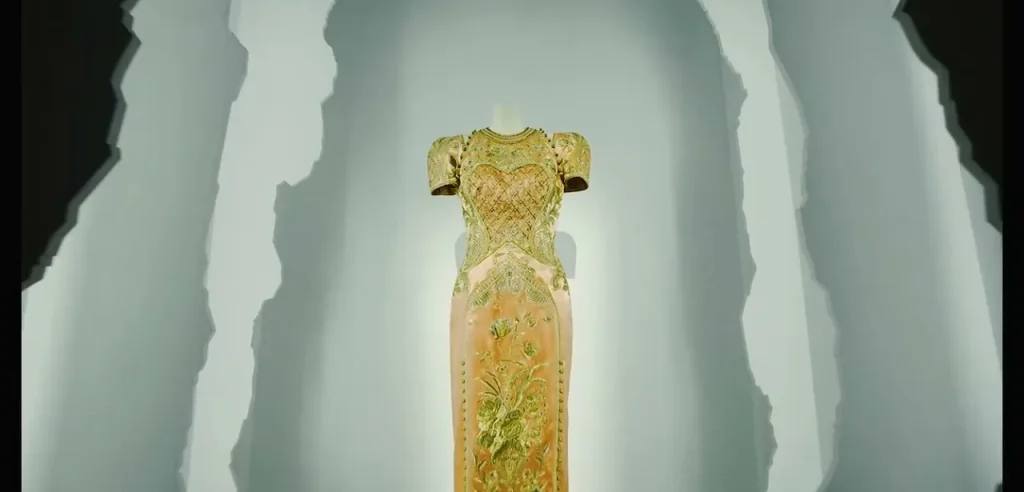
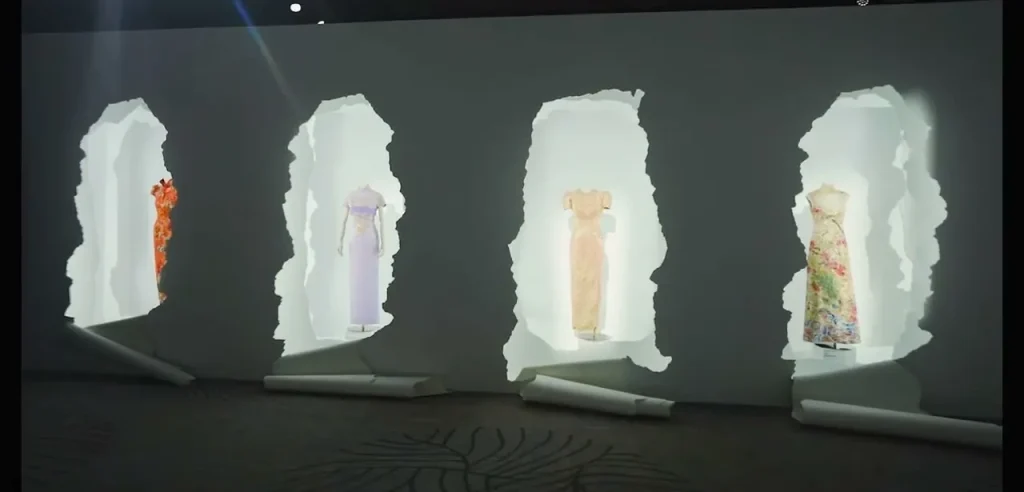
You don’t have to stop at red. Gold, pink, peach and purple all count as happy colors for the holiday, and a pale gold or lavender qipao looks festive without looking like everyone else at the table.
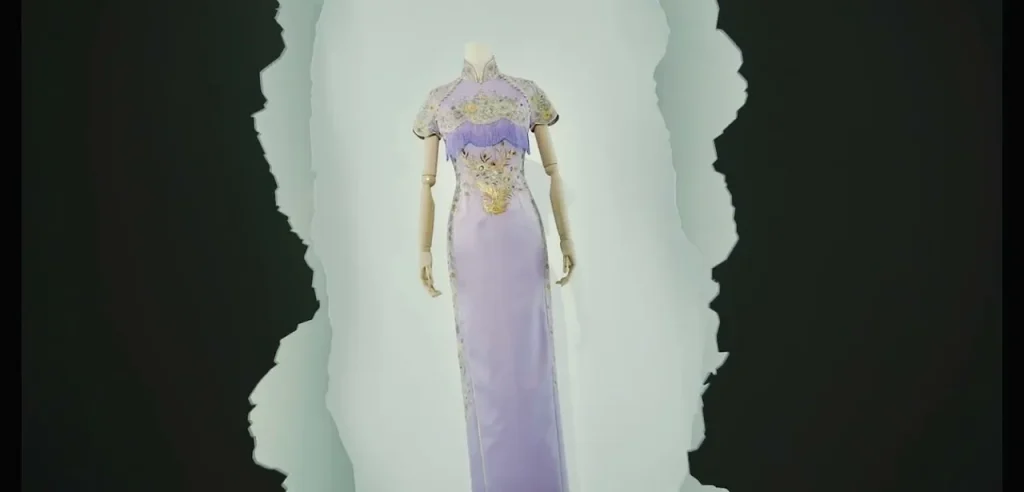
Lavender is a less obvious pick, but purple has long been tied to good fortune and high rank in China. With gold embroidery on top it still looks like a holiday dress, not an evening gown.
Green and white need a little care. Jade green is fine and reads fresh, but a dress that is all white leans toward mourning clothes in Chinese custom. If you love white, pick one with colored embroidery or wear it with a red or gold accessory.
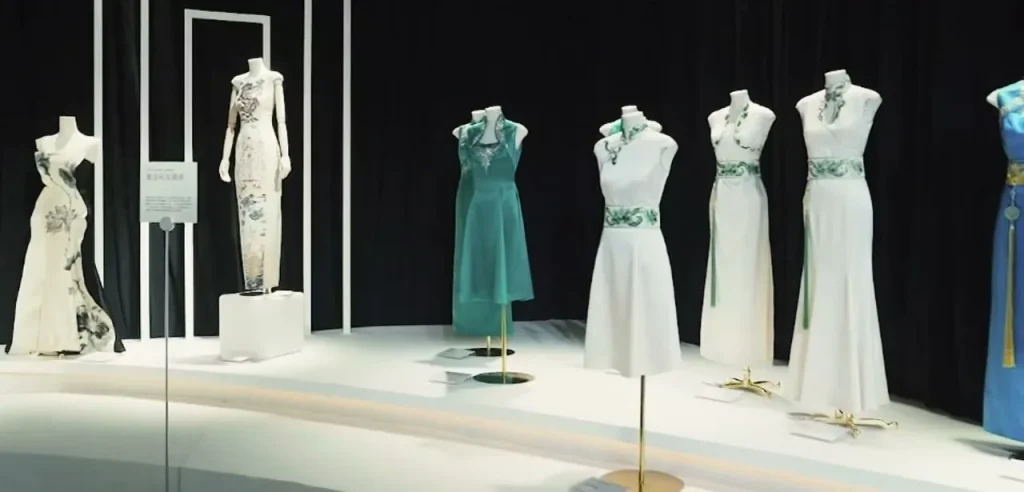
Long sleeves help white too. A white dress with sleeves to the wrist and flowers stitched near the hem looks like a winter party dress, nothing like mourning clothes.
When a whole family dresses up, one easy trick is to agree on a palette instead of one color: say red, gold and peach. Everyone looks like part of the same photo, and nobody has to hunt for an exact match.
Chinese New Year outfits for men: the Tang suit and the shirt
For men, the traditional Chinese New Year outfit is the Tang suit, or tangzhuang (唐装). Despite the name it has nothing to do with the Tang dynasty. It grew out of the magua, a short Manchu riding jacket, and the name comes from “Tang people,” an old word overseas Chinese used for themselves.
A Tang suit jacket has the same stand collar and knotted buttons as the qipao, but the opening runs straight down the center. Satin with a woven pattern of round longevity characters or clouds is the usual festive version, in red, deep blue or gold. Leaders at the 2001 APEC meeting in Shanghai all wore them for the group photo, which brought the style back into fashion in China.
What people mean by a Chinese New Year shirt
A Chinese New Year shirt is usually the lighter version: a shirt with a mandarin collar and frog buttons, worn on its own or under a coat. It’s the easiest choice if a full silk jacket feels like too much, and it works for a restaurant dinner as well as a family one.
Many men also skip traditional clothes and wear a red tie, a red scarf or red socks with a normal suit. That is still well within the custom.
Hanfu for Lunar New Year
Hanfu (汉服) is the clothing of the Han Chinese before the Qing dynasty, and it looks nothing like the qipao. The collar crosses over at the front with the left side over the right, the sleeves are wide and the skirt is long and loose. A revival began in the early 2000s, and hanfu is now a common sight at New Year temple fairs and in holiday photos in China.
For New Year the most popular piece in the last few years has been the mamianqun (马面裙), or “horse-face skirt,” a Ming-style pleated wrap skirt with flat panels at the front and back. Women wear it with a short jacket or even a sweater, which makes it the most practical way into hanfu for a cold-weather holiday.
If you want to try hanfu, pick a set made for wearing, not a thin costume for photos. Winter hanfu sets usually come lined or padded, and those are the ones to look for.
Kids’ Chinese New Year clothes
For children the usual choice is a padded jacket set: a small Tang-style jacket with knotted buttons and matching trousers, or a mini qipao for girls with a quilted jacket on top. Many come with fur-like trim at the collar and cuffs, and many come in red with a zodiac animal for the coming year.
Comfort matters more for kids than for anyone else at the table. Look for front fastenings they can manage, a hem they can run in and fabric that washes, because there will be dumplings.
How to choose a Chinese New Year dress you can wear all day
A New Year outfit gets a long day of use: a big meal, sitting on low stools, visiting several homes and a lot of bowing and hugging. I’d judge every dress by that day, not by how it looks on a hanger.
Fit is the first thing. A qipao is cut close to the body, so a traditional one leaves little room after a ten-course dinner. Look for a little ease at the waist or a modern cut with some stretch.
Weather comes next. Chinese New Year falls in late January or February, deep winter in northern China and in much of the US. Long sleeves, a padded jacket set or a qipao with a wool coat over it will all keep you warmer than a short-sleeved dress.
If you’re not Chinese and want to wear a qipao or Tang suit to a Lunar New Year party, go ahead. Most Chinese hosts take it as a compliment when it’s worn with care. Choose a real garment over a party costume, skip anything sold as “sexy” or “geisha,” and you’ll be well received.
FAQ
Is it okay to wear a qipao to a Chinese New Year party?
Yes. Wearing a qipao to a Chinese New Year party is generally welcomed, whether or not you’re Chinese. Choose a well-made dress that fits, in a festive color, and avoid costume versions.
What is the difference between a qipao and a cheongsam?
A qipao and a cheongsam are the same dress. Qipao is the Mandarin name and cheongsam is the Cantonese one, which is why you’ll hear cheongsam more in Hong Kong and in English.
What should men wear for Chinese New Year?
Men can wear a Tang suit jacket or a mandarin-collar shirt with knotted buttons. A normal suit or sweater with one red piece also fits the custom.
Do you have to wear traditional clothes for Chinese New Year?
No. Most people wear new everyday clothes for Chinese New Year. Traditional dress is optional, usually saved for the family dinner, visits to relatives or photos.
Written by
Daozhang MaMaoshan Taoist, Jintan, Jiangsu
Daozhang Ma is a Maoshan Taoist who has practiced for 22 years and is skilled at writing talismans and painting Taoist pictures. He runs Zodiac & Tradition.
About Daozhang Ma