Chinese New Year Fireworks: Why Firecrackers? Are They Legal?
By Daozhang MaMaoshan Taoist, Jintan, Jiangsu
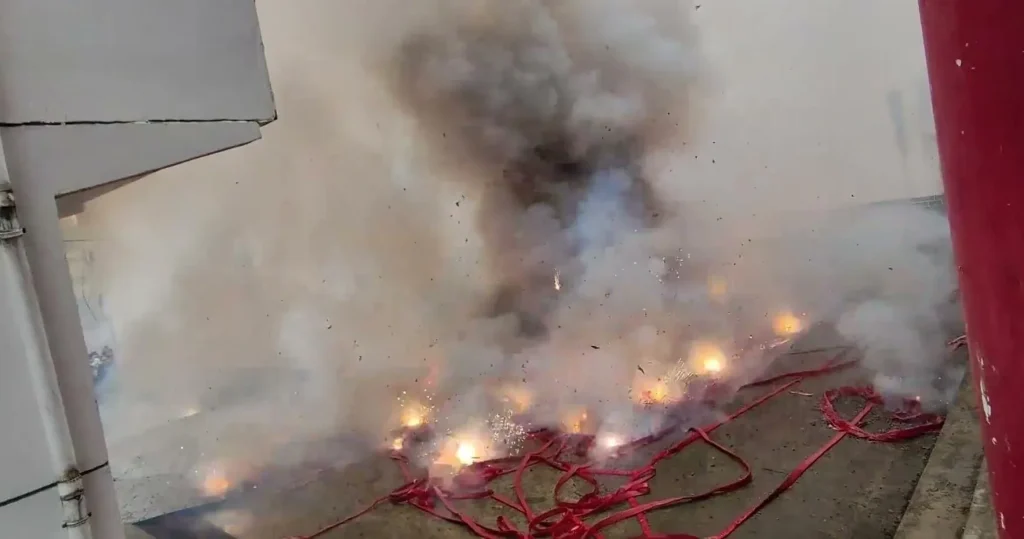
In short
Most of the noise you hear at Chinese New Year comes from firecrackers, not sky rockets. Long strings of small red paper tubes go off at midnight on New Year’s Eve, on the first morning, on the fifth day and at the Lantern Festival, all to scare bad luck and bad spirits away from the new year.
The Chinese word for a firecracker, baozhu (爆竹), means “exploding bamboo,” and the habit is older than gunpowder. Plenty of Chinese cities now limit or ban them, though. Beijing banned fireworks across the whole city in January 2022.
Of all the New Year customs, this is the one I find easiest to explain as a Maoshan Taoist, because its reason has barely changed in two thousand years.
Here is where the custom comes from, when the strings go off, how a long string burns, where you can and can’t set them off, and how to keep the noise without lighting anything.
Why are firecrackers used during Chinese New Year?
Firecrackers are used during Chinese New Year to drive away evil spirits and bad luck at the moment one year turns into the next. Loud bangs and fire were the two things old folk belief said spirits could not stand, so the louder the start of the year, the cleaner it was supposed to be.
That belief has two roots. One is a very old practice of burning bamboo, and the other is a much younger story about a beast called Nian.
Baozhu, “exploding bamboo”: from burning bamboo to paper and gunpowder
The earliest firecracker was a stalk of bamboo thrown on a fire. Heated long enough, the air inside each section expands until the stalk bursts with a crack, and people were doing this as early as 200 BCE.
When gunpowder came along, people packed it into paper tubes shaped roughly like a section of bamboo. They sounded much the same, so the old name stayed. Every firecracker you light today is still called baozhu, exploding bamboo, even though there’s no bamboo in it.
The purpose stayed too. Firecrackers in traditional Chinese culture were for warding off spirits long before they were ever used as weapons or entertainment, and the New Year string is the direct descendant of that habit.
The Nian beast and the older shanxiao story
Ask most people why firecrackers go off at New Year and you’ll hear about Nian, a beast from the mountains or the sea that raided villages at the turn of the year. It feared loud noise, fire and the color red, so villagers banged drums and bowls, wore red and threw firecrackers until it fled.
Here’s the part that surprised me. The earliest written sources that describe Nian as a creature date only to the early twentieth century, so nobody can say whether the beast is an old folk legend or a local tale that got written down late.
The older records talk about something else: firecrackers used to drive off shanxiao (山魈), ape-like creatures of the mountains that first appear in the Shanhaijing, the ancient Classic of Mountains and Seas. As a Taoist I read Nian as the newer face on that older idea. The name changed; the cure, noise and fire at the edge of the year, did not.
When Chinese New Year firecrackers go off: Eve to the Lantern Festival
Driving out the old year’s bad luck only works at the turn of the year, so the firecrackers cluster around a few fixed moments rather than going off all month.
The biggest moment is midnight on New Year’s Eve. Many families stay up to see the new year in, and at twelve the strings go off together, which is why a whole town can sound like one long explosion at that hour.
The next comes on the first morning of the new year, when a family opens the front door and sets off a string before anyone goes out. The idea is to start the year with a bang at your own threshold.
On the fifth day, shops reopen and welcome the God of Wealth with firecrackers, and businesses that can afford it set off long ones. The fifteenth day, the Lantern Festival, closes the season with one more round.
Even where cities still allow firecrackers, those dates tend to be written into the rules. Before Beijing’s full ban, the suburbs that still permitted them allowed them only on New Year’s Eve and the first day, plus 7 a.m. to midnight from the second day to the fifteenth.
How a long firecracker string burns, from laying it out to the red paper afterward
The firecrackers that fill those dates are usually long strings rather than single bangers. The string comes wound on a flat cardboard reel, and in a village courtyard you unroll it across the ground before anyone lights it.
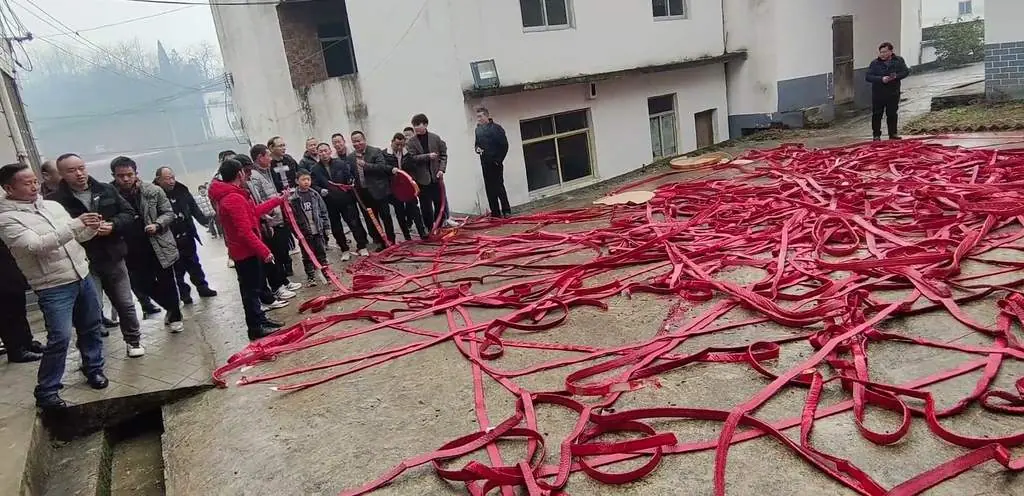
A big celebration can use enough strings to cover the whole yard, with people pulling lengths off the reels and laying them out flat. Laying them flat on bare concrete, away from walls and cars, is what keeps the burning paper where you want it.
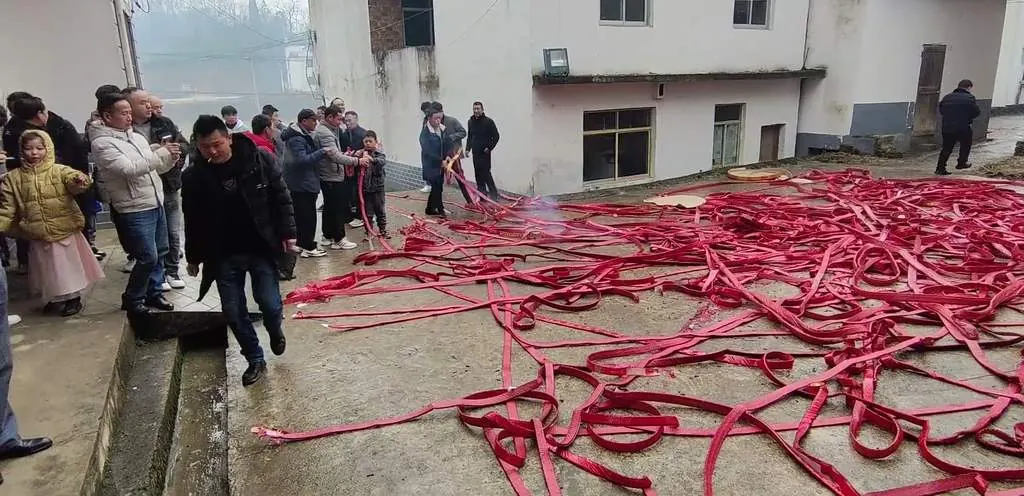
Somebody lights one end and walks away. From there the string does the rest: each tube sets off the next, so the burning point travels along the ground, bang after bang, and a cloud of smoke rises over the whole yard.
Look closely at a single burst and you can see how it moves. Behind the flash is string that has already gone off and turned to shredded red paper; ahead of it is string still waiting its turn.
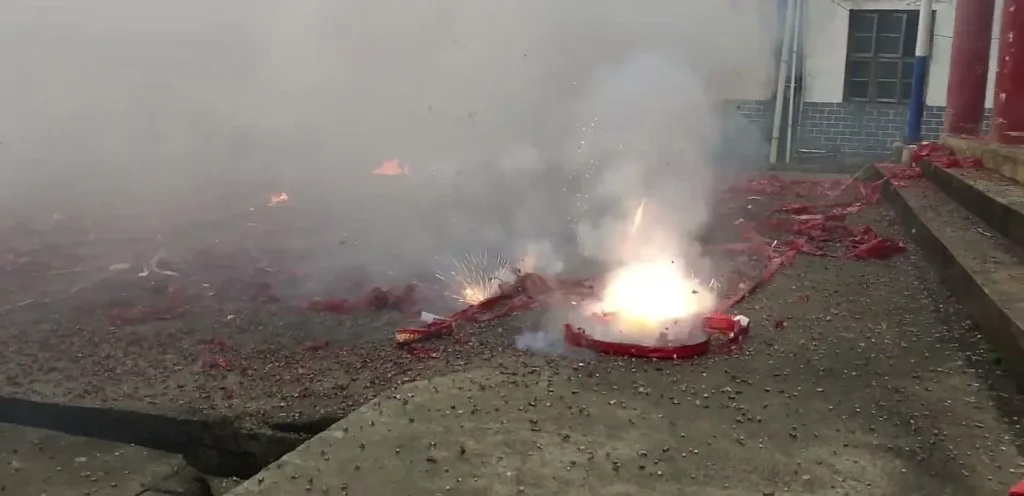
When it’s over, the ground is red. The paper casings lie in drifts, and a few spots keep smoking for a while, so nobody walks straight back in.
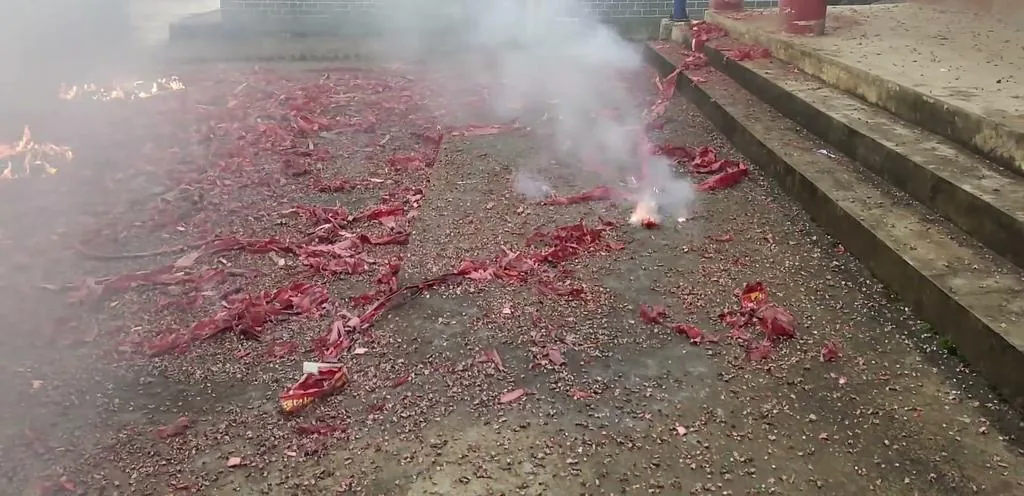
That carpet of red is part of the point. Red is the lucky color of the holiday, and a doorstep covered in it on the first morning looks like a year that started well.
Are Chinese fireworks legal? Where they’re banned or limited
A courtyard in the countryside is one thing; a street of apartment towers is another. Whether you can legally set off Chinese New Year fireworks depends entirely on where you are, and in many big cities the answer is now no.
Beijing and other mainland Chinese cities
Beijing’s urban districts banned firecrackers from 1993 to 2005, then allowed them again.
On December 1, 2017, the city passed a regulation banning fireworks inside the Fifth Ring Road, the beltway around the city proper, citing air pollution and the injuries and deaths fireworks had caused. Before that, setting them off inside the Fifth Ring Road was allowed only at Lunar New Year and the Lantern Festival.
The outer districts kept their own limits until January 1, 2022, when Beijing banned fireworks throughout the city. Shops stopped selling them for that year’s Spring Festival, the Chinese name for the New Year holiday. The one exception was Universal Beijing Resort, allowed to stage police-approved displays, and any official show is approved and announced by the city government.
Other mainland cities set their own rules, and they change from year to year, while rural areas have usually been far looser than city centers. If you’re traveling for the 2027 holiday, check the local announcement in the weeks before New Year rather than going by an older article, this one included.
Hong Kong, Singapore and the US
Hong Kong banned firecrackers and fireworks for security reasons in 1967, after the bomb attacks of that year’s riots, and the ban still holds. The government puts on its own fireworks display over the harbor on the second day of Chinese New Year instead.
Singapore banned them partly in March 1970, after a fire killed six people and injured 68, and fully in August 1972. Since 2003 only government-approved people may set them off. At midnight on the first day, firecrackers go off under controlled conditions at the Chinatown light-up. Malaysia bans private use on paper, but enforcement over the festival is light.
In the US, states and cities set the rules, so the answer can change from one town to the next. New York City lifted its decade-old ban in 2007 for a display of 300,000 firecrackers in Chatham Square, Chinatown.
If you want to light your own, ask your local fire department first. For many people the public celebrations are the easier answer.
Chinese New Year firecracker safety: what the injury numbers show
Bans like Beijing’s didn’t come out of nowhere. Beijing officials counted dozens of people injured or killed in fireworks accidents during the Lunar New Year periods between 2015 and 2017, and in February 2026 Chinese state media reported at least 12 people killed in an explosion and fire at a fireworks shop in eastern China.
US numbers give a sense of who gets hurt. The US Consumer Product Safety Commission received reports of 8 fireworks-related deaths in 2023, a number it treats as a minimum, and estimates 9,700 injuries treated in hospital emergency rooms that year.
In its study month around the Fourth of July, firecrackers alone accounted for about 800 of those emergency room visits, and sparklers for about 700. Hands and fingers took about 35% of the injuries, the head, face and ears about 22%, and the eyes about 19%.
Those figures come from American holidays, not Chinese ones, but the firecracker is the same object, and the injuries land on the same hands and faces. A few habits cover most of the risk:
- Lay the string flat on bare ground, away from buildings, cars, dry plants and anything that burns.
- Light one end, then walk away at once; never hold a lit string in your hand.
- Keep children back with an adult, and keep a bucket of water or a hose nearby.
- Leave a dud alone and soak it in water rather than relighting it or leaning over it.
- Wait for the smoke to clear and the last spots to stop smoking before walking back over the paper.
Ways to keep the noise without setting off firecrackers yourself
If the rules where you live, or common sense, rule out a string of your own, the custom has always had other ways to make noise and show red.
The simplest is to go where someone else is doing it legally. Hong Kong’s harbor show, Singapore’s Chinatown countdown, official displays in Chinese cities, and the parades in US Chinatowns such as San Francisco’s all keep the noise going without you holding a lighter. Some cities have added drone light shows to their New Year programs as well.
At home, drums, gongs and banging pots do the old job; in the Nian story the villagers beat drums, plates and empty bowls as well as throwing firecrackers.
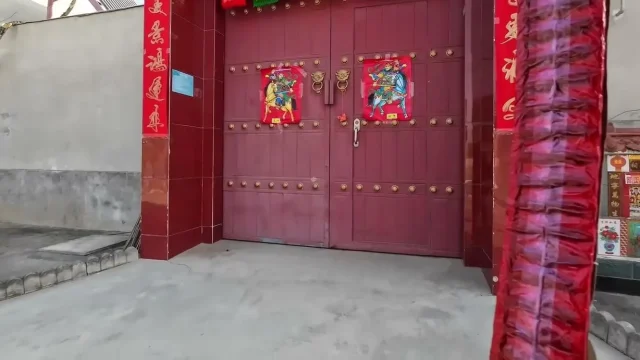
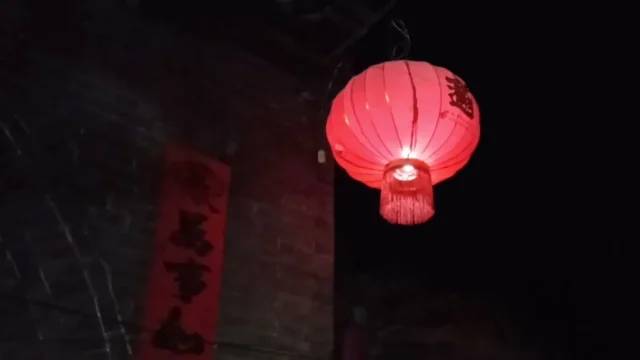
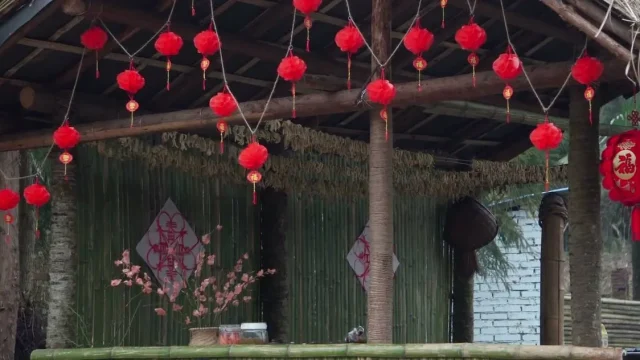
Electronic firecracker strings that flash and crackle on a speaker are popular in apartments. Red decorations, red lanterns at the door and red clothes carry the same message the noise does.
For my part, I don’t think the spirit of the custom lives in the gunpowder. What matters is marking the turn of the year loudly and brightly, on purpose, at your own door; a drum at midnight does that job, and so does a pair of red lanterns lit on the Eve.
Written by

Daozhang MaMaoshan Taoist, Jintan, Jiangsu
Daozhang Ma is a Maoshan Taoist who has practiced for 22 years and is skilled at writing talismans and painting Taoist pictures. He runs Zodiac & Tradition.
About Daozhang Ma