Chinese New Year Jewelry: Gold, Longevity Locks, Red String
By Daozhang MaMaoshan Taoist, Jintan, Jiangsu

In short
Chinese New Year jewelry comes down to three things: gold, longevity locks and red. Gold bangles and pendants are the classic New Year purchase and gift, and in China the weeks around Spring Festival are a peak season for buying gold. Babies and small children often wear a gold or silver longevity lock (changmingsuo, 长命锁) on a red cord, and anyone entering their own zodiac year is told to wear red. The sections that follow take gold, the baby locks, silver and red one at a time, with a look at real pieces and a few things to check before you buy one as a gift.
Gold for the New Year: bangles and pendants
Gold is the default because it does two jobs at once. It’s an ornament you wear to the New Year dinner, and it’s savings you can sell later, so nobody feels a gold gift was money wasted. The color reads as wealth and good luck, which is exactly the wish you make for the coming year.
The habit isn’t only for the older generation anymore. A Chinese article from February 2022 about young people’s new taste for gold described young shoppers picking out heavy gold bangles during the 2021 Spring Festival, the same people who used to laugh at “big gold chains.” Gold had gone from a parents’ thing to something people in their twenties wanted for themselves.
A plain bangle for your mother is about as classic as it gets, and having one made by hand is the more personal version. The bangle below has a hammered, matte surface instead of a high polish. I like that kind of finish better than a mirror shine; it hides scratches and looks good after years of daily wear.
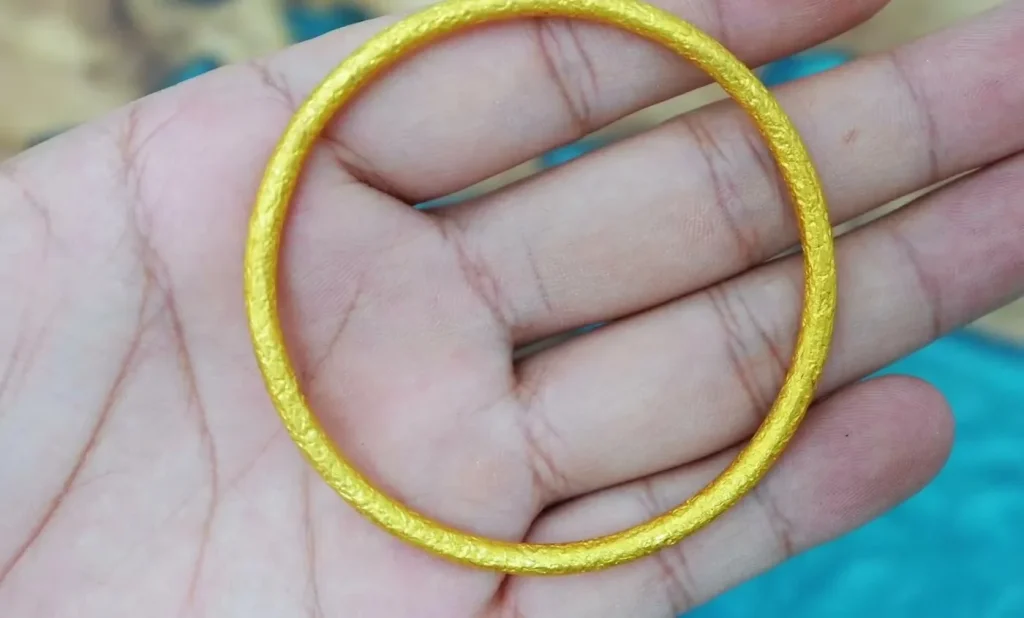
Bangles aren’t only for women, either. The man below brought in about 30 grams of his own gold and had it made into a plain open-ended bangle, about as simple as a gold bangle gets.

Pendants are the other common gold piece. Shops stock small gold zodiac animals ahead of the holiday, both the sign of the coming year and all twelve, and many people hang one on a red cord instead of a chain. You’ll also see small gold beads sold as “luck-turning beads” (zhuanyunzhu, 转运珠), strung on red string for the wrist, though you’ll see them on black cord too. For men, a zodiac pendant on red cord or a plain gold chain is the usual choice. If you’re not sure which animal someone was born under, the twelve signs are laid out on our zodiac and festival home page.
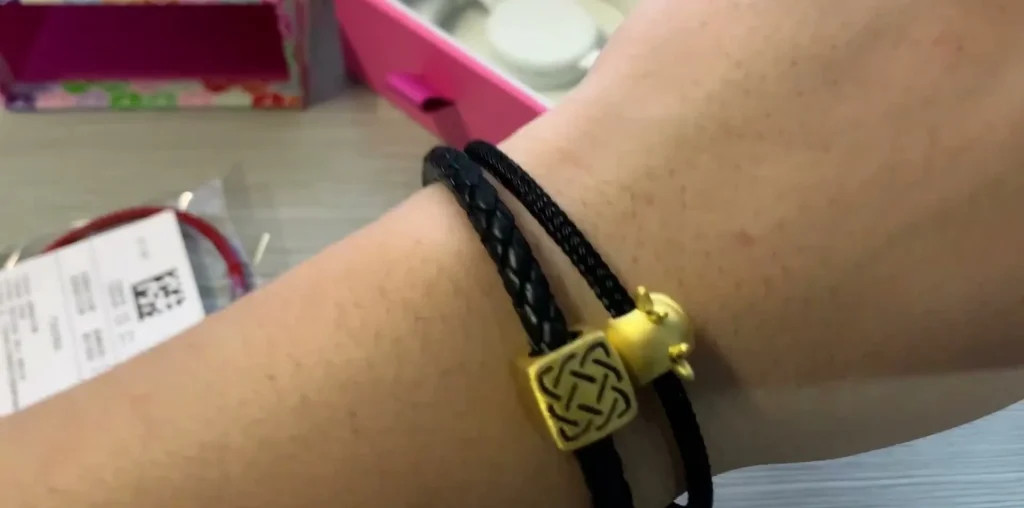
If you’re buying gold in a Chinese shop, look at the stamp on the back. The two characters 足金 (zujin) mean pure gold, and you’ll often see them on bangles and zodiac pendants. Pure gold is soft and dents easily, which is one more reason the hammered and matte finishes are popular.
Longevity locks (changmingsuo) for babies
A longevity lock is a pendant shaped like an old Chinese padlock, usually in silver or gold, hung around a baby’s neck. The common explanation is that the lock “locks” the child safely to this life and keeps illness and bad luck away. That’s the folk reading you’ll hear from grandparents, not a rule written down anywhere, and families take it as a wish rather than a promise.
The usual moment to give one is the 100-day celebration (bai sui, 百岁), when a baby has made it through the first hundred days. Friends and relatives bring gold or silver locks in red boxes, and it isn’t unusual for a baby to end up with more than one. A child who gets a lock often keeps wearing it, so you’ll see them at New Year visits too.
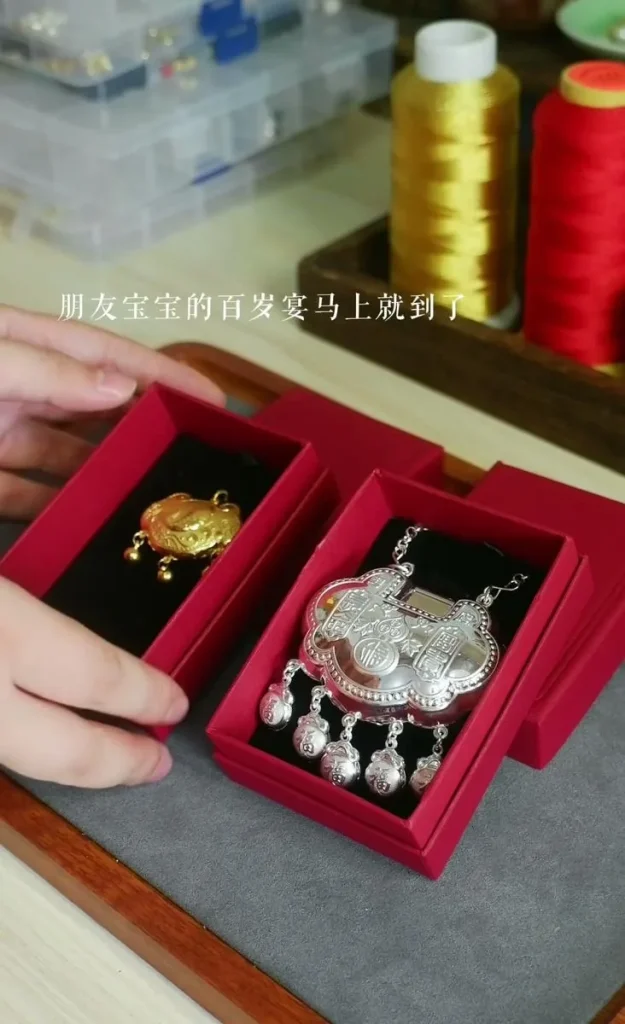
What the symbols on a gold lock mean
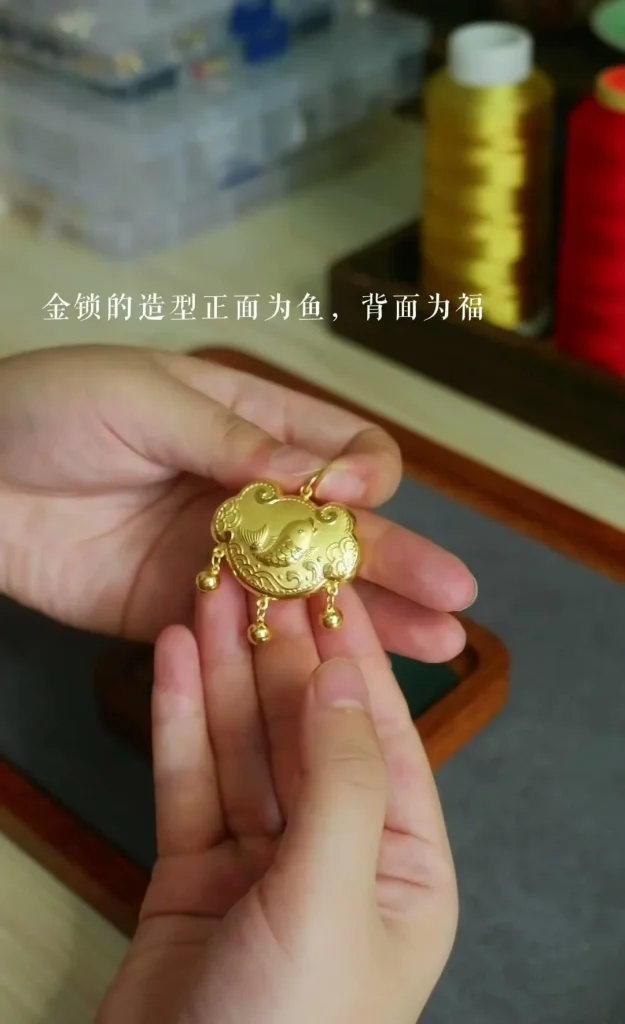
Every part of a lock carries a wish. The small gold lock below has a fish on the front and the character 福 (fu, good fortune) on the back. Fish is yu in Chinese, which sounds like the word for “surplus,” so a fish wishes the child more than enough. Three tiny bells hang from the bottom edge, and the bells are a standard feature on baby locks.
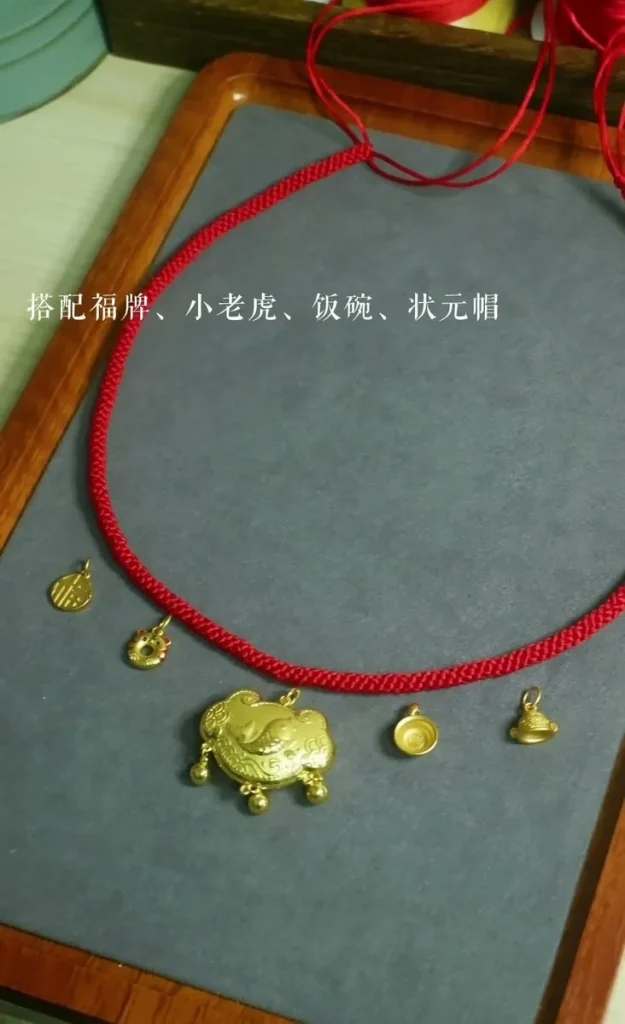
Small gold charms often go on the cord next to the lock. On this one there are four: a fortune plaque, a little tiger, a rice bowl and a scholar’s hat. The usual readings are easy to follow. The tiger stands for strength and courage, the rice bowl for never going hungry, and the scholar’s hat for doing well in school, since it’s the hat of the top scorer in the old imperial exams.
Stringing the lock on a red cord collar
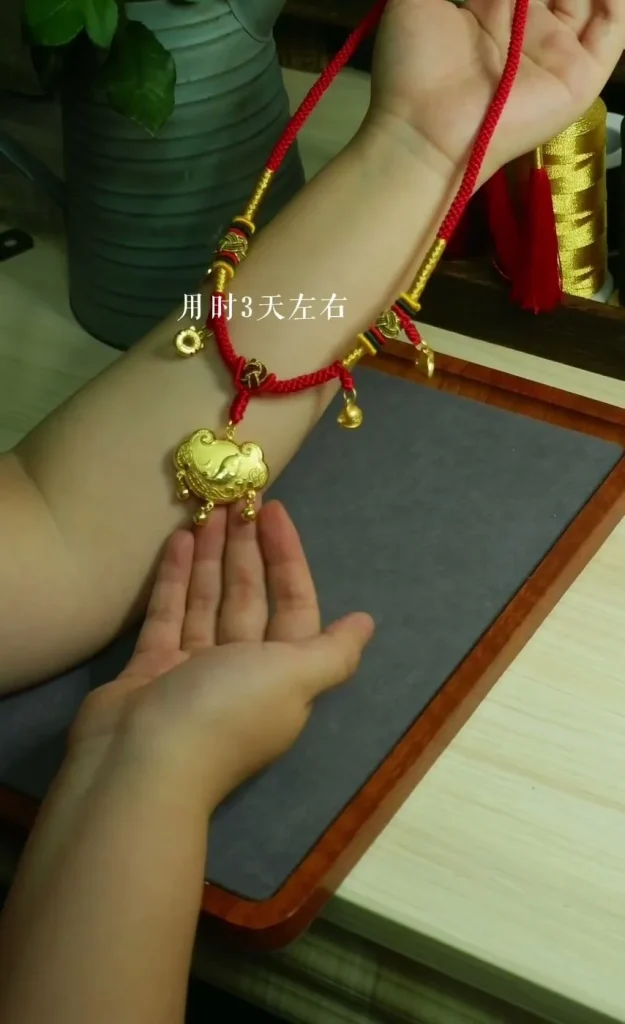
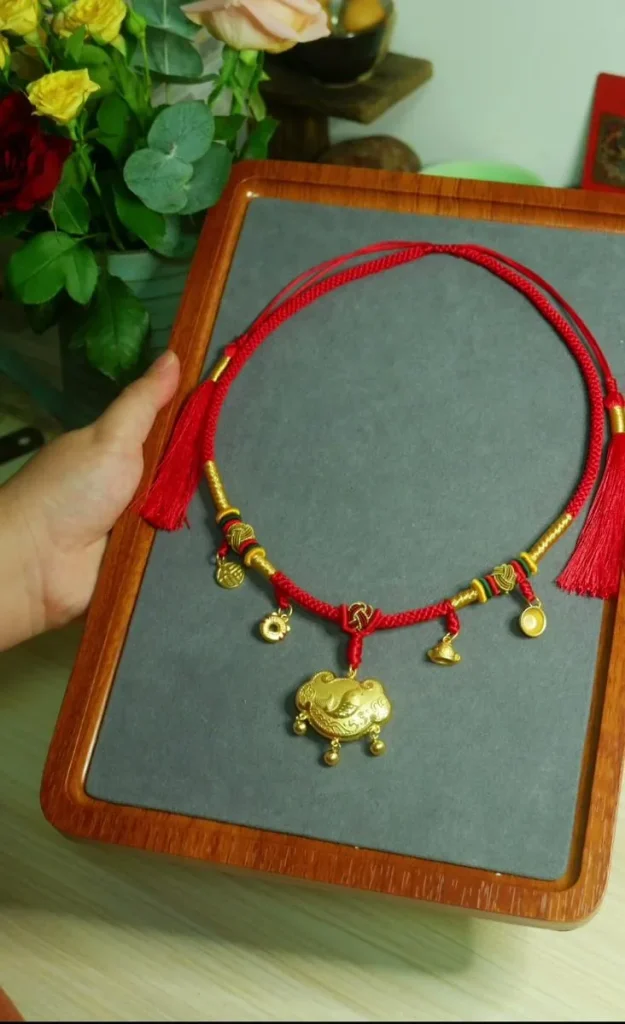
Instead of a gold chain, a lot of families put the lock on a braided red cord, which is softer on a baby’s neck and adds the lucky red. The collar here was knotted by hand, with the small charms spaced along the cord and a red tassel on each side. It took about three days to finish, so a hand-braided collar is a gift people notice.
Laid flat, you can see how the charms sit in pairs between knots, with the lock hanging lowest at the center.
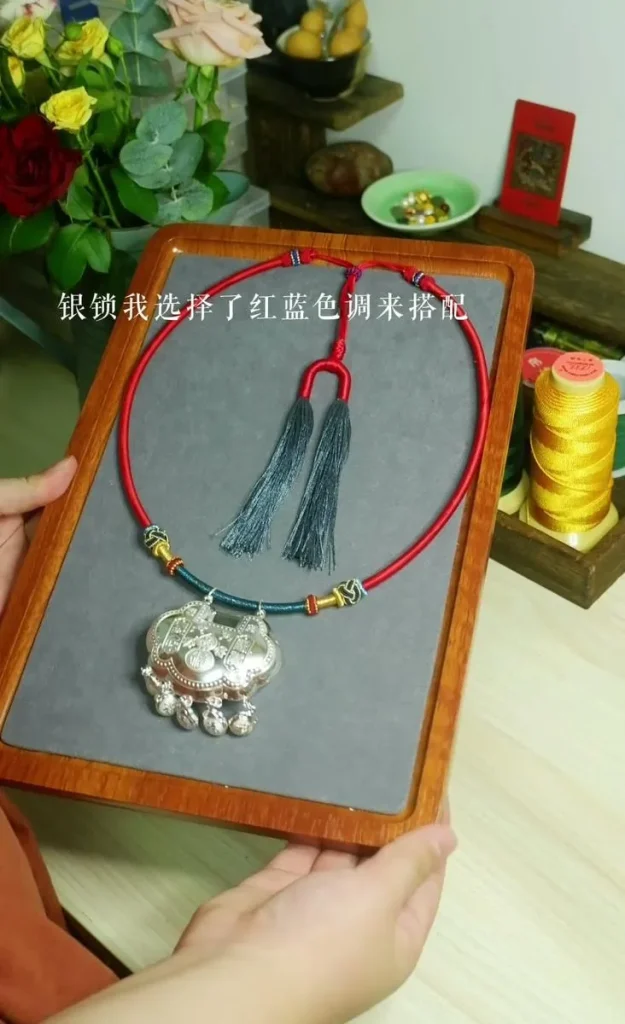
A silver lock doesn’t have to go on plain red. This silver lock is strung on red cord mixed with blue-green and finished with two gray-blue tassels, which suits the cooler color of silver.
Silver locks and bangles worn by children
Gold makes the showier gift, but silver is what a lot of babies actually wear day to day. It costs far less, so nobody worries when a toddler bangs a bangle against a table. Grandparents often give a whole silver set, and it’s common for it to arrive still sealed in its bag inside a red box.
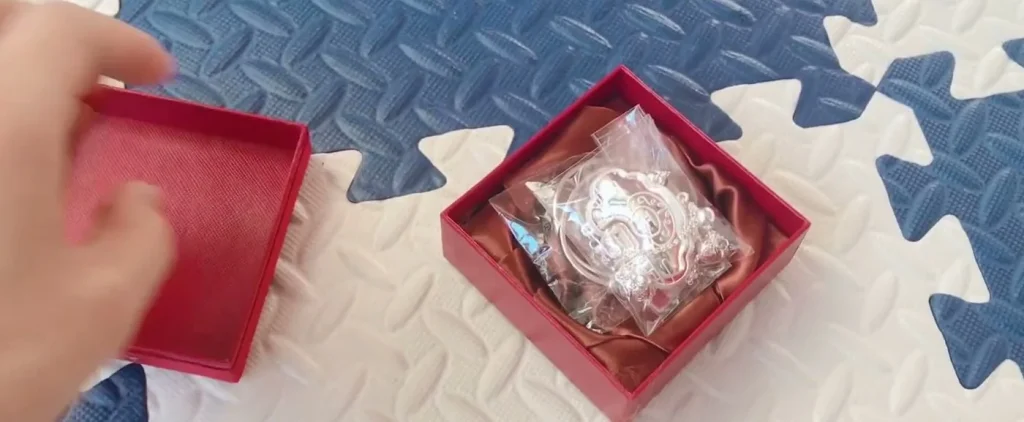
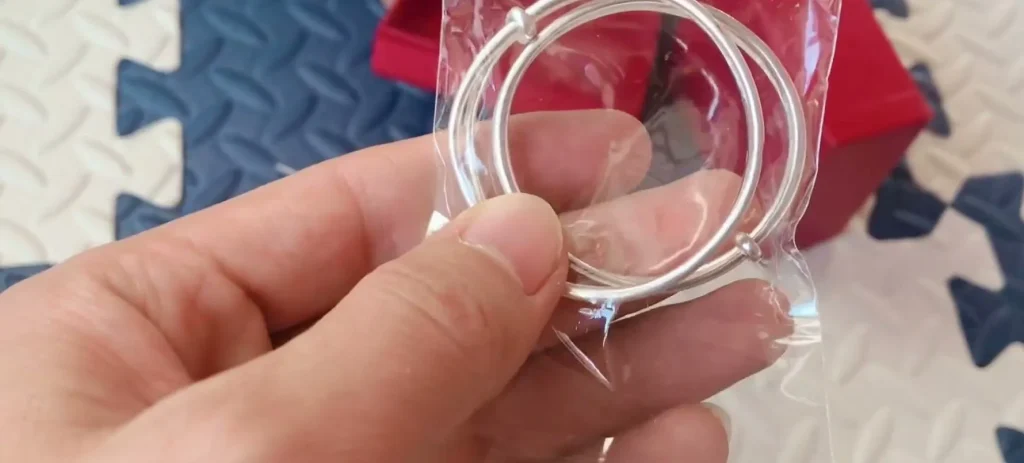
Baby bangles usually come as a pair, one for each wrist, and the plain round ones are the most common. They’re small enough to slip over a baby’s hand without a clasp.
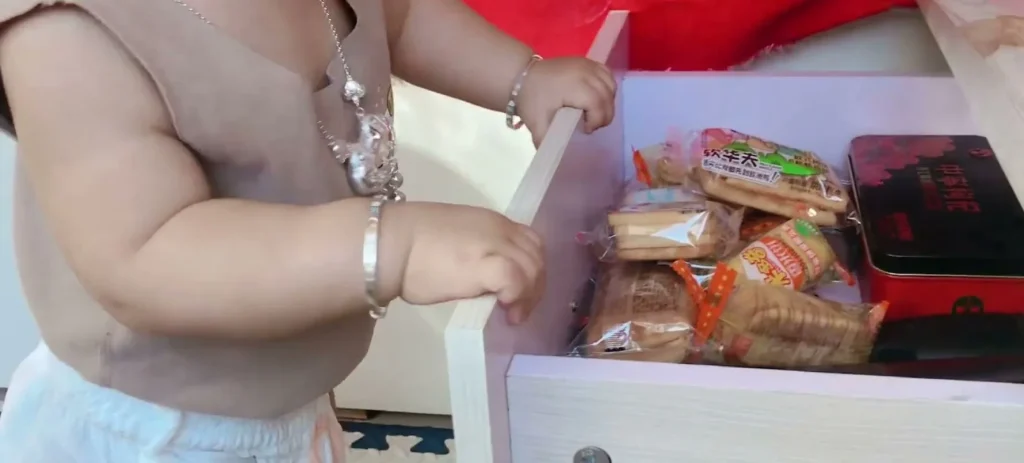
Once the 100-day celebration is over, the lock and bangles go on and mostly stay on. The baby below wears a silver lock on a chain and a silver bangle at home while digging through a snack drawer. If you’re giving baby jewelry, check that bells and small charms are fixed on firmly, since they’re small enough to swallow.
Red string for your zodiac year (benmingnian)
Red is the other half of Chinese New Year jewelry, and it matters most to people entering their zodiac year, called benmingnian (本命年). That’s the year of your own animal sign, which comes around every twelve years, and tradition treats it as a year when your luck is shaky. The answer is to wear red, and a red string on the wrist is the simplest way.
The older custom goes further. A Chinese folklore piece on benmingnian describes adults and children alike tying on a red waist sash in their zodiac year, a practice called zha hong (扎红, “tying on red”). It also notes that Spring Festival markets sell red and yellow lucky ribbons for exactly this, worn at the waist or around the wrist.
For the Year of the Goat, which starts on February 6, 2027, that means anyone born in a Goat year: 1967, 1979, 1991, 2003 or 2015. People born in January or early February should check the date of that year’s New Year first, since they may belong to the sign before. A red string with a small gold zodiac charm is a thoughtful gift for someone in their year.
Red hair accessories for New Year outfits
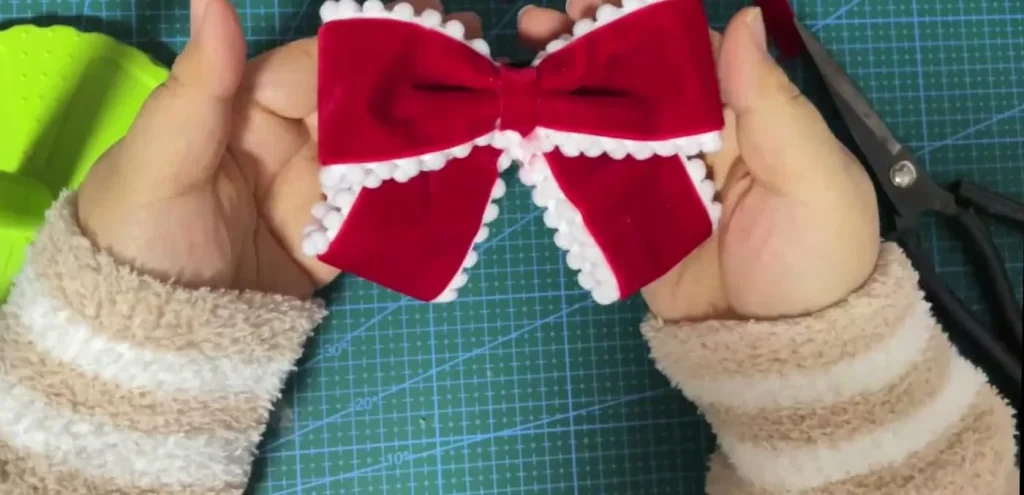
Girls’ New Year outfits usually come with something red in the hair: bows, flowers, pompoms or clips. Red velvet is a favorite in winter because it looks warm and catches the light. These aren’t heirlooms like a lock or a bangle; they’re worn for the holiday and the photos, and many parents make them at home.
Choosing Chinese New Year jewelry as a gift
The easiest way to choose is by who it’s for. For a new baby, a longevity lock or a pair of plain bangles fits, gold if it’s a keepsake and silver if it’ll be worn every day. For parents, a gold bangle or a gold zodiac pendant is the safe, traditional pick. For a friend whose zodiac year is coming, go with red string, ideally with one small gold charm.
Presentation counts as much as the piece. The locks and the silver set in the photos above came in red boxes, and that’s the norm, since red is the color of the holiday. In my view a simple design in good gold beats a busy one in thin gold; the plain hammered bangle is still the piece I’d hand to a parent.
Written by

Daozhang MaMaoshan Taoist, Jintan, Jiangsu
Daozhang Ma is a Maoshan Taoist who has practiced for 22 years and is skilled at writing talismans and painting Taoist pictures. He runs Zodiac & Tradition.
About Daozhang Ma