Dragon Dance for Chinese New Year: Meaning and Origin
By Daozhang MaMaoshan Taoist, Jintan, Jiangsu
In short
Nine dancers, nine poles and one long cloth dragon make up the core of a dragon dance, wulong (舞龙) in Chinese. A tenth performer runs ahead with a ball on a stick, the pearl, and the dancers swing their poles in turn so the dragon rolls after it in a wave, to drums, gongs and cymbals.
Chinese communities bring the dragons out at Lunar New Year, from the first day through the Lantern Festival, because the dragon stands for power, wisdom and good fortune, and its dance is meant to chase off bad luck for the year ahead. The longer the dragon, the more luck it is said to bring.
Under the festival sits an older layer, the one I notice first as a Maoshan Taoist. Before it was New Year entertainment, the dragon dance was a way of asking the dragon for rain, and that history still shapes where the dragon is kept and why it comes out in the first weeks of the year.
Below I go through how the dance works, why it belongs to the New Year, how a dance dragon is built, one full performance at a street festival in Chaoshan, where the dance came from, the regional styles, how to tell it from a lion dance, and where to see one.
What happens in a dragon dance: poles, a pearl and a moving wave
The dragon itself is a long tube of cloth stretched over hoops, with a decorated head at the front and a tail at the back. Poles of wood or aluminum are fixed under it at even intervals, and each dancer holds one, so the team spreads out along the body from head to tail.
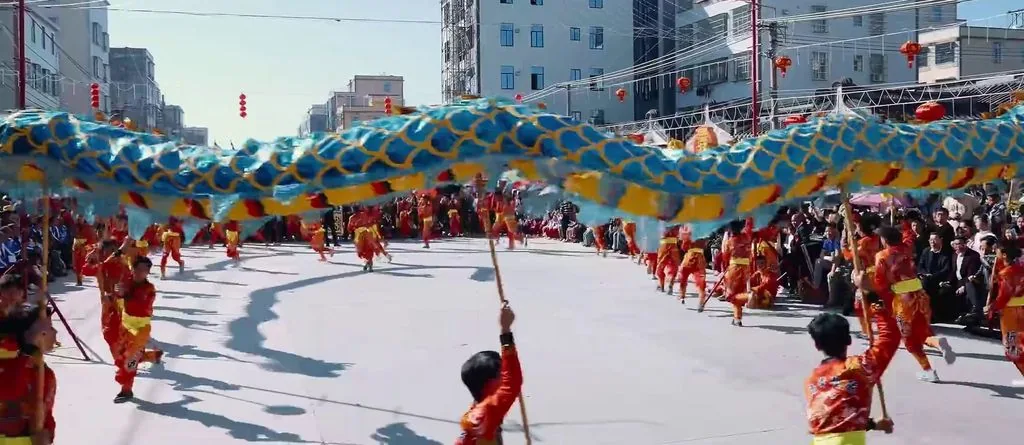
The head dancer has the hardest job. On a large parade dragon the head can weigh almost 32 pounds (14.4 kg), and it sets the timing for everyone behind it by moving to the drum.
The tail has to answer every move the head makes. The dancers around the fifth section, the middle of a standard dragon, need to stay alert as well, because the body changes direction there most often.
The basic movement is the wave. Each dancer swings a pole a beat after the person in front, so the motion travels down the body and the dragon seems to swim through the air. From that base, teams run in spirals so the body twists over itself, jump over or through its sections, and climb onto each other’s thighs and shoulders to lift it higher.
Out in front, the pearl leads. Its carrier swings the ball left and right, up and down, and the head follows wherever it goes. The routine is often called dragon chasing the pearl, and because the pearl stands for wisdom, the dance shows a dragon that never stops going after it.
So how many dancers does a dragon need? A Vancouver club, Chau Luen Athletics, puts nine dancers under a 59-foot (18 m) dragon plus one on the pearl, and swaps in a second full team of ten, pearl included, for parades longer than two hours. One or two drummers and three or four cymbal and gong players keep the beat.
Why the dragon dance comes out at Chinese New Year
Dragons are danced at Chinese New Year to drive off evil spirits and bad luck and to bring prosperity for the coming year, so the moving dragon is a blessing on every street it passes. In Chinese culture the dragon stands for power, dignity, wisdom and good fortune, and it was long the emperor’s emblem.
In China and in Chinatowns abroad, dragons turn up from New Year’s Day to the Lantern Festival on the 15th day of the first lunar month, in parades, at temple fairs and along shopping streets. Being touched by the dragon as it passes is counted as lucky, so people near the front often lean in rather than step back.
Length counts as well. The longer the dragon, the more luck it is said to bring to the community, which is why towns sometimes build dragons far longer than any team could dance. Hong Kong holds the record for the longest dragon, 18,390 feet (5,605 m), set on October 1, 2012.
Color carries its own meaning. Green is linked to a good harvest, yellow to the empire, gold or silver to prosperity, and red to excitement and good fortune, so a town’s choice of dragon says something about what it is hoping for. The bright red and gold dragons common in Chinatowns lean on the last two.
How a dance dragon is built: head, hoops, scales and odd-numbered sections
All that luck has to ride on a body light enough to swing. A dance dragon is made of separate sections joined by their hoops into one long tube, covered in fabric, with the ornamental head and tail fixed at either end. Older dragons had wooden frames, bamboo hoops and heavy cloth; newer ones use aluminum and plastic to cut the weight.
The recommended body runs about 110 feet (34 m) in nine major sections, with the small rib-like hoops spaced about 14 inches (35 cm) apart, which gives 81 rings. Nine is a deliberate choice. Odd numbers of joints are considered lucky, so dragons are commonly built with 9, 11 or 13 sections, and some go much longer.
Size depends on how many people, how much money and how much open ground a group has. A small display dragon can be about 6 feet (2 m) long and worked by two people, acrobatic dragons usually run 80 to 110 feet (25 to 35 m), and parade dragons reach 160 to 230 feet (50 to 70 m).
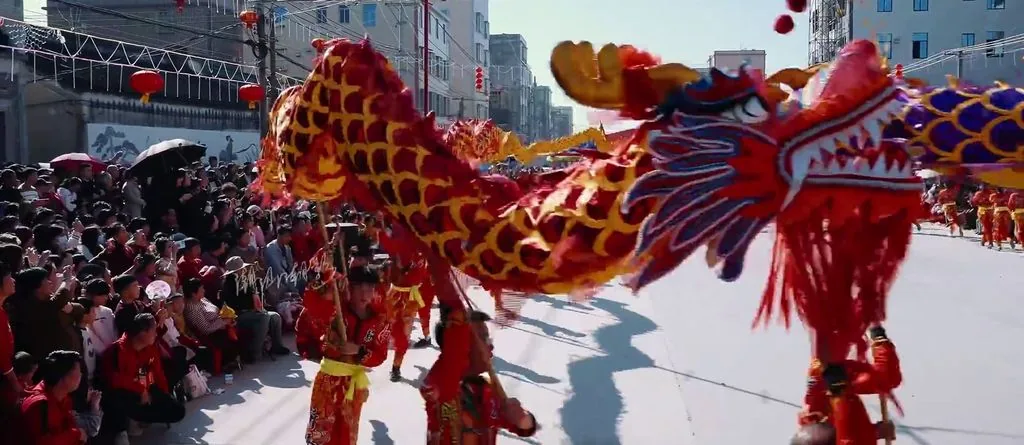
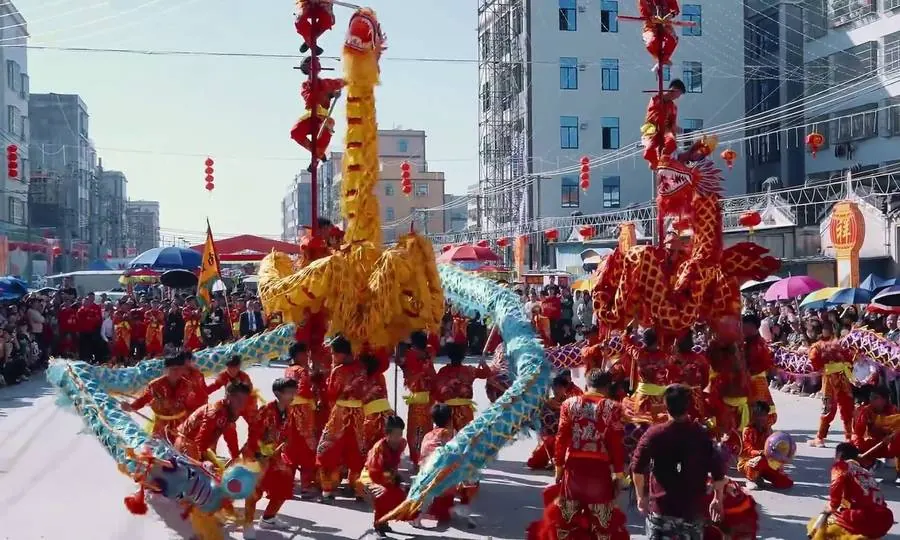
The head gets the most decoration, and on a street with several teams each dragon has its own face. On the Chaoshan street pictured in this guide, one head is indigo with a red mane, gold whiskers and antlers, its jaws open over the pole that carries it.
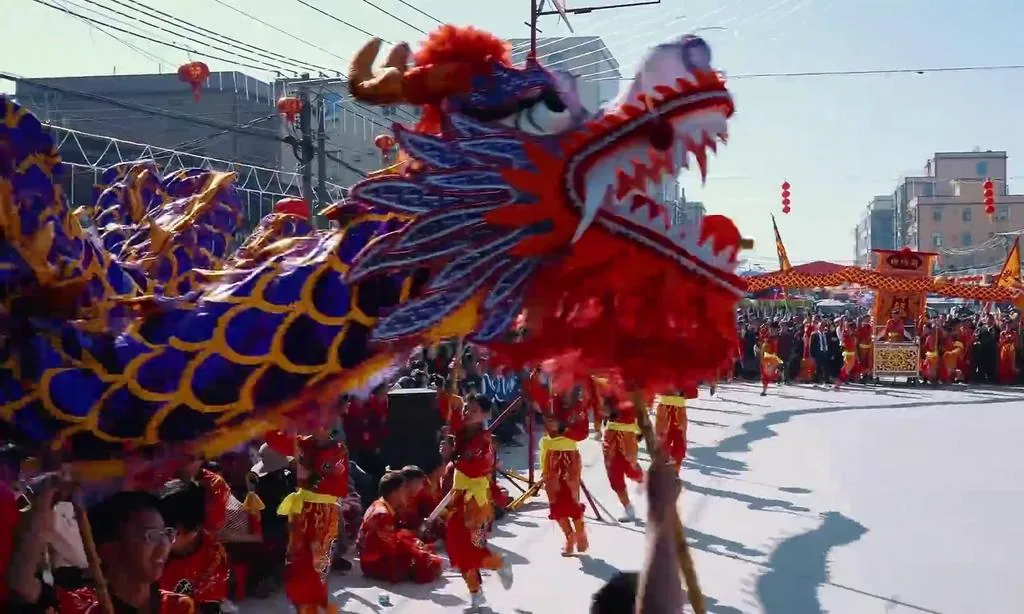
Another is red and gold with blue fins at the sides, and a third is turquoise with purple brows and a red pompom hanging under its chin. The colors let the crowd follow one team’s dragon through a street full of them.
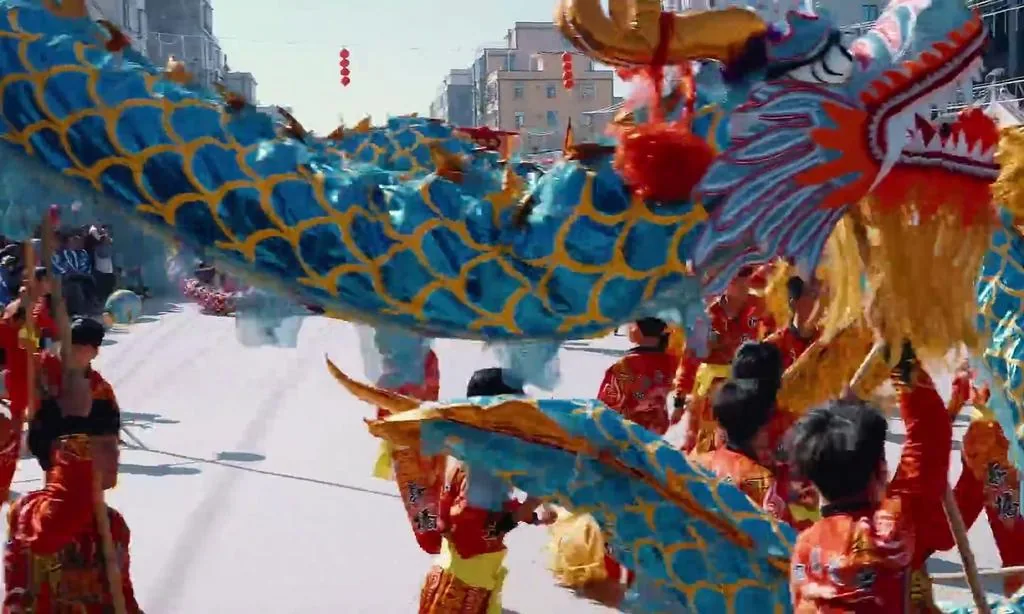
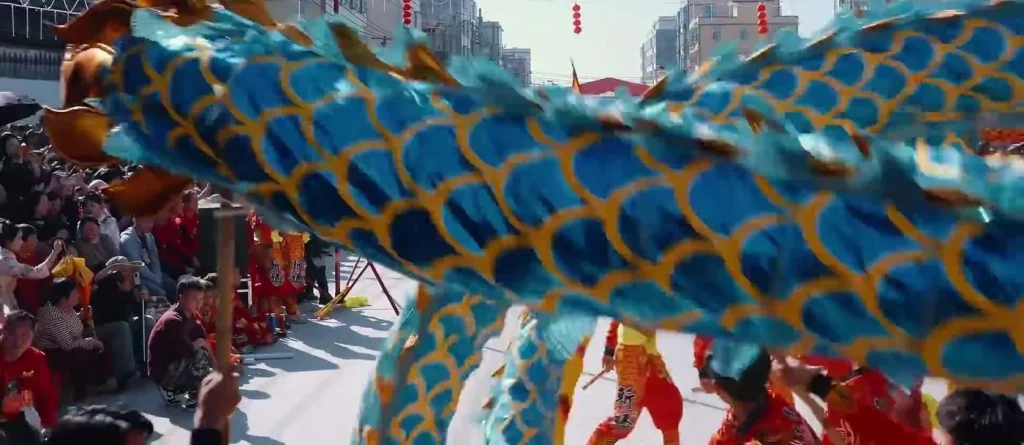
Along the body, the skin is rows of overlapping cloth scales, each edged in gold, so the dragon flashes as it turns in the sun. Because a dragon only dances on special days, troupes touch up the cloth and paint before each performance, and a dragon that is worn out is traditionally burned rather than kept.
One dragon dance from start to finish, at a street festival in Chaoshan
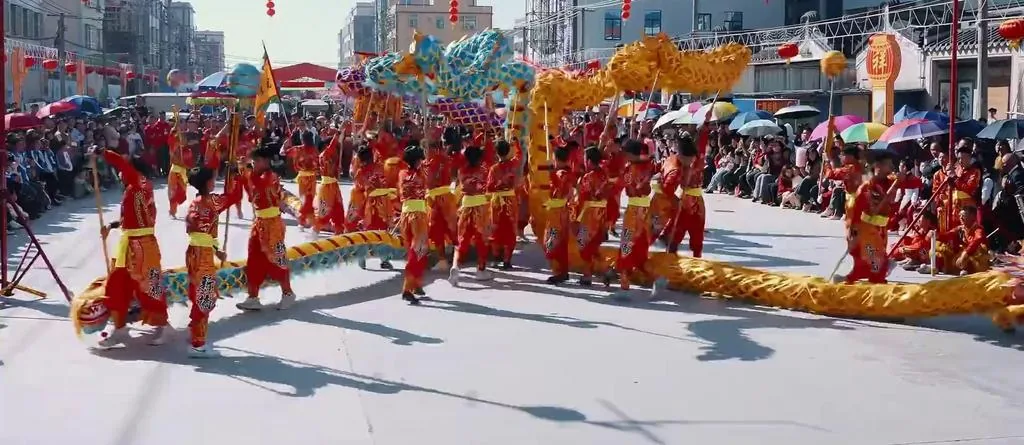
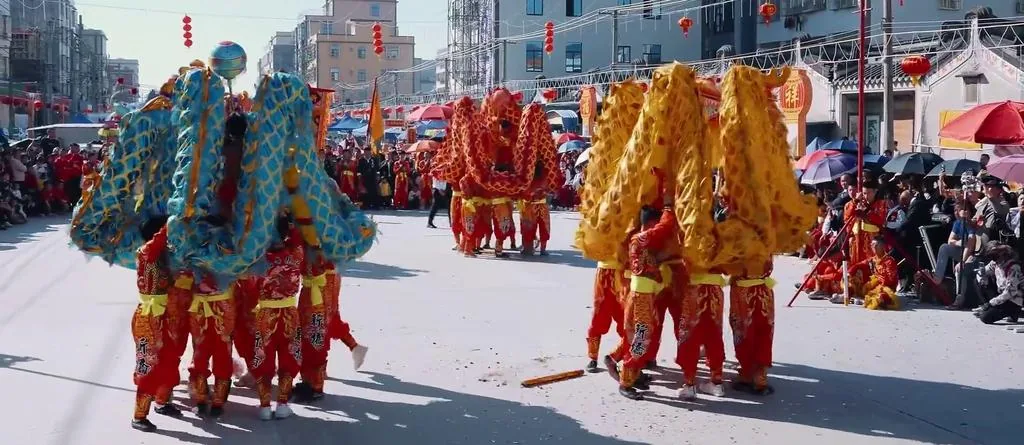
Knowing the parts is one thing; seeing a whole team move them is another. At a town festival in the Chaoshan region of eastern Guangdong, several teams in red jackets and yellow sashes bring their dragons onto one street, and the crowd sits along the curbs under umbrellas, close enough to be brushed by a passing tail.
In many places the dance begins before any dragon reaches the street. The body is kept in a local Dragon King temple and brought out only on the day, with banners, drums and horns. The head and tail are joined to it and the eyes are dotted so the dragon comes alive, and then the pearl takes the lead.
Coiling the dragon into a ring and stretching it into a line
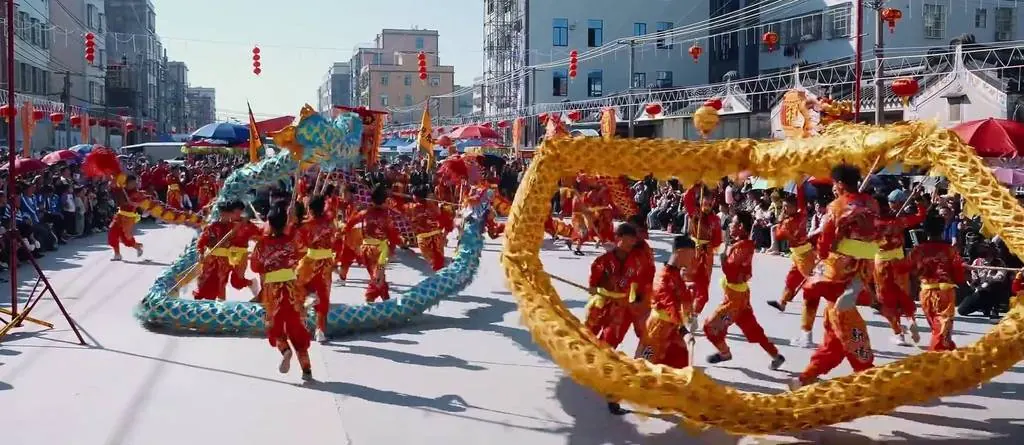
Coiling shows how well a team runs together. The lead dancers curve inward and everyone behind follows at a run, until the whole golden dragon lies in a wide ring on the street with the dancers moving inside it. One dancer out of step and the ring breaks into an awkward bend.
The classic repertoire gives these shapes names: cloud cave, whirlpool, the tai chi pattern, threading the money and looking for the pearl. Each name describes the path the body draws on the ground or in the air, so a team that calls out “whirlpool” knows exactly which way to run.
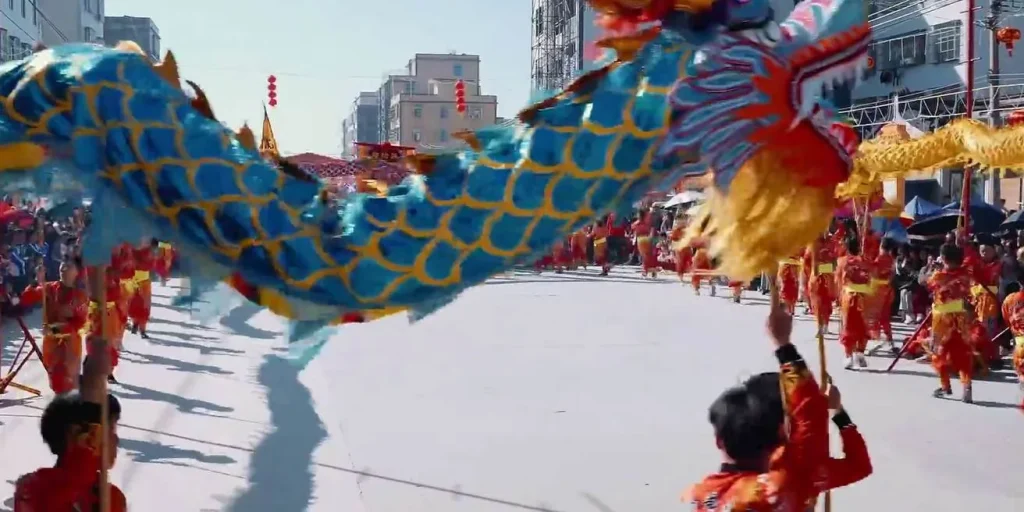
The opposite move is the straight line. Pulled taut, with every dancer holding a pole at the same height, a dragon shows its full length at once, like the blue dragon stretched across the street near the top of this guide.
Raising the dragons into upright columns
Partway through, the teams turn their dragons vertical. The dancers close in on each other and push their poles straight up, so the body stands as a tall column of scales above their heads, and blue, red and gold dragons rise side by side.
Lifting a dragon higher than arm’s reach takes the same stacking used in the wave, with performers standing on teammates’ thighs and shoulders. A column only holds if the dancers at the bottom keep still while those above them reach up, which is harder than any run.
I read the upright dragon as the rain dragon rising toward the clouds, the way dragons are painted on temple walls. I can’t say every team means it that way, but the image of a dragon climbing straight up is an old one in Chinese art, and the move suits it.
Dragon encircling the pillar: the pole-climbing finale
The last big move uses tall poles set up in the street. Performers climb to the top, one to a pole, while the dragons coil in a tight knot below them, ready to go up.
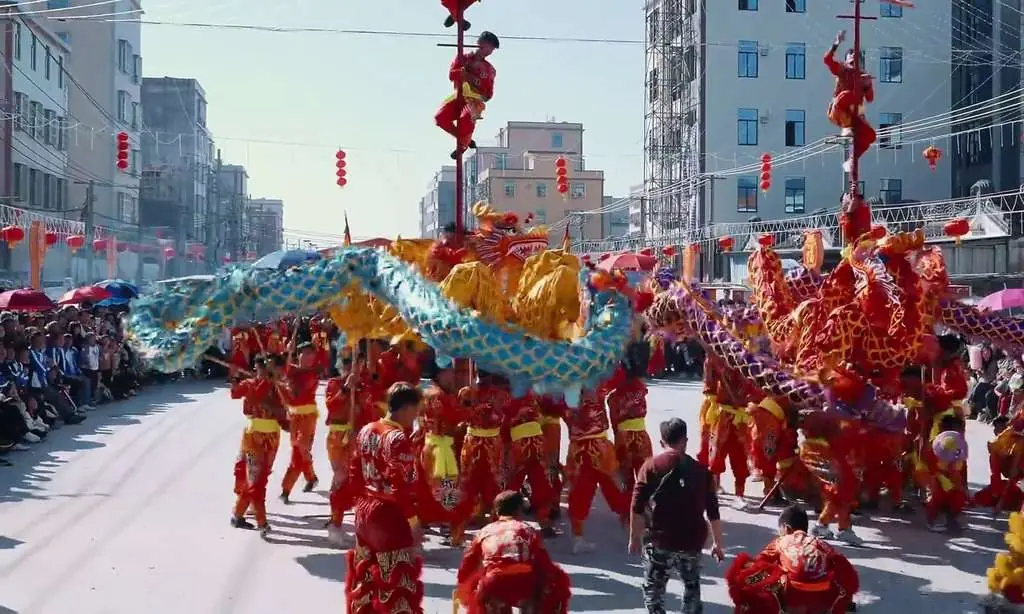
Then the golden dragon winds up its pole in loops, its head passed up to the climber at the top, while a red dragon goes up a second pole and the blue one circles the base. The move is known as dragon encircling the pillar, one of the named patterns in the classic repertoire, and firecrackers go off around the knot of dragons as it finishes.
What happens after the last loop depends on the place. In some towns the head and tail are burned once the festival is over and the body goes back to the temple to wait for the next year. A popular team may also be invited to five or six banquets in a row, a custom called trading the dragon for wine.
Where the dragon dance came from: rain prayers to the Dragon King
That trip back to the temple points to where the dance began. The dragon dance goes back to the Han dynasty (206 BCE to 220 CE), when it belonged to rituals for worshiping ancestors and praying for rain.
Dong Zhongshu’s Han text, Luxuriant Dew of the Spring and Autumn Annals, describes making clay dragons for a rain ritual. Children or adults danced, and the dragons’ number, length and color changed with the season.
The Han court also staged dragon acts in its baixi variety shows, where performers dressed up as beasts, fish and dragons. One act, the fish-dragon extending, turned a fish into a dragon to entertain foreign guests. Han stone reliefs suggest those props were heavy, though, closer to a pageant than to the light dragon on poles that teams use now.
By the Tang and Song dynasties, dragon dances had become a regular part of festivals such as the New Year. Song writers describe dragon lanterns of grass and cloth, lit from inside with candles and paraded at the Lantern Festival. Regional styles kept branching off from there, and the Fenghua cloth dragon of Zhejiang, a bamboo frame under cloth, is said to date to the 1200s.
From where I stand as a Maoshan Taoist, the rain story is the one that ties the rest together. In Taoist and folk temples the Dragon Kings, Longwang (龙王), are the officials in charge of rain, rivers and seas, and villages turn to them in drought.
A dragon carried out of the Dragon King’s temple at the start of the farming year still follows that logic, even when the crowd is there for the show.
A well-known legend tells of a boy in a village called Lotus, born with dragon scales, who escaped the village chief by turning into a golden dragon and then brought rain whenever drought came. The villagers thanked him with a dragon of lotus petals every Spring Festival. I’d treat it as a story told about the dance, not a record of how it started.
Southern dragons, northern dragons and China’s local dragon dances
As the dance spread across China, it split into regional forms, and the broadest split runs along the Yangtze River. South of it, dragons are heavier and more finely decorated, made for momentum and a grand look rather than fast tricks, and about 10 people carry one.
Northern dragons are smaller and lighter, built from paper or plant fiber. They are often danced after dark, so many are made with fluorescent materials, and their quick, flexible style sits closer to the lion dance. The light, fast dragon that most performing and competition teams use today follows the northern model, and some teams paint it to glow under black light.
Beyond those two families, the number of different dragon dances in China has been put at more than 700. A handful look so unlike the standard dragon that they are worth knowing by name:
- Bench dragon, Pujiang County, Zhejiang. The body is a chain of wooden stools, carried by many families together.
- Human dragon, Zhanjiang, Guangdong. There is no cloth body at all; dozens to hundreds of performers link up to form the dragon themselves.
- Tongliang dragon, Chongqing. It began in the Ming dynasty as snake worship, grew popular in the Qing, and its fire version dances under showers of molten iron.
- Puzhai fire dragon, Fengshun County, Guangdong. Every Lantern Festival since the Qing dynasty, villagers hoist a dragon about 100 feet (over 30 m) long covered in fireworks. It was listed as national intangible cultural heritage in 2008.
- Steel fire dragon, Xiangxi, Hunan. Fireworks shoot from bamboo pipes along the route as the dancers run through the sparks, and some dances end with the dragon run into a river.
Most fire dragons belong to the Lantern Festival rather than New Year’s Day, and they were meant to ward off plague and bring good weather and harvests. If one of them is the reason for a trip, plan around the 15th day of the first lunar month.
Dragon dance vs lion dance: how to tell them apart
With so many dragons in play, it is no surprise that the most common mix-up at New Year has nothing to do with regional styles. People confuse dragons with lions, and lion dance troupes in both Sydney and Vancouver say audiences call their lions dragons all the time.
The quickest test is to count the people and look for poles. Inside every lion there are two dancers, one working the head and one the tail, both hidden by the costume, and the lion does its tricks up close, at shop doors and on stands.
A dragon, by contrast, rides on poles above a whole team who stay in full view beneath it, and it needs open ground for its sweeping waves. Big New Year festivals usually bring out both.
Where to see a dragon dance at Lunar New Year
Once you can tell the two apart, finding a dragon is mostly a question of date and place. In China, dragon dances fill the days from New Year’s Day to the Lantern Festival at temple fairs, town festivals and parades. In 2027, that window runs from February 6 to February 20.
Outside China, the dance travels mainly with Chinese communities, unlike the lion dance, which many Asian countries have their own versions of. Chinatown New Year parades, such as San Francisco’s and Vancouver’s Chinatown Spring Festival Parade, put dragons on the street every year, and Nagasaki’s Kunchi festival in Japan and Tết, the Vietnamese Lunar New Year, have dragon dances of their own.
You can also see dragons that no longer dance. The head of Moo Lung, the oldest surviving dragon, made in 1878, is displayed at the Bok Kai Temple in Marysville, California, and the Golden Dragon Museum in Bendigo, Australia, keeps Loong from 1901, the oldest complete one. Standing next to a retired head gives a sense of the weight a head dancer carries that no parade can.
Written by
Daozhang MaMaoshan Taoist, Jintan, Jiangsu
Daozhang Ma is a Maoshan Taoist who has practiced for 22 years and is skilled at writing talismans and painting Taoist pictures. He runs Zodiac & Tradition.
About Daozhang Ma