Dui Lian for Chinese New Year: Meaning, Rules and Examples
By Daozhang MaMaoshan Taoist, Jintan, Jiangsu
In short
A dui lian (对联, duìlián) for Chinese New Year is a pair of handwritten or printed lines of poetry pasted on the two posts of a front door, usually with a short horizontal banner above. The New Year version is called chunlian (春联), “spring couplets,” and the first line traditionally goes on the right as you face the door.
The two lines look like a matching pair of wishes, and they are. They’re also a small word puzzle, because every character in one line has to answer the character beside it in the other.
Plenty of people who hang them never learn that part. It’s a shame, because it’s the part that tells you which line goes where.
Below I’ll explain the three pieces and their names, the rules that turn two lines into a couplet, and four classic couplets with pinyin. Then come the custom’s origins, the other red paper on the door, how to choose or write a set, and when to put it up.
What is dui lian at Chinese New Year?
Dui lian is the general Chinese word for a couplet: two lines of poetry written as a matched pair. Dui means “pair” or “facing,” and lian means “joined.” You’ll see couplets at temples, weddings and funerals all year, but the ones on house doors at New Year have their own name, chunlian. In English they’re usually called spring couplets or New Year couplets.
In Cantonese the same decorations are called fai chun (挥春), the name you’ll often see in Hong Kong.
A full set has three pieces of red paper. The upper line, shanglian (上联), goes on one door post, the lower line, xialian (下联), on the other, and a short horizontal banner, hengpi (横批), sits across the lintel. The banner usually holds four or five characters that sum up the wish of the pair.
Each line of a spring couplet is most often seven characters long. Shorter sets exist too, down to four characters a line, as long as the two lines match each other.
The rules of a dui lian: matching length, words and tones
The “pair” in dui lian is strict. Two lines only count as a couplet when they mirror each other on five points:
- Both lines have the same number of characters.
- Each character matches the one beside it in kind: a noun answers a noun, a verb answers a verb, a number answers a number.
- The tones run opposite. Where one line has a level tone, the other has an oblique tone in the same position.
- The upper line ends on an oblique tone, so the lower line ends on a level tone.
- The two lines talk about the same thing, and so does each matching pair of characters.
A classic study couplet shows all five at once. The upper line is 书山有路勤为径 (shū shān yǒu lù qín wéi jìng), “the mountain of books has a road, and diligence is the path.” The lower line is 学海无涯苦作舟 (xué hǎi wú yá kǔ zuò zhōu), “the sea of learning has no shore, and hard work is the boat.”
| Upper line | 书 book | 山 mountain | 有 has | 路 road | 勤 diligence | 为 is | 径 path |
|---|---|---|---|---|---|---|---|
| Lower line | 学 learning | 海 sea | 无 has no | 涯 shore | 苦 hard work | 作 serves as | 舟 boat |
Read the table column by column and every pair makes sense on its own: book and learning, mountain and sea, a road and a shore, a path and a boat. That echo is what Chinese readers enjoy in a good couplet, and it’s the first thing an English translation loses.
How to tell the upper couplet from the lower one
The last character settles it. In classical Chinese, tones split into two groups, level (平, ping) and oblique (仄, ze). In today’s Mandarin a level tone is roughly the first or second tone, and an oblique tone roughly the third or fourth. In practice that gives the upper line a third- or fourth-tone ending, and the lower line a first- or second-tone one.
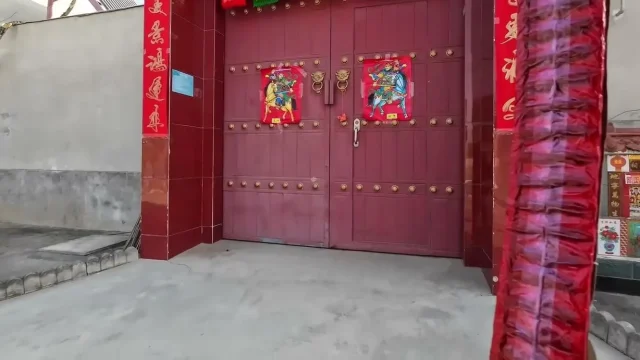
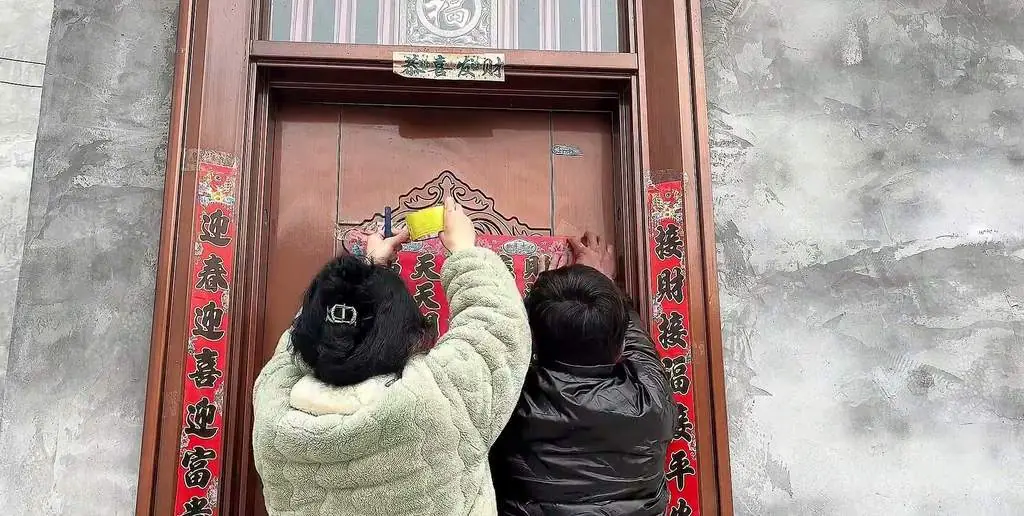
Take the pair on the gate below. The right-hand line, 喜居宝地千年旺 (xǐ jū bǎo dì qiān nián wàng), “joy dwells on this fine ground, thriving for a thousand years,” ends on wàng, a fourth tone. The left-hand line, 福照家门万事兴 (fú zhào jiā mén wàn shì xīng), “good fortune shines on the house and everything flourishes,” ends on xīng, a first tone.
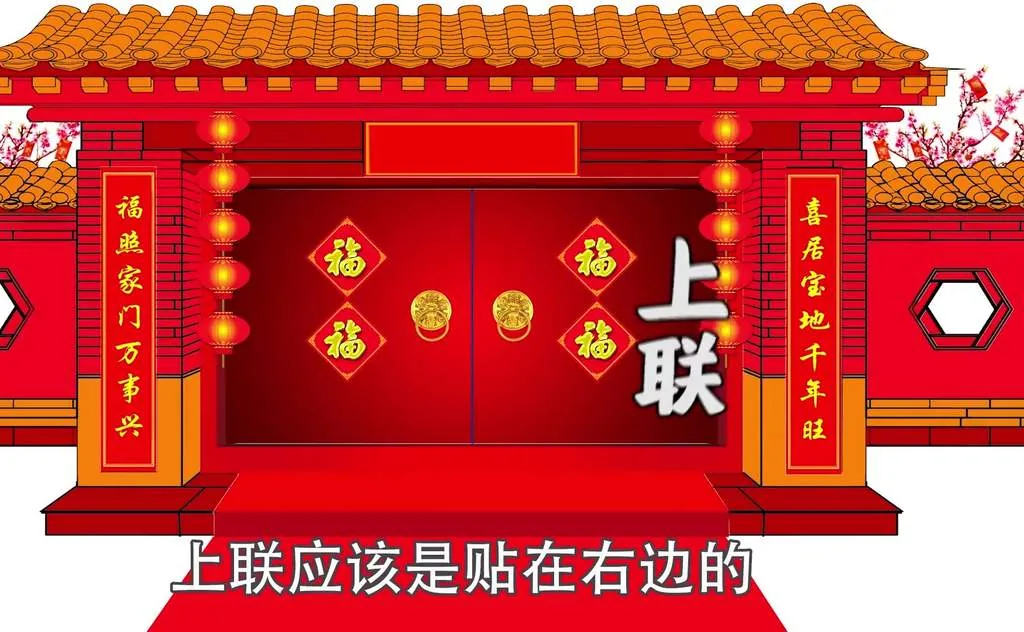
So the right post, ending on wàng, holds the upper line, which is exactly where tradition puts it. When a shop hands me two loose red strips with no labels, I say the last character of each out loud, and I can hear the answer straight away.
If you don’t read Chinese, a phone translation app that shows pinyin will give you the tone mark on the last character. That’s all the test needs.
Why printed Chinese New Year couplets bend the rules
Spring couplets follow the tone rules of classical poetry loosely, not strictly. A wish that sounds lucky matters more on a front door than a perfect tone pattern, and plenty of printed sets break one or two of the five rules above.
The last-character test still works on most of them, because ending the upper line on an oblique tone is the rule I see kept most often, even on cheap printed sets. When a set breaks even that, I go by the banner, which I’ll come back to in the last section.
What I wouldn’t do is hang two lines of different lengths, or two lines that talk about different things. Those aren’t couplets at all, just two lucky phrases sold together.
Classic Chinese New Year couplets with pinyin and English
Traditional spring couplets repeat from year to year, and the four below have been pasted on doors for generations. Each one passes the last-character test, and the table after them shows the tones side by side.
The first recorded spring couplet. Meng Chang, ruler of the Later Shu kingdom in Sichuan during the 10th century, wrote a couplet on a peach-wood board that’s usually counted as the first chunlian. It’s only five characters a line:
- 新年纳余庆 (xīn nián nà yú qìng), “the new year takes in the blessings left over”
- 佳节号长春 (jiā jié hào cháng chūn), “the fine festival is called Long Spring”
The everyday favorite. This seven-character pair turns up on printed sets every year, and it’s the one I’d hand anyone who wants a safe choice:
- 天增岁月人增寿 (tiān zēng suì yuè rén zēng shòu), “heaven adds a year to time, and people add a year to their lives”
- 春满乾坤福满门 (chūn mǎn qián kūn fú mǎn mén), “spring fills heaven and earth, and good fortune fills the house”
The one about the custom itself. This six-character pair names both firecrackers and the old peach-wood charms, so you can almost hear the New Year in it:
- 炮竹一声除旧 (pào zhú yì shēng chú jiù), “one crack of the firecrackers clears out the old”
- 桃符万象更新 (táo fú wàn xiàng gēng xīn), “the peach-wood charms make everything new”
The emperor’s couplet for a butcher. A popular legend says the first Ming emperor, Zhu Yuanzhang, found a butcher’s house without couplets on New Year’s Eve. Nobody there could write, so he wrote one for them on the spot:
- 双手劈开生死路 (shuāng shǒu pī kāi shēng sǐ lù), “two hands split open the road of life and death”
- 一刀割断是非根 (yì dāo gē duàn shì fēi gēn), “one knife cuts off the root of right and wrong”
| Couplet | Upper line ends on | Lower line ends on |
|---|---|---|
| Meng Chang’s couplet | 庆 qìng, fourth tone | 春 chūn, first tone |
| Heaven adds a year | 寿 shòu, fourth tone | 门 mén, second tone |
| One crack of the firecrackers | 旧 jiù, fourth tone | 新 xīn, first tone |
| The butcher’s couplet | 路 lù, fourth tone | 根 gēn, first tone |
My favorite of the four is the butcher’s couplet. It’s written for one trade and still obeys every rule, which shows a couplet can be personal without being sloppy.
Where spring couplets come from: peach-wood charms to red paper
The third couplet above mentions taofu (桃符), peach-wood charms, and that’s where the whole custom starts. Long before anyone wrote poetry on a door, families hung peach-wood boards on either side of it carrying the images, and later the names, of two gods, Shentu (神荼) and Yulei (郁垒). Legend made the pair guards at the gate where ghosts passed between the worlds.
To a Taoist like me, a spring couplet is a door charm that learned to speak in verse. The two boards stayed on the same two posts. Over the centuries the god names gave way to blessings, and Meng Chang’s lines went onto exactly that kind of board.
By the Song dynasty (960–1279), swapping the charm had become shorthand for New Year itself. The poet Wang Anshi wrote that every household was busy replacing the old charm with a new one, 总把新桃换旧符 (zǒng bǎ xīn táo huàn jiù fú).
Red paper came later. Writing the old charms on red paper began in the Ming dynasty (1368–1644), and a Ming source credits Zhu Yuanzhang, the emperor from the butcher legend, with ordering every household in the capital to put up couplets. Red stayed the color because it’s the color of fire and celebration, the opposite of bad luck.
Not every house uses red, even now. In the Qing dynasty (1644–1912), a family in mourning didn’t hang red paper for three years, and their couplets turned blue, yellow or white, with sad words in place of New Year wishes. Customs vary by region, but if you see a blue couplet on a neighbor’s door, that’s usually what it means.
Hengpi, fu squares and the other red paper around a Chinese New Year door
Once red paper took over, the couplet picked up companions. Each one has its own job. On a fully dressed door the dui lian is only the frame.
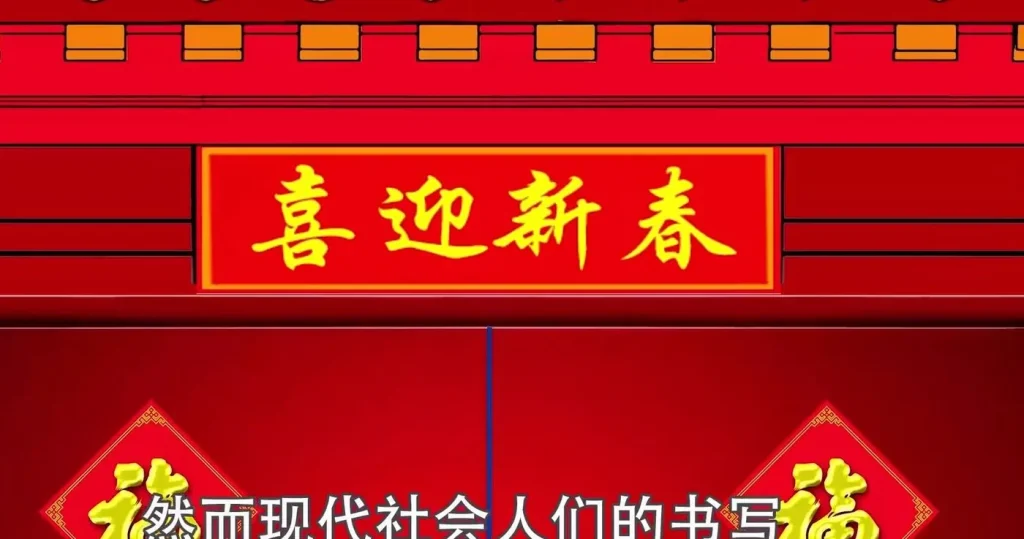
The hengpi is the four-character banner on the lintel. Common ones include 吉星高照 (jí xīng gāo zhào), “a lucky star shines high,” and 出入平安 (chū rù píng ān), “safe coming and going.” The banner on the featured picture at the top of this page reads 喜迎新春 (xǐ yíng xīn chūn), “joyfully welcome the new spring.”
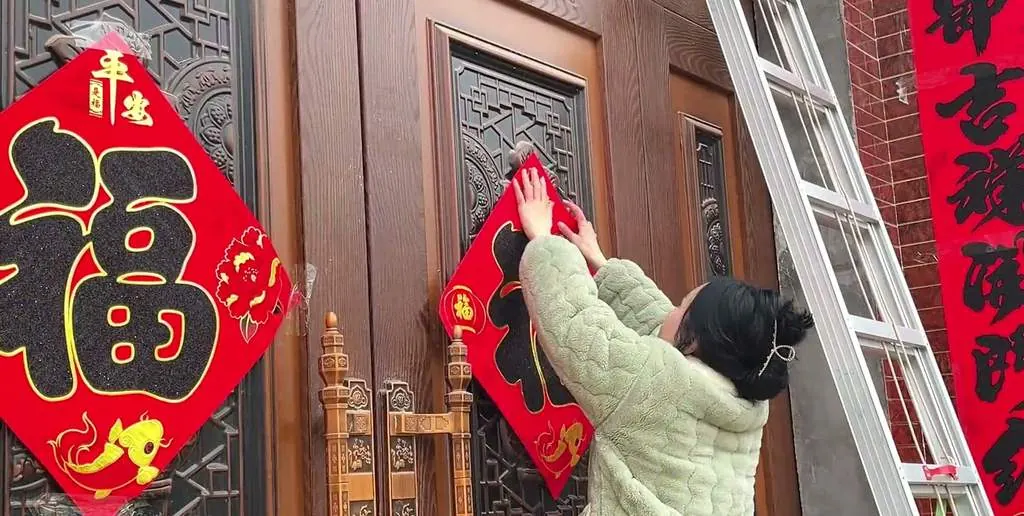
The diamond squares are doufang (斗方): a square of red paper turned on its point, carrying a single character. The best known is 福 (fu), “good fortune,” which people often turn upside down. In Chinese, “the fu is upside down” and “good fortune has arrived” sound the same: fu dao le. Most families keep the fu on the main gate upright and turn the ones on inner doors.
Other single characters go where their meaning fits. 满 (man), “full,” goes on rice bins so the bin never runs empty. Short strips called chuntiao (春条) carry phrases such as 年年有余 (nián nián yǒu yú), “a surplus every year,” for walls and bedroom doors.
Matching the words to the spot matters more than it sounds. A Qing-dynasty writer tells of a man who couldn’t read and pasted “people in the house are safe and well” over the pigsty, and “fat pigs fill the pen” in the bedroom. It’s still told as a joke, and it’s why I always read a phrase before I pick its door.
How to choose a dui lian set, or write your own
With the pieces sorted out, choosing a set is mostly a matter of checking it. Printed couplets come in packs at Asian grocery stores and online during the run-up to New Year, often with the banner and the fu squares in one bag.
Before I buy, I check five things:
- The two long lines have the same number of characters.
- The last character of the upper line carries a third or fourth tone, and the lower line’s last character a first or second.
- It’s a New Year couplet, not a wedding, birthday or memorial set, which come in the same red paper with different words.
- The banner talks about the same wish as the two lines.
- The paper is red with gold or black characters, unless you mean to mark mourning.
None of these checks takes long. Printed or handwritten is a matter of taste. Couplets were always written by hand with a brush, and printed sets only became common in recent decades. Many now come on cardboard, cloth or plastic that survives a winter outside and can go up again next year.
Handwritten ones still carry something printed ones don’t. Street calligraphers set up stalls before the holiday and write couplets while you watch, and some families believe a couplet written by a lucky person brings that luck home.
Even families who couldn’t write found a way. A 1940s county gazetteer from Shaanxi records villagers drawing a simple cross, 十, on red paper when nobody could write for them, and I find that more moving than any gold-printed set.
To write your own, borrow a traditional pair from the list above rather than making one up. Use a brush pen or a thick marker on long strips of red paper and write top to bottom. The poem you copied already keeps the tone rules, so all you need to watch is that each line matches its partner in length.
When and how to put up dui lian at Chinese New Year
Spring couplets go up on New Year’s Eve, usually in the afternoon before the reunion dinner, once the house is clean and last year’s couplets are torn down. Most families leave them in place until the paper fades.
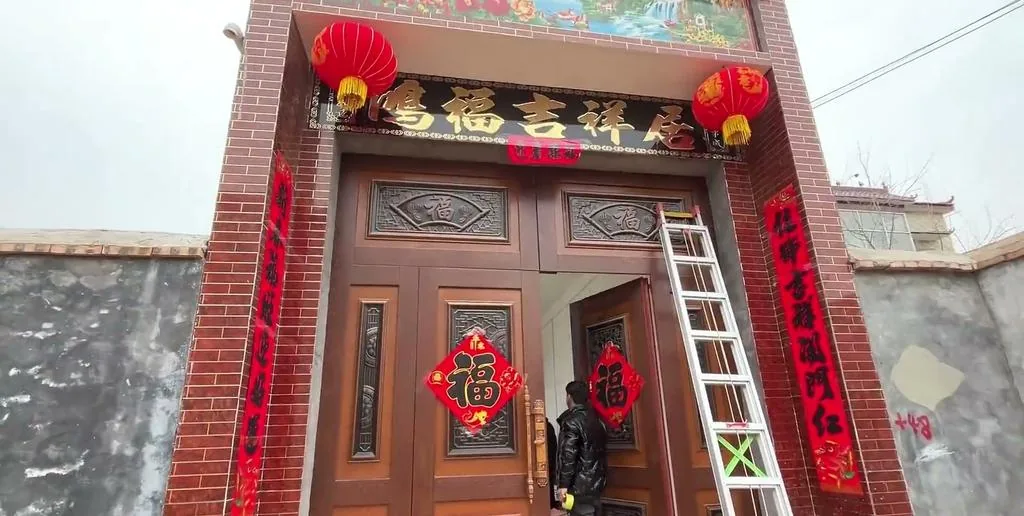
The traditional layout puts the upper line on the right-hand post, seen from outside, the lower line on the left, and the banner reading right to left above them. That order comes from old Chinese writing, which ran in vertical columns starting at the right.
Many printed banners now read left to right, and when they do, the two lines swap sides, so the upper line goes on the left. Both layouts are correct. You’ll meet both kinds in the same shop.
My shortcut is to hang the banner first, read which way it runs, and put the upper line on the side where the banner begins. Then I check it against the last-character test, and the set reads the way its writer meant it to.
Written by
Daozhang MaMaoshan Taoist, Jintan, Jiangsu
Daozhang Ma is a Maoshan Taoist who has practiced for 22 years and is skilled at writing talismans and painting Taoist pictures. He runs Zodiac & Tradition.
About Daozhang Ma