Dumplings for Chinese New Year: Meaning, Fillings and Recipe
By Daozhang MaMaoshan Taoist, Jintan, Jiangsu
In northern China, dumplings (jiaozi, 饺子) are the food of Chinese New Year’s Eve. The whole family wraps them together in the evening and eats them as the old year turns into the new, around midnight.
Two things make them a New Year food. The name jiaozi sounds like jiao zi (交子), the handover of the years at the zi hour, and the crescent shape looks like an old silver ingot, so a plate of dumplings reads as a wish for money. Many families also hide a coin in one dumpling for luck.
As a Taoist of the Maoshan tradition, I find the midnight half of this custom gets the least attention in English, so I start there, then go on to the coin, the lucky fillings, and a recipe. The recipe is the everyday northern pork and napa cabbage dumpling, boiled, with two ways to fold it; give it an afternoon, since the filling chills for two hours.
Why do Chinese families eat dumplings for New Year?
Chinese families eat dumplings at New Year for two reasons built into the food itself: the name marks the hour when the year changes, and the shape stands for money. On top of that, dumplings are a dish everyone at home can help make, which suits a night meant for the whole family.
Jiaozi and the zi hour, when the old year meets the new
Traditional Chinese timekeeping splits the day into twelve two-hour periods, and the first one, the zi hour (子时), runs from 11 p.m. to 1 a.m. On New Year’s Eve, that is the hour when one year hands over to the next.
Food eaten at that hour picked up a pun. Jiao (交) means to hand over or to meet, so the dumpling’s name can be read as “the handover at the zi hour.”
The historian Luo Shuwei of the Tianjin Academy of Social Sciences ties this to the phrase gengsui jiaozi (更岁交子), “the year changes at the zi hour.” He also quotes an old line about New Year’s Eve: one night joins two years, and the fifth watch, the last stretch of night before dawn, divides them.
That midnight handover is the part of the custom I would keep even if I dropped everything else. A dumpling eaten as the zi hour turns marks the exact moment the year changes, much as a toast marks midnight on December 31. Leftover dumplings reheated the next afternoon keep the food but lose that meaning.
Dumplings shaped like silver ingots
The second reason is the shape. A boiled dumpling pinched into a half-moon looks like a yuanbao (元宝), the boat-shaped silver and gold ingots used as money in Ming-dynasty China.
A table full of them therefore reads as a pile of silver. Luo Shuwei sums up what bowl after bowl of dumplings stands for with a rhyme: “a big fortune in the new year, ingots rolling in” (新年大发财,元宝滚进来).
The shape is worth keeping in mind when you fold. In the crescent fold further down, the last push of the edge toward the middle is what plumps a dumpling up into that ingot outline instead of leaving it flat.
How northern families eat dumplings on Chinese New Year’s Eve
Because the meaning rests on that midnight hour, the custom is strongest where dumplings are everyday food anyway, in northern China. In the south, the New Year’s Eve dish with the same job is more often niangao (年糕), the rice cake whose name sounds like “higher every year.”
In a northern home, the wrapping is the event. One person mixes the filling in the afternoon, another rolls wrappers, and everyone at the table folds, so the evening passes with flour on every pair of hands. When the plates come out, the whole family reaches in at once.
Families differ on the exact timing. Some boil the dumplings just before midnight and eat as the year turns; others wrap them on New Year’s Eve and boil them first thing on New Year’s morning. Both follow the same idea of eating them at the handover.
The coin hidden in one New Year dumpling
Many families slip a clean coin into one dumpling, and whoever bites on it is said to have money all year. That is part of why everyone grabs at the plate.
The custom is old. Liu Ruoyu was a eunuch who served in the Ming palace under three emperors. In his memoir Zhuo Zhong Zhi (酌中志), he wrote that the palace rose at the fifth watch on New Year’s Day and ate “water snacks,” meaning dumplings. Sometimes a silver coin or two was hidden inside, and whoever found one took it as a reading of good luck for the year.
If you do it at home, scrub the coin well and boil it before it goes in. Give that dumpling an extra pinch on the edge so you know which plate it lands on, and tell small children there is a coin somewhere, since it is easy to bite down hard on one.
From Ming palace “water snacks” to every home
Dumplings themselves are far older than the New Year custom. In the sixth century, the scholar Yan Zhitui described a crescent-moon-shaped dumpling as common food everywhere. Archaeologists have also found more than 20 Tang-dynasty dumplings, nearly identical in size and shape to today’s, in the dry Astana tombs near Turpan in Xinjiang.
A 2024 Xinhua report pushes the date back further. A bronze vessel from a Spring and Autumn period tomb in Tengzhou, Shandong, excavated in 1978, held triangular, dumpling-like food about 2,500 years old, with a crumbly filling no longer identifiable.
Eating them for the New Year came later. The archaeologist Wang Renxiang of the Chinese Academy of Social Sciences dates the palace custom to the Ming, with coins already tucked inside. By the Qing it had spread everywhere. The Beijing almanac Yanjing Suishi Ji (燕京岁时记) says that on New Year’s Day everyone, rich or poor, ate dumplings of white flour. Beijingers called them zhubobo, “boiled buns.”
There is also a popular legend that the Eastern Han physician Zhang Zhongjing invented dumplings as “tender ears” (娇耳), stuffed with mutton and warming ingredients to keep villagers’ ears from frostbite in winter. China Daily presents it as one of many origin stories, and I would treat it the same way.
Lucky Chinese New Year dumpling fillings and what they mean
If the coin is one way to put a wish inside a dumpling, the filling is the other, and most lucky fillings work by sound.
| Filling | Sounds like | The wish |
|---|---|---|
| Napa cabbage, baicai (白菜) | bai cai (百财), “a hundred fortunes” | Wealth of every kind |
| Celery, qincai (芹菜) | qin (勤), “hard-working” | Wealth that comes from diligence |
| Chinese chives (garlic chives), jiucai (韭菜) | jiu (久), “long-lasting” | Luck and wealth that last |
| Fish, yu (鱼) | yu (余), “surplus” | Money left over at year’s end |
Older New Year fillings followed what people had in winter. Luo Shuwei lists the old standards as mutton with napa cabbage, pork with chives or spinach, and a meatless filling of assorted fried vegetarian bits mixed with cabbage.
For a first New Year batch, pork with napa cabbage is the one I would pick. It is the classic northern pairing, the cabbage carries the “hundred fortunes” pun, and it is forgiving for beginners once the cabbage is squeezed properly.
Pork and napa cabbage dumplings for Chinese New Year: ingredients
This is a northern home-style pork and napa cabbage filling in a hand-rolled wrapper, boiled. The gram weights are the exact figures; the cup and spoon amounts are close equivalents.
For the pepper water
- 1 pinch Sichuan peppercorns
- 1 1/4 cups (300 g) just-boiled water
- 1 piece scallion, about half a palm long, and 4 thin slices ginger
For the pork filling
- 1.1 lb (500 g) ground pork from the hind leg, with some fat in it
- 1/4 teaspoon (1 g) food-grade alkali powder (jian, 碱), optional
- 1 1/2 teaspoons (8 g) salt
- 2 tablespoons light soy sauce (10 to 20 g)
- 1/2 tablespoon (5 g) dark soy sauce
- 1 heaping tablespoon (20 g) oyster sauce
- 1 small teaspoon (1 g) five-spice powder or thirteen-spice powder (a Chinese spice blend)
- 1 teaspoon (3 g) MSG and 1 teaspoon (2 g) chicken bouillon powder, either or both optional
- 1 teaspoon (3 g) sugar
- 3 tablespoons (30 g) cooking oil
- 1 tablespoon (10 g) sesame oil
For the cabbage
- About 1.1 lb (500 g) napa cabbage
- 3 level teaspoons (10 g) salt
- About 1.5 oz (40 g) chopped scallion or Chinese leek
- 1 tablespoon cooking oil
- 1 heaping tablespoon oyster sauce
For the dough
- About 3 3/4 cups (480 g) all-purpose or bread flour
- 2 1/2 tablespoons (20 g) potato starch
- 1/2 teaspoon (3 g) salt
- 1 cup plus 1 tablespoon (260 g) cold water
One ratio from this recipe is worth remembering for any filling: about two parts meat to one part squeezed vegetable by weight.
How to make the dumpling filling and dough
Both the filling and the dough need resting time, so make them first, starting with the pork, which needs at least two hours in the fridge.
Pork filling: stir in the pepper water a little at a time
Step 1: Put a pinch of Sichuan peppercorns in a small bowl and pour over 1 1/4 cups (300 g) of just-boiled water. Boiling water is what pulls the full aroma out of the peppercorns.
Smash the scallion and ginger with the flat of a knife. Once the water is just warm, add them and squeeze them hard in your hand until the water turns cloudy, then strain out 1 cup (250 g). Waiting for the water to cool keeps the scallion and ginger flavor clean.
Step 2: Put the pork in a large bowl with the alkali and the 8 g of salt and mix by hand. Then fold and press the meat like dough, with no water yet, until it turns sticky and starts to string. The salt and alkali both help the meat take up water, and the alkali makes it more tender.
By now the pepper water is cold. Add it in six or seven small batches. Each time, squeeze the water into the meat by hand until it disappears, then stir hard in one direction until the filling is very sticky and drags against your hand.
Stir the same way every time; switching directions breaks the paste and the filling goes loose. Before each new batch, scrape the meat stuck to the sides back in. A stand mixer saves effort, but if you are working by hand, use your hand rather than chopsticks.
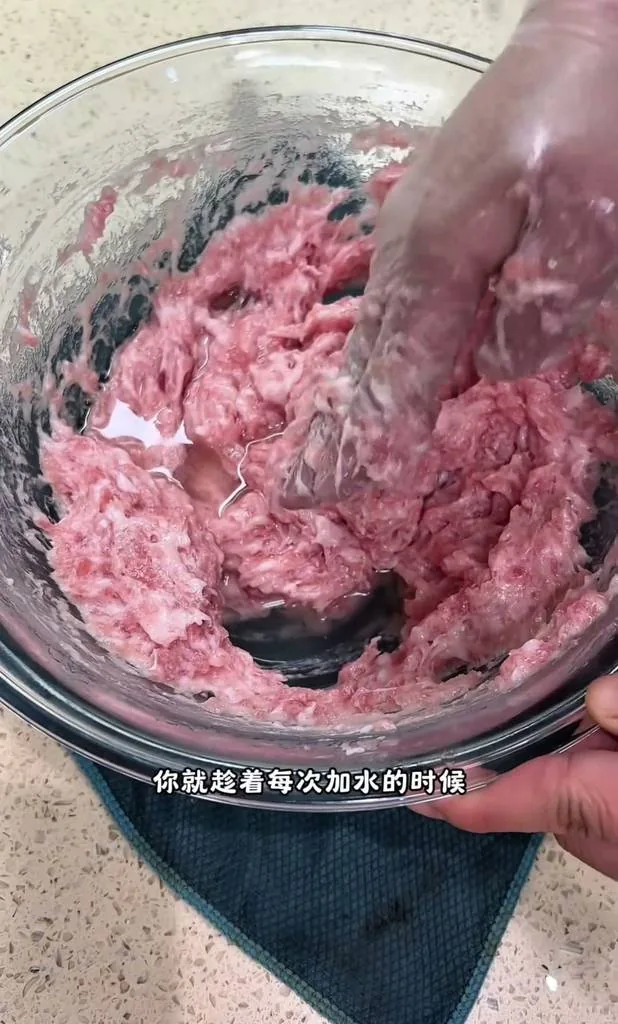
After the last batch, the filling looks puffed up but is not wet at all. It is thick and pushes back against your hand.
Step 3: Season it with 2 tablespoons of light soy sauce (1 if you like it mild or your soy is salty) and half a tablespoon of dark soy for color. Add a heaping tablespoon of oyster sauce, a small teaspoon of five-spice, the MSG and bouillon if you use them, and the sugar.
Squeeze the seasoning in by hand; the meat soaks up the soy sauces like it soaked up the water. Then stir one way until it strings again.
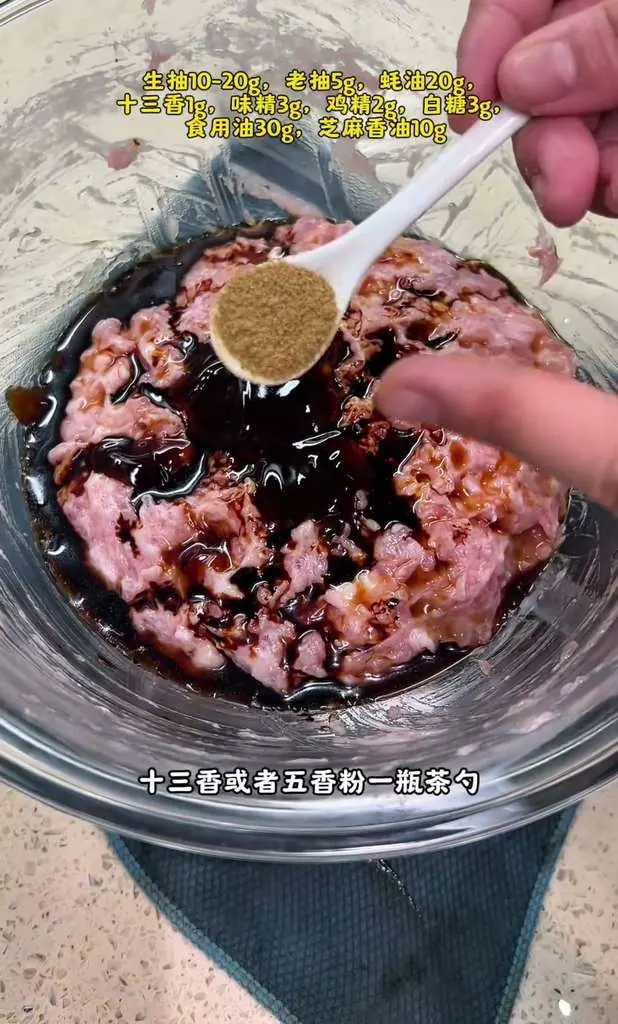
Add the 3 tablespoons of oil and stir the same way until sticky again; the oil seals the water inside the meat. Add the sesame oil and stir until it is absorbed.
Cover the bowl and chill it for at least two hours, or make it the day before. Straight out of the bowl this filling is too soft to wrap well, but chilled it firms up and sits neatly on a wrapper.
Salting and squeezing the napa cabbage
Step 4: While the pork chills, prepare the cabbage. Watery vegetables like napa cabbage and celery have to be salted and squeezed before you weigh them; drier ones like chives and fennel go in as they are. About 1.1 lb (500 g) of napa cabbage ends up as roughly half that, 9 oz (250 g), once squeezed.
Chop it with a knife instead of a food processor, which turns it to mush. Cut it into shreds first, then into small bits, then run the knife over the whole pile a few more times. Stop while you can still see distinct pieces.
Put it in a large bowl, add the 3 level teaspoons (10 g) of salt and toss it firmly by hand until you can clearly feel water coming out. Leave it for 10 minutes.
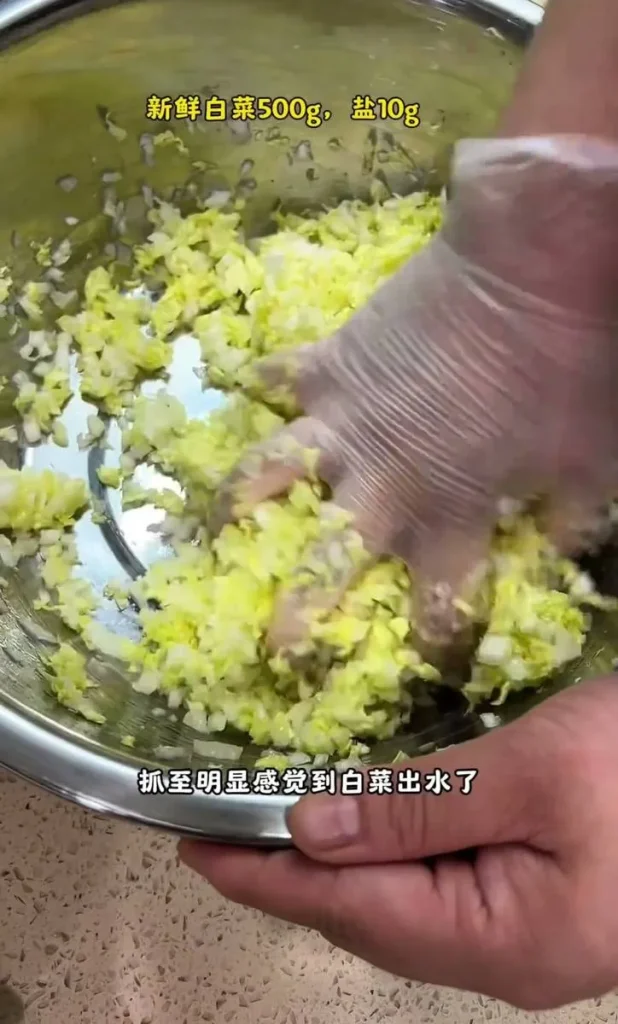
Don’t squeeze it yet. Rinse it in clean water, squeezing as you wash, three or four times to get the salt out. Drain it in a sieve, squeeze it as dry as you can and set it aside. It stays apart from the pork until you are ready to wrap.
Dumpling dough: rest and knead three times
Step 5: Mix the 480 g of all-purpose or bread flour with the 20 g of potato starch and 3 g of salt, which brings the dry mix to exactly 500 g. The starch makes the wrappers chewy and slippery, and the salt firms up the dough. Avoid cake flour.
Slowly pour in the 260 g of cold water, stirring as you go so the flour turns into shaggy flakes.
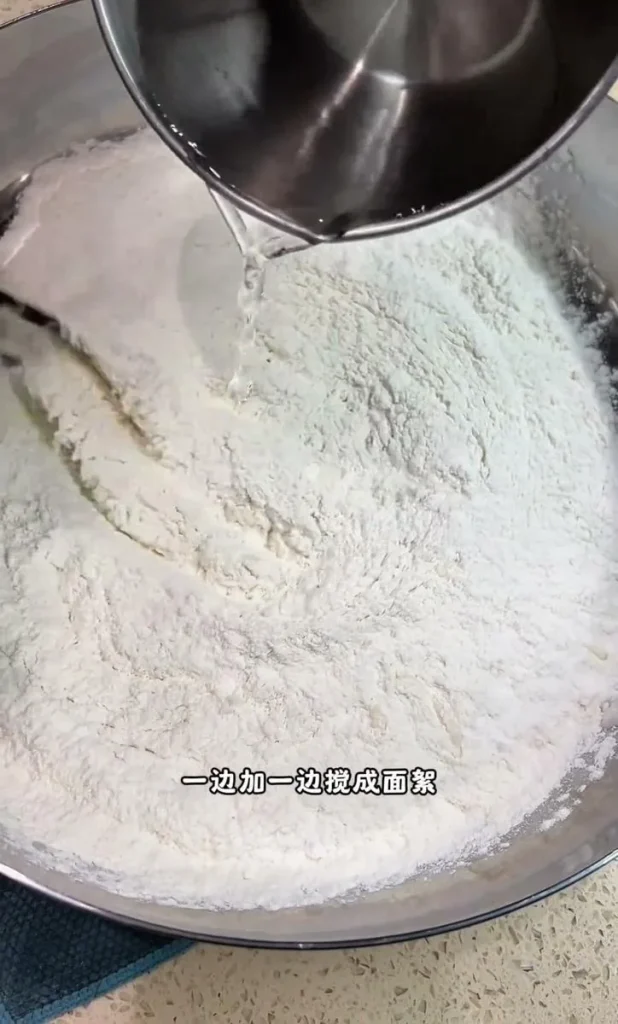
Press the flakes into a ball by hand. It will feel dry and stiff, and there is no need to force it smooth. Cover it and let it rest for 15 minutes, kneading it briefly every 5 minutes; by the third knead it turns smooth.
Cover it again and let it rest for another hour before using it. If you make it the day before, wrap it in plastic and keep it in the fridge. The dough starts firm and gets softer as you work it, and done right it ends up about as soft as an earlobe.
Rolling, folding and boiling Chinese New Year dumplings
Step 6: Once the pork has chilled for two hours and the dough has rested, finish the filling. Stir the 40 g of chopped scallion and a tablespoon of oil into the squeezed cabbage first, which keeps it from weeping, then a heaping tablespoon of oyster sauce for flavor. Tip the cabbage into the pork and mix it in evenly.
The chilled pork will not have released any water. It is only firmer than when it went in, which makes it much easier to wrap.
Cutting and rolling dumpling wrappers
Step 7: Cut the rested dough in half and wrap the half you are not using in plastic so it doesn’t dry out. Roll the other half on the counter into a rope about 26 inches (65 cm) long, pushing your hands outward as you go.
Cut it into pieces of about 1/3 oz (10 g). After each cut, turn the rope so the cut face stands up, then cut again; the pieces fall into two even rows.
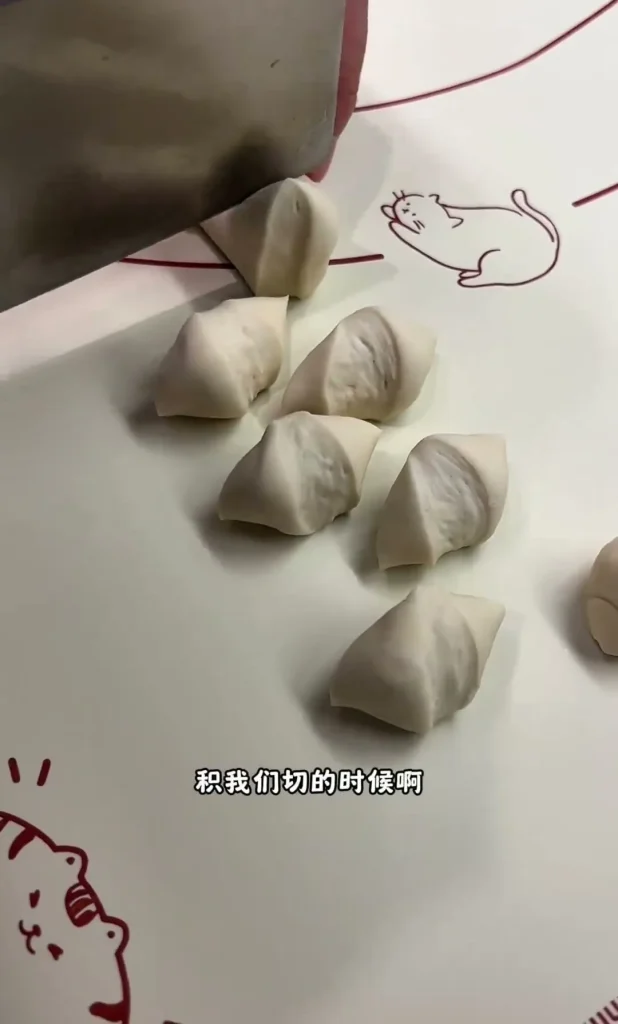
Dust them very lightly with flour, gather them together so both cut faces pick up a little, and press each one flat with the heel of your hand. If you are wrapping alone, cut a few pieces at a time, since cut dough dries out quickly.
Step 8: Hold the edge of a piece with one hand and push the rolling pin with the other, turning the dough as you go. Roll the edges thin and leave the center a little thicker, until the wrapper is about 3 1/4 to 3 1/2 inches (8 to 9 cm) across and slightly translucent.
If the dough sticks, pull in a little flour and keep rolling. Rolling takes practice and won’t come in one afternoon, but it isn’t hard, and uneven wrappers still taste the same.
Folding a crescent dumpling
Step 9: Lay a wrapper across four fingers, with your little finger slightly raised. Spread filling in the center and press it down firmly so there is no air around it.
Fold the wrapper in half and pinch only the top point closed.
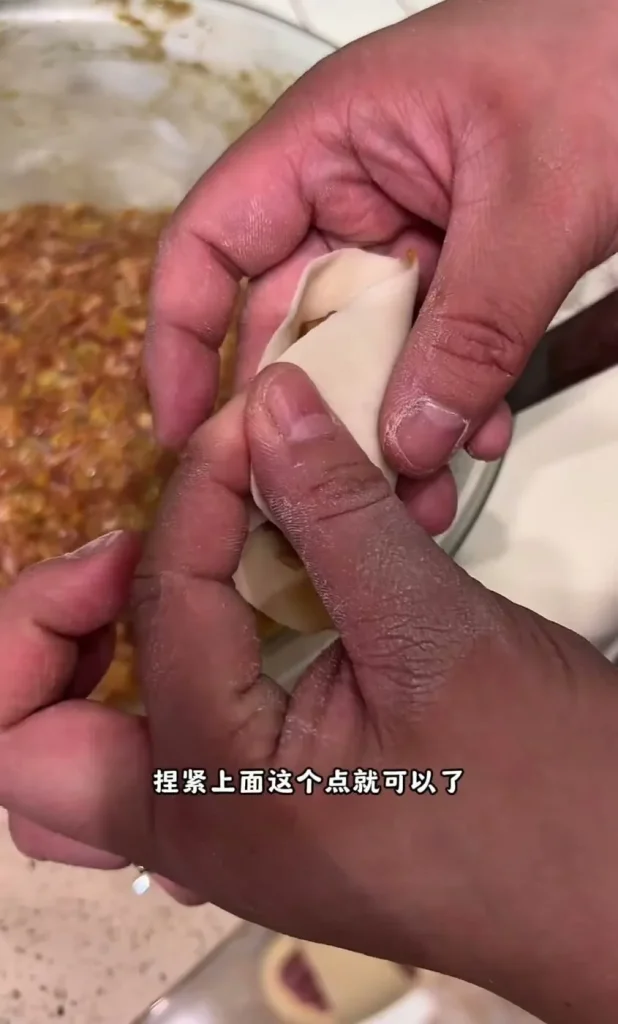
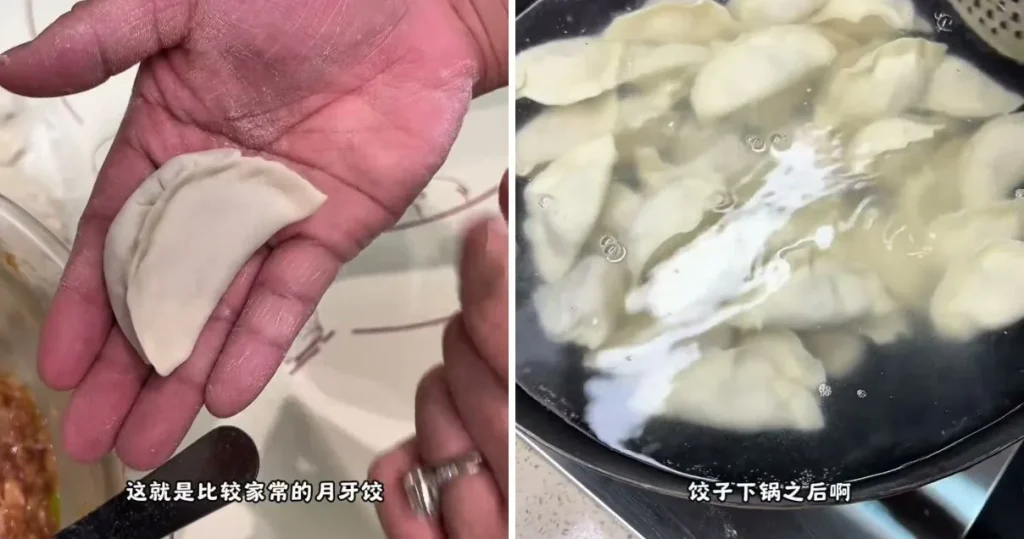
Rest the edge in the web between thumb and index finger, bring the other hand up alongside, and press both thumbs down hard along the edge. Then push the edge toward the middle. That is one dumpling.
If you worry the edge won’t hold, pinch the whole edge shut first, then press with both thumbs and push toward the middle the same way. The easiest version of all is to pinch it closed, then pinch small pleats along one side and then the other.
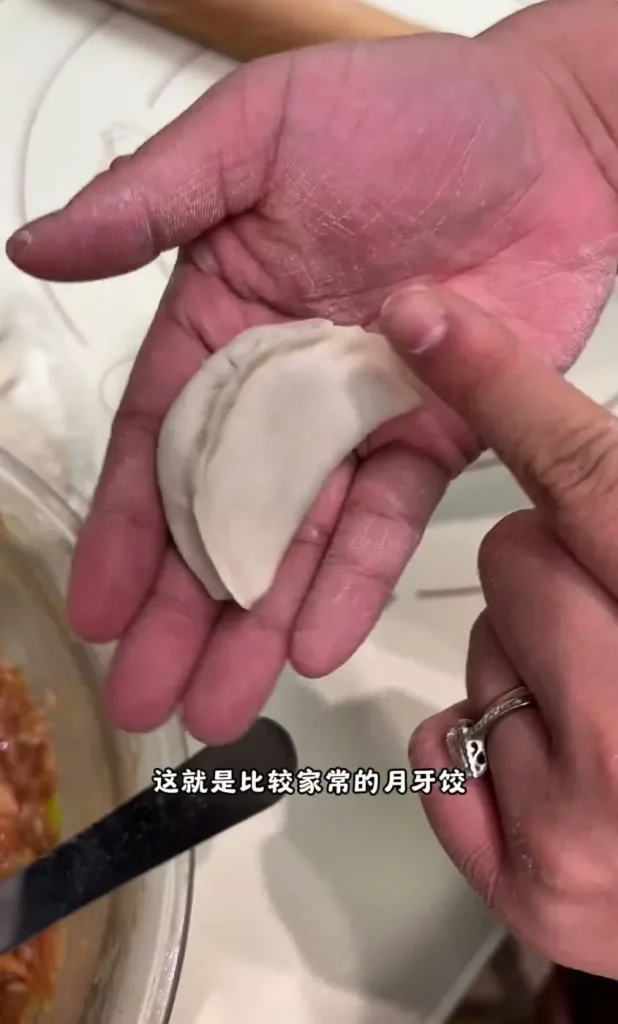
Both folds give you a homestyle crescent dumpling, so use whichever your hands find easier. What matters more is that the edge is sealed all the way along.
Boiling dumplings so they don’t stick
Step 10: Use plenty of water, much more than seems necessary. Bring it to a full boil over high heat, then add the dumplings.
As soon as they go in, nudge them gently with the back of a spatula so none settle on the bottom and stick.
When the pot comes back to a full boil, turn the heat down to medium and boil them uncovered for 2 minutes. This method skips both old tricks, covering the pot and adding splashes of cold water.
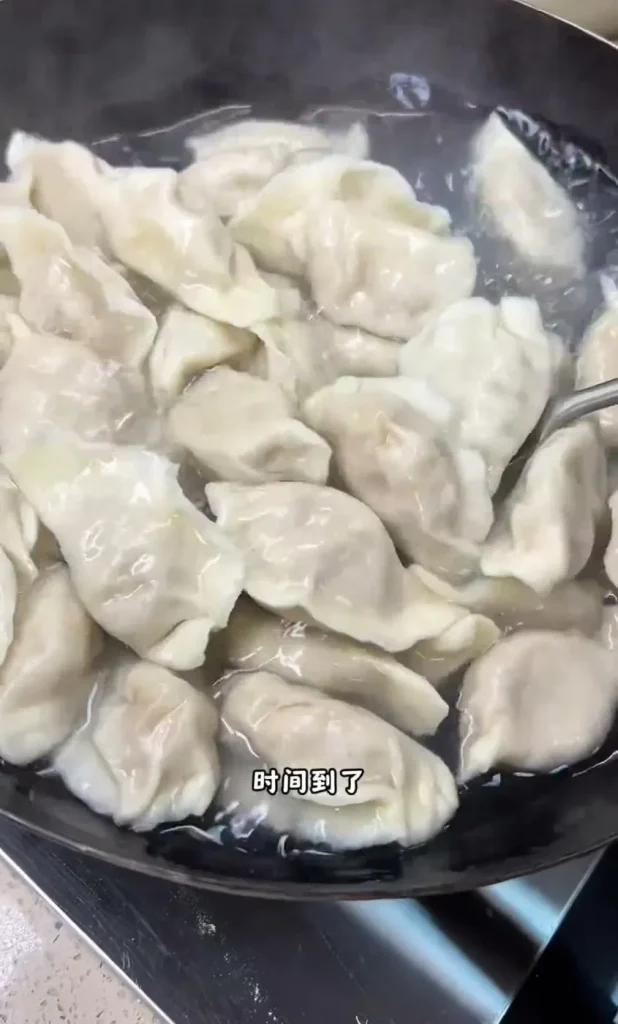
Cooked this way the dumplings come out separate, and stay separate even after cooling, with thin, glossy skins. The first time, cut one open to check that the pork is cooked through, since stoves and pots vary.
Common Chinese New Year dumpling problems and swaps
Most dumpling trouble on New Year’s Eve traces back to one of the steps above, so each fix points to where it starts.
The pork won’t take the water. This is the most common problem. Work the meat sticky before any water goes in, add the water in small batches, and stir in one direction only.
The filling turns watery. That water nearly always comes from the vegetable. Salt and squeeze napa cabbage or celery, coat the cabbage in oil before it meets the pork, and combine the two only when you are ready to wrap.
The wrappers crack or won’t seal. Cut dough dries out fast. Keep the spare dough and cut pieces covered, and roll only a few at a time.
The dumplings stick together in the pot. Use more water, nudge them right after they go in, and boil uncovered over medium heat.
Swapping the vegetable. Celery needs the same salting and squeezing as cabbage, while chives and fennel go in as they are. Keep roughly two parts pork to one part vegetable, and leave out the alkali, MSG and bouillon if you prefer.
Planning dumplings for New Year’s Eve: what to make ahead
Working backward from midnight takes the pressure off the day. Both the pork filling and the dough can be made the day before and kept in the fridge, which leaves only the cabbage, the wrapping and the boiling for New Year’s Eve itself.
Salt and squeeze the cabbage in the late afternoon and mix it into the pork after dinner, when everyone is ready to sit down and wrap. With several people rolling and folding, a batch this size goes quickly, and the work itself is the point of the evening.
The one thing I would not move is the boiling. Put the pot on shortly before midnight, so the first bite really does fall as the zi hour turns and the old year hands over to the new.
Written by
Daozhang MaMaoshan Taoist, Jintan, Jiangsu
Daozhang Ma is a Maoshan Taoist who has practiced for 22 years and is skilled at writing talismans and painting Taoist pictures. He runs Zodiac & Tradition.
About Daozhang Ma