Lunar New Year Games: Mahjong, Card Games, Lantern Riddles
By Daozhang MaMaoshan Taoist, Jintan, Jiangsu
At Lunar New Year, Chinese families play mahjong and cards after the reunion dinner, stage small cash-prize games for the children, and guess lantern riddles on the fifteenth night. Outside, kids kick a feathered jianzi shuttlecock or toss sticks into a pot.
Games of chance have had a seasonal pass for a very long time. In the Song dynasty, the capital opened three days of street gambling on New Year’s Day. The sections that follow take each game in turn with how it’s played, trace that pass back to the Song capital, and end with picking a game by the number of people at your table.
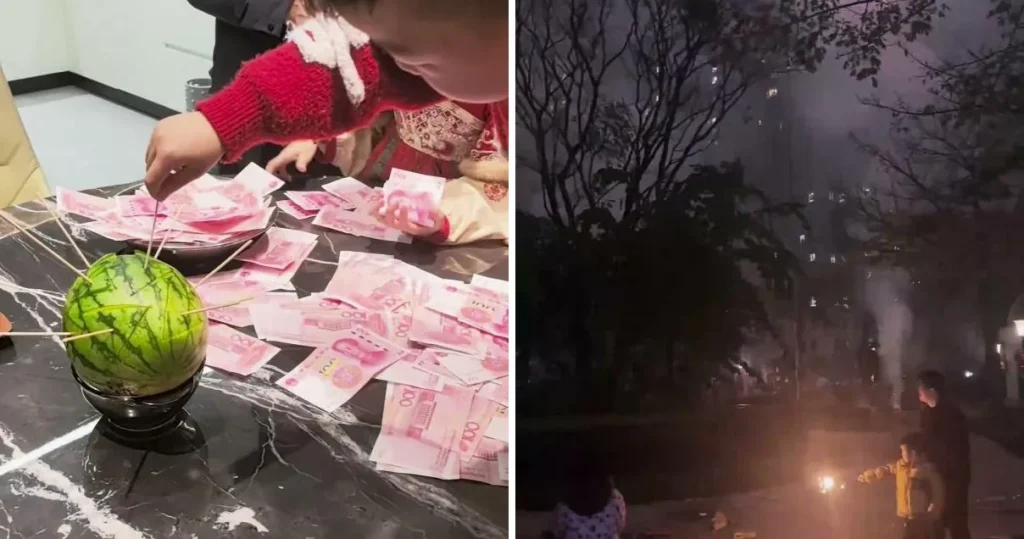
What games do people play at Lunar New Year?
The short list is mahjong, two card games called guandan and dou dizhu, prize games for children, lantern riddles, and a few old outdoor games. Each one fits a different moment of the holiday and a different number of players, so the table below sorts them that way.
| Game | Players | When it comes out | What you need |
|---|---|---|---|
| Mahjong | Four (two to four possible) | New Year’s Eve and the first days | A 144-tile set and dice |
| Guandan | Four, in two teams | Same | Two decks of cards with jokers (108 cards) |
| Dou dizhu | Three | Same | One deck with both jokers (54 cards) |
| Blindfold scoop | Any number, one at a time | After the reunion dinner | A blindfold, a spatula, a basin, banknotes |
| Watermelon blind box | Any number | After the reunion dinner | A watermelon, toothpicks, prize slips |
| Lantern riddles | Any number | The Lantern Festival, on the fifteenth day | Riddles on paper, small prizes |
| Jianzi and pitch-pot | One or more | Daytime, outdoors or in a hallway | A shuttlecock; a tall pot and sticks |
| Bầu cua cá cọp | A banker and any number of players | Tết in Vietnamese homes | Three picture dice and a betting mat |
What most of these share is a small stake. Coins, notes or prizes sit on the table, and winning a little at the start of the year is read as a good sign for the months ahead. That thread runs through every section below.
Mahjong at Chinese New Year: the game that comes out after the reunion dinner
Mahjong is usually the first game on the table once the reunion dinner plates are cleared. It needs four players, and a New Year house is the one time of year when four free adults are easy to find.
A standard set has 144 tiles. Each player sits at one of four wind positions, East, South, West and North, and starts with a hand of thirteen tiles. On your turn you draw a tile and discard one. You can also claim another player’s discard under certain conditions.
The goal of each round is a complete hand: four sets and a pair. A set is three matching tiles or a run of three in one suit. Scores carry over from round to round, which is why a New Year game can run long past midnight.
Mahjong is younger than most people guess. It took shape in the 19th century under the Qing dynasty, growing out of older draw-and-discard card games, and the earliest tile sets that survive date to around 1870. They were collected in Fuzhou, Shanghai and Ningbo.
If you sit down at someone else’s table, watch two hands before you play. Scoring and special hands change from region to region, and a family will play its own house rules rather than a rulebook’s.
Lunar New Year card games: guandan and dou dizhu
Mahjong needs four people who all know the rules. When the table is a player short, or the younger cousins want something faster, the cards come out instead.
Guandan, Jiangsu’s four-player partnership game
Guandan, 掼蛋, means “throwing eggs.” It was invented in Huai’an, in Jiangsu province, in the 1960s and spread to nearby cities such as Nanjing in the 1990s. A 2020 estimate put its players at over 20 million in Jiangsu and Anhui.
Here in Jiangsu, where I live on Maoshan, it’s the card game I see most often at New Year tables. Four players play in two teams, and partners sit across from each other.
The deck is two standard decks plus all four jokers, 108 cards, so each player holds 27. Suits mostly don’t matter. Cards rank from 2 up to the Ace, then the black joker, then the red joker. You try to shed your hand by beating the last play, and a “bomb” of four or more matching cards beats ordinary plays.
Each team has a level that starts at two and climbs toward the Ace as it wins hands. How far a team jumps depends on how soon the partner of the first player out also gets rid of their cards. Once a team reaches the Ace level, winning one more hand takes the game, so a full game fills a long evening.
Dou dizhu, the three-player “fight the landlord” game
Dou dizhu, 斗地主, means “fight the landlord.” The name goes back to the land reform of the 1950s, when peasants were urged to rise up against landlords, and the game turns that into one player against two.
The game is built for exactly three players. It uses one 52-card deck plus two jokers, 54 cards. Each player gets 17, and the last three go face down to one side.
Players bid one, two or three to become the landlord. The winner picks up the three spare cards, now holds 20, and plays alone against the other two, the peasants. If either peasant goes out first, the peasants’ side wins.
Online play made it far more widespread in the 2000s, and it now counts as a national game in China. At New Year, dou dizhu is the game for the hour after midnight, when only three people are still awake.
Why gambling games are fine at Chinese New Year: the Song dynasty’s three days of guanpu
Both the mahjong table and the card table usually play for small money, and nobody at a Chinese New Year table finds that strange. The custom has a paper trail.
Dongjing Meng Hua Lu, a memoir of the Northern Song capital at Kaifeng, records that on New Year’s Day the city government “released guanpu for three days” (放關撲三日). From early morning, people went around exchanging New Year greetings.
Guanpu was gambling for goods. Street vendors laid out food, household wares, fruit, firewood and charcoal, and called out to passers-by to bet for them. Toward evening, women of wealthy families went into the gambling venues to watch and play, and the same memoir says this was so customary that nobody mocked them for it.
The same three-day release came round again at the Cold Food Festival and at the Winter Solstice. To me, that detail matters most. The permission was always tied to the calendar: three days of luck-testing, and then back to ordinary life. A few hands of mahjong for coins at New Year carry that old seasonal pass, and they feel different from gambling in any other week.
Lunar New Year family games with cash prizes: the blindfold scoop and the watermelon blind box
That appetite for winning a little money now shows up in games families stage for the children after dinner. Some households call the evening a “family annual meeting,” borrowing the name of a company’s year-end party, prizes included.
The blindfold scoop: shoveling banknotes into a basin
Scatter banknotes across the dining table and set a steel basin among them. The player is blindfolded, takes a cooking spatula, and scoops as many notes into the basin as they can before their turn ends. I’d let each player keep whatever lands in the basin.
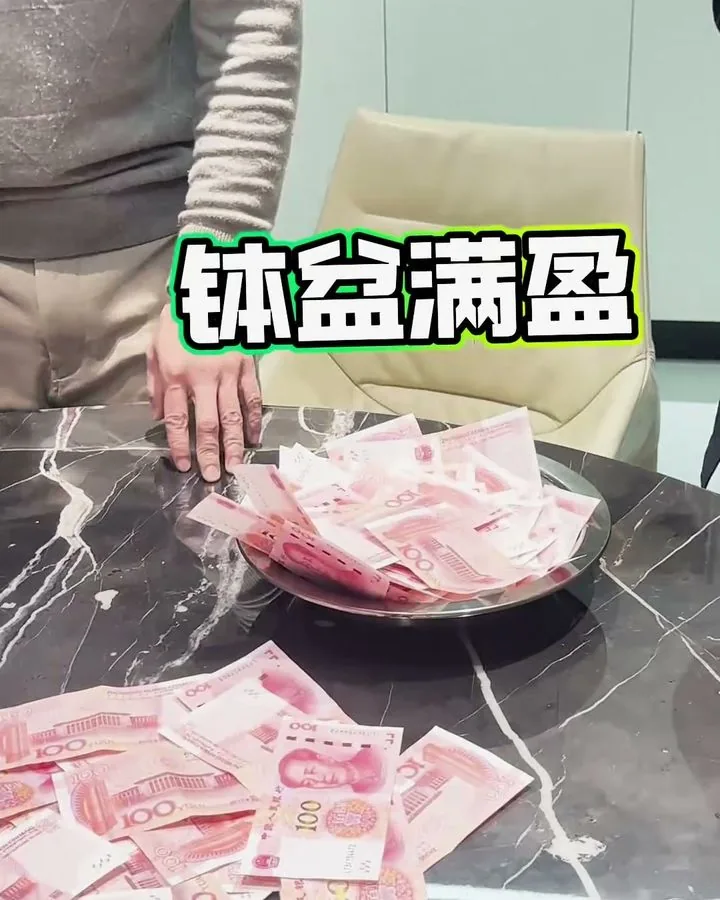
The fun is in the blind scooping. Notes slide off the spatula, land on the wrong side of the basin, and the whole table shouts directions. Agree on how long each turn lasts before anyone starts, because that’s the first thing people argue about.
The game also works as a blessing. A brimming basin is a picture of the year everyone hopes for, which is why the phrase 钵盆满盈 suits it so well. For small children, play with coins or chocolate money, and let the youngest go last so they’ve watched the others first.
The watermelon blind box: one toothpick, one prize
Push toothpicks all over a whole watermelon and set it in a bowl. Each toothpick marks a prize, written on a slip of paper. Every player gets one pull, and the rule is strict: only one chance to choose, with no swapping and no second try.
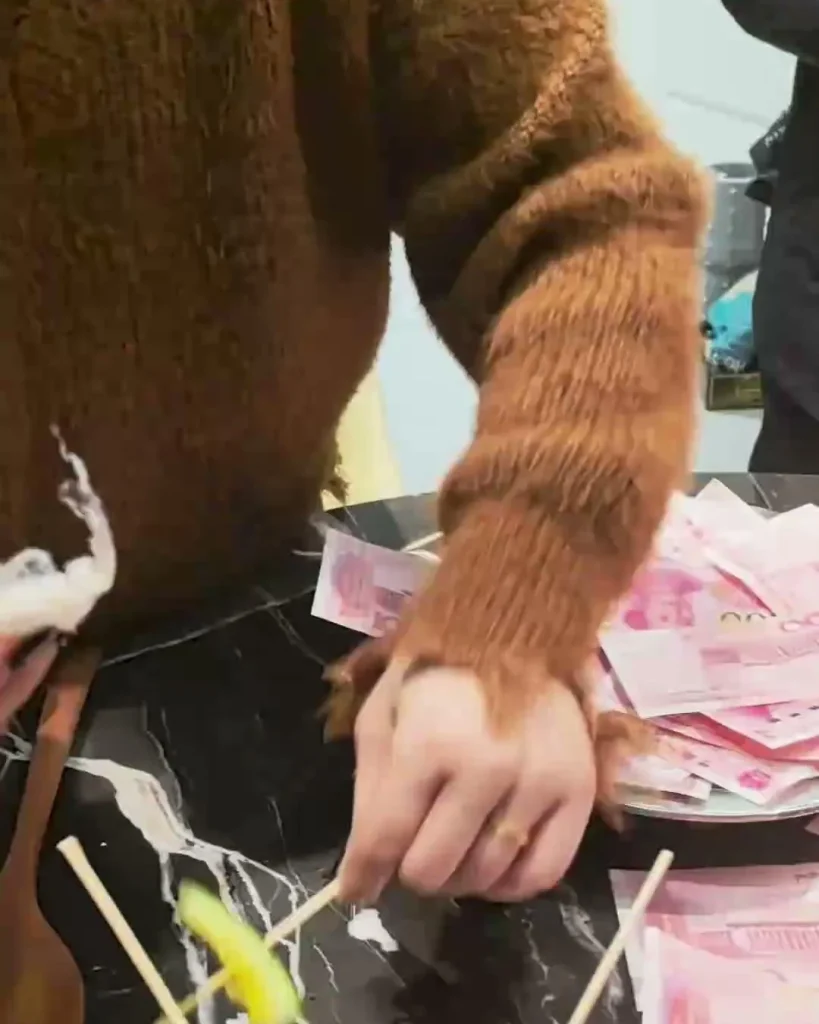
Children love the moment of choosing more than the prize itself. Some walk around the melon twice before they pick, and the one-pull rule is what makes that moment count.
Mix the slips so a few are big and most are small, and add one or two joke prizes. A slip that says “sing one song for the table” gets the biggest laugh of the night. The slips are also the easiest part to adapt if your family doesn’t use cash.
Lantern riddles: how to play the Lantern Festival guessing game
The cash games belong to the first nights of the year. The last night of the holiday, the fifteenth, has its own guessing game with prizes: lantern riddles, cai dengmi (猜燈謎).
Each riddle is written on paper and pasted on a lantern, and most of them are lines of verse. After the riddle comes a hint that tells you what kind of answer to look for, for example “guess one character.” Guess right and you can win a small prize.
The custom is old. Japanese scholars date its popularity to the Northern Song dynasty (960–1126). A record of Southern Song Hangzhou describes silk lanterns cut with poems and “hidden-head riddles,” some of them jokes that teased the people walking past.
Here’s a classic. The riddle is “a branch of red apricot blossom reaches over the wall” (一枝紅杏出牆來), and you guess a kind of person, in two characters. The answer is 員外, yuanwai, an old word for a country squire. The branch is outside (外, wai) the garden, and the garden (園, yuan) sounds like 員.
Because the answer works by sound, the riddle carries a named format, the “white head” format (白頭格), which tells you to read the first character by its sound. Strict lantern riddles allow sound-alike answers only when such a format is named.
At home in English, any riddle works, and the lantern is optional. Hang the riddles on red paper around the room, give each correct guesser a tangerine or a candy, and hold one hard riddle back for last.
Traditional Lunar New Year games for kids: jianzi, pitch-pot and bầu cua dice
Lantern riddles are a thinking game. The old games kids play outside over the holiday are about feet, aim and luck.
Jianzi, 毽子, is a shuttlecock with four feathers fixed into a rubber or plastic base. Some homemade ones use a washer or a coin with a hole in the center. You keep it in the air with any part of your body except your hands, mostly your feet. Play in a circle of five to ten people, or as a duel between two.
Jianzi traces back to cuju, a ball-kicking game from the Han dynasty. In Vietnam the same game is called đá cầu and counts as a national sport.
Pitch-pot, touhu (投壺), means throwing arrows or sticks from a set distance into a tall pot. The game goes back to the Spring and Autumn and Warring States periods, and was probably invented by archers or soldiers to pass idle time. At home, a tall vase and a handful of chopsticks are enough.
Bầu cua cá cọp, “gourd, crab, fish, tiger,” is a Vietnamese dice game played across Lunar New Year. Three dice show a fish, a prawn, a crab, a rooster, a gourd and a stag or tiger instead of dots. Players bet on a picture mat, and a match on one die pays the stake back once more.
China plays the same game as Hoo Hey How. For kids, bet with candy.
Hosting a Lunar New Year game night at home: picking a game by group size
Every game above has a number of players it works best with, so start from who’s coming.
- Two people: a jianzi duel, or a quiet round of lantern riddles.
- Three adults: dou dizhu. It needs only one deck, and the bidding takes a few minutes to learn.
- Four adults: mahjong if someone owns a set and knows a house rule, guandan if you have two decks and want teams.
- Mixed ages: the watermelon blind box first, then riddles, and the blindfold scoop last, when everyone’s loud.
- Kids only: jianzi, pitch-pot with chopsticks, or bầu cua for candy.
If I had to choose one game for a family new to all of this, I’d pick the watermelon blind box. It has no rules to teach, every guest gets exactly one turn, and it works just as well with candy, chores or a song as with cash.
Keep the stakes small, whatever you play. The old three-day pass was about testing your luck for the year, and a stake of a few dollars or a bag of chocolate coins tests it fine.
Written by
Daozhang MaMaoshan Taoist, Jintan, Jiangsu
Daozhang Ma is a Maoshan Taoist who has practiced for 22 years and is skilled at writing talismans and painting Taoist pictures. He runs Zodiac & Tradition.
About Daozhang Ma