Lunar New Year Lanterns: Meaning, Types, When to Hang Them
By Daozhang MaMaoshan Taoist, Jintan, Jiangsu
In short
Lunar New Year lanterns are the red lanterns that go up over front doors, gates and shop fronts for Chinese New Year. Most families hang them a few days before New Year’s Eve and keep them up through the Lantern Festival on the 15th day of the first lunar month.
Red is the short answer to why. The color has stood for luck and celebration in China for a very long time, and the old New Year story explains the rest.
Nian, a beast that came out at the turn of the year to raid villages, fled from three things: the color red, firelight and loud noise. A lit red lantern covers two of the three by itself, which is why one at the door counts as protection as well as decoration.
Below I go through what the lanterns mean, the types you’ll run into, when and where to hang a pair at home, a 15th-night flower lantern parade in western Guangdong, the characters painted on lanterns, and whether to buy a set or make a paper one yourself.
What do Lunar New Year lanterns mean?
A Lunar New Year lantern is a wish for a bright, lucky and complete year, and each part of it carries a piece of that wish. The red is for good fortune and joy, and the gold trim and tassels add wealth to the message. The round shape echoes tuanyuan (团圆), the word for a family gathered in one place, which is what the New Year meal is about.
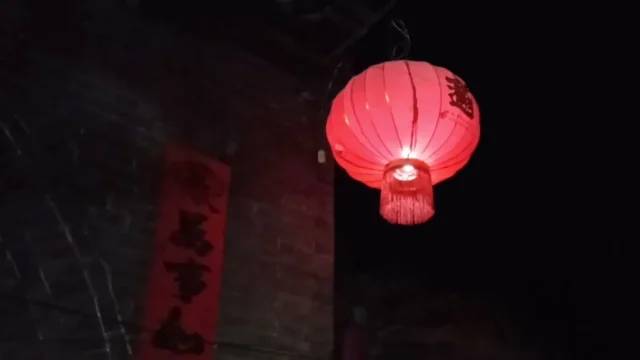
Light carries its own share of the meaning. A lantern burning at the door through the darkest weeks of winter tells the street that the household is home and celebrating. The way I sum it up: on a New Year night, light is the signal that the family is together again.
There is a sound pun as well. Deng (灯), the word for lantern, sounds close to ding (丁), an old word for sons and new members of a family. That pun is part of why red lanterns hang at weddings too, and why a lantern lit for the New Year doubles as a wish for the family to grow.
Lanterns in China go back at least to the Han dynasty, roughly two thousand years ago, when lamps were lit for the Buddha on the 15th night of the first month and the custom grew into the Lantern Festival. Paper lanterns are harder to date, so I treat the earliest origin stories as tradition rather than record.
Types of lanterns for Lunar New Year, from round red lanterns to sky lanterns
Once you know what a lantern stands for, the next surprise is how many shapes carry the same wish. Six types cover nearly everything you’ll see during the New Year season, and only one or two of them belong at a front door.
| Type | What it looks like | Where you’ll see it at New Year |
|---|---|---|
| Round red lantern (大红灯笼, da hong denglong) | A red globe of silk, nylon or paper over a folding frame, with a gold tassel below | Front doors, gates, shop fronts, strung along streets |
| Palace lantern (宫灯, gongdeng) | A six- or eight-sided wooden frame with painted silk or glass panels and tassels at the corners | Halls, restaurants, temples; first made for the imperial palace |
| Paper flower lantern (花灯, huadeng) | A paper body wrapped in paper flowers, with paper fringe hanging below, often lettered by hand | Village lantern parades around the 15th day, especially in southern China |
| Animal and zodiac lantern | Lanterns shaped like the year’s zodiac animal, fish, dragons or rabbits | Lantern fairs; in Nanjing, rabbit lanterns on little wheels for children |
| Sky lantern (孔明灯, kongming deng) | A paper balloon lifted by a small flame | Released at some Lantern Festival events; banned or restricted in many places |
| River lantern (河灯, hedeng) | A small lantern set afloat on water | Mostly the Ghost Festival in the seventh lunar month |
For a home, the round red lantern does almost all the work. It folds flat, it reads as “New Year” from across the street, and it is the easiest kind to find in stores. Palace lanterns are the formal cousin: heavier, framed in wood, and better suited to a hall or a restaurant entrance than to a porch in the rain.
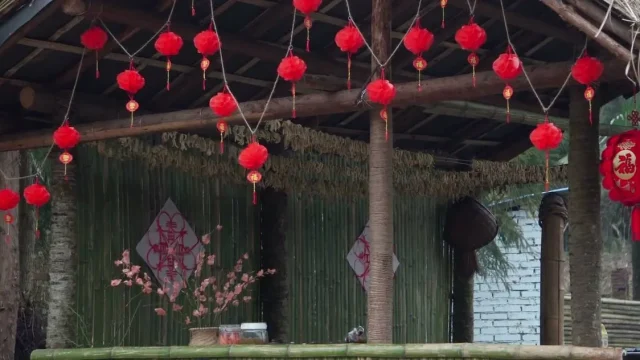
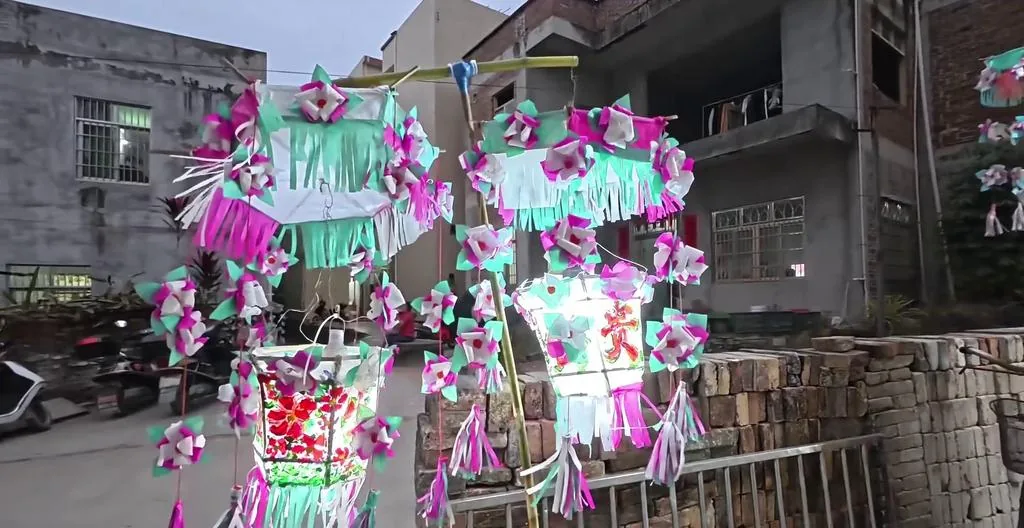
Paper flower lanterns show how local the form gets. The ones made in western Guangdong villages have a square or six-sided paper body wrapped in pink and white paper roses, with paper fringe hanging below, and they go up on bamboo poles in daylight long before anyone lights them. They come out for the 15th-day parades described further down.
Sky lanterns get the most photographs and cause the most trouble. A sky lantern drifts wherever the wind takes it while its flame is still burning, so many US states and cities ban releasing one, and some countries ban them outright. Check your local fire rules before you buy a pack.
River lanterns belong mostly to the Ghost Festival in the seventh lunar month, so I leave them out of New Year decorating altogether.
When and where to hang Lunar New Year lanterns
For most homes, all those types come down to a pair of round red lanterns, and the bigger question is timing. Hanging them on the right days matters more to me than which lantern you pick.
Putting lanterns up before New Year’s Eve and taking them down after the 15th
Most households hang their lanterns in the last few days of the 12th lunar month, before or alongside the spring couplets that go up on the afternoon of New Year’s Eve, so everything is in place before the New Year’s Eve dinner. The lanterns get switched on that night, when families stay up to see the old year out.
For the coming Year of the Goat, the dates work out like this: New Year’s Eve falls on February 5, 2027, New Year’s Day on February 6, 2027, and the Lantern Festival on February 20, 2027. Hanging your lanterns on February 3 or 4 and taking them down on February 21 follows the usual pattern.
The Lantern Festival closes the New Year season, so the days right after it are the natural time to retire the lanterns. Plenty of shops leave theirs up for weeks longer.
My advice is to take yours down once the 15th has passed, wipe off the dust, fold them flat and store them somewhere dry for next year. A faded lantern still hanging in July sends the opposite message of the one it went up to send.
Hanging Lunar New Year lanterns in pairs at the front door
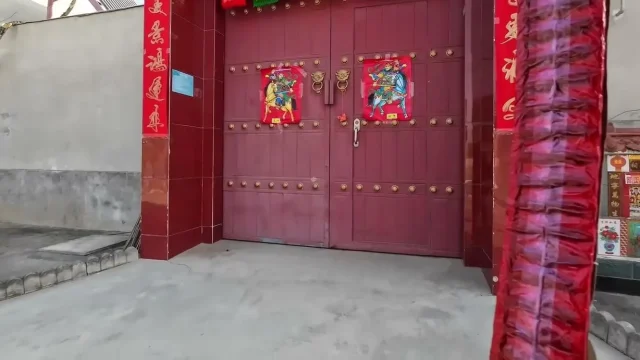
Hang them in pairs. Good things come in twos at New Year, which is why couplets, door gods and lanterns all go up as matched sets. One lantern on each side of the door, at the same height, frames the entrance the same way the couplets do.
Hang them above head height so nobody walks into a tassel, and keep the bottoms clear of the door swing. If the door sits under an overhang, hooks in the eave work well. If it opens straight onto the weather, choose nylon or polyester lanterns and bring paper ones inside.
Indoors, a single lantern or a string of small ones works in an entryway, over the table for New Year’s Eve dinner, or in a front window where the street can see it. Wherever a lantern hangs indoors, put an LED or battery light inside it, because curtains and paper burn easily.
Lanterns on the 15th day: a flower lantern parade in western Guangdong
The 15th day, where the home calendar ends, is also where lanterns leave the doorway and go out into the street. In western Guangdong, the flower lantern festival is a folk tradition that celebrates the new year and asks for good luck, and it centers on the days around the 15th of the first lunar month.
Handmade flower lanterns are the heart of it, usually with lion and dragon dances alongside. By day, the lanterns hang from long bamboo poles outside village houses, two or three to a pole, their pink and white paper roses and paper fringe moving in the wind. In daylight they look like decorations waiting for a job.
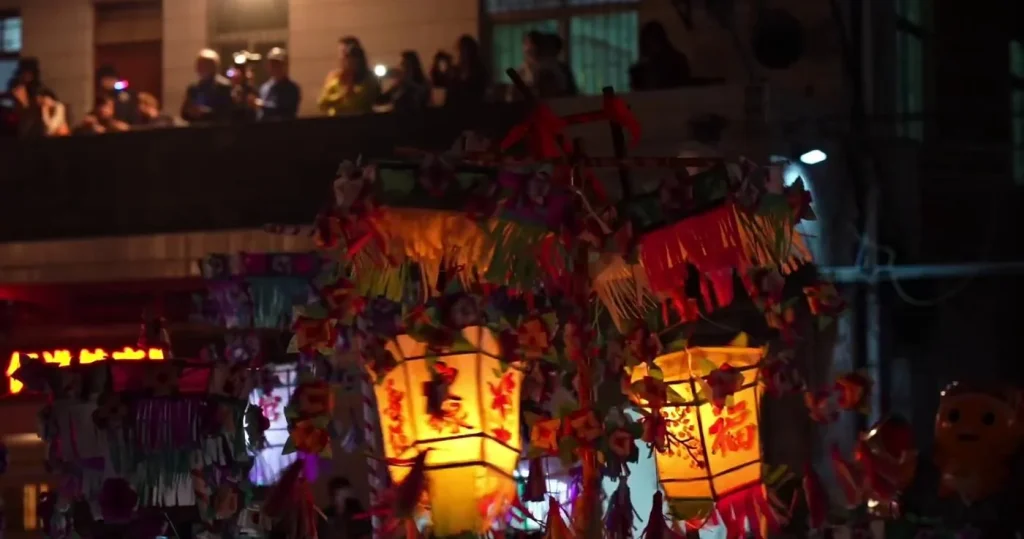
After dark the job starts. The lanterns are lit, raised on poles and carried through the lanes, a row of glowing pink and white shapes above the crowd while fireworks burst overhead. Some of the brightest are six-sided yellow lanterns with one red character, 福, painted on the side, topped with paper flowers and red fringe.
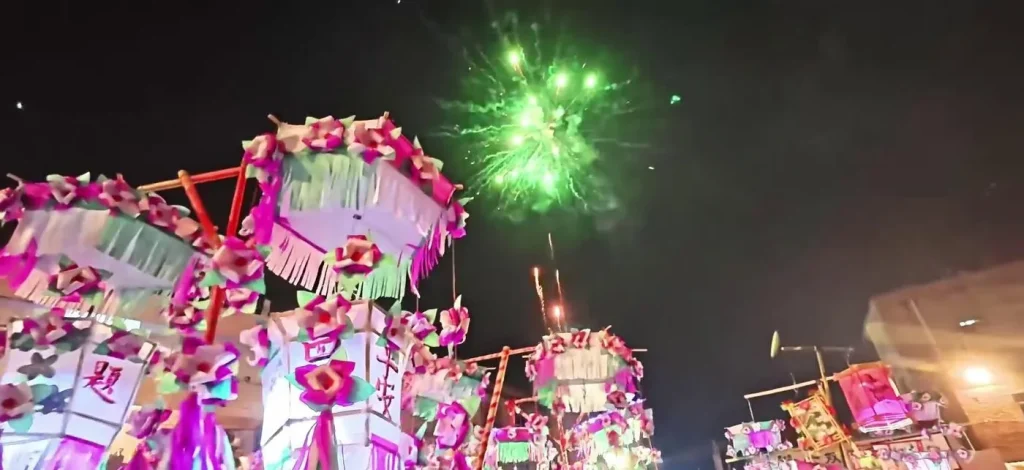
What I take from the Guangdong parades is that a New Year lantern was meant to travel as well as to hang. Carried through the lanes on the 15th night, it turns a whole village’s wishes into a moving line of light, and the round red pair at your door is the quiet household version of the same thing.
Reading the characters painted on lanterns
The Guangdong parade lanterns carry words as well as light, and village lanterns are often lettered by hand in red brush strokes. Here are the phrases painted on those lanterns and what each one wishes for:
- 福 (fu): good fortune. One of the most common characters on New Year lanterns, doors and red envelopes, and the one painted on the yellow parade lanterns.
- 平安 (ping’an): peace and safety, a wish that everyone in the house gets through the year unharmed.
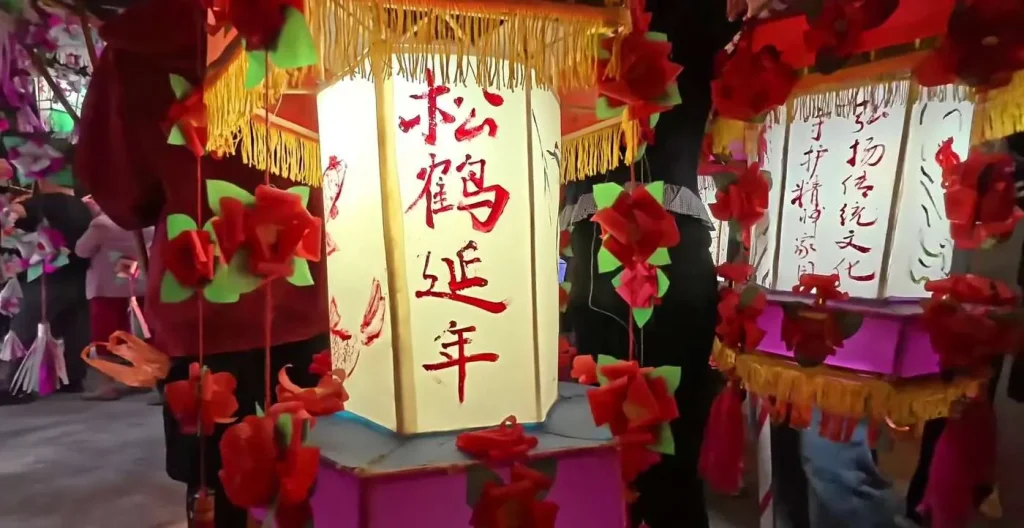
- 松鹤延年 (song he yan nian): “pine and crane, long life.” Pines stay green through winter and cranes stand for longevity, so the phrase usually goes out as a wish for the elders of the house.
- 弘扬传统文化 守护精神家园: “carry on traditional culture, guard our spiritual home.” This one is a modern slogan rather than an old blessing, a sign that village lanterns pick up new phrases along with the old ones.
As a Taoist, I’m fondest of 松鹤延年. The crane is the bird the immortals ride in Taoist art, and pairing it with the evergreen pine turns a simple birthday wish into a picture of a long, unhurried life.
Store-bought red lanterns usually stick to a short list printed in gold: 福 on its own, or 吉祥如意 (jixiang ruyi), “good luck and everything as you wish.” If a four-character phrase on your lantern looks oddly ordered, try reading it right to left. Older horizontal writing in China ran that way, and traditional-style lanterns sometimes keep the old order.
Buying Lunar New Year lanterns or making a simple paper one
Once you can read a lantern, the last choice is whether to buy one or make one. Buying makes sense for the front door, where a lantern has to survive two weeks of weather; making one makes sense for a table, a window or an afternoon with kids.
What to check when you buy lanterns
- Material. Paper is cheap and fine indoors for one season. Nylon or polyester holds up to rain and wind and lasts several New Years. Silk and brocade look the richest and belong indoors.
- Light. Pick lanterns sold with an LED string or with room for a battery light. A real candle inside paper or nylon is a fire risk, and most decorative lanterns are built for electric light.
- Size. Lanterns are sold by diameter. For a front door, I’d look at something around 12 to 16 inches (30 to 40 cm) across, which reads clearly from the street; 6 to 8 inches (15 to 20 cm) suits a window string or an indoor table.
- Frame. A spring-wire frame that folds flat makes storing them between New Years easy.
- Outdoor fittings. Check that the top hook is metal rather than a paper loop, and tie the tassel down on a windy porch so it stays untangled.
How to make a simple paper lantern at home
You’ll need:
- One sheet of red paper, letter size (8.5 by 11 inches, or 22 by 28 cm)
- One sheet of gold or yellow paper the same size, for an optional liner
- Scissors, a ruler and a pencil
- A glue stick or clear tape
Cut a strip about 1 inch (2.5 cm) wide off one short end of the red sheet and set it aside for the handle. Fold the rest in half lengthwise, then draw a line about 1 inch (2.5 cm) in from the open edges. Cut slits from the fold up to that line, about 1 inch (2.5 cm) apart.
The line is the part that matters: cut past it and the lantern falls apart in your hands. Unfold the sheet, roll it into a tube with the slits running up and down, and glue the short edges together. Press the top and bottom gently toward each other so the middle bows out into ribs, then glue the handle strip across the top.
For a New Year version, roll the gold sheet into a plain tube first and slide it inside, so gold shows between the red ribs. A 福 written in black marker on a small square of paper and glued to the front finishes it. Set a battery tea light underneath instead of a candle, and the lantern will see you through to the 15th.
Written by
Daozhang MaMaoshan Taoist, Jintan, Jiangsu
Daozhang Ma is a Maoshan Taoist who has practiced for 22 years and is skilled at writing talismans and painting Taoist pictures. He runs Zodiac & Tradition.
About Daozhang Ma