Chinese New Year 2027: Date, Fire Goat Year and Key Days
By Daozhang MaMaoshan Taoist, Jintan, Jiangsu
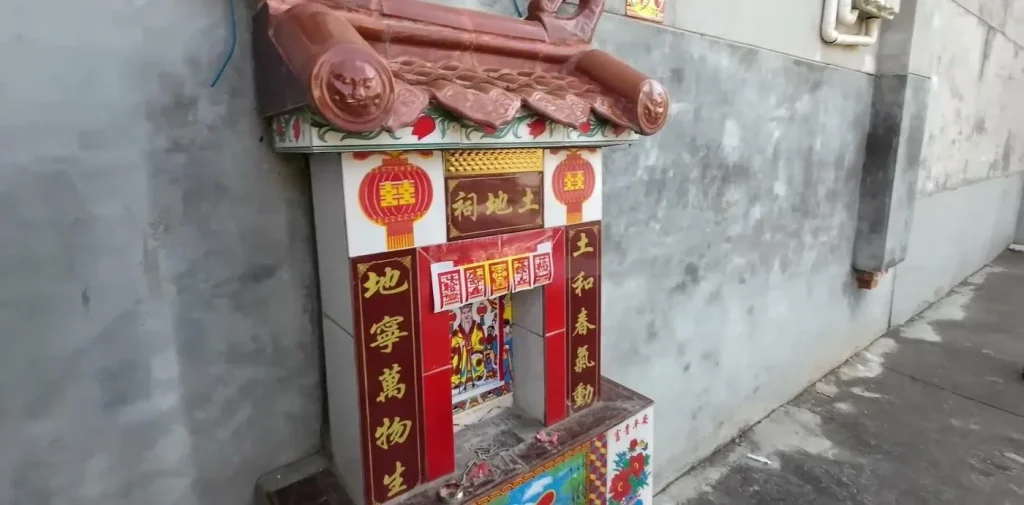
In short
Chinese New Year 2027 falls on Saturday, February 6, 2027. That’s the first day of the first month in the Chinese lunar calendar, and it opens the Year of the Goat, a Fire Goat year that runs until January 25, 2028. New Year’s Eve, the night of the reunion dinner, is Friday, February 5, and the season closes 15 days later with the Lantern Festival on Saturday, February 20.
Below I’ve put the whole 2027 calendar in one place, then what the Fire Goat label means, how the days off work, and what families actually do at the gate and on the Eve.
When is Chinese New Year 2027?
The date of Chinese New Year 2027 is February 6, and it’s a Saturday. The Hong Kong Observatory’s official Gregorian-lunar conversion table for 2027 marks February 6 as the start of the first lunar month, and that’s the day calendars across China, Hong Kong and Chinese communities overseas go by.
The date moves every year because the lunar new year usually starts on the second new moon after the winter solstice, and it always lands between January 21 and February 20. In 2026 it fell on February 17. In 2028 it comes early, on January 26.
For readers in the US, the date doesn’t shift. The lunar calendar is reckoned on Beijing time, and February 6 in Beijing is still February 6 on any American wall calendar. If you’re in New York or Los Angeles, the Eve dinner is Friday night, February 5, and New Year’s Day is the Saturday after.
There’s one small quirk in 2027. The last month of the old year, the twelfth lunar month, has only 29 days. Families who say they’ll “do it on the thirtieth” won’t find a thirtieth this time. The Eve is the 29th, which is February 5.
The Chinese New Year 2027 calendar, from Little New Year to the Lantern Festival
The New Year season isn’t one day. It starts about a week before, with the Kitchen God’s send-off, and it ends on the 15th day of the first month. Here are the 2027 dates, checked against the Hong Kong Observatory table.
| Day | Lunar date | 2027 date | What happens |
|---|---|---|---|
| Little New Year (north) | 12th month, day 23 | Saturday, January 30 | Kitchen God sent off to report to heaven |
| Little New Year (south) | 12th month, day 24 | Sunday, January 31 | Same send-off, one day later in much of the south |
| Lichun, Beginning of Spring | solar term | Thursday, February 4 | Almanac year changes |
| New Year’s Eve (chuxi) | 12th month, day 29 | Friday, February 5 | Couplets up, reunion dinner, staying up |
| Chinese New Year’s Day | 1st month, day 1 | Saturday, February 6 | Visits to elders, red envelopes |
| Second day | 1st month, day 2 | Sunday, February 7 | In many families, married daughters visit their parents |
| Fifth day (po wu) | 1st month, day 5 | Wednesday, February 10 | God of Wealth welcomed, many shops reopen |
| Lantern Festival | 1st month, day 15 | Saturday, February 20 | Lanterns, sweet rice balls, the season ends |
Little New Year belongs to the Kitchen God, the household god who’s said to report on the family to the Jade Emperor. The 23rd or 24th depends on the region, and I wouldn’t treat either one as the “right” day.
If you only mark two dates in your 2027 calendar, mark Friday, February 5 and Saturday, February 20. The first is the dinner everyone travels home for, and the second is when the decorations can finally come down.
Why 2027 is the Year of the Fire Goat (Ding Wei)
The Year of the Fire Goat comes from the year’s name in the 60-year cycle, Ding Wei (丁未). Wei is the earthly branch that goes with the Goat, and Ding is a heavenly stem that belongs to fire. Put them together and you get a Fire Goat. The cycle repeats every 60 years, so the last Fire Goat year was 1967.
The animal itself is the same one English sources call the Goat, the Sheep or the Ram. The Chinese word yang (羊) covers all three, and none of those translations is wrong. Other Goat years are 1955, 1967, 1979, 1991, 2003 and 2015.
There’s one detail that trips people up. The almanac and Chinese birth-chart reckoning (bazi) change years at Lichun, the Beginning of Spring, which falls on February 4, 2027. The zodiac most people use changes at New Year’s Day, February 6. A baby born on February 4 or 5, 2027 is a Goat by the almanac and still a Horse by the lunar new year. I go by the lunar new year for the animal, and I tell parents that both answers have a long history behind them.
As for what the Fire Goat year “brings,” the old readings describe Goat years as gentle and fire as quick to warm up. That’s the tradition as it’s written. I read it as a mood for the year, not a forecast, and the 2027 Chinese zodiac page goes through what the readings say for each sign.
Is Chinese New Year 2027 a public holiday?
In mainland China, Chinese New Year is the longest public holiday of the year. Since a 2024 revision by the State Council, which took effect in 2025, the Spring Festival gets four statutory days off: New Year’s Eve plus the first three days of the new year. Swapped weekends usually stretch that into a break of about eight or nine days. The State Council’s General Office published the 2027 schedule on November 5, 2026.
For 2027 the statutory days are Friday, February 5, through Monday, February 8. With the weekend swaps the break runs nine days, from the Eve to Saturday, February 13, the eighth day of the new year. Sunday, January 31 and Sunday, February 14 become working days. Factories and offices often close for longer, and trains and flights fill for weeks either side.
In the US, Chinese New Year isn’t a federal holiday. Some places do give the day off. New York City public schools, for one, close for Lunar New Year. Because February 6, 2027 is a Saturday, most American parades and community celebrations will fall on that weekend or the weekends after it.
How families prepare the home for Chinese New Year 2027
Getting the house ready is the part of Chinese New Year that takes the most work, and it mostly happens on the last day or two of the old year. In 2027 that’s Thursday, February 4 and Friday, February 5. The house gets swept, the old couplets come off the gate, and the new red ones go up.
Spring couplets (chunlian, 春联) are a pair of vertical red strips with matching lines of verse, one on each side of the door, plus a short horizontal banner across the top. They’re pasted, not taped, and the paper is long enough that it’s easier to lay out and brush on the ground first.
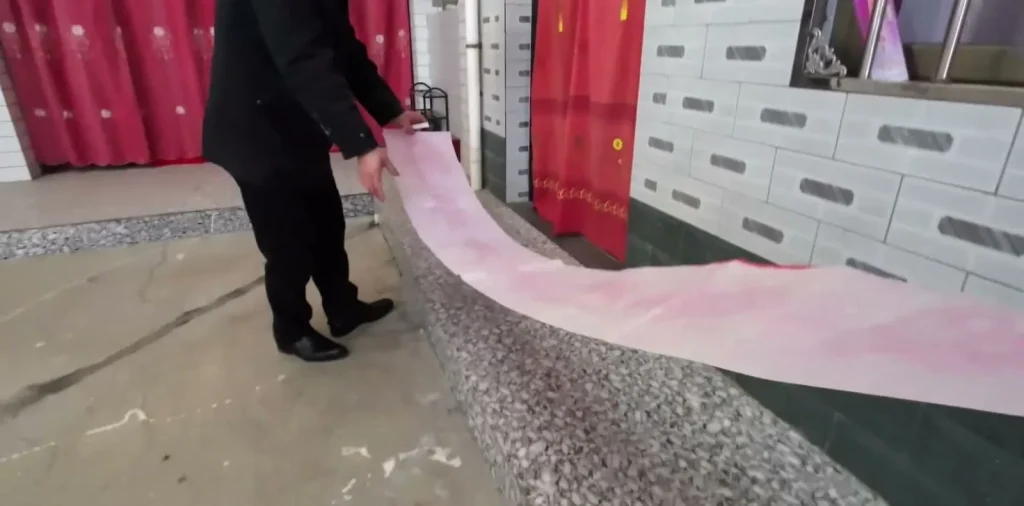
The rule I’d pass on is the one most families keep without thinking: the couplets go up before the Eve dinner, not after. Once the family sits down to eat, the gate should already be finished. The couplets page covers how to tell the left line from the right one, which is the mistake people make most.
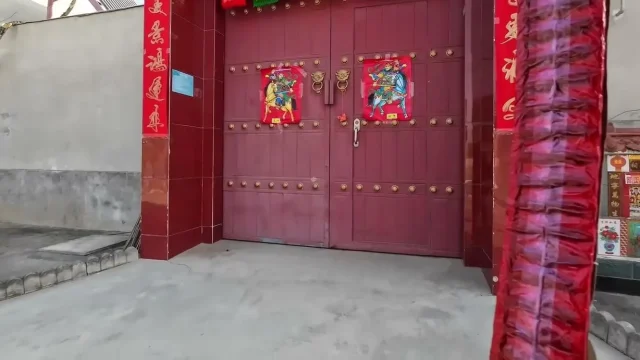
Door gods (menshen, 门神) are the other thing that goes on a gate with two leaves. They’re a pair of painted guardians, one on each leaf, facing each other. Most printed sets show Qin Qiong and Yuchi Jingde, two generals who served Emperor Taizong of the Tang dynasty in the 600s.
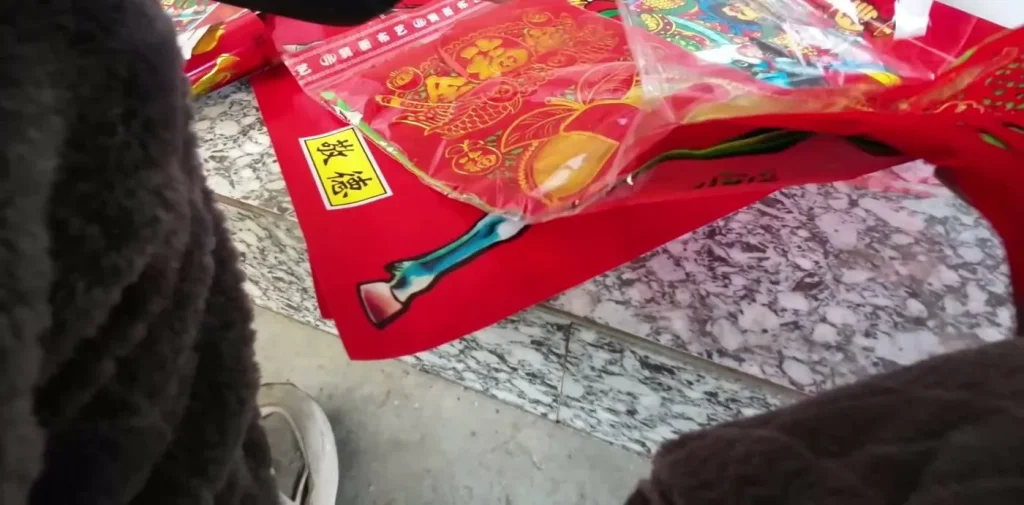
The story behind them is told in the Ming novel Journey to the West. Taizong is kept awake by a ghost, and the two generals stand guard at his door all night so he can sleep. When they grow tired, their portraits are hung in their place. That’s a story, not history, but it explains why the pair stands at the door and why the prints come labeled with a name. The two are pasted so that their faces turn toward each other across the gap.
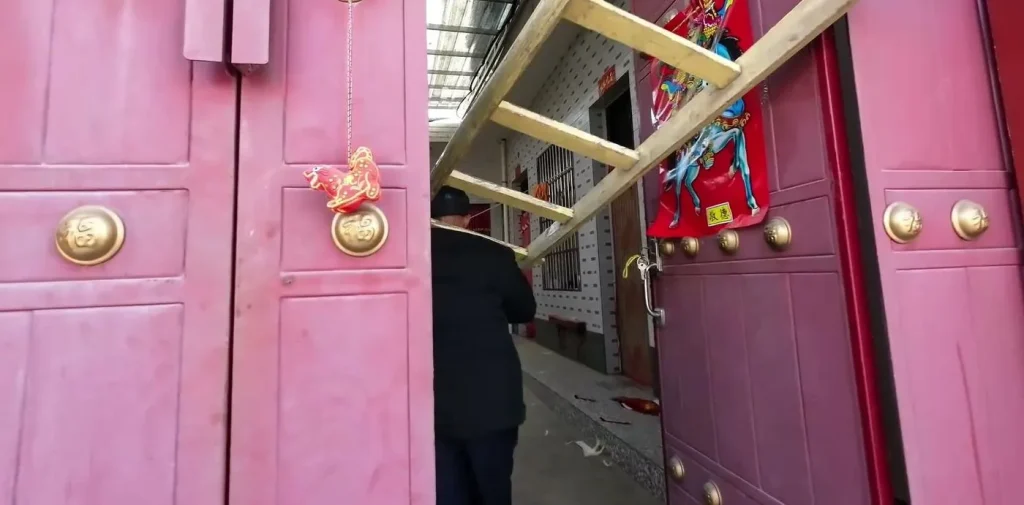
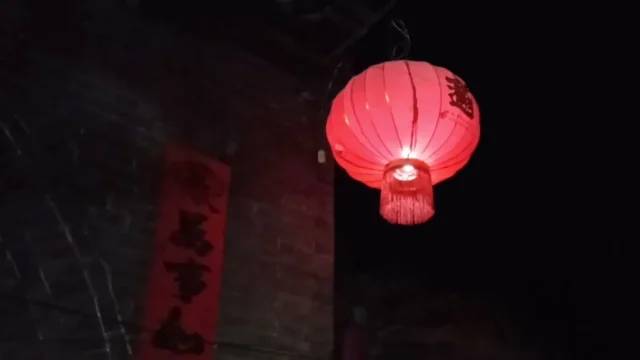
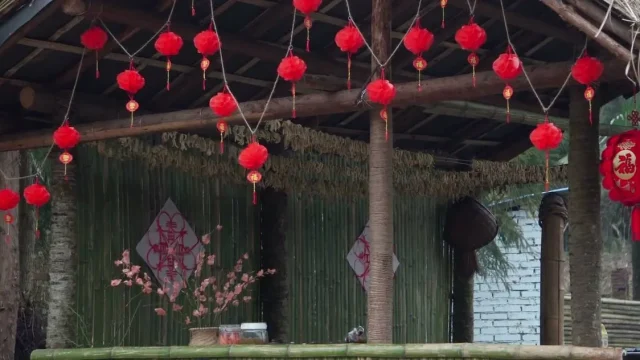
The order on a farmhouse gate is usually the banner first, because it needs the ladder, then the side couplets and the door gods. Red lanterns go up last. If there’s a single-leaf door inside the house, a fu (福) sign, the character for good fortune, goes there instead.
Firecrackers and New Year’s Eve customs in 2027
The Eve, Friday, February 5, 2027, is the center of the whole holiday. Families eat the reunion dinner together, give children red envelopes, and many stay up past midnight to see the old year out, a custom called shousui (守岁), “guarding the year.” The Chinese New Year’s Eve page goes through the dinner dish by dish.
Firecrackers are the loudest part of it. Families set off a string at the gate when the decorating is done, again at midnight, and again on the morning of New Year’s Day. The usual explanation is the legend of Nian, a beast that came out at the turn of the year and was scared off by noise, fire and the color red.

I’d take the Nian story the way most people tell it, as a story for children. The older reason for the noise goes back to burning bamboo, which cracks loudly in a fire, and the custom of making a racket to clear out the old year. In 2027 the noise will depend on where you are. Many Chinese cities limit or ban firecrackers within city limits, and villages are where you still hear them all night.
New Year’s Day itself, Saturday, February 6, has a short list of things families avoid. People don’t sweep, so the luck isn’t swept out the door, and they don’t break things or talk about death. These are traditional customs, not promises of anything, and the superstitions page explains where each one comes from.
FAQ about Chinese New Year 2027
Is Chinese New Year the same as Lunar New Year? Yes. In China the two names mean the same day, February 6, 2027. “Lunar New Year” is the wider name, because South Korea, Vietnam and other places mark the same new moon with their own customs. In 2027 South Korea’s Seollal falls a day later, on Sunday, February 7, because that new moon arrives just after midnight Seoul time. The Lunar New Year guide covers those differences.
What is the Chinese element for 2027? Fire. 2027 is a Ding Wei year, and the stem Ding belongs to fire, so 2027 is a Fire Goat year.
Is 2027 a leap year? No. The Gregorian year 2027 has 365 days. The Chinese lunar year that starts on February 6, 2027 has 12 months and no leap month, so it lasts 354 days and ends on January 25, 2028.
When does the Year of the Goat end? On January 25, 2028. The Year of the Monkey starts the next day, January 26, 2028.
The Fire Goat year is a quiet name for a long, loud holiday. If you’re planning around Chinese New Year 2027, put the Eve dinner on February 5 first and let the rest of the calendar fall in around it. I’d plan it that way myself.
Written by
Daozhang MaMaoshan Taoist, Jintan, Jiangsu
Daozhang Ma is a Maoshan Taoist who has practiced for 22 years and is skilled at writing talismans and painting Taoist pictures. He runs Zodiac & Tradition.
About Daozhang Ma