Happiness Chinese New Year: Say Happy New Year in Chinese
By Daozhang MaMaoshan Taoist, Jintan, Jiangsu
In short
To wish someone happiness at Chinese New Year, say xinnian kuaile (新年快乐), the standard Mandarin for “Happy New Year,” which reads word for word as “new year, happy.” It suits anyone from a neighbor to your boss, and in 2027 the holiday starts on February 6. Two more lines cover most other moments: guonian hao (过年好), the warmer everyday form, and gong xi fa cai (恭喜发财), the wish for wealth. Below you’ll find how to say them, what “happiness” means in Chinese, the four-character wishes people brush on red paper, the lines for elders, this year’s Goat greetings, and what to do with your hands.
How to say Happy Chinese New Year in Mandarin
Four short lines will carry you through the whole holiday, and you only need the first one to be polite. The “sounds like” column is a rough American spelling, so treat it as a starting point and copy a native speaker’s tones when you can.
| Chinese | Pinyin | Sounds like | Meaning | When to use it |
|---|---|---|---|---|
| 新年快乐 | xīnnián kuàilè | shin-nyen kwhy-luh | Happy New Year | Anyone, in speech or writing; also said on January 1 |
| 新年好 | xīnnián hǎo | shin-nyen how | Good New Year | Casual, in place of a plain hello |
| 过年好 | guònián hǎo | gwoh-nyen how | Good New Year to you | Face to face during the holiday, especially in the north |
| 春节快乐 | chūnjié kuàilè | chwun-jyeh kwhy-luh | Happy Spring Festival | Only for this holiday, never for January 1 |
If you want to sound as if you mean this New Year and not the Western one, chunjie kuaile (春节快乐) is the clearest choice. Chunjie is the Chinese name for the holiday, and the Lunar New Year guide walks through what happens on each day of it.
Chinese New Year happiness in four words: kuaile, xi, fu and xingfu
Chinese has no single word for “happiness,” which is why a translation app can hand you a line nobody says. Each of these words does a different job at New Year:
- Kuaile (快乐) is cheerfulness, the feeling of having a good time. It’s the “happy” in Happy New Year and in Happy Birthday.
- Xi (喜) is joy you can celebrate out loud, the kind that goes with weddings and good news. It sits inside gong xi (恭喜), “congratulations.”
- Fu (福) is blessing, the good fortune that arrives from outside you. It’s the single character you’ll see pasted on doors all through the holiday.
- Xingfu (幸福) is lasting happiness, the settled contentment of a good life. It’s the word a dictionary gives for “happiness,” yet you’ll seldom hear it as a greeting on its own.
So “happiness” at New Year is really a bundle. You say kuaile, you wish for fu, and you offer xi to the people around you. Written wishes do use xingfu, usually for a family, as in hejia xingfu (阖家幸福), “happiness for the whole household.”
How to wish gong xi fa cai, in Mandarin and Cantonese
Gong xi fa cai (恭喜发财) means “congratulations, and may you get rich,” and you say it with a smile, often with your hands clasped. Gong xi is the congratulations, and fa cai is the getting rich. It’s the safe line for handing over a red envelope, and it’s also the greeting most Americans have already heard.
The Cantonese form uses the same four characters and sounds quite different. Wiktionary spells it gung1 hei2 faat3 coi4 in Jyutping, the standard romanization for Cantonese, and you’ll see it on Chinatown banners as “kung hei fat choy” or “gung hay fat choy.” China Highlights, a China travel company, says the phrase is heard most in Hong Kong, Guangdong and nearby areas, and that it’s now common in many Chinatowns. Wiktionary traces it to Guangzhou Cantonese after the Opium Wars, though that’s one reference, so I wouldn’t lean on it too hard.
Use whichever form matches the person in front of you. I live in Jiangsu and don’t speak Cantonese, so I’m stopping at this one line instead of guessing at the tones of any others. For the rest, ask a Cantonese speaker.
Four-character greetings for good fortune at New Year
Once xinnian kuaile is out of the way, the next step up is a four-character wish, and these are the phrases people add after it, write in cards and hang on the wall. The most useful one is wan shi ru yi (萬事如意): wan is ten thousand, shi is matters, and ru yi is “as you wish.” Put together, it says that every last thing in your year should go the way you want.
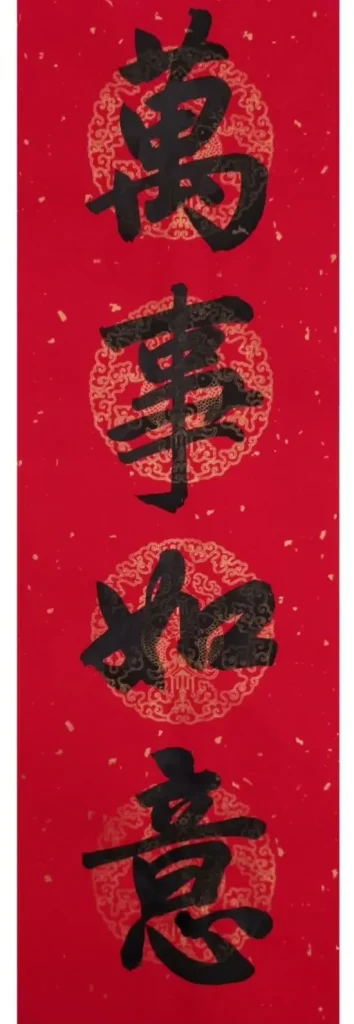
Strips like this usually run top to bottom, so read them that way. Notice the first character. Mainland China’s everyday form of ten thousand is 万, three strokes, but calligraphers often keep the older 萬 on New Year paper. If you’re writing a card, use simplified characters for mainland readers and traditional ones for Hong Kong, Taiwan and many older overseas families.
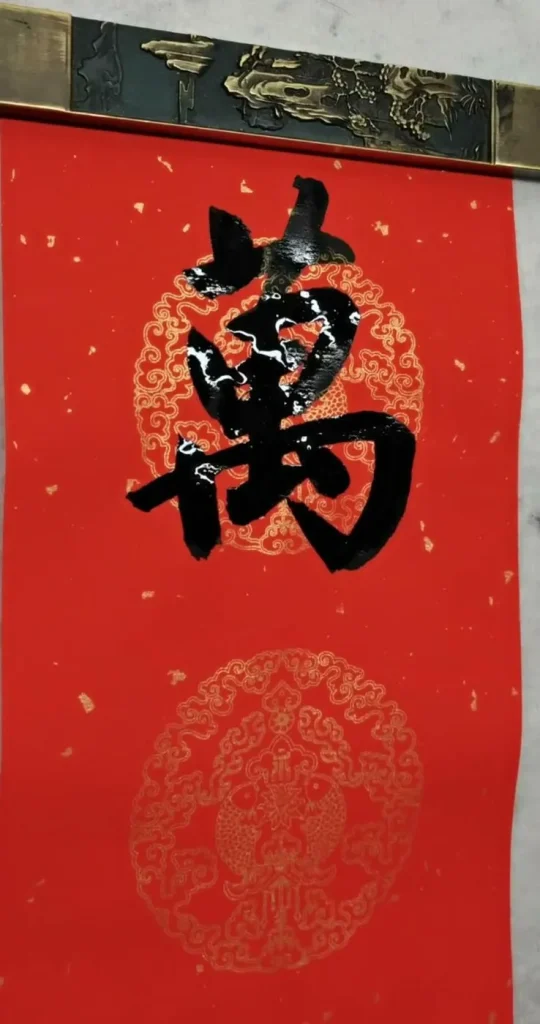
Ru yi (如意) turns up at the end of more than one wish, because “as you wish” fits after nearly anything good. Ji xiang ru yi (吉祥如意) means “good fortune, and all you wish.” The same word also names a curved ornamental scepter, given as a lucky gift.
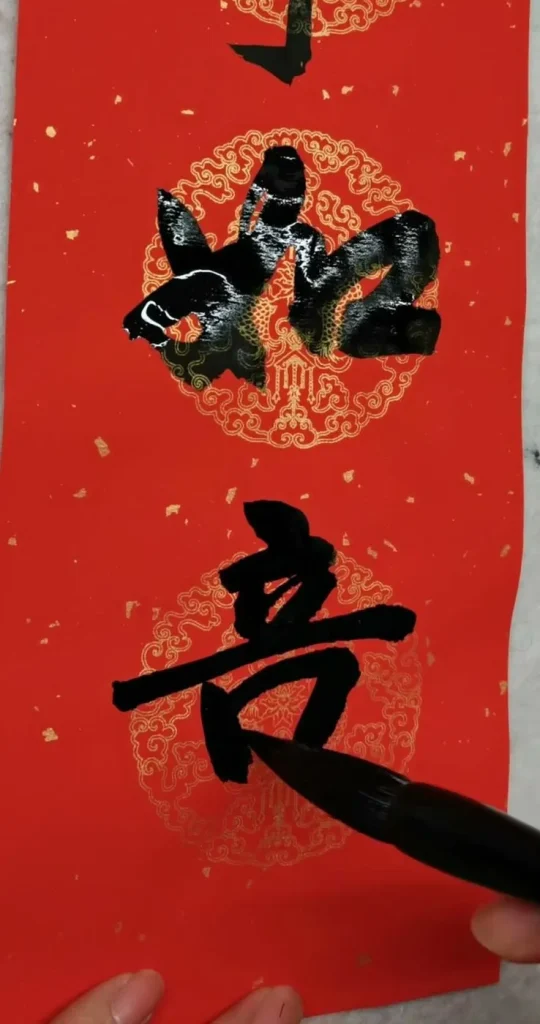
Two more belong with these, and both are easy to say. Si ji ping an (四季平安) asks for peace in all four seasons, and he jia huan le (合家歡樂) asks for joy for the whole family. Shops and doorways have their own stock of phrases too, and the four-character banners on my couplets page sort them by who usually picks which.
Wishing health and luck to elders and family
Older relatives care less about wealth than about staying well, so the good-fortune wishes above give way to health at their table. Shen ti jian kang (身體健康), “good health to your body,” is the line I’d never skip with anyone past 60. In a sentence it’s zhu nin shen ti jian kang (祝您身体健康), and nin (您) is the respectful form of “you.”
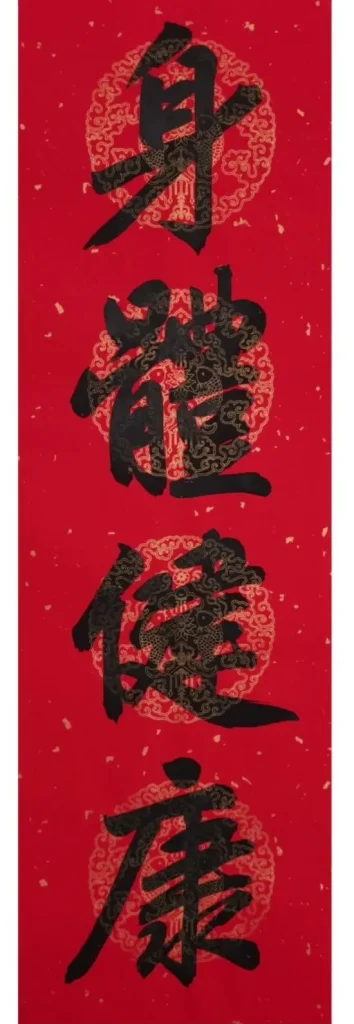
The second half of that phrase, jian kang, is the plain modern word for health, and it works alone on a card.
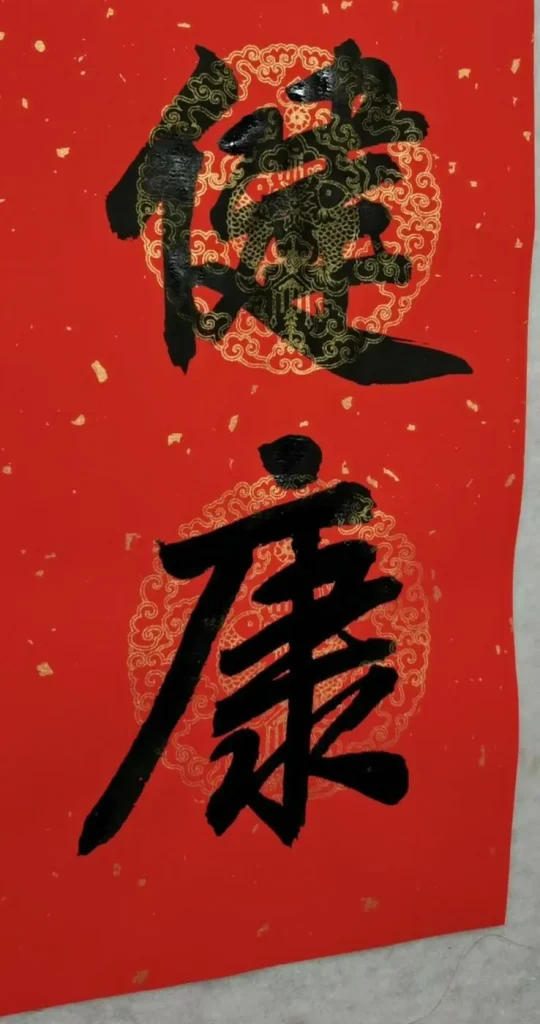
For a grandparent, fu shou kang ning (福壽康寧) reaches further back. It wishes fortune, long life, health and peace. Long life and kang ning both appear among the Five Blessings in the Book of Documents, one of China’s oldest classics, so this greeting has very old roots.
Luck has its own word, ji xiang (吉祥), and it goes on almost anything. When I brush a pair of characters like these, I leave the sheet flat until the shine goes off the ink. Hang it wet and the strokes run, and I’ve ruined a few that way.
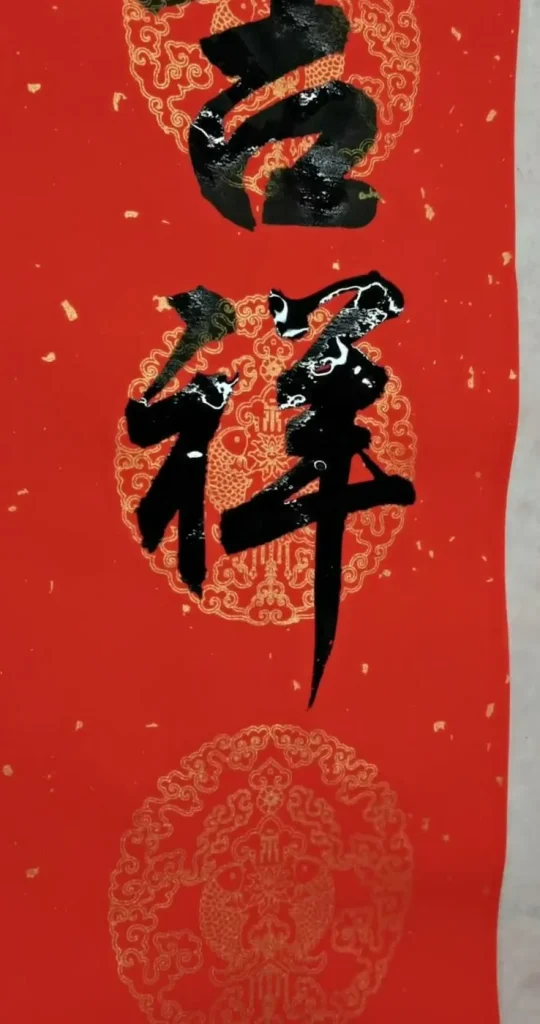
Happy Chinese New Year 2027: Goat-year greetings
Beyond the wishes that fit every year, each zodiac animal brings its own lines. The Chinese New Year 2027 holiday opens the Year of the Goat, so the easy swap is yang nian kuai le (羊年快乐), “Happy Year of the Goat.”
The clever one is san yang kai tai (三羊开泰), “three goats open the way to good times.” It’s a pun. Goat (羊) and yang (阳), the bright force in yin and yang, are both pronounced yang, and the older phrase means “three yang lines open Tai.” Tai (泰) is the I Ching hexagram of peace, with three yang lines at the bottom, and tradition ties it to the first lunar month. A goat year is simply the best excuse to use it.
The goat also hides inside ji xiang. The Shuowen, a Han dynasty character dictionary, explains the character 羊 by the character 祥, so a goat year suits that wish rather well.
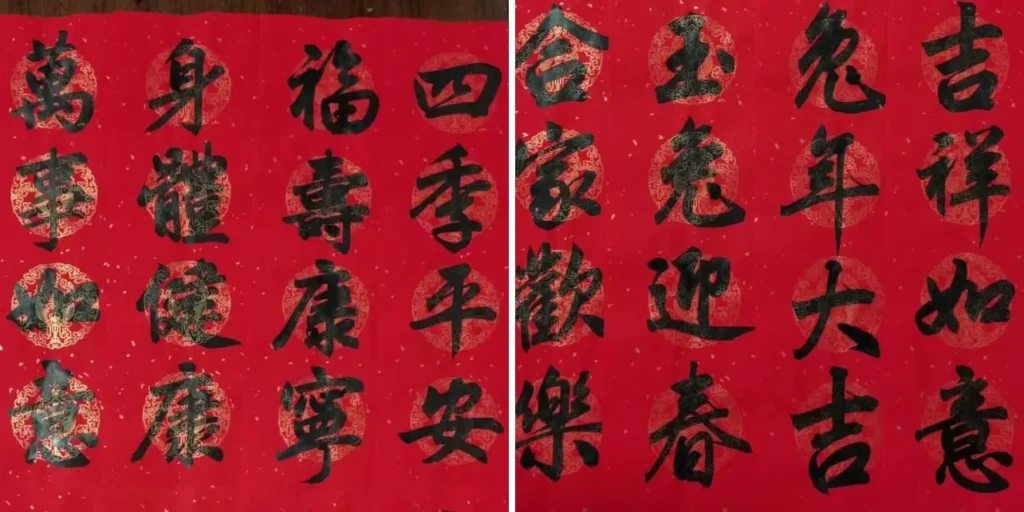
Lines like these expire. The sheet at the top of this page was brushed for the 2023 Rabbit year, and two of its eight wishes show that: yu tu ying chun (玉兔迎春), “the jade rabbit welcomes spring,” and tu nian da ji (兔年大吉), “great luck in the Year of the Rabbit.” They’re good examples of the form, and they’re wrong for 2027. The next Rabbit year is 2035.
How to greet someone in person at Chinese New Year
Knowing the words only gets you halfway, because a New Year greeting also has an order and a gesture. A guest who gets those right can mumble the Mandarin and still be welcome at the table, and four things matter most:
- Who speaks first: the younger person greets the older one, and New Year calls run the same way.
- When to say it: say it the first time you see someone after New Year’s Day. People keep greeting each other through to the Lantern Festival on the 15th day.
- What to do with your hands: cup them at chest height, one hand wrapped over the other fist, and bow slightly. Men traditionally put the left hand on the outside, and women the right. Duan Yucai, the Qing scholar who annotated the Shuowen, recorded that funeral bows reverse this, so the side does matter. I greet with my hands more often than with words on Maoshan, and a quiet nod with them goes a long way.
- How to reply: repeat the greeting back. To gong xi, the neat answer is tong xi (同喜), “the same joy to you.”
The greeting often comes with something in your hands as well. The gift etiquette page covers what to carry on a New Year call and how to hand it over, and a short wish belongs in that moment too.
The best Chinese New Year message for a card or text
A good written message is two pieces: Happy New Year, then one wish that fits the person. Zhu (祝) at the start means “I wish,” and these four sentences are ready to copy:
| For | Message | Pinyin | Meaning |
|---|---|---|---|
| An elder | 祝您新年快乐,身体健康! | Zhù nín xīnnián kuàilè, shēntǐ jiànkāng! | Happy New Year and good health |
| A friend | 祝你新年快乐,万事如意! | Zhù nǐ xīnnián kuàilè, wànshì rúyì! | Happy New Year, may it all go as you wish |
| A client | 祝您新年快乐,生意兴隆! | Zhù nín xīnnián kuàilè, shēngyì xīnglóng! | Happy New Year and booming business |
| A student | 祝你新年快乐,学业进步! | Zhù nǐ xīnnián kuàilè, xuéyè jìnbù! | Happy New Year and progress in your studies |
One caution before you send anything. A family that lost someone this past year may be keeping the holiday quietly, so I’d drop “happy” and “get rich” with them and simply say you’re thinking of them. For the rest of the year’s zodiac and calendar reading, start from the Zodiac and Tradition home page.
Written by
Daozhang MaMaoshan Taoist, Jintan, Jiangsu
Daozhang Ma is a Maoshan Taoist who has practiced for 22 years and is skilled at writing talismans and painting Taoist pictures. He runs Zodiac & Tradition.
About Daozhang Ma