Kitchen God
By Daozhang MaMaoshan Taoist, Jintan, Jiangsu
At a glance
Deity
灶君 Zao Jun
- Origin
- A household god of the stove who grew out of ancient fire and stove worship; a later folk tale made him Zhang Lang, who leapt into the stove in shame.
- Source
- Book of Rites (five household sacrifices); Huainanzi; Xu Shen's Wujing Tongyi and Duan Chengshi's Youyang Zazu; folk tale of Zhang Lang Classical text
- Tradition
- Sent to heaven on the 23rd (north) or 24th (south) of the 12th lunar month with malt candy and his old print burned; a new print goes up on New Year's Eve.
A traditional Chinese kitchen has a watcher by the stove: the Kitchen God, Zao Jun (灶君), the household god who keeps an eye on the family all year. On the 23rd day of the twelfth lunar month, the 24th in much of southern China, he goes up to heaven to report on the household to the Jade Emperor.
Families see him off with sticky malt candy so that his report comes out sweet. They burn his old paper image to send him on his way and paste up a new one when he returns on New Year’s Eve.
Below I cover who he is, why his day moves between the 23rd and 24th, the candy, how to read his print, the send-off and the welcome back, his stories, and how a Taoist reads him.
Who the Kitchen God is: Zao Jun, the god who watches the family from the stove
His names all point back to the stove. Zao is the Chinese cooking stove, so Zao Jun means Lord of the Stove and Zao Shen means Stove God. Many people call him Zao Wang Ye, Grandpa Stove King, and you’ll also hear Zao Gong and Siming.
The Kitchen God’s worship is very old. The Book of Rites lists five household sacrifices, to the gate, the inner door, the central room, the stove and the path, and from the Han dynasty on he was counted among them as a god who notes small wrongs.
Every family has its own Kitchen God. When brothers split one household into two, one of them had to set up a new Kitchen God. Two families cannot share one stove, or the god who watches it.
He belongs to the whole Chinese cultural world. Koreans honor a kitchen god called Jowangsin, Japanese homes have Kōjin, and Vietnamese families honor Táo Quân, three kitchen gods who also report to the Jade Emperor at the end of the lunar year.
Kitchen God Day: why he leaves on the 23rd, or the 24th in the south
His departure falls on Little New Year, xiaonian (小年), which is why the day is also called the Kitchen God Festival. Northern China keeps it on the 23rd of the twelfth month and most of the south on the 24th, and some coastal communities send him off on the 25th.
The split goes back to an old saying, guan san min si chuan wu: officials on the 23rd, common people on the 24th, boat people on the 25th. From the Northern Song dynasty the offering settled on the 24th, joined to a festival that marked the turn of the year.
In the Qing dynasty, the government moved its own offering to the 23rd. Families in the north, close to the capital, followed the officials, while most of the south kept the 24th.
The date matters less than the order. The Kitchen God leaves first, about a week before Lunar New Year, and the cleaning and New Year shopping start after he has gone.
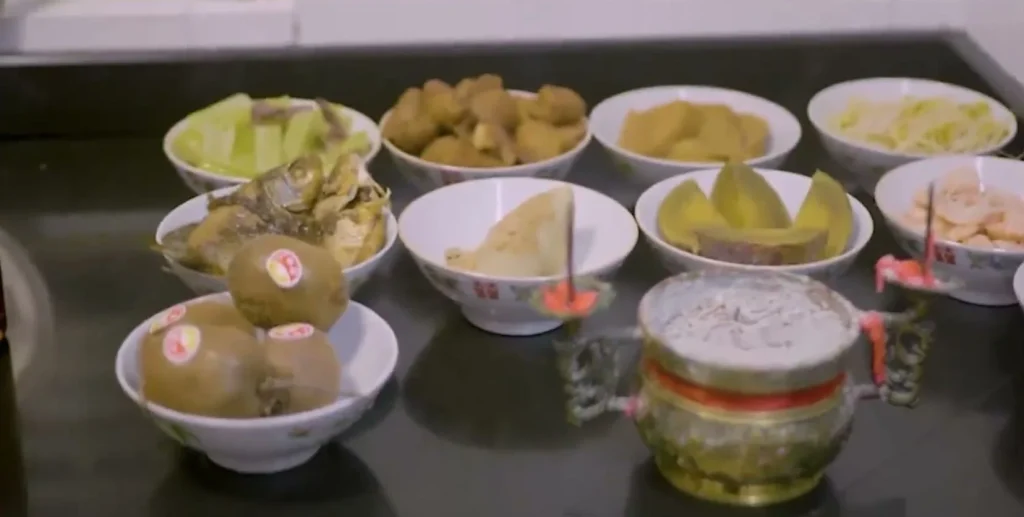
Kitchen God candy: sticking his mouth shut with malt sugar
His report decides whether the Jade Emperor rewards or punishes the household, so the offering for him is candy made from maltose. The northern saying for the 23rd is ershisan, tanggua zhan: “on the 23rd, the sugar melons stick.”
The candy comes in a few shapes. Tanggua (糖瓜), sugar melons, are round. Guandong candy comes in sticks about ¾ inch (2 cm) thick, so hard that the real thing is said to need a knife. In Shanghai and Jiangsu, where I live, people call the same candy tang yuanbao, sugar ingots.
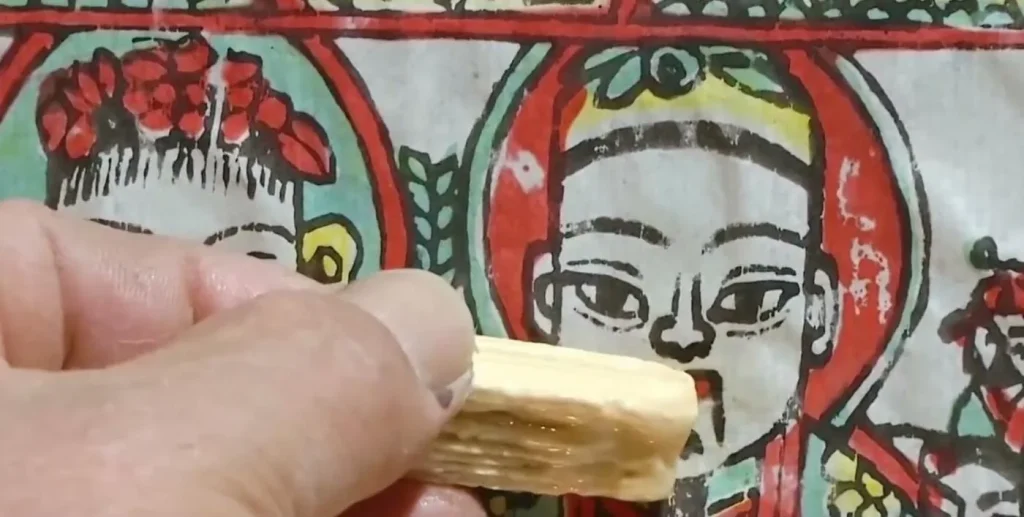
People explain the candy two ways. In one, he eats something sweet and only says sweet things. In the other, the candy glues his teeth together so he can’t say anything bad, which is why another name for it is jiaoya tang, tooth-gluing candy. Some families smear honey on the lips of his paper image for the same reason.
A Tang dynasty record of the capital’s festivals tells of people dabbing wine dregs on the stove to get the Overseer of Fate drunk before his trip. Today some families just pass a piece of candy or chocolate lightly toward the incense burner as a token.
How to read a Kitchen God print
All that candy goes onto a paper print. A Kitchen God print is a woodblock picture of the god, called zhima (纸马), and it hangs by the stove all year. Two kinds are common, and once you know what to look for you can read either at a glance.
The Kitchen God seated alone
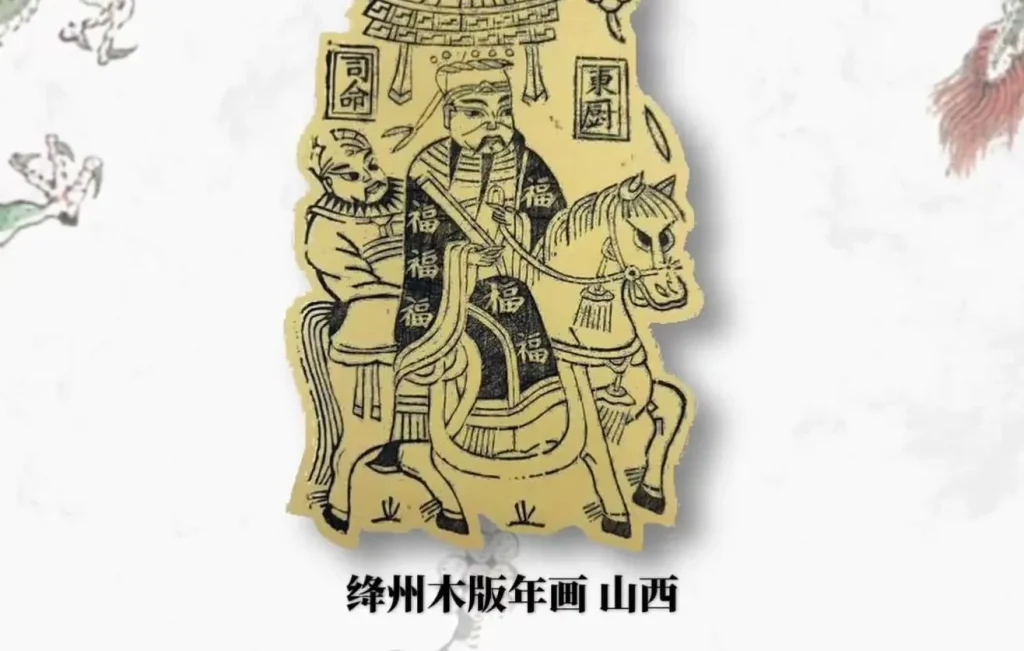
The simplest print shows him alone on a throne, dressed as an official, sometimes with a censer and attendants at his feet. Families who can’t find a print write a stand-in on red paper, Siming Zao Jun shenwei, “seat of the Overseer of Fate, Lord of the Stove,” and paste it over the stove.
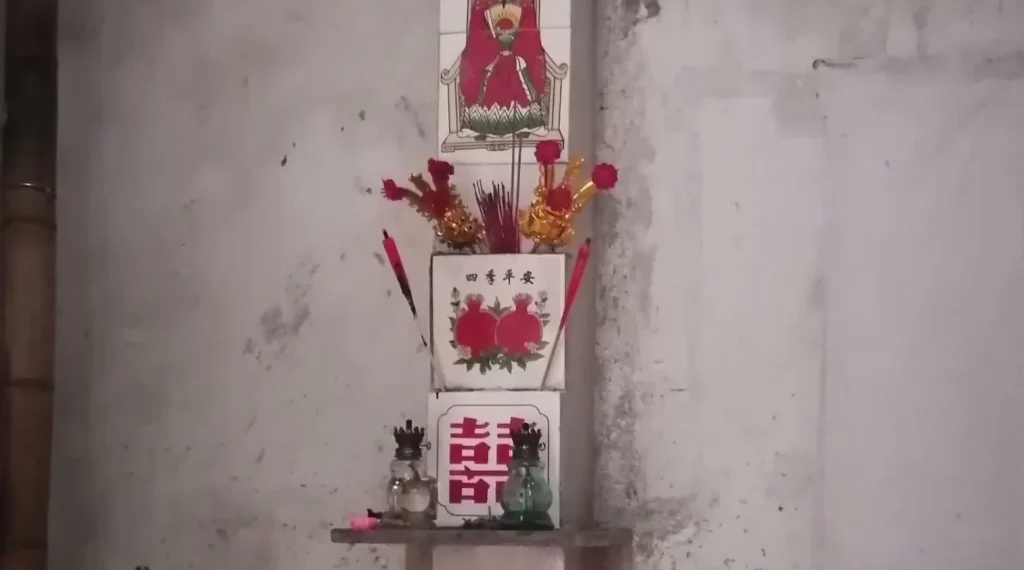
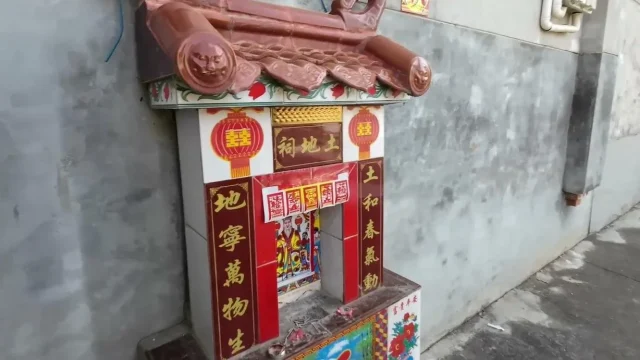
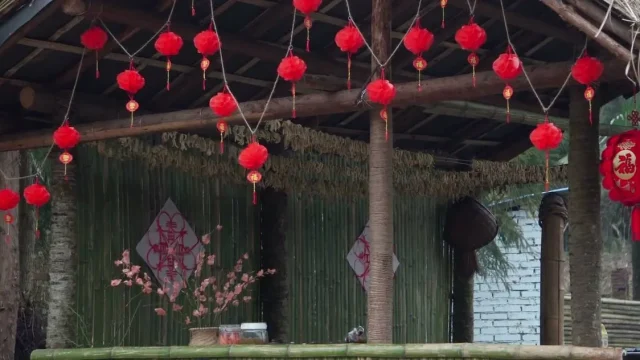
A shrine like the one above is about as much as most kitchens give him: a print, a few sticks of incense, a pair of small lamps and a red card wishing the house peace through the four seasons.
A seated-alone print is the one I’d suggest for a small kitchen. It takes little wall space, it reads clearly from across the room, and the god you are sending off and welcoming back is plainly the one on the paper.
The Kitchen God and his wife, with the year’s calendar
The fuller print seats him beside his wife, and some show him with two wives. In many tellings she keeps the household record for his report, writing down what the family says through the year.
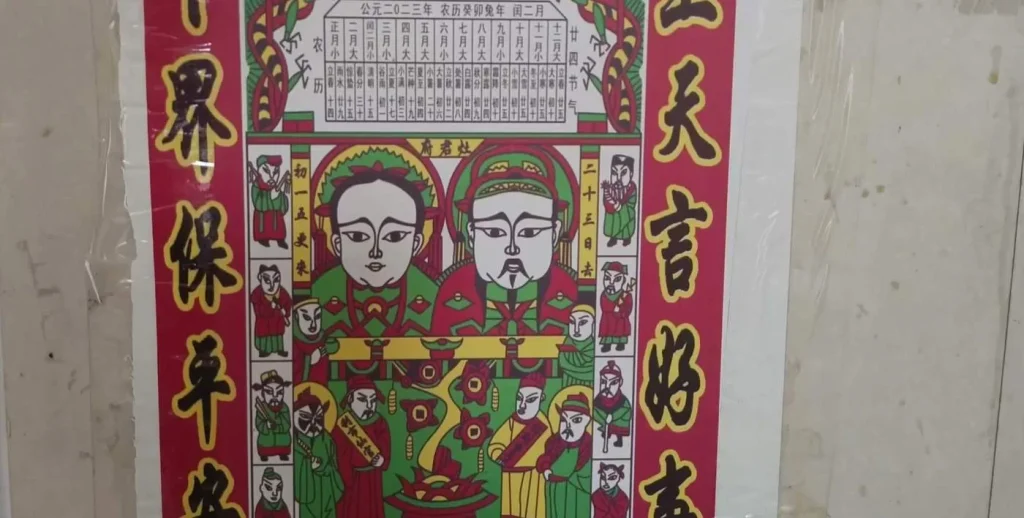
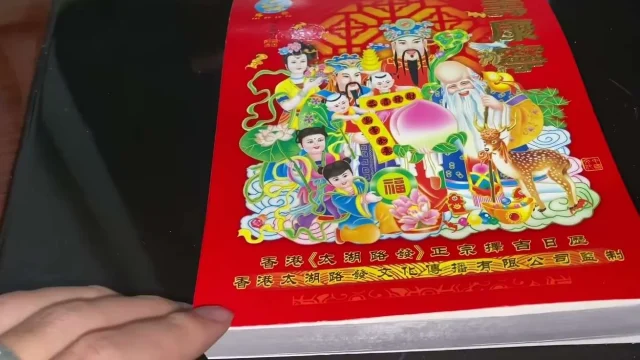
Read this print from the top down. The grid along the top is a calendar for the coming lunar year, 2023 in this one, so the print doubles as the family’s almanac. The band above the couple reads Zao Jun Fu, the Stove Lord’s residence.
The two small columns are the most useful part. One says ershisan ri qu, he leaves on the 23rd, and the other says chuyi wugeng lai, he comes back in the last watch before dawn on New Year’s Day. Down the sides runs the couplet you’ll see beside many stoves: shangtian yan haoshi, xiajie bao ping’an, report good things in heaven, keep the house safe below.
Sending the Kitchen God off: what families do on the night
Once his print has hung for a year, the send-off on the 23rd starts in front of it. Families clean the stove top and set out wine, dishes and the sweets, above all the sugar melons, so the Kitchen God speaks sweetly.
His horse gets fed too. Some families scatter hay at the mouth of the stove, and others lay out raw carrots, sweet potato or cucumber for the horse he rides to heaven. A common rhyme says it outright: “the Kitchen God’s name is Zhang, he rides a horse and carries a spear, says good things in heaven and keeps the house safe below.”
Then come the incense and a few words. One traditional prayer runs: “This year the 23rd has come again, we send the Stove Lord up to the blue sky; there’s a strong horse and fodder for the road, may you arrive safe; the sugar melons are sweet, so speak well to the Jade Emperor.”

After the prayer the family takes the old print down and burns it in the stove together with paper money and a paper horse for him to ride, so the smoke carries him up. Some pour a little liquor on it to make the flame burn bright, and firecrackers go off to speed him along.
In many families the man of the house leads the rite, and some places keep the old rule that women don’t sacrifice to the stove. Once the god is gone, the big New Year cleaning begins.
Welcoming the Kitchen God back on New Year’s Eve
The house stays without him for about a week. Many families welcome the Kitchen God back on New Year’s Eve, in line with the print’s own promise to return before dawn on New Year’s Day; in other places he is received on the fourth day of the New Year.
Welcoming him back means a new print over the stove, fresh incense and food. Some families paste up the new print the same night they burn the old one, so the stove is never left bare.
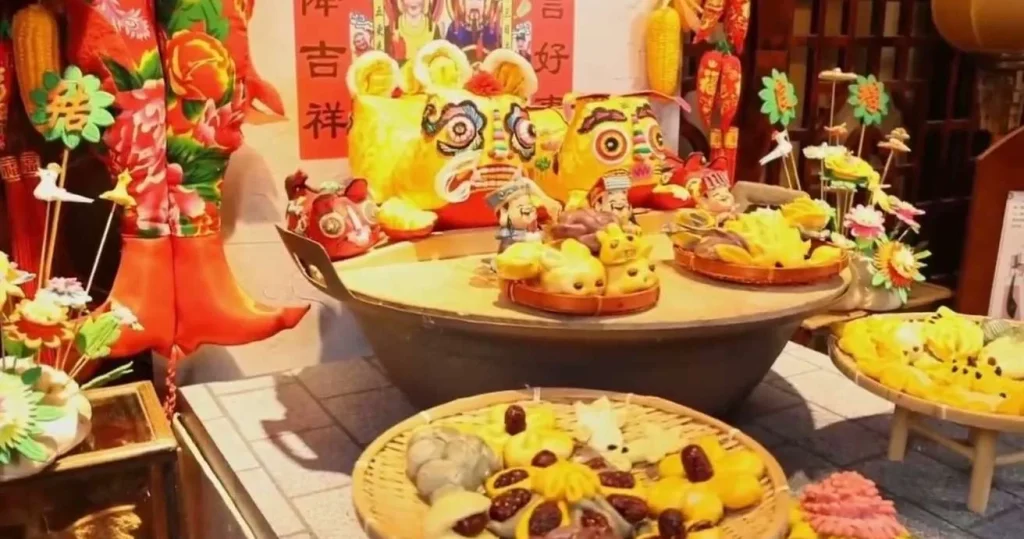
Families who make flower buns and dough animals for New Year often set some out in front of the new print. Tigers, fish, pigs and flowers all turn up on the table below the god.
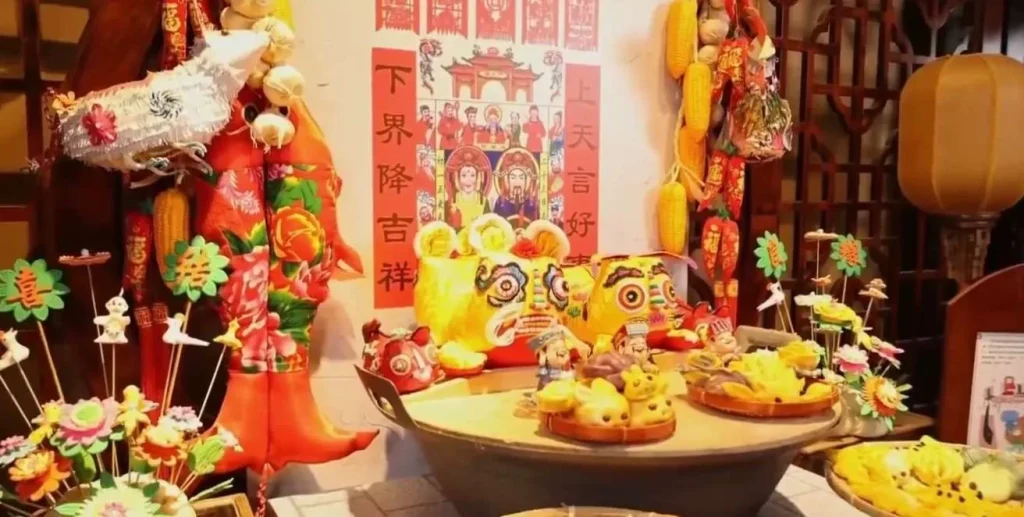
From that night he is back on watch, and the household year starts over with him.
Where the Kitchen God came from: the stories behind Zao Jun
With the yearly round complete, the next question is who this god was before he was a god. There isn’t one answer; China has at least four, and they come from different centuries.
The story most people know is a folk tale about a man named Zhang Lang. He left his good wife for a younger woman, went blind and ended up begging, and one day he begged at his former wife’s door without knowing her.
She fed him anyway. When his sight came back and he saw who she was, he threw himself into the stove out of shame, and Heaven made him the god of the stove.
The early written sources give other names. Xu Shen, a scholar of the Eastern Han, wrote that the stove god’s surname was Zhang and his given name Dan, with the courtesy name Ziguo. He named the wife too, with the courtesy name Qingji. The Tang writer Duan Chengshi repeated it. That is where the “surname Zhang” in the rhyme comes from.
Older still, the Huainanzi says the fire emperor Yandi “died and became the stove,” and the Han book Fengsu Tongyi names Zhurong, the god of fire. The Zhuangzi mentions a stove spirit, which the third-century commentator Sima Biao described as a beautiful woman dressed in red. A god of the hearth grew out of the worship of fire long before anyone gave him a sad love story.
A Taoist view: the Overseer of Fate, not a spy you bribe
The folk tales give him a human past; our Taoist scriptures give him a heavier job. One of his honorifics is Jiutian Dongchu Siming Dingfu Zao Jun, the Kitchen Lord of the Ninth Heaven, Overseer of Fate of the Eastern Kitchen, who settles good fortune.
Siming means the one who keeps the record of a person’s fate. A Lingbao scripture on thanking the Stove King says he notes the good and bad each person does on the first day of every month and reports at midnight to the heavenly office. The yearly trip on the 23rd is only the best known of those reports.
I read the candy in that light. The common English story calls it bribing the Kitchen God, and I find that half right at most. You can’t sweeten twelve monthly records with one night of sugar; the candy is a courtesy to a guest leaving on a long trip, and a reminder to the family that the report is already written by how they lived.
The same scripture warns that a household which ignores the taboos around its stove invites trouble. I take that as practical advice as much as doctrine: keep the stove clean, keep quarrels away from it, and waste no food. A family that does those things has little to fear from the 23rd.
On Little New Year I wipe the stove top first, then set a few pieces of malt candy in front of the print and light incense. What I say to him is mostly thanks for the year, with very little asking.
Keeping the Kitchen God in a modern kitchen without a stove fire
Most readers here cook on a gas or electric range in an apartment, and burning paper indoors is a fire risk I wouldn’t take. The custom bends easily, and the point is the sending off and the welcome back, not the flame.
If you want to keep the Kitchen God, paste a print or a red paper with Siming Zao Jun shenwei near the stove. On the 23rd or 24th, clean the stove top, set out a little malt candy and a cup of tea, light incense if you can, and say a few words of thanks for the year.
I’d take the old print down that night and burn it outdoors where it is safe, or fold it into red paper and set it aside respectfully. Then on New Year’s Eve put up the new one with fresh offerings, and the stove has its watcher again for the year ahead.
Written by
Daozhang MaMaoshan Taoist, Jintan, Jiangsu
Daozhang Ma is a Maoshan Taoist who has practiced for 22 years and is skilled at writing talismans and painting Taoist pictures. He runs Zodiac & Tradition.
About Daozhang Ma