Chinese New Year Oranges: Why Mandarin Oranges Bring Luck
By Daozhang MaMaoshan Taoist, Jintan, Jiangsu
In short
Families buy, display and hand out mandarin oranges at Chinese New Year because the fruit’s Chinese names sound like “gold” and “good luck.” In Cantonese, the mandarin, gam (柑), is pronounced exactly like the word for gold, and the everyday character for small mandarins, gat (桔), sounds just like the word for luck.
Add a golden color, a round shape and a harvest that peaks in midwinter, and you have the one fruit nearly every Chinese household keeps in a bowl from New Year’s Eve to the Lantern Festival.
The custom has a few rules, though they’re straightforward. Oranges travel in pairs, never in fours, and when you visit someone over the holiday you bring two and usually leave with two.
I’ll go through why the fruit carries those wishes, which citrus counts (mandarin, tangerine, kumquat or a navel orange), how to choose a good bag of them, where they go in the house, how the exchange works on a New Year visit, and what to do with the leftovers once the holiday ends.
Why mandarin oranges are lucky at Chinese New Year
Mandarins are lucky at Chinese New Year because three different things about them point the same way: the sound of their names, their color and the time of year they ripen.
The sound comes first. Spoken Chinese is full of homophones, and half the New Year’s food and decorations are chosen for what their names echo. Because gam, the Cantonese mandarin, is said exactly like the word for gold, a pair of mandarins on the table reads as a pair of gold pieces. Mandarin Chinese has its own version. A big orange, da ju, sounds like da ji, “great luck,” which is why big, plump fruit gets picked first.
Color does the rest of the work. Gold is the color of money in Chinese symbolism, and a ripe mandarin is about as close to gold as fruit gets. The round shape adds a quieter wish, for a family that stays whole and together.
The season matters more than people think. Mandarins in southern China are at their best from about December through February, right when the New Year falls. Traditions usually settle on whatever is fresh, inexpensive and abundant at the right moment, and mandarins have been all three for a very long time.
Mandarin, tangerine, kumquat or orange: which Chinese New Year fruit is which
That pile of puns spreads across several Chinese characters, and English names for citrus don’t line up with them neatly. Here is how the fruit people buy for the New Year maps onto both languages.
| Chinese | Pinyin / Cantonese | English name | What it sounds like | How it’s used at New Year |
|---|---|---|---|---|
| 柑 | gan / gam | Mandarin orange (larger, loose skin) | Gold (金) | Gifts on visits, altar offerings, the fruit bowl |
| 橘 / 桔 | ju / gat | Mandarin or tangerine (smaller) | Luck (吉) | Same as above; most shop signs use 桔 |
| 金桔 | jinju / gam gat | Kumquat | Golden luck | Potted trees by the door, rarely given as loose fruit |
| 橙 | cheng / caang | Sweet orange, such as navel | Success (成) | Fruit platters and gift boxes |
The last row explains why navel oranges turn up on platters too. In Mandarin Chinese, cheng, the sweet orange, shares its pronunciation with the word for success, a welcome wish for students and small businesses alike.
In practice, “Chinese New Year oranges” almost always means mandarins. A tangerine is simply one type of mandarin, and the English name dates from the 1800s, when fruit shipped through Tangier in Morocco. Clementines are mandarin hybrids too, so the small easy-peel fruit sold in American supermarkets in winter work just fine.
Kumquats are a separate fruit. Even the English word comes from Cantonese gam gat, golden luck. Kumquats mostly arrive as potted trees for the doorway, not as loose fruit to eat, and I cover those trees with the other New Year flowers and plants.
The fruit itself is old in China. Most botanists place the mandarin’s origin in southern China, and the poet Qu Yuan wrote his “Ode to the Orange Tree” more than 2,000 years ago.
Choosing mandarin oranges for Chinese New Year
Once you know you want mandarins, the next question is which ones, and that depends mostly on where you shop. Asian supermarkets in the weeks before the New Year stack boxes of several kinds.
Ponkan, a large mandarin from southern China, are round, sweet and easy to peel, and the usual pick for gifts because size matters for “great luck.” Shatangju, “sugar mandarins,” are small, very sweet and better for snacking than giving. Cantonese shops stock a few other local kinds as well. If all you can find is a mesh bag of clementines at a regular supermarket, buy them. Nobody at the door is checking the variety.
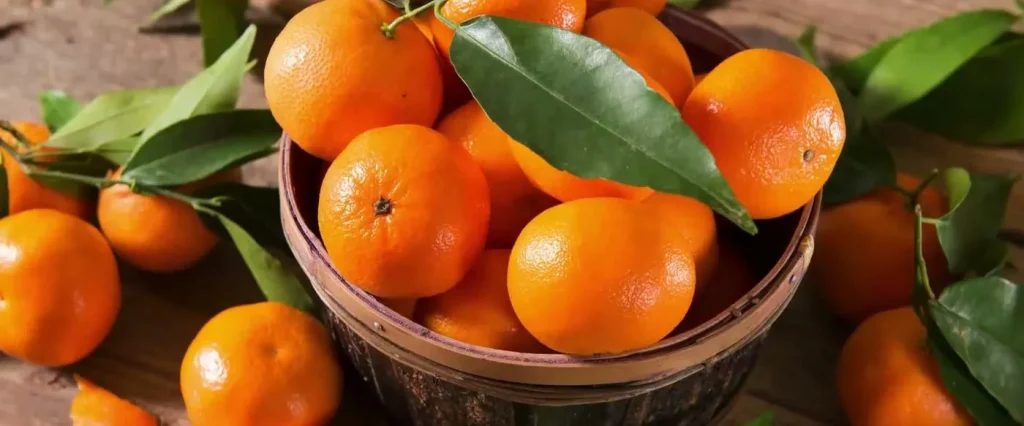
Look for fruit with the leaves still on when you can. A leafy stem shows the mandarins were picked recently, and many families read it as a wish for life that keeps going. Gift boxes in Chinese markets often sell them this way.
Then check each fruit. You want bright, even color, skin that’s firm but slightly loose, and a fruit that feels heavy for its size. Skip any with soft spots or a white bloom near the stem, because one moldy mandarin ruins a bag within days. Buy in even numbers, and buy more than you think you need, since you’ll be giving most of them away.
Where to put oranges at home during Chinese New Year
With the fruit home, set it out before New Year’s Eve so the house greets the year already full. Three places matter most.
The first is the family altar. Ancestors and household gods get a plate of mandarins, often stacked into a small pyramid, and the fruit stays there through the first days of the year. On a Taoist altar, fruit is one of the standard offerings, and in these weeks it’s nearly always mandarins.
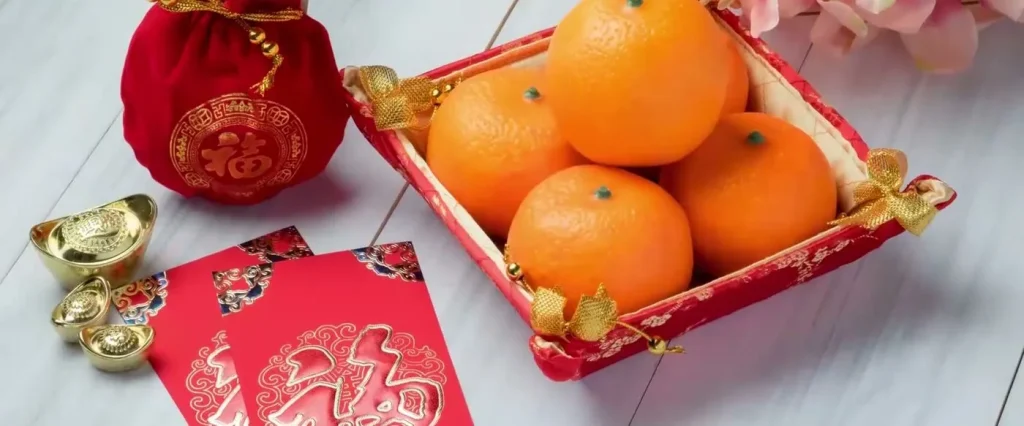
The second is the living room table, where guests sit. A tray or bowl of mandarins there is the house’s way of saying there’s gold to share, and it’s where the oranges you hand back to visitors come from. People like to set them beside other wealth symbols: red envelopes, a pouch printed with fu (福), blessing, and little gold ingots.
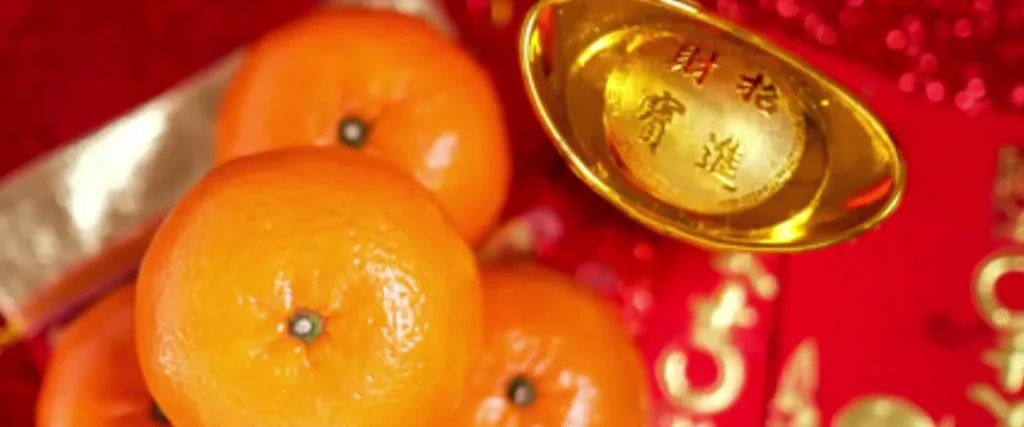
The pairing isn’t decoration for its own sake. An ingot means money and a mandarin sounds like money, so together they repeat the same wish. I like that the whole display can be eaten in the end, which you can’t say for most New Year decorations.
The third spot is the entrance. Many Cantonese homes and shops put a pair of potted kumquat trees by the door. Those trees are ornamental, and the fruit is often sprayed, so don’t eat it unless the seller tells you it’s safe.
How to give oranges for Chinese New Year visits
The table bowl gets busy from the first day of the New Year, when relatives and friends start visiting each other. Mandarins are the standard thing to bring, especially in Cantonese families and across Singapore and Malaysia, and the exchange runs in both directions.
Bringing oranges when you visit
Bring at least two mandarins, and keep the number even. Pairs say that good things come twice, so two, six or eight all work. Four is the number to avoid, because it sounds like the word for death.
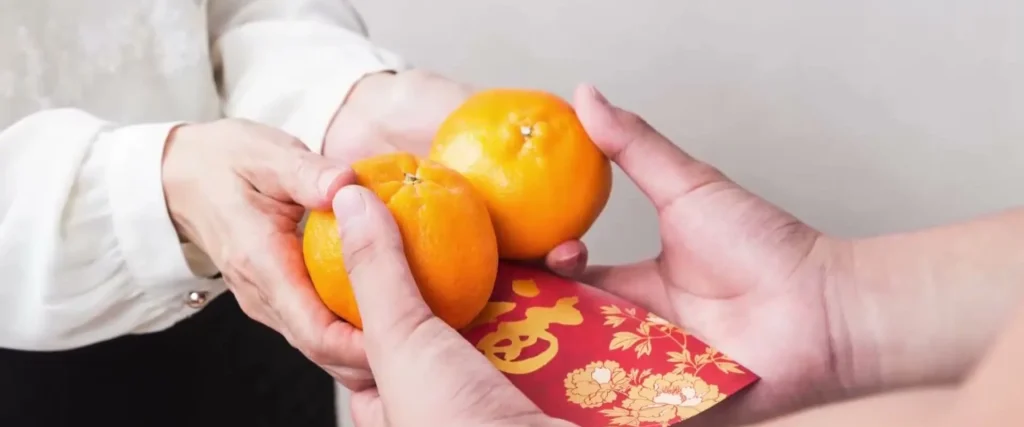
Hand them over with both hands when you greet your host, and say a New Year wish as you do. Using both hands is the polite way to give anything in Chinese culture, and with mandarins it also turns the gift into a small offer of gold from you to them. Many people carry the fruit in a red bag rather than handing it over loose.
If the family has children, the red envelopes go to the kids, not to the host. Oranges are for the household, envelopes are for the young ones, and on a busy visit you’ll often hand over both within a minute.
Receiving oranges and sending a pair back
When you’re the host, take the mandarins with both hands, thank the guest and set them on the table or altar. Then, when the guest leaves, give them two mandarins from your own bowl.
That return pair is what makes this an exchange rather than a one-way gift, and I think the reciprocity is the whole point. Gold comes in the door and gold goes back out, so neither household ends the visit poorer, and the wish for wealth gets passed on to the next house the guest visits. Over a few days of visiting, the same fruit can travel through half a family.
If someone hands you a pair and you’ve run out to give back, don’t worry about it. Thank them and send them home with something else from the table. What people remember is the gesture, not whose mandarins they were.
What to do with Chinese New Year oranges after the holiday
All that trading leaves most homes with a mountain of mandarins by the end of the holiday. The answer is simple: eat them. Many families feel that throwing away good fruit at New Year throws away luck with it, so they work through the bowl in the days up to the Lantern Festival.
To keep them that long, store mandarins somewhere cool and out of plastic bags. On a cool counter they usually last about a week. In the fridge they keep for roughly two to three weeks. Check the bowl every few days and pull out any fruit going soft before it spreads mold to its neighbors.
Don’t throw out the peel either. Dried mandarin peel, chenpi (陈皮), is a staple of Cantonese cooking and tea, and the town of Xinhui in Guangdong is famous for it. Home-dried peel won’t match Xinhui’s, but it’s still lovely in a pot of red bean soup. Just wash the fruit well first, scrape away the white pith and dry the strips on a rack until they snap.
The fruit that came into the house as gold leaves it as dessert and seasoning. To me that’s a very sensible way for a New Year custom to end.
Written by

Daozhang MaMaoshan Taoist, Jintan, Jiangsu
Daozhang Ma is a Maoshan Taoist who has practiced for 22 years and is skilled at writing talismans and painting Taoist pictures. He runs Zodiac & Tradition.
About Daozhang Ma