Lion Dance: Meaning, Origin, Southern vs Northern Lions
By Daozhang MaMaoshan Taoist, Jintan, Jiangsu
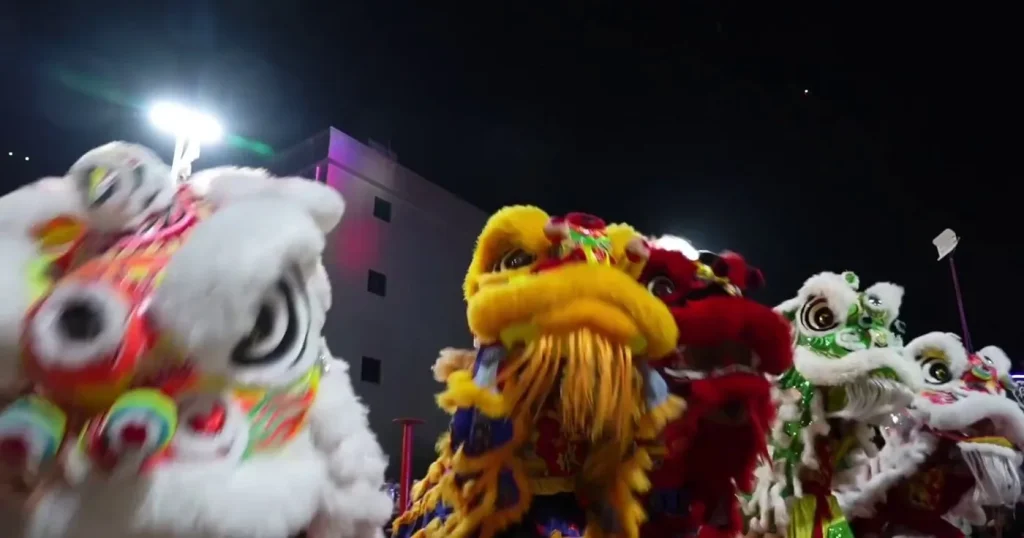
In short
A lion dance needs two people inside one costume. One holds up the head and works the eyes and mouth, the other bends over as the back and tail, and both move to a drum, gong and cymbals. In Chinese it is wushi (舞狮), and troupes perform it to drive off bad luck and call in good fortune at Lunar New Year, shop openings, weddings and village festivals.
There are two main kinds. The southern lion from Guangdong, with its single horn and a mirror on its forehead, is the one most Chinatowns know. The northern lion is shaggier, usually comes in pairs and leans harder on acrobatics.
The step I watch most closely comes before any dancing: someone dabs paint on the lion’s eyes, and the lion is said to wake up. In the Maoshan Taoist tradition I belong to, that gesture looks very familiar, and I’ll explain why further down.
I’ll cover how two dancers share one lion, how to tell southern and northern lions apart, where the dance came from, what happens during a show, when people hire a troupe, and how to watch one up close.
What is a lion dance? Two dancers, one lion and a drum
A lion dance is a performance in which dancers inside a lion costume copy a lion’s movements to bring good luck and chase away evil. A full-size lion takes two people. The head dancer holds the head up with both hands and works the eyes, ears and mouth, which is where the lion’s moods come from. The tail dancer follows the head dancer’s steps and wags the tail.
The tail dancer also does the lifting. When a lion rears up to look around or reach something high, the tail dancer is holding the head dancer up, standing on their thighs or sitting on their shoulders, so the pair has to trust each other completely. Many troupes grew out of kung fu schools, and a lot of the stances come straight from martial arts training.
Smaller lions exist as well. A “little lion” is worked by one person, while the big two-person lions are called “great lions.”
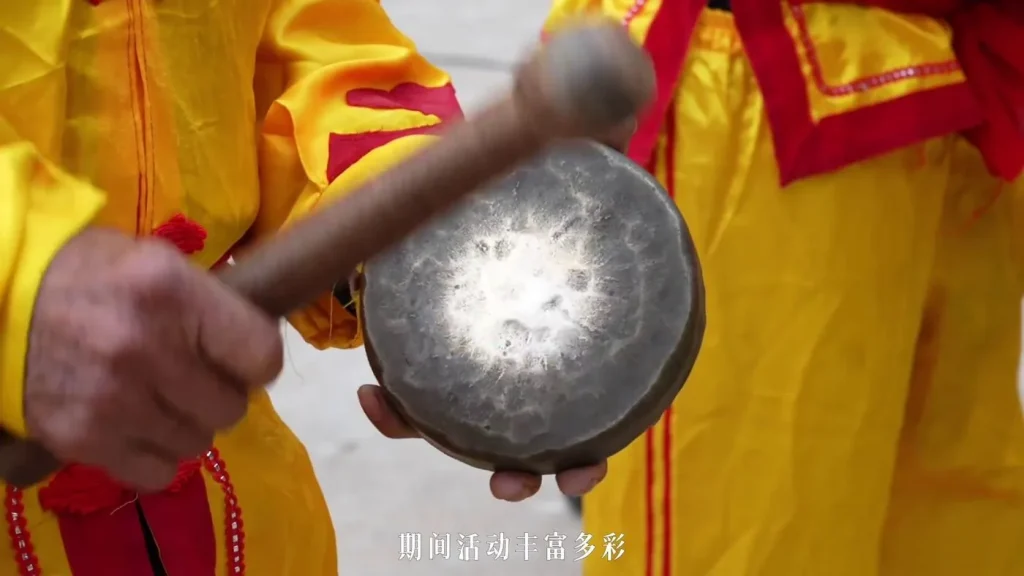
The music sets the pace. Each of the lion’s moves has its own drum rhythm, and the gong and cymbals add the crash on top. When the lion turns curious and sniffs around, the band goes quiet; when it charges, everything gets loud at once, as if the lion itself were roaring. It’s the same din you hear up and down the street at Lunar New Year, when troupes go from door to door.
Southern lion vs northern lion: how to tell them apart
Once you know two people are inside, the next thing to notice is which kind of lion they’re wearing. China has plenty of local lions, but the southern and northern lions are the two main forms, and you can usually tell them apart from across the street.
| Southern lion | Northern lion | |
|---|---|---|
| Where it comes from | Guangdong province (Cantonese) | Northern China, including Beijing and Hebei |
| Head | Large painted head with a single horn and a mirror on the forehead | Gold-painted head that looks like a Pekingese or a foo dog |
| Body | Cloth body trimmed with fur and a long tail | Shaggy red and yellow hair covering the body and legs |
| Clue to look for | Eyes that swivel and a mouth that opens and closes | A red bow for a male lion, a green bow for a female |
| How it moves | Like a big cat: scratching, shaking, licking its fur | Rolling, leaping and balancing, often in pairs |
The southern lion’s head is traditionally papier-mâché over a bamboo frame, painted and trimmed with fur; newer heads use aluminum frames and weigh less. The mirror on the forehead has a job of its own: it is meant to scare evil spirits away by showing them their own reflection.
Within the southern style, the Fut San (Foshan) and Hok San (Heshan) schools are named after the places they come from, and you tell them apart by the shape of the head. Southern lion colors often point to the three sworn brothers of the Three Kingdoms period (AD 220–280), too: yellow or gold for Liu Bei, the virtuous king; red for Guan Yu, the general; and black for Zhang Fei, famed for his bravery.
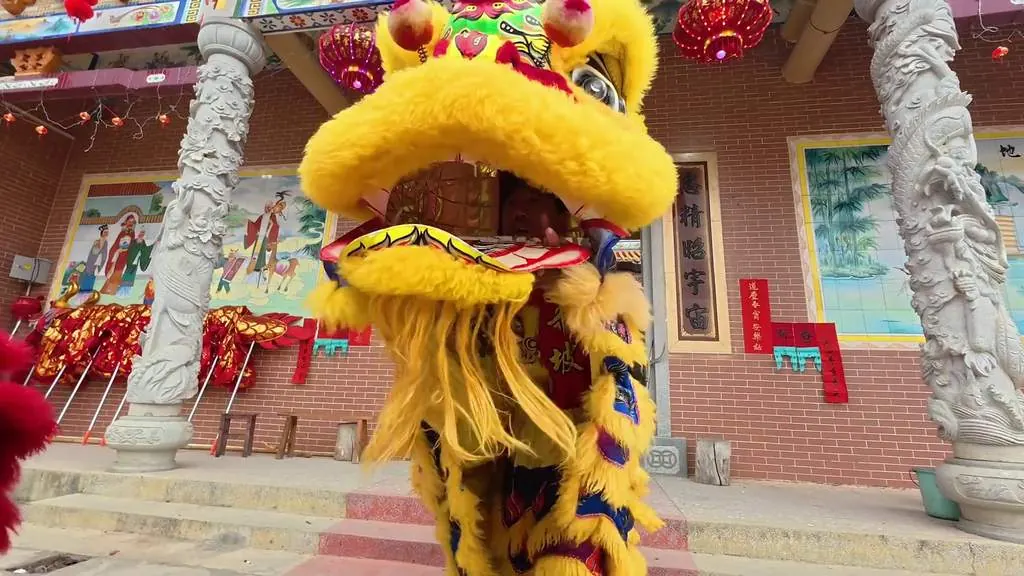
Northern lions tend to perform as a pair, a male with a red bow and a female with a green one. Sometimes a whole family turns up, two adult lions and two cubs, and each cub is worked by a single person. Their shows lean on acrobatics: lifts, balancing on raised platforms and even walking on a giant ball.
If you’ve watched a lion dance in an American Chinatown, it was most likely a southern lion. Chinese communities overseas came mostly from southern China, and they took the Guangdong lion with them.
Where did the lion dance come from?
The lion dance most likely reached China from the west, along with the idea of the lion itself. Lions aren’t native to China, and scholars have suggested the dance began in India or Persia and came in through Central Asia; the Chinese word for lion, shi, may even come from the Persian word šer.
Chinese writing mentions “lion acts” as early as the third century AD, in notes by a Three Kingdoms scholar named Meng Kang. Early on, the dance was tied to Buddhism. A Northern Wei account of the temples of Luoyang describes a parade for a Buddha statue led by a lion to drive away evil spirits.
By the Tang dynasty, the lion dance was a court performance. The “Lion Dance of the Five Directions” put five large lions of different colors in front of the court, each led on ropes by two handlers, with 140 singers.
The southern lion came later. One popular story ties it to a village that drove off the Nian monster, the New Year beast that folklore says was scared away by noise and red. Another credits the Qianlong Emperor, an 18th-century Qing ruler, who dreamed of a lucky beast and had it recreated for festivals. The likelier explanation is that the northern lion was adapted to Guangdong, perhaps during the Ming dynasty, so I treat the Nian version as a good New Year story told about the dance.
That Buddha parade is the detail I find most telling. The lion’s oldest job in China was to walk at the front of a procession and clear the road of evil spirits, and the dance still does that job when a troupe goes door to door at New Year.
What happens in a lion dance performance
A temple parade and a shopfront show look different, but a traditional performance still follows a rough order. The band plays for a few minutes to gather the crowd; the lion is woken by having its eyes painted; it bows to the place, plays and shows off; then it hunts for its food, eats it and closes with more greetings.
Dotting the eyes: how the lion is woken up
Before a new lion dances, or at the start of a big occasion, a guest of honor dabs paint on its eyes with a brush. The step is called dotting the eyes, and a lion that has been through it is called xing shi (醒狮), an “awakened lion.”
One story behind it comes from the Qing court. The Qianlong Emperor asked a painter for a dragon, and the painter left the eyes blank, saying that painting them would bring the dragon to life, and two dragons couldn’t live in one palace.
To me, this is where the lion dance comes closest to my own work. Taoist temples consecrate a newly carved statue with a rite called kaiguang (开光), “opening the light,” and dotting the eyes belongs to it. When I perform kaiguang, I use a brush that has never touched ink, dip it in cinnabar and dot the eyes before anything else on the face, because the eyes are where the statue is said to wake. I read the lion the same way: before the brush, the troupe has a costume; after it, they have a lion that carries the blessing it was made to deliver.
Cai qing, “plucking the greens”: lettuce, oranges and a red envelope
Cai qing (采青) is the high point of most shows. A head of lettuce hangs up high on a pole or sits on a table in front of the door, with a red envelope tied to it, and the lion has to get it. In Chinese, cai (采, pluck) sounds like cai (菜, vegetable) and cai (财, fortune), so plucking the greens also means picking up wealth.
The lion approaches like a curious cat. It sniffs, backs off and creeps in again before it takes the greens, then chews the leaves and spits them back out at the business and the crowd. That spray of lettuce is the point: it showers everyone with luck.
Oranges often come with the lettuce. The lion eats an orange and spits it back out, and catching it with your hands is supposed to bring good luck. The red envelope holds the host’s money, which is both a thank-you and the troupe’s pay. In older days, rival kung fu schools competed for greens hung as high as 16 to 20 feet (5 to 6 m).
Stacks, benches and high poles
Height is the showiest part of a modern lion dance. In a stack, the tail dancer lifts the head dancer so the lion stands tall. In the bench routine, the lion climbs a “mountain” of six, eight or ten stacked benches, about 4 to 5 feet (1.2 to 1.5 m) high at the top.
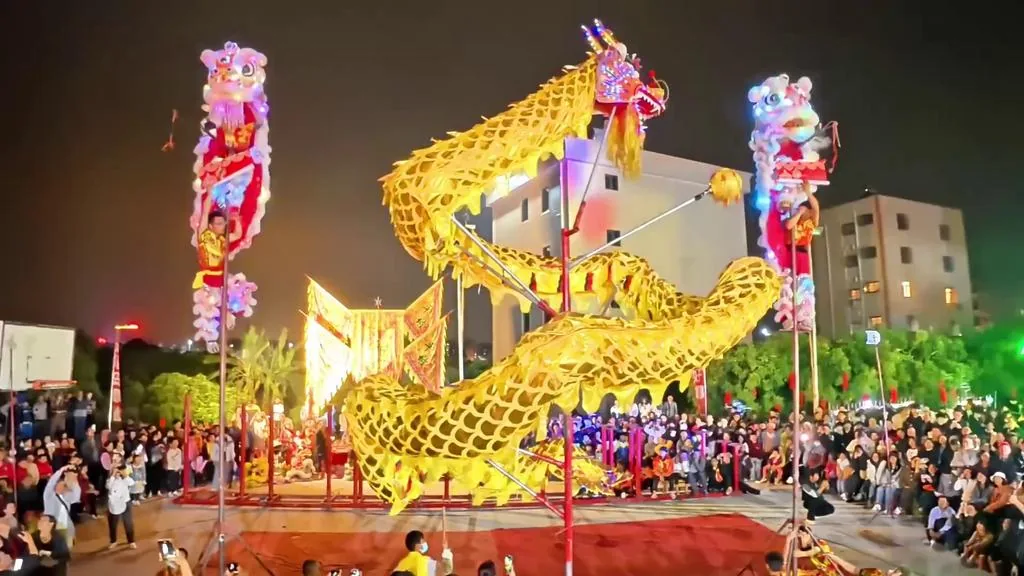
High-pole lion dance, gao zhuang (高桩) in Chinese, goes further. The lion jumps between metal poles up to about 9 feet (2.8 m) tall, with gaps as wide as about 6 feet (1.8 m). The poles come from a kung fu drill on wooden “plum blossom poles” set into the ground, and Malaysia launched a world lion dance championship in 1984 that is now held at Genting.
When do people hire a lion dance? New Year, openings and weddings
All that effort gets booked for a reason, and the reason is almost always a beginning. Lunar New Year is the busy season. In the days after New Year, troupes go down the street from shop to shop and house to house, performing cai qing wherever someone has hung out greens, and restaurants book them to start the year well.
The rest of the year follows the same logic. Grand openings, weddings, birthdays, festivals and visits from important guests all call for a lion. In the southern tradition, a white lion goes the other way: it is used only at the funeral of an important leader and is usually burned afterward.
Village festivals in Guangdong bring lions out as well, sometimes after dark under fireworks, with neighbors watching from the rooftops.
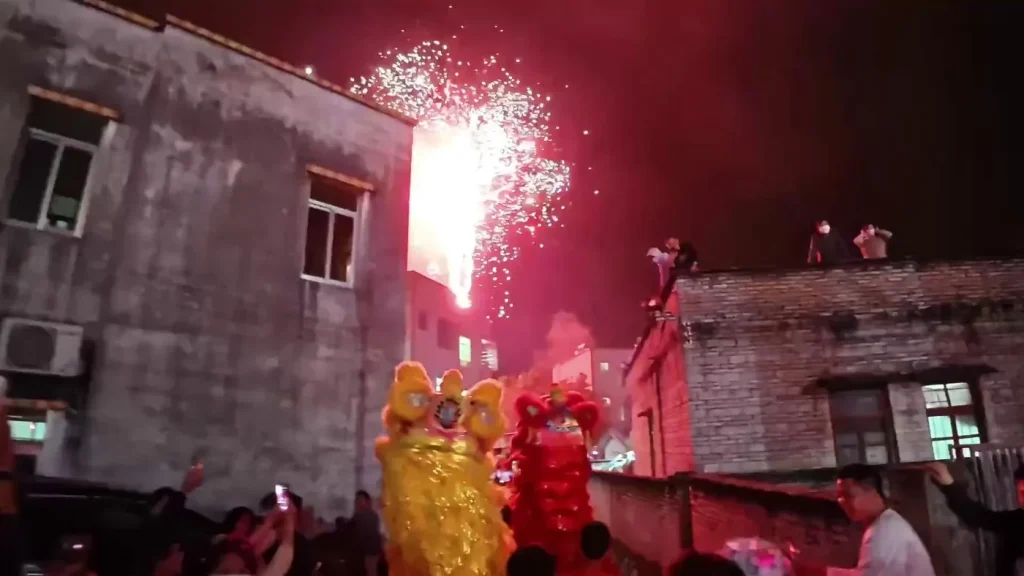
People often ask whether Chinese New Year calls for a lion dance or a dragon dance. The answer is both, and they’re easy to tell apart. A lion is worked by two people, or one for a small lion; a dragon is a long body carried on poles by a whole team, and big festivals sometimes put them on the same stage.
How to watch a lion dance up close
If you end up in that crowd, a few habits make the show better for you and easier for the troupe:
- Give the lion room. It moves fast and swings its head wide, and the dancers can see very little from inside.
- Keep the line between the drum and the lion clear. The lion follows the drum, so standing in between makes the performers’ job harder.
- Catch an orange if one comes your way. Catching it is considered good luck.
- Expect some lettuce. Being hit by the spat-out greens is part of the blessing.
- Ask before you touch a lion or pose with it. Troupes treat their lion heads as sacred, though some are happy to stop for photos after the show.
- If you’re the host, fill the red envelope and tie it to the greens before the troupe arrives.
For children, the drums, cymbals and any firecrackers are the loud part, so standing a few rows back helps. Kids can learn the dance, too: one-person little lions exist, and a Song dynasty painting already shows children playing at lion dance. If your child wants to try, ask a local kung fu school, since many of them keep their own troupe.
When I watch one, I keep my eyes on the lion’s face rather than on the jumps. A good troupe makes the head look curious, then wary, then greedy, and by the time it reaches the lettuce you forget there are two people inside.
Written by
Daozhang MaMaoshan Taoist, Jintan, Jiangsu
Daozhang Ma is a Maoshan Taoist who has practiced for 22 years and is skilled at writing talismans and painting Taoist pictures. He runs Zodiac & Tradition.
About Daozhang Ma