Dragon Dance vs Lion Dance: Lion vs Dragon at Lunar New Year
By Daozhang MaMaoshan Taoist, Jintan, Jiangsu
In short
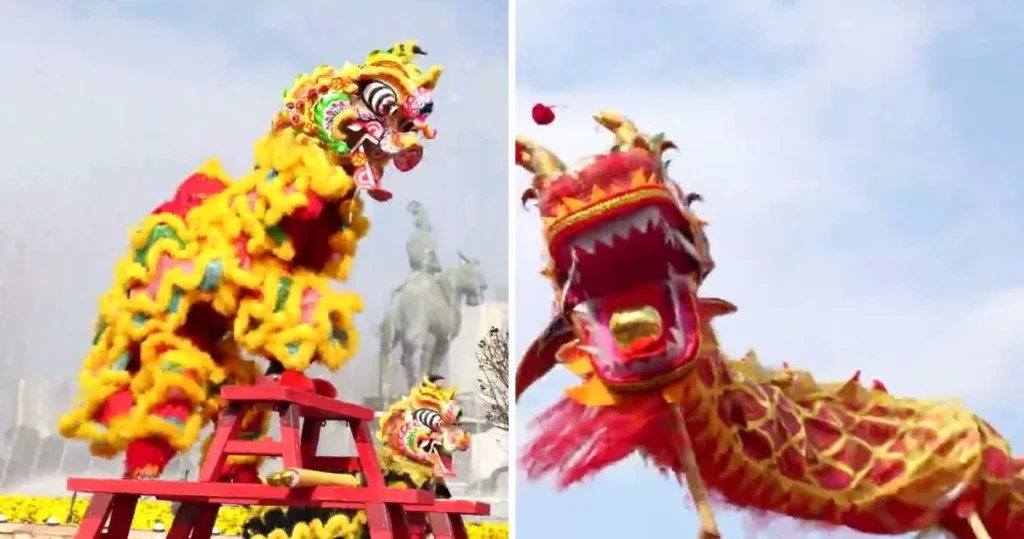
If you can see a whole team walking under a long body on poles, you’re watching a dragon dance. If two dancers are hidden inside one furry costume, it’s a lion dance. Headcount is the main difference between the dragon dance and the lion dance: a lion takes two people, while a standard dragon takes nine or ten, and many more on a long parade dragon. Lions suit a shop door or a wedding floor, dragons need a street or a square, and Chinese New Year brings out both.
The rest of the gap follows from that headcount, from how each animal moves to what it goes after and where it can fit. The two also have different roots, one in rain prayers and one in a road-clearing parade, and as a Maoshan Taoist that’s the part I find most telling. A side-by-side table comes first, then the street test, the costumes, the moves, the origins, the New Year question and how to choose one for an event.
Dragon dance vs lion dance side by side
Nearly every row here comes back to how many people it takes to move the animal.
| Dragon dance | Lion dance | |
|---|---|---|
| Chinese name | wulong (舞龙) | wushi (舞狮) |
| Performers | Usually nine on poles plus one on the pearl, sometimes dozens | Two per lion, one on the head and one on the tail |
| Can you see them? | Yes, the team stays in full view | Barely, the costume covers them down to the legs |
| Costume | Long cloth tube on hoops, held up on poles | Big head with a cape-like body |
| Space needed | A street, a square or a parade route | A shop front or a wedding dance floor will do |
| Main moves | Waves, coils and spirals | Kung fu stances, jumps and lifts |
| What it goes after | The pearl, a ball on a stick | The greens, a head of lettuce with a red envelope |
| Roots | Han dynasty rain rituals | Most likely came in from the west, and is linked to early Buddhist parades |
| Usual bookings | Parades and large public events | New Year shop visits, openings, weddings and birthdays |
Those are the standard versions you’d meet at a parade, and sizes do vary. A Vancouver club, Chau Luen Athletics, runs nine dancers under a 59-foot (18 m) dragon, with a tenth on the pearl. Small display dragons exist that two people can work, and a little lion can be worked by one.
I’ve written up each dance on its own, the dragon dance with its poles and pearl and the lion dance with its two styles. This page sticks to what separates them.
Lion vs dragon dance on the street: look for poles, then count
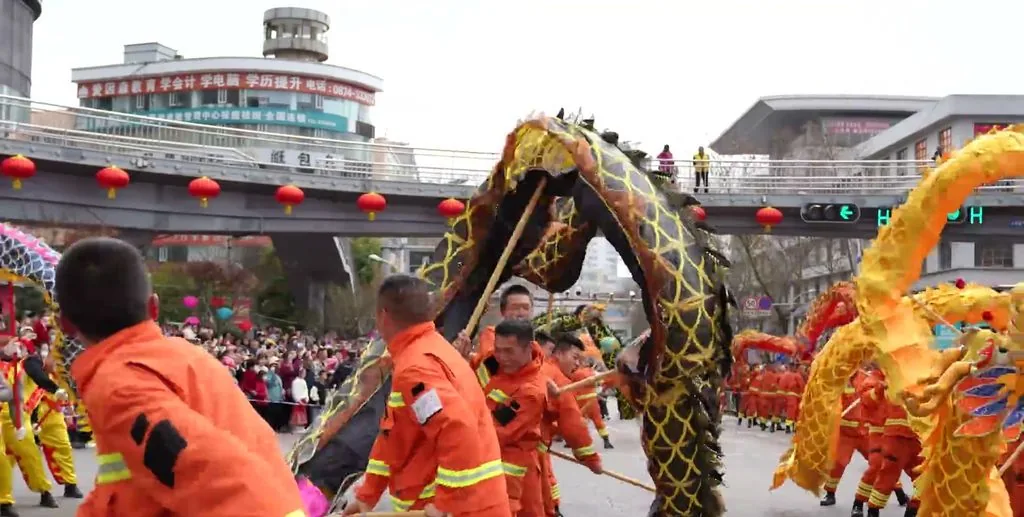
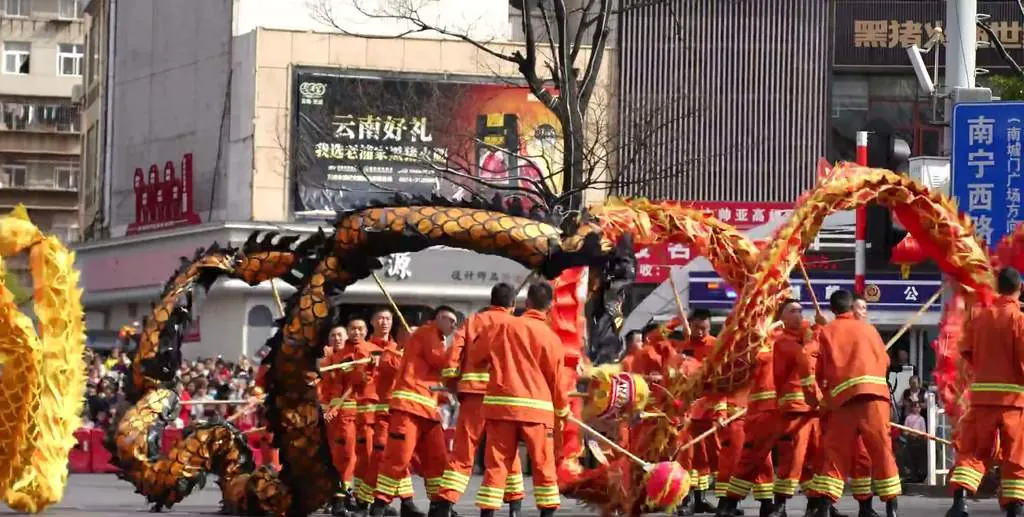
Out in a crowd, that table shrinks to a two-step test, and it’s the one I give friends at their first parade. Look for poles first. A dragon rides above its team on poles of bamboo or aluminum, so you see every dancer’s face and uniform, and the body runs on and on down the street.
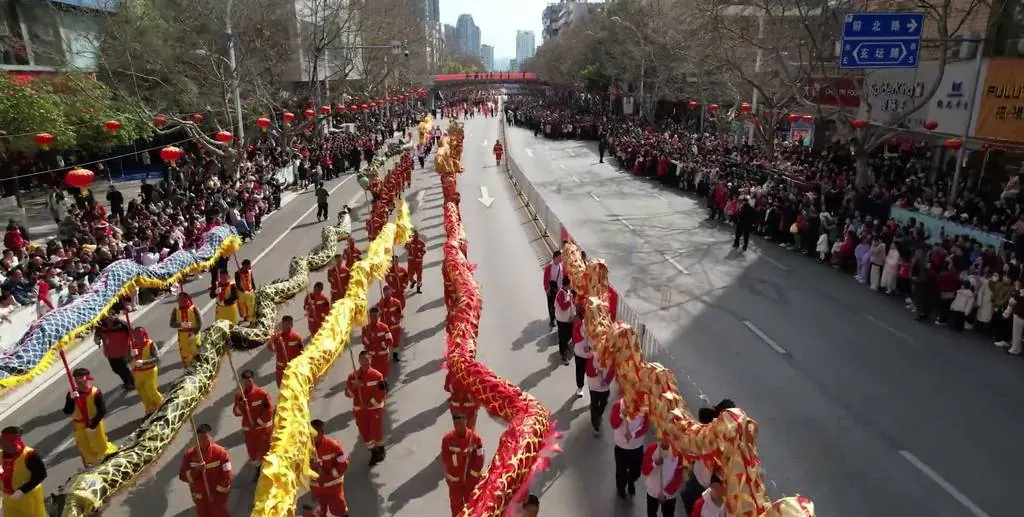
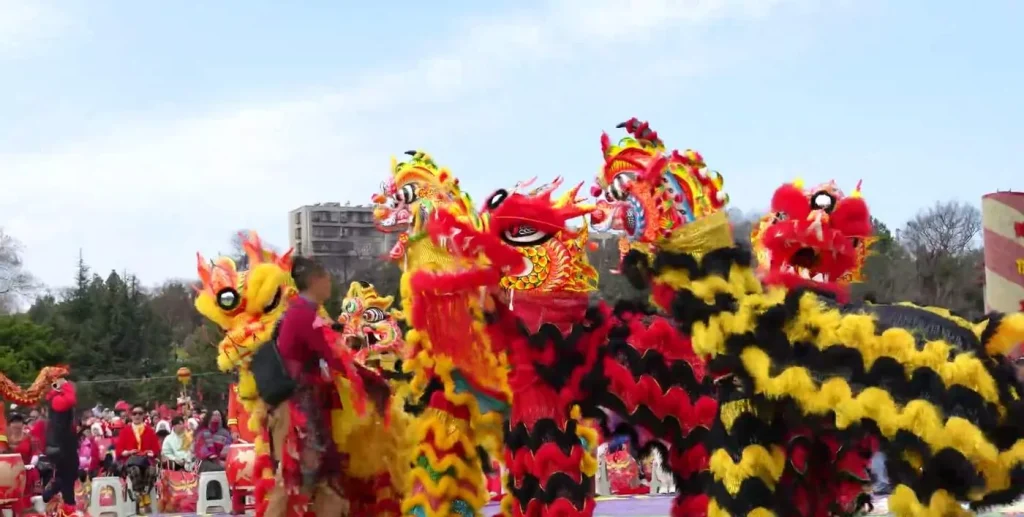
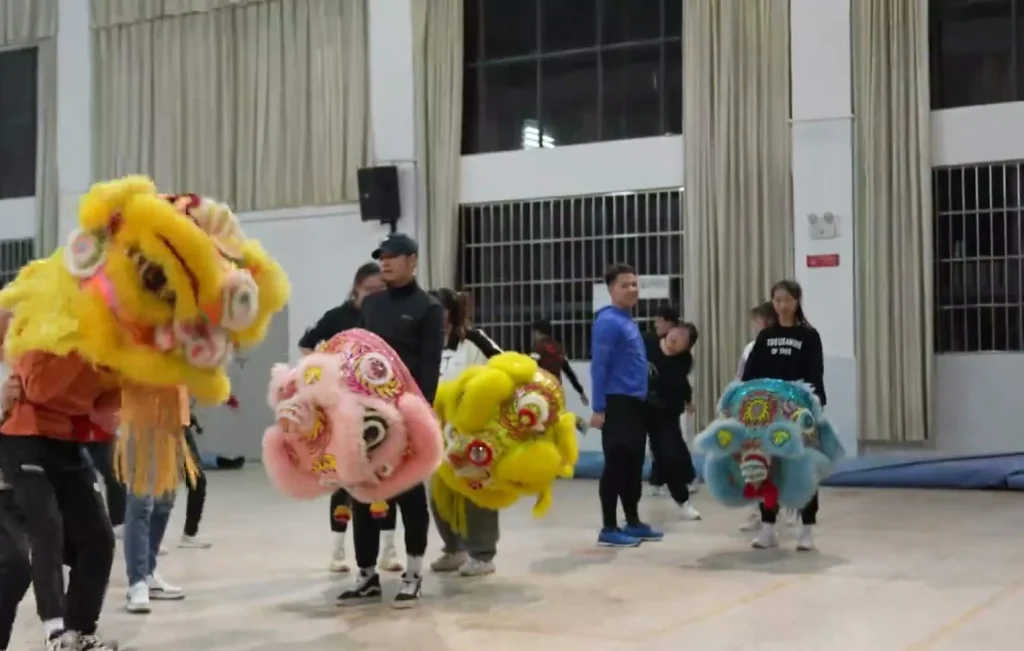
No poles means you should count legs. A lion has two people under one costume, so you’ll see four human legs at most and no faces. The head dancer works the eyes, ears and mouth, and the tail dancer bends over behind and follows the steps. Lions also tend to turn up in pairs or groups.
Why crowds call lions dragons
That test is worth knowing because the mix-up is everywhere. Lion dance troupes in Sydney and Vancouver both say audiences call their lions dragons, and the Vancouver club says it corrects the word almost by reflex.
I don’t blame the crowd. Lions aren’t native to China, so the Chinese lion never had to look like the animal in a zoo. The head is oversized and dragon-like, with a big painted face and a wide mouth, and both animals share the same colors, the same streets and the same din of drums, gongs and cymbals.
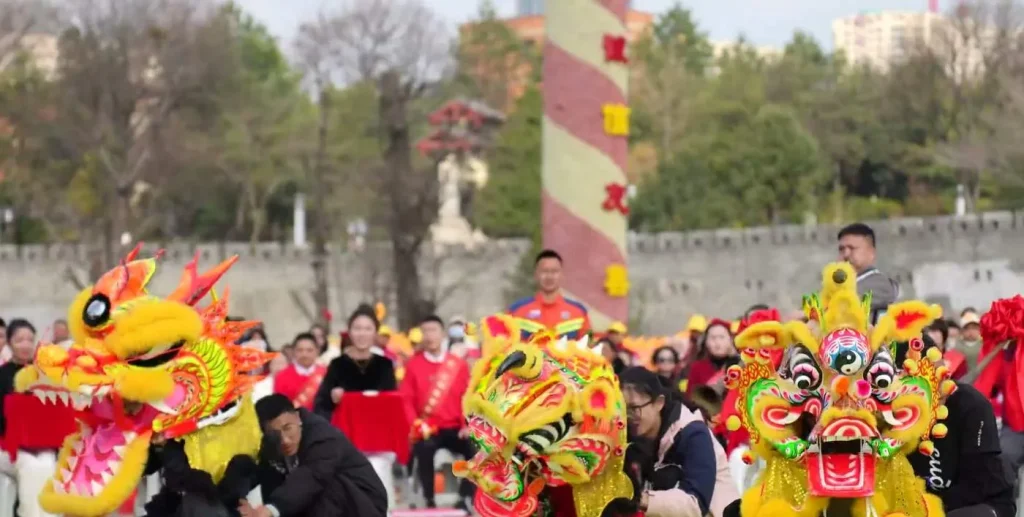
A third animal can muddy things further. Some troupes also perform a unicorn dance with the qilin (麒麟), a mythical beast often called the Chinese unicorn. It’s worked by a head and a tail dancer, so it passes the lion’s test, and if you’re not sure which one you’re seeing, ask someone from the troupe after the show.
A lion is worn and a dragon is carried: how the costumes are built
The headcount comes straight out of the way each costume is made. A lion has a papier-mâché head, traditionally over a bamboo frame, and a cape-like body draped over the tail dancer. Newer heads use aluminum frames and weigh less. The head dancer lifts it with both hands, so it works like a hollow shell.
Nobody could wear a dragon. It’s built from separate sections joined by hoops into one long tube of cloth, with a pole fixed under each section. On a large parade dragon the head alone can weigh almost 32 pounds (14.4 kg). The team spreads out along the body and holds it up from below.
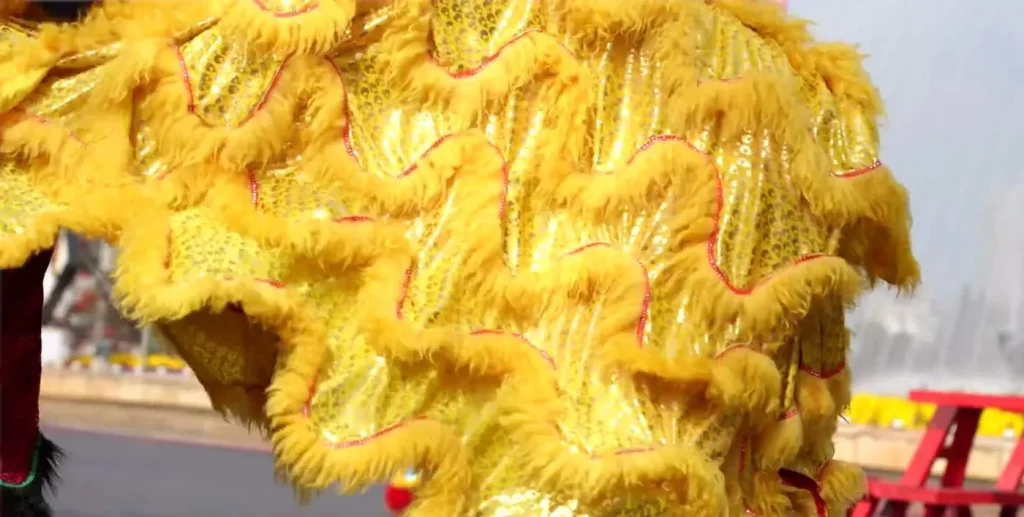
The skin gives a second clue if you’re close enough. A lion is covered in fur, as trim on the southern lion’s cloth body and as shaggy hair all over the northern lion.
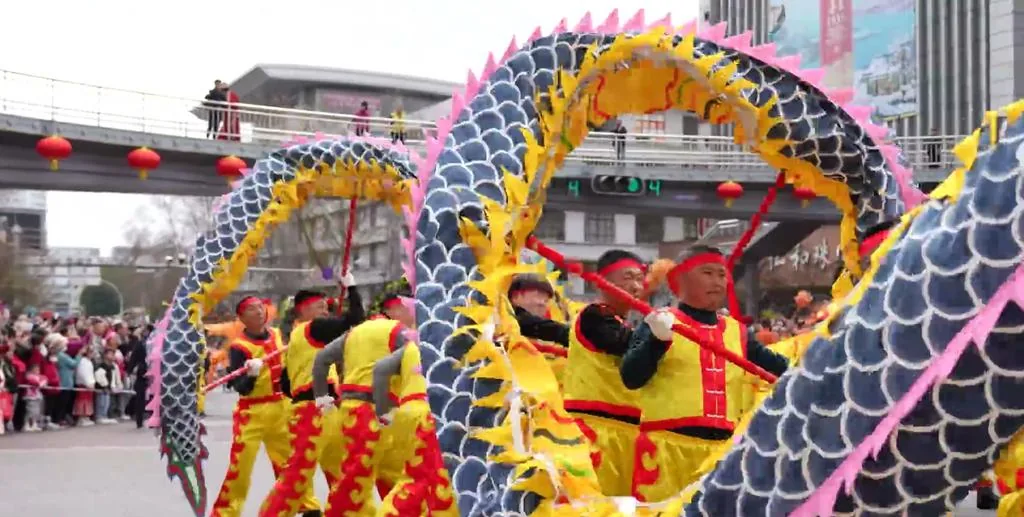
A dragon wears rows of overlapping cloth scales instead, so it flashes as it turns in the sun. In Qujing, Yunnan, the praise for a good dragon runs: a mighty head, a painted body and a lively tail.
How each animal moves: kung fu for the lion, a rolling wave for the dragon
Two such different builds can’t dance the same way. A lion acts like a big cat. It scratches, shakes, sniffs and backs off, and many troupes grew out of kung fu schools, so the stances come from martial arts training. When a lion rears up, the tail dancer is lifting the head dancer. Bench and pole routines take that lift higher.
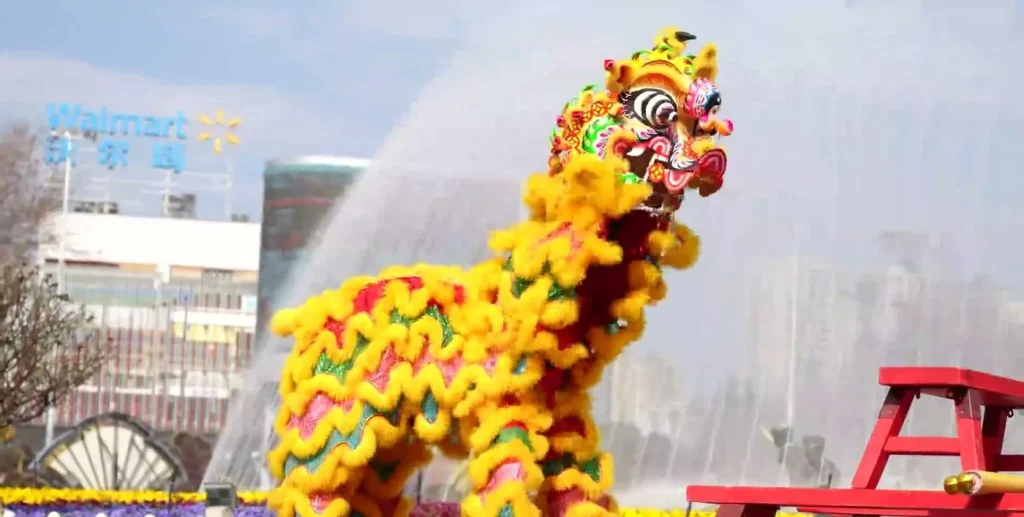
A dragon moves by timing. Each dancer swings a pole a beat after the person ahead, so a wave rolls down the body. From there the team runs spirals, figure eights and coils, and one person out of step spoils the shape.
The two also want different things. A dragon chases the pearl, a ball on a stick spun by a senior member of the team, and the pearl stands for wisdom.
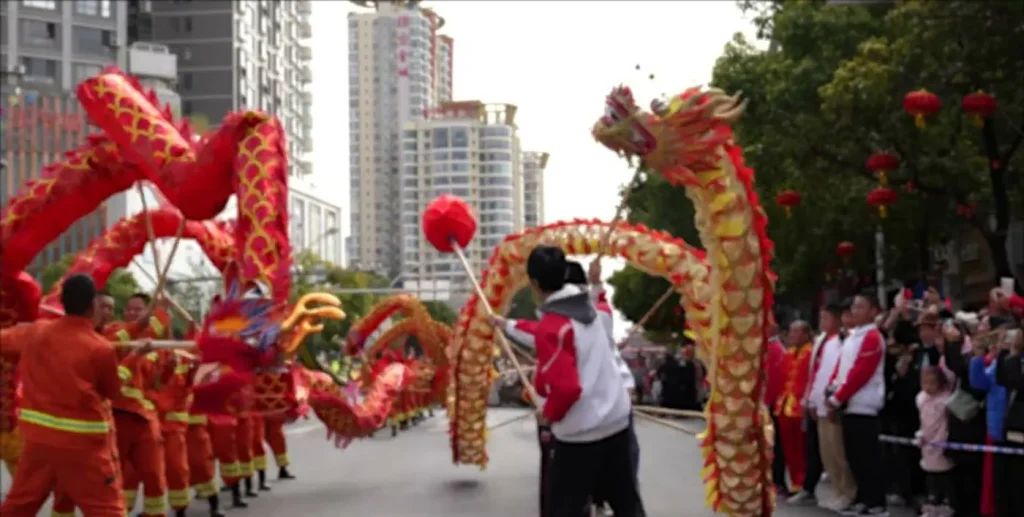
A lion goes after food. In cai qing (采青), “plucking the greens,” it creeps up on a head of lettuce tied to a red envelope, chews the leaves and spits them back over the host as luck. Oranges often get the same treatment.
To my eye that’s the real difference in mood. A lion plays to the person standing in front of it, while a dragon plays to the whole street.
Where the two dances came from: rain prayers and a road-clearing lion
Those moods sit on top of two separate histories. The dragon dance goes back to the Han dynasty (206 BCE to 220 CE), when it belonged to rituals for ancestors and for rain. Dragons were thought to control water, so a dragon was danced in times of drought.
The lion came from outside. Scholars have suggested the dance began in India or Persia and reached China through Central Asia, and Chinese writing mentions “lion acts” as early as the third century AD. Detailed accounts follow in the Tang dynasty. Early on the dance was tied to Buddhism: a Northern Wei account of Luoyang describes a Buddha statue’s parade led by a lion to drive off evil spirits.
So the dragon’s first job was asking for rain, and the lion’s was clearing the road. Today both are danced to chase off bad luck and call in good fortune, and the paper trail alone gives the dragon the older start. Neither early form looked like what you’ll see now, though. Han dragon props were heavy pageant pieces, and the southern lion is a later adaptation.
I recognize the dragon’s old job at once, since the Dragon Kings, Longwang (龙王), are the officials in charge of rain in Taoist and folk temples. The step both animals share is the one closest to my own work. Each has its eyes dotted before it dances, and when I perform kaiguang (开光), the rite that consecrates a new statue, I dot the eyes in cinnabar first. A dragon and a lion start from different places, and they wake up the same way.
Is it a lion or dragon dance for Chinese New Year?
It’s both, and they usually work different parts of the festival. In the days after Lunar New Year, lions go from shop to shop and house to house, performing cai qing wherever someone has hung out greens. Dragons turn up in parades, temple fairs and shopping streets from New Year’s Day to the Lantern Festival on the 15th day of the first lunar month.
Big parades put them on one route. In Qujing, Yunnan, where local accounts date the dragon dance to the Ming and Qing dynasties, the New Year float parade sends dragons and lions down the same streets to the sound of a full band.
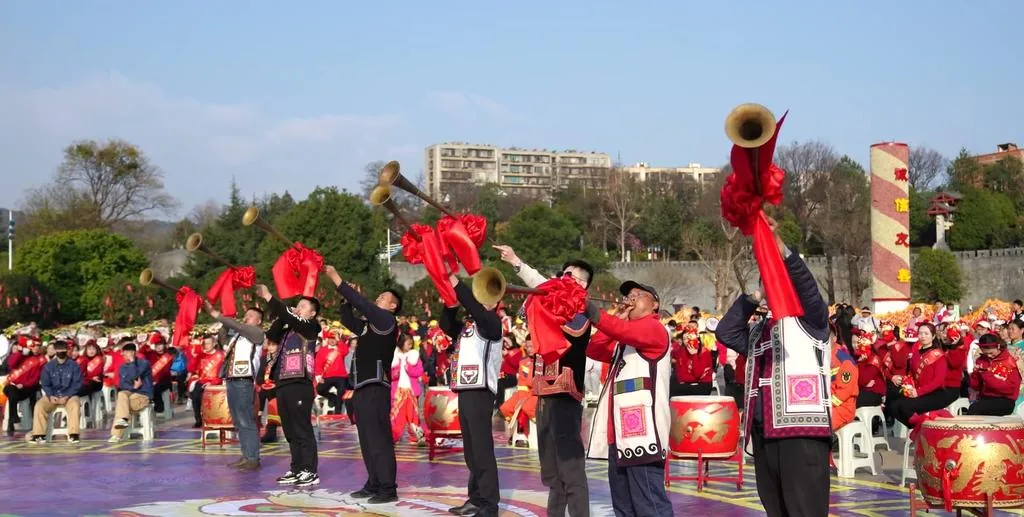
Seen side by side, the size gap is hard to miss. A lion holds one spot on the road, and a line of dragons takes up a whole block.
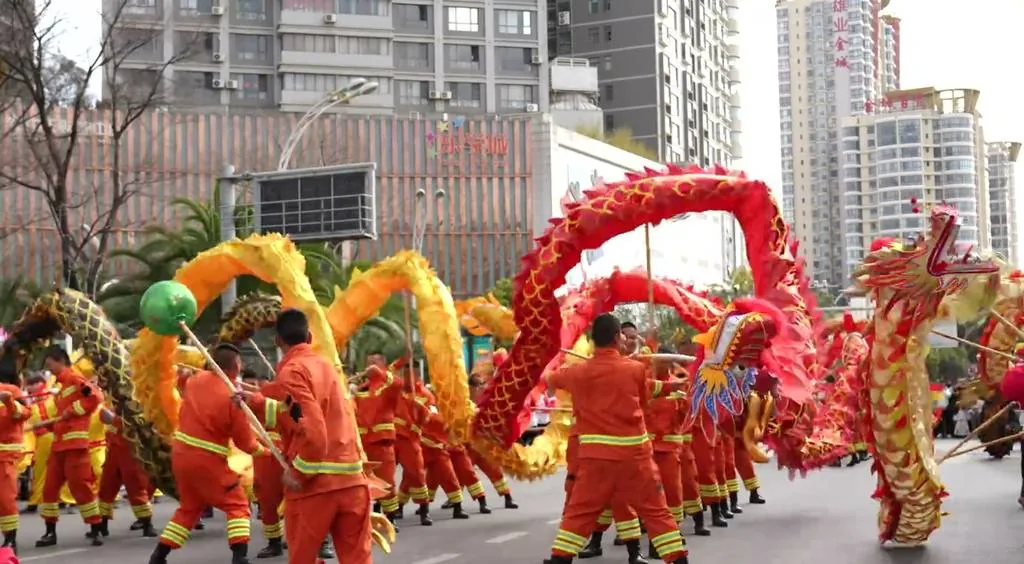
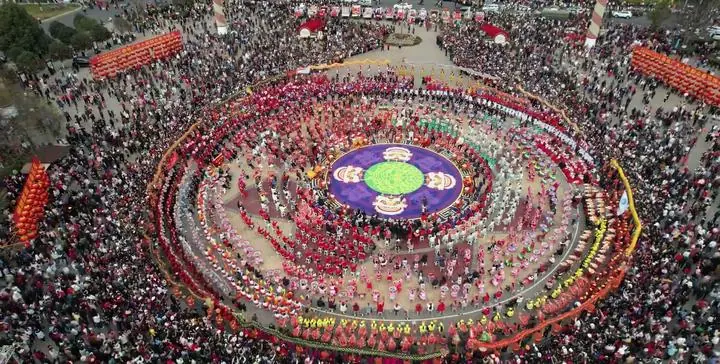
When the teams reach an open square, the crowd closes in around them.
Lion or dragon: which dance to book for an event
If you’re hiring rather than watching, the space and the guest list decide it:
- Shop opening, wedding or birthday: choose a lion. It fits indoors, it can walk up to one door, and the blessing lands on one business or couple.
- Parade, street festival or large public event: choose a dragon. It blesses a whole community and needs the room to swing.
- A very long route: ask how the team handles it. Chau Luen brings a second full team of ten, pearl included, for parades over two hours.
Plan for the band as well. Chau Luen counts at least three percussionists for a lion and up to six for a dragon, so by its numbers a single lion is about five people and one dragon about 15. That’s why the club says to book a dragon well ahead.
Can non-Chinese people join a lion or dragon dance team?
Yes, at many clubs. Chau Luen says it invites anyone to learn and perform regardless of gender, race or background. Policies differ, though. The same club notes that some old-school troupes still keep women out of the lion or limit them to percussion, so ask before you turn up. A local kung fu school is a good first call, since many keep their own troupe.
Where to stand: close for a lion, a few rows back for a dragon
If you only remember one thing from all this, let it be where to stand. A lion rewards being close, because the whole act is in its face, and I keep my eyes there rather than on the jumps. Give it room all the same, and ask before you touch one.
A dragon only makes sense from a distance, since up close you’ll see a pole and a few yards of cloth. I step back until I can see the head and the tail at once. Being brushed by a passing dragon counts as lucky, but that’s an old saying, not a promise, and the same goes for most of the customs I write about here.
Written by
Daozhang MaMaoshan Taoist, Jintan, Jiangsu
Daozhang Ma is a Maoshan Taoist who has practiced for 22 years and is skilled at writing talismans and painting Taoist pictures. He runs Zodiac & Tradition.
About Daozhang Ma