Angpao Chinese New Year: Red Envelopes and New Year Money
By Daozhang MaMaoshan Taoist, Jintan, Jiangsu

In short
Angpao is the Hokkien name for the red packet of money handed out at Chinese New Year, the same packet Mandarin speakers call hongbao (红包) and Cantonese speakers call lai see. In Singapore and Malaysia you’ll hear it as angpao, ang pow or ang bao, and the rule of thumb there is simple: married adults give, children and anyone still single receive. The money inside goes in as crisp notes, in an even amount that keeps clear of the number four. Below I cover the names, who gives and who collects, how families get the packets ready before the visiting starts, and a few customs you’ll mostly meet in Singapore and Malaysia.
Angpao, ang pow, hongbao, lai see: one red packet, several names
The angpao is not a different object from the red envelope you may already know. It’s the same small red packet, called by the name that Hokkien speakers use. In Hokkien, “ang” means red and “pao” means a packet or a wrapped bundle, so angpao is simply the local way of saying 红包. Where I live, in Jiangsu, nobody says angpao. It’s hongbao from the oldest grandmother to the youngest child.
Singapore’s Chinese community uses several names side by side. Culturepaedia, the online reference run by Singapore’s main Chinese cultural center, lists angbao (sometimes written angpow) in Hokkien, lai see in Cantonese, and an older literary name, yasuiqian. That last one comes from a legend about a demon called Sui who preyed on children on New Year’s Eve.
Hokkien never had one fixed romanization, so you’ll see angpao, ang pao, angpow, ang pow and ang bao on packets, shop signs and greeting cards. None of them is wrong.
What the packet means, how the custom started, and how much people put in are the same across the Chinese world, and I’ve gone through all of that in my guide to red envelopes. This page stays with what is particular to the angpao as Singapore and Malaysia know it.
Who gives an angpao in Singapore and Malaysia, and who collects
The dividing line is marriage, not age or income. Married people give angpao to children and to elders, and unmarried adults keep receiving them even after they’ve started work. That’s how the custom runs at every Lunar New Year family visit, and it’s why a single adult with a good salary can still walk away from an aunt’s house with a packet in hand.
There’s no hard rule about when someone moves from receiving to giving. Culturepaedia names two usual milestones: earning a first paycheck, or the end of the first year of marriage. Newlyweds in their first year are often excused from giving at all.
Adults with a steady income also give packets to their own parents and grandparents, and some bosses hand them to their staff as a gesture of goodwill.
The marriage line has a teasing side, too. Elders like to ask a single adult, “When can I stop giving you red packets?” Everyone at the table knows the real question is when the wedding will be.
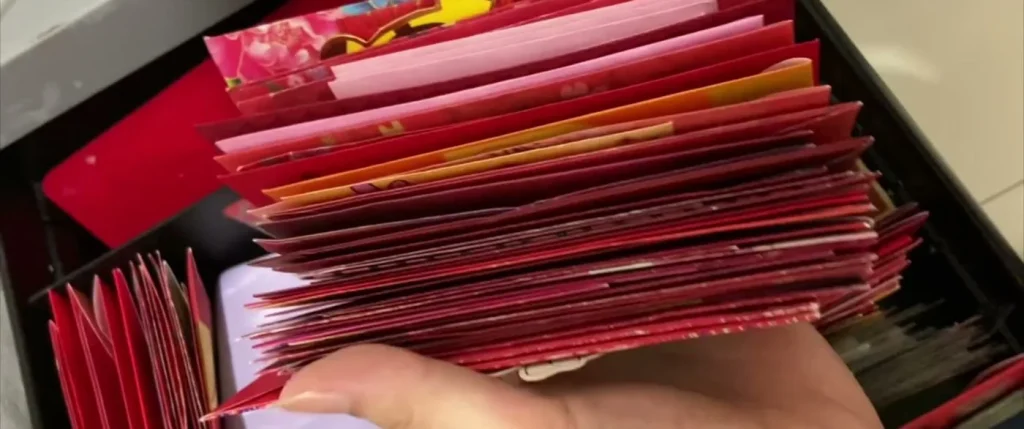
In a household with small children the packets pile up quickly. Each visit to a relative brings a packet for every child, so a couple with young kids can be holding dozens after the first few days, and many parents keep a separate pile for each person who received them.
Getting angpao ready before the New Year visits
Because the giving happens house by house over several days, the real work comes before New Year’s Day: getting the packets, getting the notes, and filling a stack of them in advance.
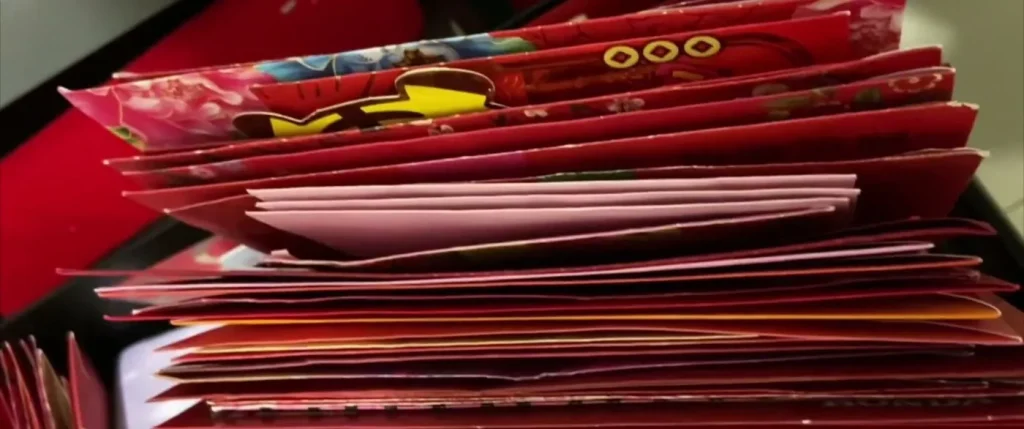
The packets themselves are rarely bought. In Singapore, banks, department stores and other companies print their own each year and hand them out to customers, and banks alone print and give out tens of millions of packets a year. That’s why a single family’s collection mixes plain red packets with foil stamping, gold coins, cartoon characters and brand logos.
The notes are where the queues form. Givers want them fresh from the press, clean and unwrinkled. The Monetary Authority of Singapore says new notes typically become available within the 2 week period before Chinese New Year, and the run on bank counters and ATMs in those two weeks is part of the season.
Singapore’s central bank has started pushing back on that habit. MAS has said it issues about 100 million new notes a year for Chinese New Year and other festive periods, and that a large share of them, especially the $2 notes, come back to the banks after the holiday and are destroyed. It now asks people to give used notes in good condition, which it calls fit notes, or to send an e-hongbao instead.
Even so, Culturepaedia notes that Singapore’s Chinese community still generally prefers paper packets to digital ones.
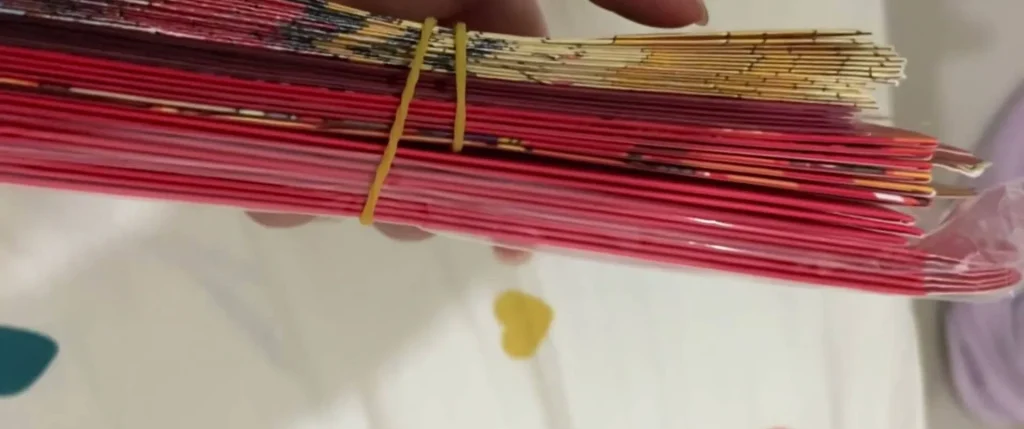
Once packets and notes are in hand, people fill a batch at home and keep them ready in a bag or a drawer. Even a few days into the New Year, most homes still have unused packets left.
Lucky and unlucky amounts inside an angpao
The amount follows the same number beliefs found wherever Chinese New Year is kept, and Singapore families observe them closely:
- Even amounts. Good things come in pairs, so the total is an even number.
- No four. Four sounds like the word for death, so no amount should contain a 4, whether that’s $4, $14 or $40.
- Eights welcome. Eight sounds like the word for prosperity, which makes $8, $28 and $88 popular choices.
- Nine allowed. Nine is odd, but it’s accepted because it sounds like the word for longevity.
Beyond those rules there’s no fixed rate. Closer relatives get more than neighbors’ children, and a giver goes by what they can afford. I’d rather see a modest packet given with a real blessing than a large one handed over in a rush. For more on why four is avoided, see my page on Chinese New Year superstitions.
How to give and receive an angpao politely
The handing-over takes a few seconds, but the order of it matters to older relatives. This is how it usually goes:
- The giver holds out the packet and says a New Year blessing.
- The receiver takes it with both hands as a sign of respect and answers with a blessing of their own.
- In some families, a child or grandchild kneels to receive a packet from a grandparent.
- The receiver puts the packet away without opening it. Opening it in front of the giver is considered rude.
The blessing you’ll hear most in Malaysia and Singapore is “gong xi fa cai,” a wish for wealth in the new year. Some people also hold that angpao money shouldn’t be spent too quickly, since spending it fast is like throwing away the blessing that came with it.
An angpao answers a visit, so it often travels alongside the oranges and gifts that guests bring. How those gifts are chosen and returned is covered in my guide to Chinese New Year gift etiquette.
Angpao customs you’ll mostly meet in Singapore and Malaysia
A few habits around the angpao have grown up in Singapore and Malaysia that you won’t see much in Jiangsu or Beijing.
Lottery tickets in the packet. In Singapore, slipping a lottery ticket into an angpao is a widely accepted practice. If the ticket wins, the receiver is expected to give a token sum back to the giver.
Packets for bad luck, not just good. Red packets are also used to dispel bad luck. Cantonese families, for instance, give red packets to relatives and friends who visit them in the hospital.
Green packets and Deepavali packets. The packet itself has crossed into other communities. In the 1980s, Singapore banks began printing green packets for Hari Raya, since green is the color associated with Islam, and Hindu families give cash in packets decorated with deities, peacocks and oil lamps during Deepavali.
The season ends at Chap Goh Mei. Chap Goh Mei, Hokkien for “the 15th night,” is the 15th day of the first lunar month and the last day of the New Year celebrations, known elsewhere as the Lantern Festival. In Malaysia and Singapore, some unmarried women write their names and contact details on mandarin oranges that night and throw them into a lake or river, hoping the right suitor fishes one out. For anyone tired of being asked when the angpao can stop, it’s a fitting way to close the season.
Written by
Daozhang MaMaoshan Taoist, Jintan, Jiangsu
Daozhang Ma is a Maoshan Taoist who has practiced for 22 years and is skilled at writing talismans and painting Taoist pictures. He runs Zodiac & Tradition.
About Daozhang Ma