Chinese New Year Couplets: Spring Festival Couplets to Hang
By Daozhang MaMaoshan Taoist, Jintan, Jiangsu
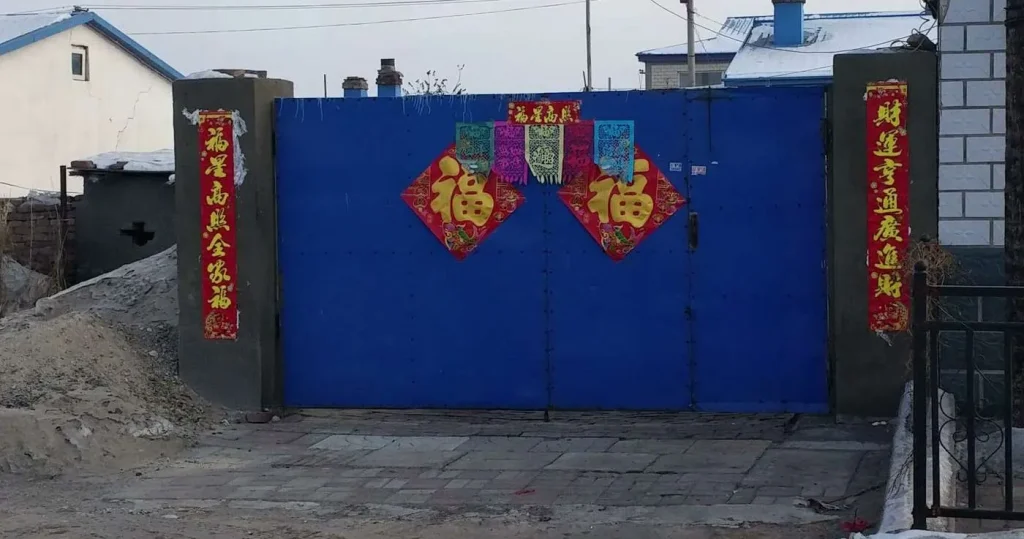
In short
Chinese New Year couplets, chunlian (春联), are two matched lines of verse written on tall red strips that flank the front door, topped by a four-character banner over the lintel. Most families paste them up on New Year’s Eve, between lunch and the reunion dinner, in a fixed order: paste on the back, the 2 side lines first, the banner last. Below you’ll find a materials list, real examples with pinyin, a 6-step photo walk-through on a village doorway, and the 2 questions I’m asked most often, which side each line goes on and which way up the fu goes.
What you need to put up a set of couplets for Chinese New Year
A standard set has 3 pieces.
Two long strips carry the upper and lower lines, usually 7 characters each, and a shorter strip, the hengpi (横批), carries a 4-character phrase for the lintel.
Printed sets often add a row of small hanging slips and a fu (福) square in the same plastic bag.
Before you start, have these ready:
- One couplet set, checked so the two long strips have the same number of characters
- A pot of paste and a flat brush, or a glue stick for small sets
- A flat table near the door, covered with newspaper
- A step ladder for the banner
- A damp cloth for your hands
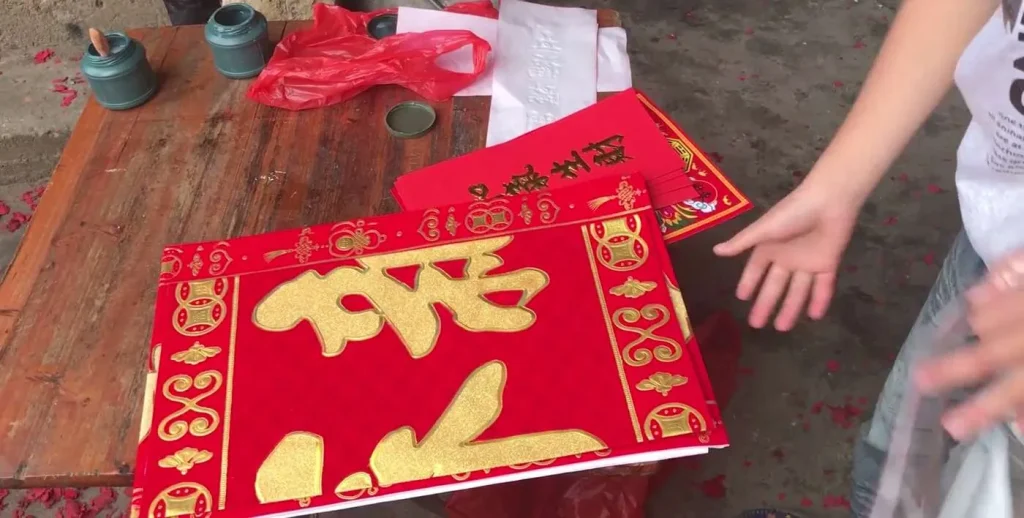
Paste works best on brick, plaster and old unpainted wood.
If the door belongs to a landlord, I’d swap the paste for removable tape or poster putty. The strips won’t sit perfectly flat, but they’ll come off in February without taking the paint with them.
Chinese spring festival couplet examples to look for on a set
Most families buy a printed set rather than writing their own, so the practical skill is knowing what the lines actually say before you pay for them.
The examples below come from the lists of traditional couplets and banner phrases that Chinese Wikipedia keeps in its articles on chunlian and duilian. I haven’t invented any of them.
Full couplets with pinyin and English
These pairs show what a properly matched couplet sounds like.
Say the last character of each line aloud: the upper line closes on a falling or dipping tone, and its partner closes on a level or rising one. The full tone test, with a worked example, is in my explainer on dui lian.
A spring couplet about the season itself:
- 杨柳吐翠九州绿 (yáng liǔ tǔ cuì jiǔ zhōu lǜ), “willows put out green shoots and the whole land turns green”
- 桃杏争春五月红 (táo xìng zhēng chūn wǔ yuè hóng), “peach and apricot blossoms race for spring and the fifth month glows red”
An innkeeper’s couplet:
- 欢迎春夏秋冬客 (huān yíng chūn xià qiū dōng kè), “welcome to guests of spring, summer, autumn and winter”
- 款待东西南北人 (kuǎn dài dōng xī nán běi rén), “good care for people from east, west, south and north”
A barber’s couplet:
- 虽是毫发生意 (suī shì háo fà shēng yì), “only a hair-thin trade”
- 却是顶上功夫 (què shì dǐng shàng gōng fū), “but top-of-the-head skill”
The barber’s pair is my personal favorite.
顶上 means both “top-notch” and “on top of the head,” so the joke and the boast live in the same 2 characters.
Four-character banners and phrases, matched to the wish
The banner and the small strips carry short phrases, and families choose them to fit whatever they’re hoping for in the coming year. Chinese Wikipedia lists which occupations tend to choose which phrase:
| Phrase | Pinyin | Meaning | Who usually picks it |
|---|---|---|---|
| 四季平安 | sì jì píng ān | Peace in all four seasons | Any household |
| 万事胜意 | wàn shì shèng yì | Everything better than hoped | Any household |
| 财源广进 | cái yuán guǎng jìn | Money flowing in from every side | Households wishing for wealth |
| 生意兴隆 | shēng yì xīng lóng | Business booming | Shop owners |
| 客似云来 | kè sì yún lái | Customers arriving like clouds | Shops and sellers |
| 风调雨顺 | fēng tiáo yǔ shùn | Wind and rain in their season | Farmers |
| 一帆风顺 | yì fān fēng shùn | Smooth sailing | Fishing families |
| 步步高升 | bù bù gāo shēng | Rising one step at a time | People with a salaried job |
| 学业进步 | xué yè jìn bù | Progress in your studies | Students |
Some phrases belong to one particular spot in the house.
满 (mǎn, “full”) or 常满 (“always full”) goes on the rice bin, 花开富贵 (“flowers bloom, wealth and honor”) on a flowerpot, and 出入平安 (“safe coming and going”) beside the entrance.
Zodiac sets play on the animal of the year. Chinese Wikipedia gives 金猴献瑞, “the golden monkey brings good omens,” and 十犬十美 for a Dog year, which swaps 犬, “dog,” into the expression 十全十美, “perfect in every way.”
For a family that doesn’t run a business, I’d point them toward 四季平安.
It asks for nothing more than a quiet year, and it suits any door in any neighborhood.
Couplets that don’t belong on a New Year door
Red paper alone doesn’t make a couplet a New Year couplet.
福如东海 (fú rú dōng hǎi), “fortune as vast as the Eastern Sea,” and 寿比南山 (shòu bǐ nán shān), “a life as long as the Southern Mountain,” is a birthday couplet. Shops sell wedding and grand-opening couplets in exactly the same red, so read the lines, or ask the seller, before anything goes on your door.
How to paste up the side lines of a spring couplet set
With a set chosen, the pasting itself is a short job done in a particular order: small pieces at the top first, then the 2 long lines, and the banner last.
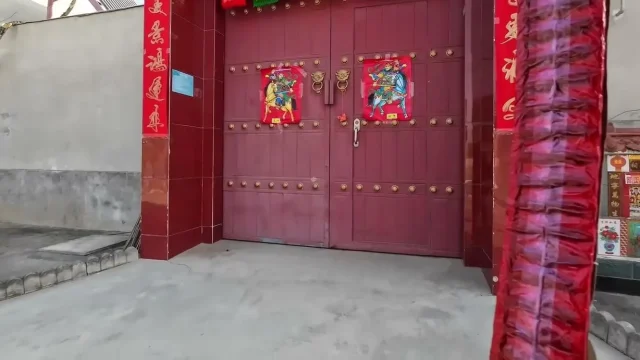
In the photographs below, a village doorway goes from a bare frame to a finished set, one step at a time.
Step 1: Hang the red slips under the lintel. Start with the row of small red hanging slips, often called menqian (门钱), “door money.” They go along the top of the door frame, just under where the banner will sit, so they’re easier to position while that spot is still empty.
Step 2: Brush the paste onto the back of the first strip. Lay the strip face down on the table and brush the paste out to every edge, corners included. Every strip of mine that has come loose started along an edge I’d left dry.
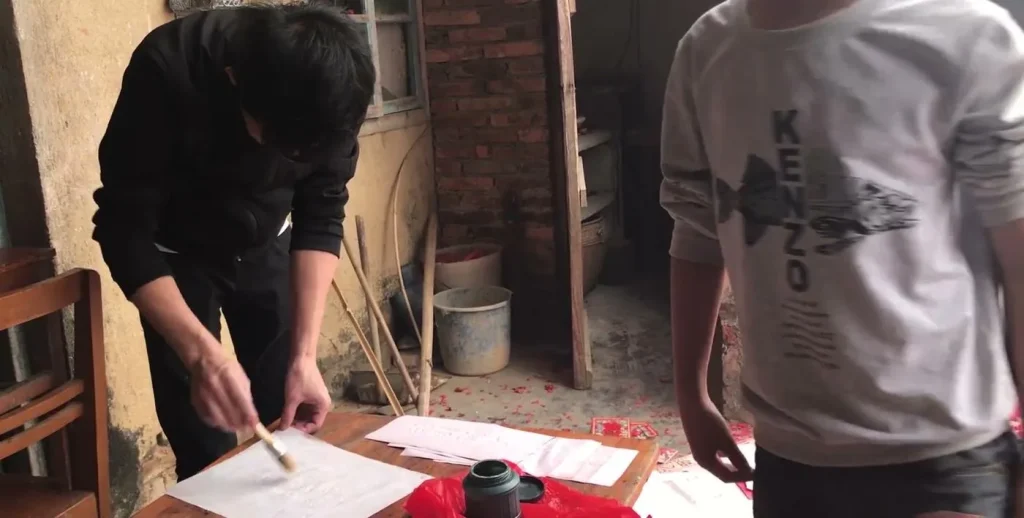
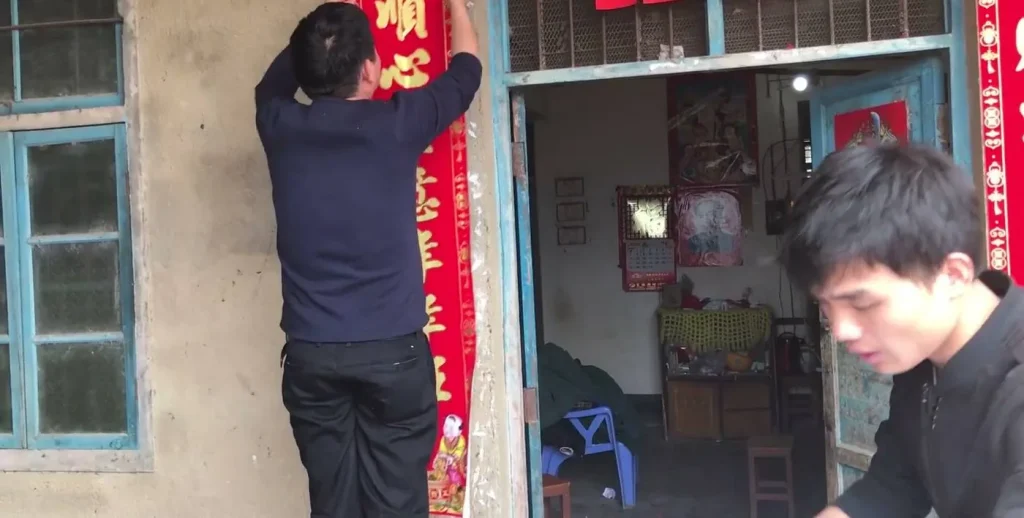
Step 3: Set the top of the strip beside the door frame and press down from the top. Carry the strip by its top end, line that end up with the top of the door frame, and press it onto the wall or post. Work your hand downward, smoothing as you go, and finish by pressing the bottom end flat.
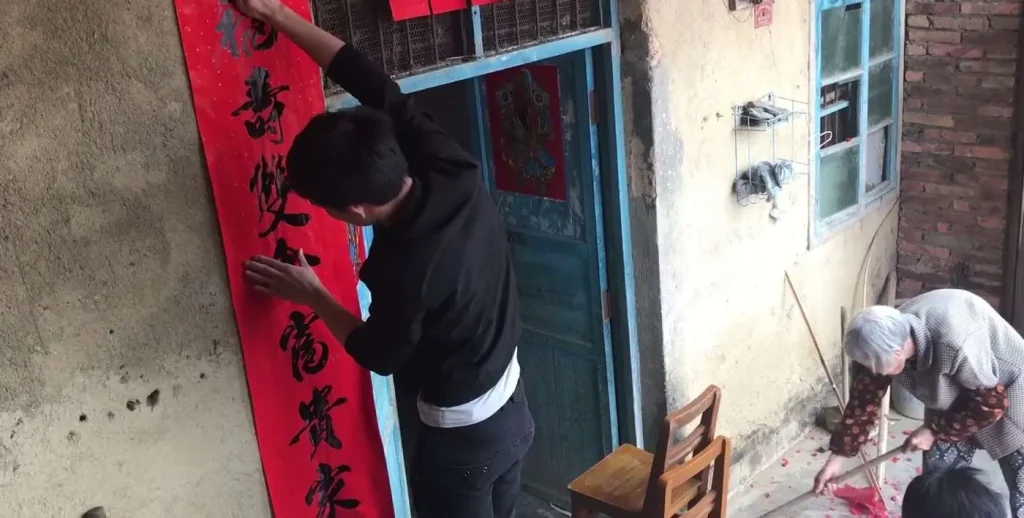
Step 4: Paste the matching line on the other side, and the door gods on the doors. Repeat the paste and the top-down press on the opposite side, keeping the top of the second line level with the first. If your set includes door gods, menshen (门神), they go on the 2 door leaves themselves, pasted the same way.
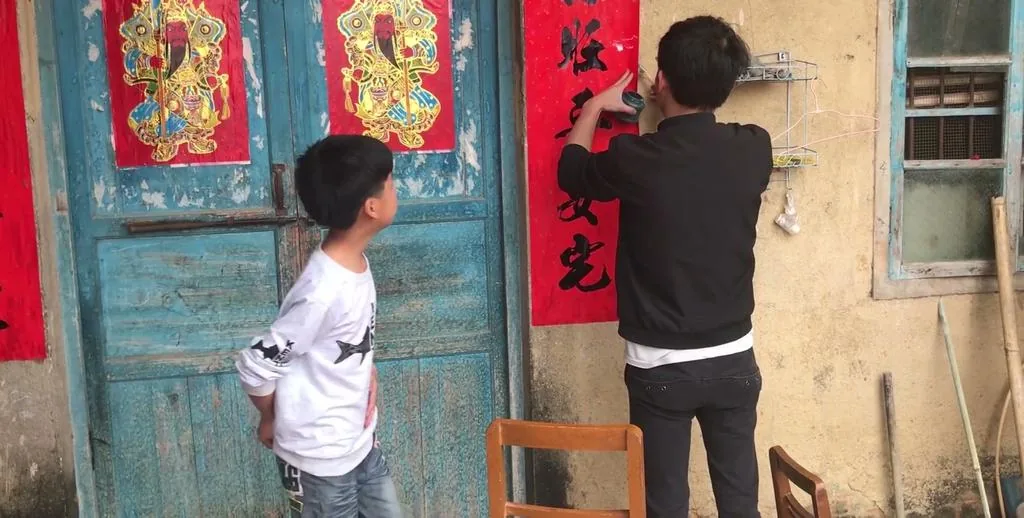
Level tops matter more than anything else on this step.
Finishing the door with the horizontal banner
Once both side lines are up, the banner closes the frame.
It goes on last because you center it between the 2 lines, and you can’t do that until they’re in place.
Step 5: Center the banner over the lintel from a ladder. Paste the back of the banner, climb the ladder and hold it up across the lintel. Check that it sits halfway between the 2 side lines before you press the middle down, then work outward to both ends.
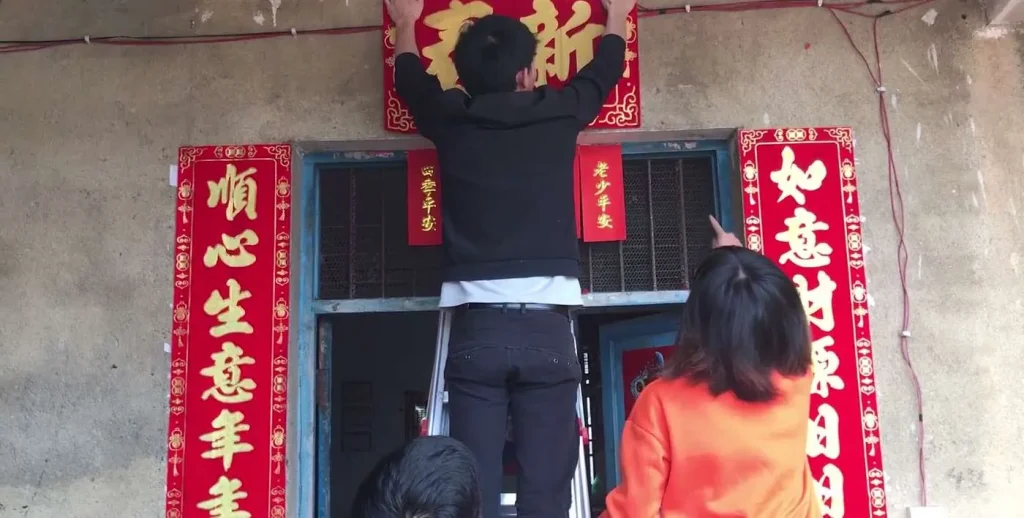
When I’m the one on the ladder, I get someone to stand below and call out “left” or “right,” which saves me a lot of climbing up and down.
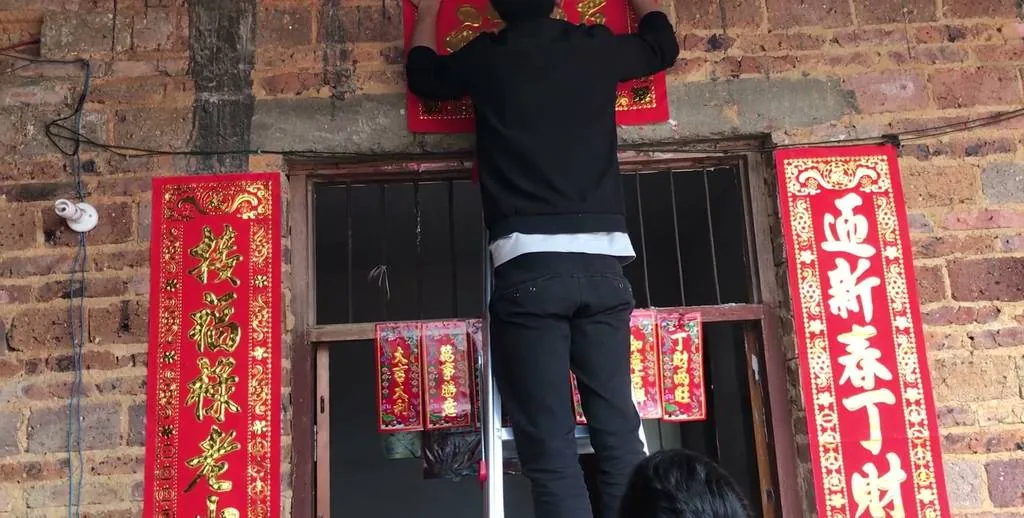
Step 6: Press the corners flat before you climb down. Run your hand over each corner of the banner and along its top edge. On my own door the corners are where the paste dries out first, so I press them twice before I come down. A lifted corner is easy to fix now and awkward to reach from the ground later.
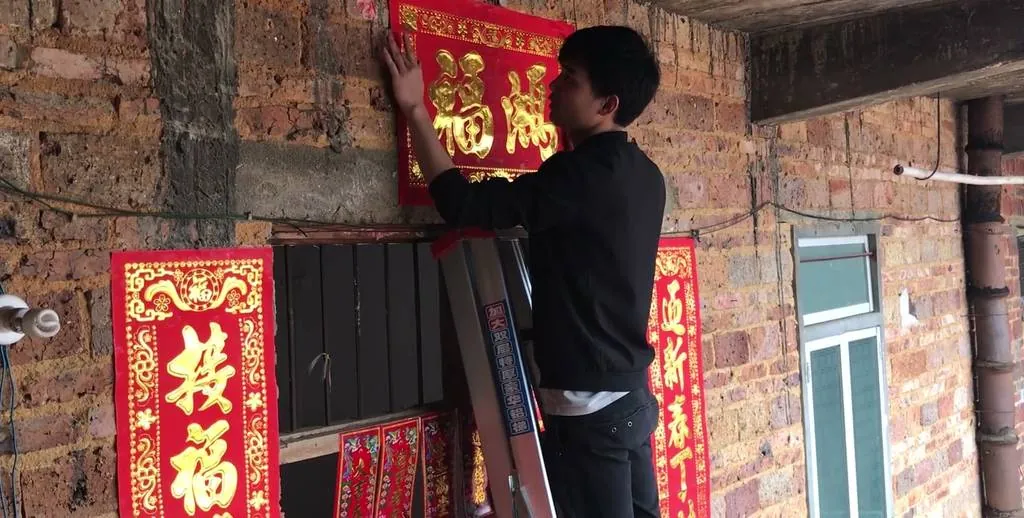
That’s one door finished.
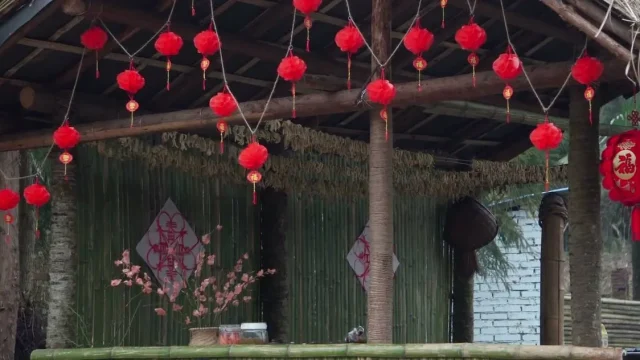
Inner doors get the same treatment with smaller sets. Paper-cuts for the windows, lanterns and the other red decorations that go up the same week each have a section in this rundown of Chinese New Year decorations.
Which side the upper line goes on, and which way up the fu goes
The photographs show the order, but 2 decisions are left to you: where the upper line goes, and how to turn the fu.
Qin Zhifa, president of the couplet society in Jiangsu, where I live, answered both in a 2016 interview with the Jiangnan Times that China News Service carried.
His rule for sides is short. The upper line goes on the side where the banner’s first character sits.
If the banner reads right to left, the upper line goes on the right as you face the door, and a left-to-right banner moves it to the left post.
When a set comes without a banner, put the upper line on the right. That’s the older arrangement, from the centuries when Chinese was written in columns starting from the right.
The fu is where most people go wrong.
Many families turn every fu upside down, because “the fu is upside down” sounds like “good fortune has arrived” in Chinese. Qin says the fu on the front door should stand upright, as a mark of respect, and the turned ones belong indoors.
That means the water vat, the trash bin and the cabinets. A vat and a bin get emptied by tipping, so the turned fu is there to stop the luck from being poured out along with everything else.
Nobody agrees on who started turning it over. Chinese Wikipedia records 3 competing stories, and the best known has a servant in Prince Gong’s household pasting a fu upside down by mistake, then talking his way out of punishment with the pun.
It’s a story. I’d hang the fu the way Qin says.
When to put up Chinese New Year couplets
The timing matters more than the technique.
Most families do it on New Year’s Eve, from the afternoon into early evening. Qin’s reasoning is practical: the evening fills up with the reunion dinner and the offerings, and the afternoon still has good daylight for climbing a ladder.
He’s careful to add that customs differ by region, so the exact hour varies from place to place. The date for the coming year, and what else fills that day, are on the page about Chinese New Year’s Eve.
Writing the couplets starts much earlier.
A folk saying Qin quotes, “on the 24th, write the big characters,” puts the brushwork any time after the 24th day of the 12th lunar month, so a handwritten set is ready well before the Eve.
Once up, the couplets stay until the paper fades, and next year’s set goes over the same spot.
Couplets are only one of the Eve’s customs, and the reunion dinner, the offerings and the rest are laid out in my Lunar New Year guide. If I could keep only one job on that day, I’d keep this one, because a door with fresh couplets tells the entire street that the household is ready for the new year.
Written by
Daozhang MaMaoshan Taoist, Jintan, Jiangsu
Daozhang Ma is a Maoshan Taoist who has practiced for 22 years and is skilled at writing talismans and painting Taoist pictures. He runs Zodiac & Tradition.
About Daozhang Ma