Northern Lion Dance: Costume, Performance and History
By Daozhang MaMaoshan Taoist, Jintan, Jiangsu
In short
Northern lion dance comes from northern China, with Hebei and Beijing as its best-known homes, and it’s the shaggy one: two dancers share a full-body fur costume, a lead dancer steers them with a silk ball, and the show runs on acrobatics such as walking on a giant ball. It looks more like a huge, grinning Pekingese than the horned lion of most American Chinatowns.
I live on Maoshan in Jiangsu, so a northern troupe is something I go out of my way to watch. The first one I saw up close, on a trip north, got a laugh out of me before it had done anything clever. It looked as if somebody’s enormous dog had climbed onto a table.
The dog is a very skilled one, though, and most of the skill is easy to miss. So here’s how to read the costume, who does what, which stunts to wait for, and where the form came from.
How to spot a northern lion: gold face, shaggy coat, red or green top
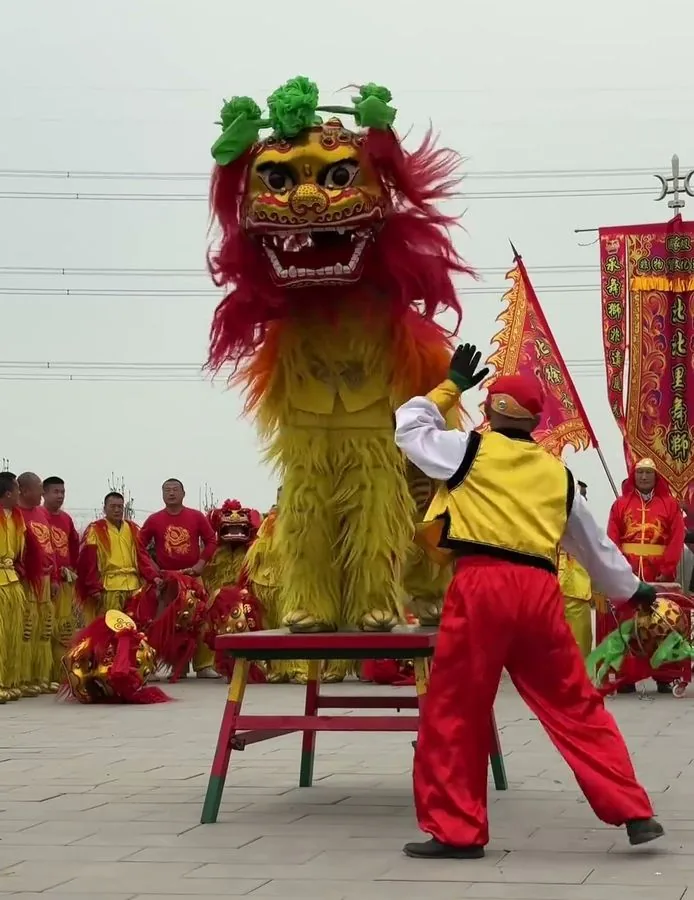
Start with the head, because it’s the fastest tell. A northern lion has a gold-painted face with a wide grin, and heads are often made of wood. The rest of the animal disappears under long hair, mostly yellow on the body and legs and red around the mane.
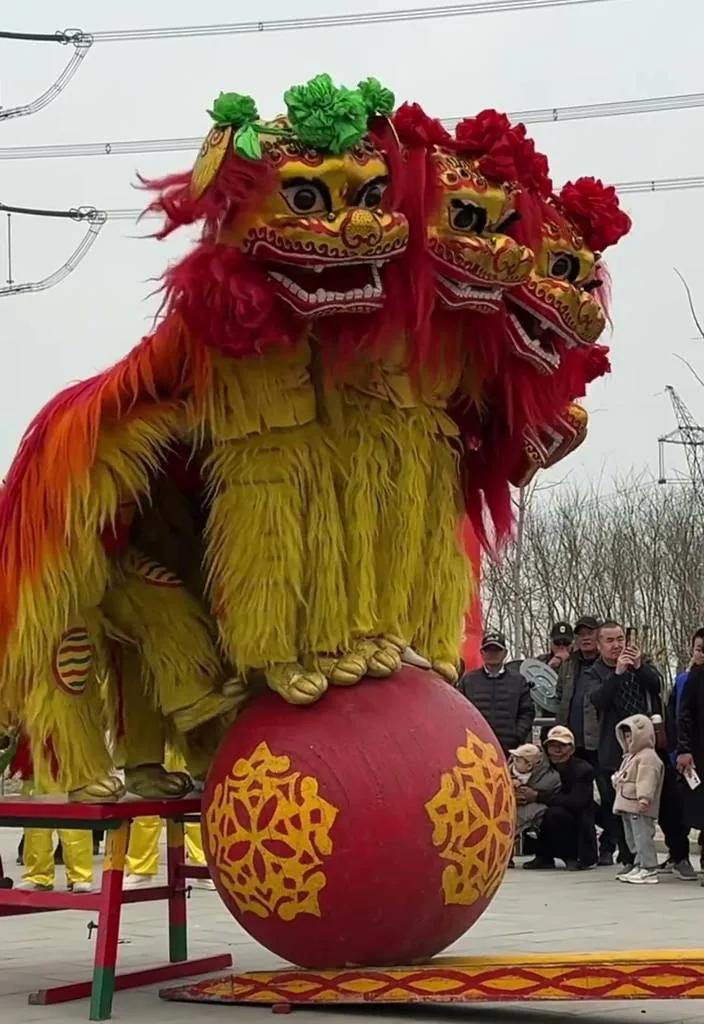
Then look at the very top of the head. By the usual convention a red bow marks a male and a green bow marks a female, and plenty of troupes use a fat silk pompom where the bow would go. It’s the one detail you can still read from the back row.
As someone who paints Taoist pictures, I can’t look at that coat the way most of the crowd does. Fur in a painting is hundreds of small strokes that have to agree on a direction, and here the whole coat swings at once whenever the lion turns. Because the hair runs right down the legs, you stop seeing two people and start seeing four paws.
Northern vs southern lion dance: a grin against a glare
That grinning face is also the shortest way to separate the two main Chinese lions. Wang Zhenshui, who leads a Xushui troupe in Hebei, told CGTN in 2020 that the southern lion is fierce and powerful while the northern lion smiles and brings people joy. The rest of the differences follow from there:
- Face: the northern lion has a gold, dog-like grin. The southern lion wears a large painted head with one horn and a forehead mirror.
- Costume: the northern lion wears hair all over, and its costume is built sturdier and plainer to leave room for movement. The southern lion has a cloth body trimmed with fur.
- Moves: northern shows roll, leap, climb and balance. Southern shows act out a big cat scratching, shaking and licking its fur.
- Company: northern lions tend to come as a male and female pair, and sometimes as a family with young lions.
Those four will get you through a crowd. For the side-by-side table, how the southern head is built and what happens from the eye-dotting to the greens, go to my guide to the lion dance. If the animal in front of you is long and carried on poles, it’s a different dance altogether, and the two-step test for lions and dragons sorts that out.
The lead dancer and the silk ball that steer a northern lion
The clearest thing a northern show adds is a person in the open. In front of the lion works a lead dancer, called yin shi lang (引狮郎), the lion-leading young man, and he’s usually dressed as a warrior. His tool is the xiuqiu (绣球), a bright embroidered silk ball.
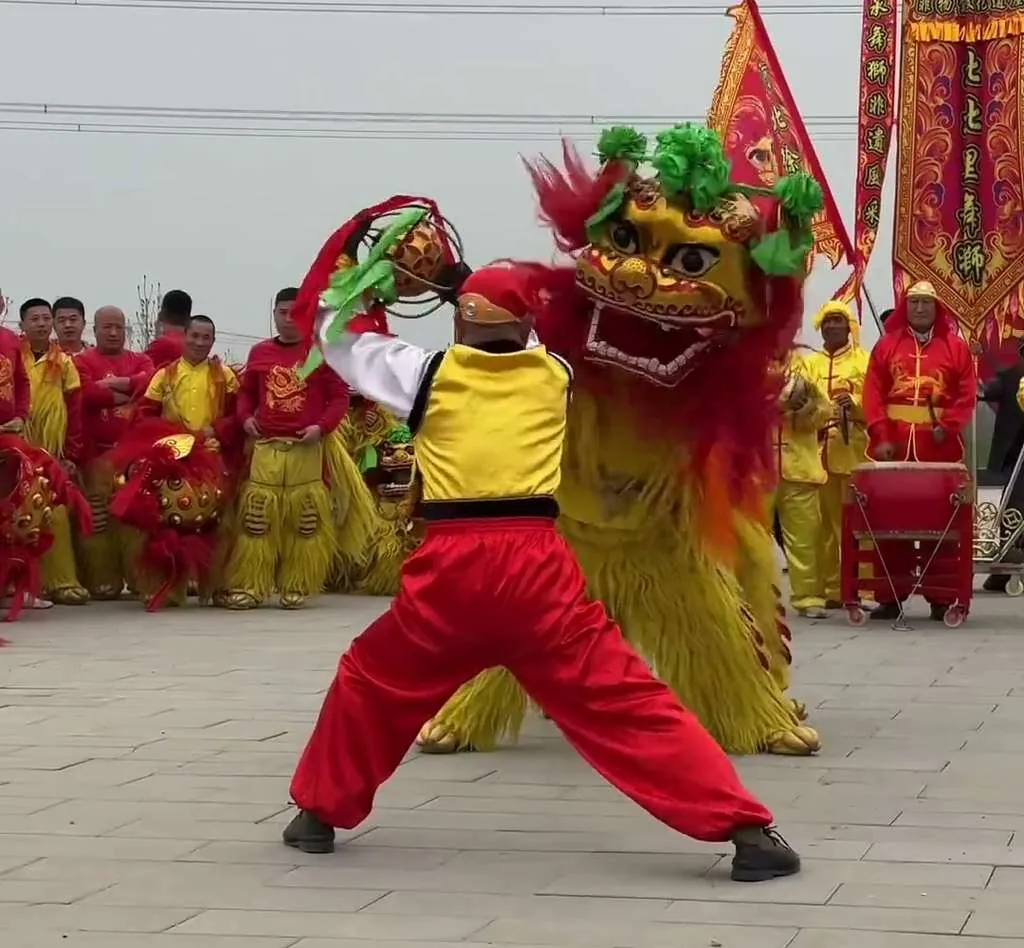
Think of the ball as bait and a cue at once. The lion chases it, so wherever it goes, the head and the crowd’s eyes follow, and the gongs, drums and cymbals keep time for both. Xushui performers treat the teamwork between this dancer and the lion as a defining feature of their style, so don’t write him off as a sidekick.
Not every northern troupe leads with a ball, as far as I can tell. Hebei lions follow a colored ball, while Beijing’s taishi lions are said to follow a cloth duster. That’s one spoken account, and I’ve never seen it done, so don’t take it as a rule for all of Beijing.
Two dancers inside one northern lion: taishi and shaoshi
Behind that ball, an adult northern lion takes two people. In Beijing it’s called a taishi (太狮), a great lion, while a young lion worked by one dancer is a shaoshi (少狮). The front dancer holds the head, and when the lion stands up, the rear dancer is often the one lifting the front dancer.
Now and then a routine shows you exactly that. Here the head comes up and the costume stops hiding anybody, with one dancer balanced on the other’s raised hands.
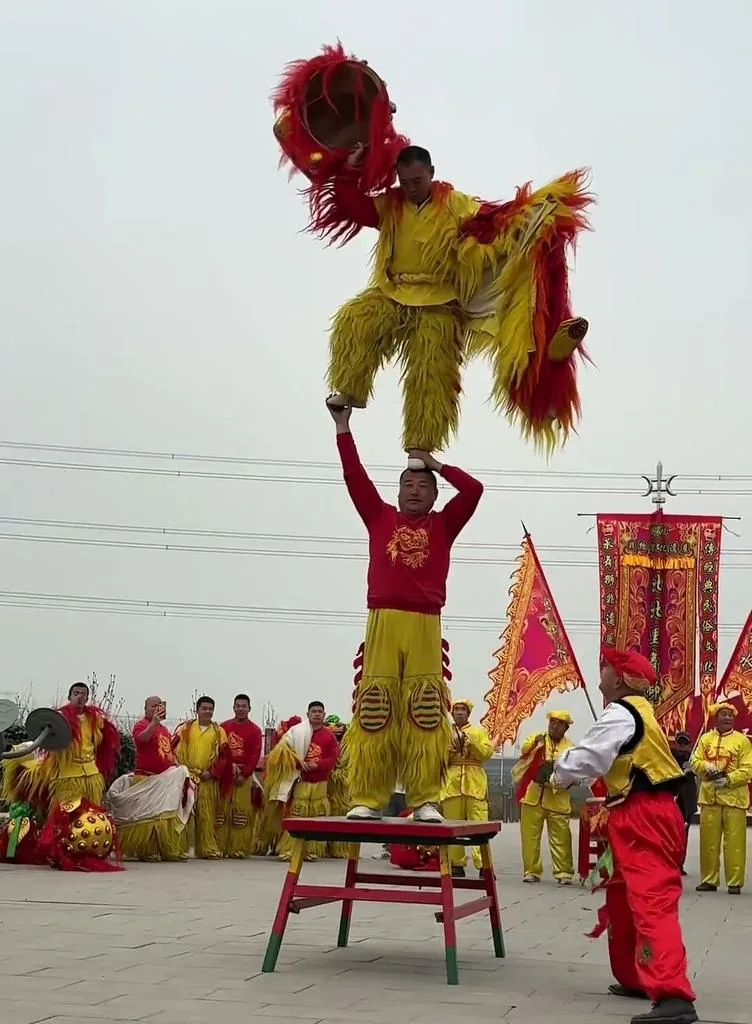
That partnership is the hard part. Wang says the dance can’t be done alone, that it takes endless sessions with the same partner, and that his performers practice all year. Xushui dancers also blink the lion’s eyes, twitch its ears and scratch its cheeks, and those small touches make a stunt read as an animal’s mood and not as gymnastics. How the head is rigged inside, I can’t tell you. A spectator never gets to see that.
Northern lion stunts on balls, seesaws and tall stands
With two bodies working as one, the routine can go up. Xushui troupes divide lions into wen shi (文狮), the civil lion, which is playful, and wu shi (武狮), the martial lion, where the point is technique between two partners. The stunts below belong to the martial side.
The big red ball is the signature prop. The lion gets all four feet onto it and rolls it forward, which is hard enough on flat ground. Then the ball goes onto a seesaw board.
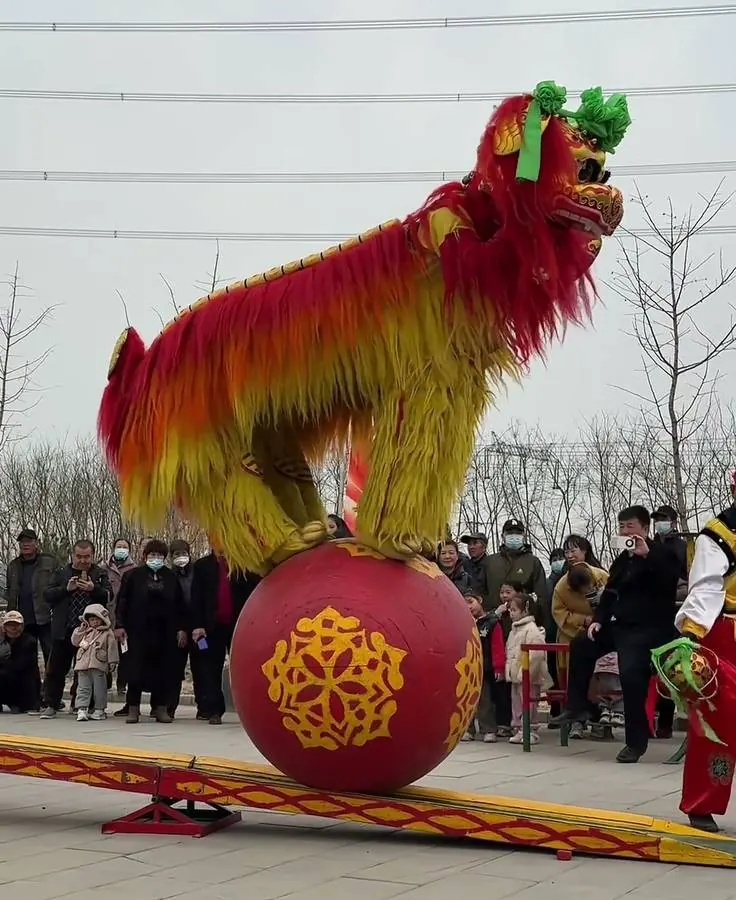
The seesaw is the one I wait for. A board about to tip gives two people with a poor view a single moment to shift their weight, and I’ve caught myself holding my breath through it.
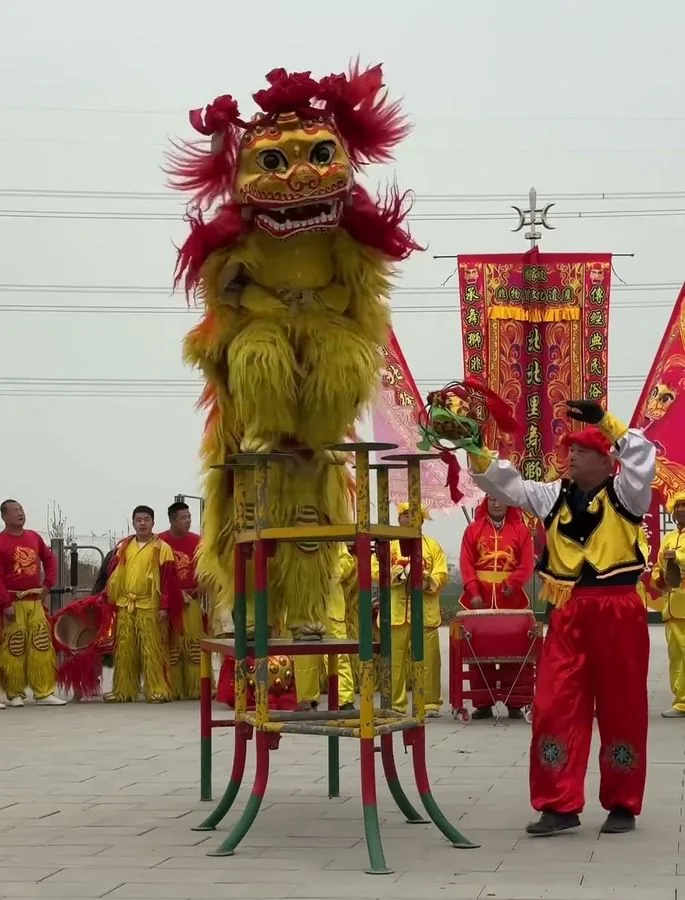
Height is the other half of the repertoire. Lions rear on tables and perch on tall stands, and reports from Beili, the Xushui village most tied to the form, mention a one-legged 360-degree spin on plum-blossom posts, which are narrow standing poles. In Xiangfen County, Shanxi, the Heavenly Tower lion climbs a tower of wooden stools.
The showpiece puts several lions on one ball. Beili’s best-known version sends four lions on a ball across a seesaw, and CGTN’s 2020 report from Xushui describes five lions, 10 performers, standing together on one large rolling ball.
Group northern lion performances: from a pair to a full line
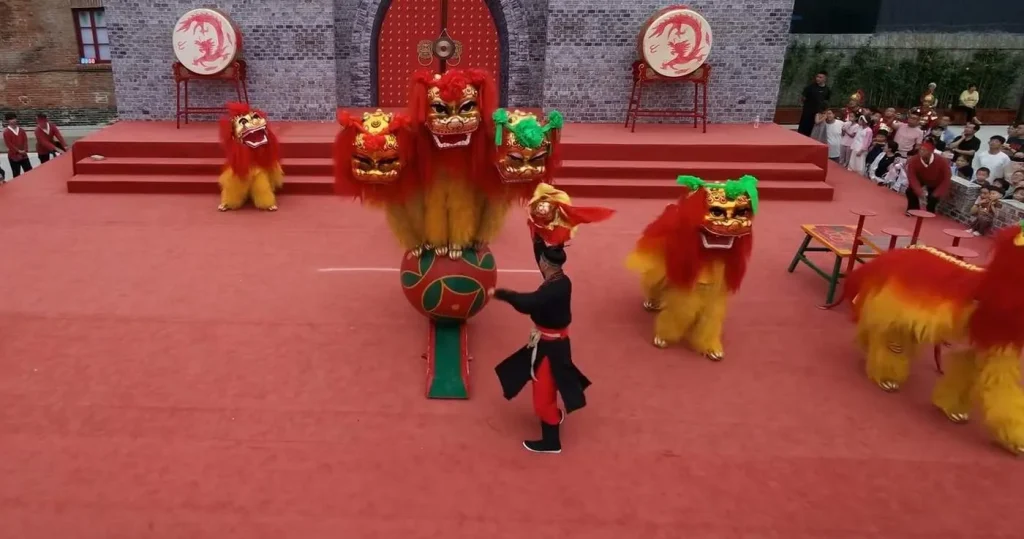
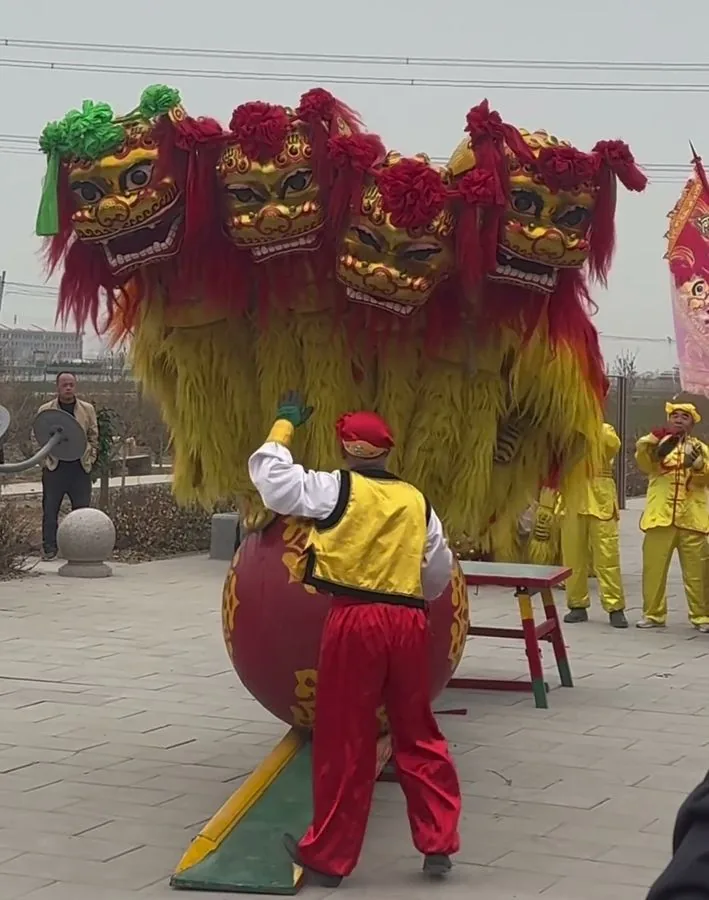
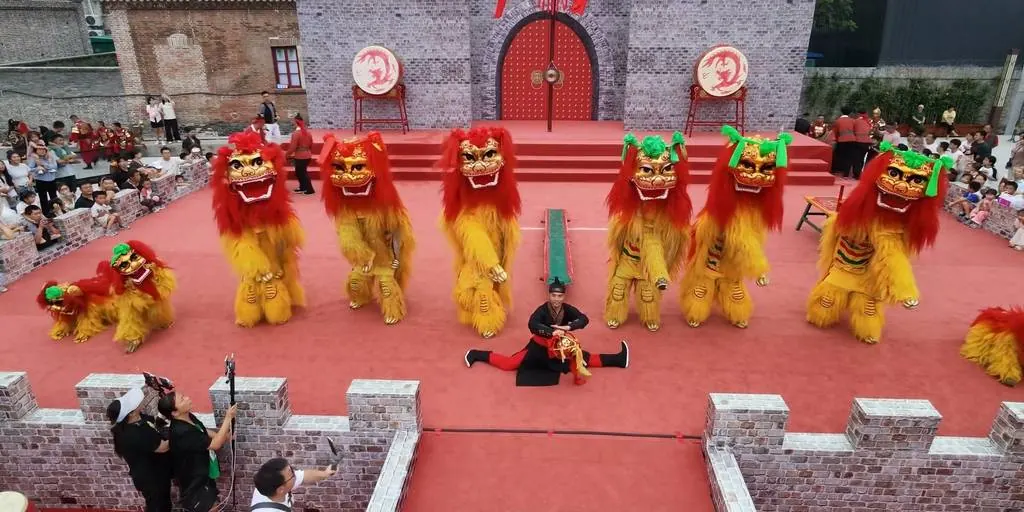
A ball can only hold so many lions, so a big stage show spreads them out. The basic unit stays the pair, but a large troupe can line up six adult lions, which means a dozen dancers trying to land the same step on the same beat.
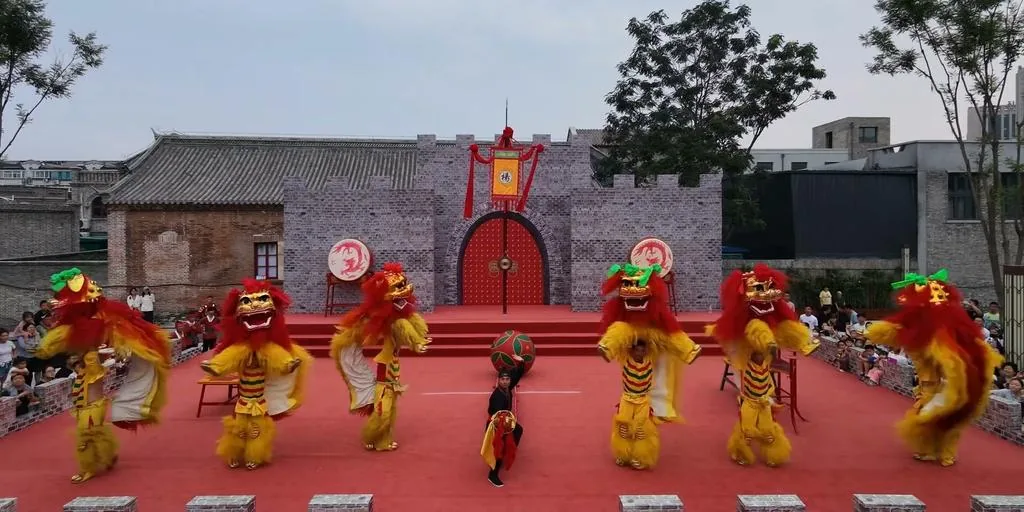
Stage shows are also where the color rule pays off. In the row below, the three lions on the left have red tops and the three on the right have green, so by convention you’re looking at males and females facing the same way. The ball hasn’t gone anywhere either: the performer at center is holding it while he sits in the splits.
Northern lion dance history: from the Northern Wei to Xushui and Beijing
Nobody can date a show like this exactly, and the age you hear depends on who’s telling it. The usual story places its start in the Northern Wei dynasty (386–534), when Hu dancers, performers from the non-Han peoples of the north and west, danced for the emperor. I’d treat that as tradition, not record.
Firmer ground comes in the Tang dynasty. The poet Bai Juyi describes two dancers in a lion costume with a wooden head, a silk tail and ears that moved, which is close to the two-person lion we have now.
The two best-documented northern lines are much younger:
- Beijing: the Baizhifang taishi traces itself to a society said to be founded in 1740, under the Qianlong Emperor. In 1870 it was reorganized, and its lion was redesigned after the stone lions in front of the Forbidden City’s Hall of Supreme Harmony. It’s now on China’s national heritage list.
- Hebei: the lion society of Beili, in Xushui, dates to 1925, though the dance there is older. Xushui lion dance was on China’s first national intangible heritage list in 2006. Chinese media call it the king of northern lions, which is local pride and not a ranking.
Where to see a northern lion dance, at New Year and beyond
Those heritage troupes are still the surest way to see the real thing, and in north China they’re busiest around the holidays. Xushui’s lions come out mainly for Spring Festival and temple ceremonies, and they also turn up at other occasions such as the Dragon Boat Festival. If you’re timing a trip, start with the Lunar New Year calendar, day by day, which runs through to the Lantern Festival.
The US is harder. Most Chinese who settled overseas left from the south, so Chinatown parades are mostly southern lions. A Singapore troupe says the form is rare there too because the moves are so difficult. Your better bet is a Chinese dance company or a cultural center’s student show. Hiring is a separate question, and my piece on lions at weddings and shop openings covers what a host needs to prepare.
When you do catch one, find the ball first and watch who’s following it. That’s the quickest way into a corner of Chinese tradition that most Americans have only seen in its southern form.
Written by
Daozhang MaMaoshan Taoist, Jintan, Jiangsu
Daozhang Ma is a Maoshan Taoist who has practiced for 22 years and is skilled at writing talismans and painting Taoist pictures. He runs Zodiac & Tradition.
About Daozhang Ma