Red Lanterns for Chinese New Year: Why Red and Where to Hang
By Daozhang MaMaoshan Taoist, Jintan, Jiangsu
In short
Red lanterns for Chinese New Year are hung as a pair at the front gate or door a few days before New Year’s Eve, lit that night, and usually taken down after the Lantern Festival on the 15th day of the first lunar month. For the coming Year of the Goat that means hanging them around February 3 or 4, 2027, and taking them down after February 20, 2027.
The red is the point. Red stands for luck, joy and a household that is doing well, and a lit red lantern at the gate tells the whole street that the family is home for the New Year.
Below I cover why the color matters, how a family actually gets a pair up on the gate, why there are two of them, the night they are first switched on, when they come down, and what electric lanterns changed.
Why Chinese New Year lanterns are red
Red is the color of the whole holiday, and the lantern carries it furthest because it glows. People wish each other a year that is honghong huohuo (红红火火), literally “red red, fire fire,” meaning busy, warm and prosperous. A red lantern burning at the gate is that phrase turned into an object: red color plus fire.
The association between red and celebration reaches well beyond the New Year. Weddings, birthdays and shop openings use it too, so a red lantern is never a neutral decoration.
The older reason comes from the story of Nian, the beast said to raid villages at the turn of the year and to fear red, firelight and noise. I go through that story, the round shape and the lantern’s other meanings on the Lunar New Year lanterns page, so here I’ll stay with what the color does at New Year.
Many lanterns also carry gold words or pictures that spell out the wish. A common one is nian nian you yu (年年有余), “may there be abundance year after year,” often painted with carp, because yu (鱼, fish) sounds like yu (余, surplus). Gold on red adds wealth to luck, and the two colors are hard to miss from the road.
How a family hangs red lanterns for Chinese New Year
Knowing what the red means, most families don’t think about it much once the lanterns arrive. Getting them up is a small job that the household does together, usually a few days before New Year’s Eve.
In the countryside of northeast China, many families buy their lanterns ready-made or have them made to order, often in red velvet with gold printing and a yellow fringe. A pair can last several New Years if it’s stored dry.
The first job is the light. Before the lantern goes up, someone pushes an electric bulb holder down into the ring at the top so the cord runs out above it.
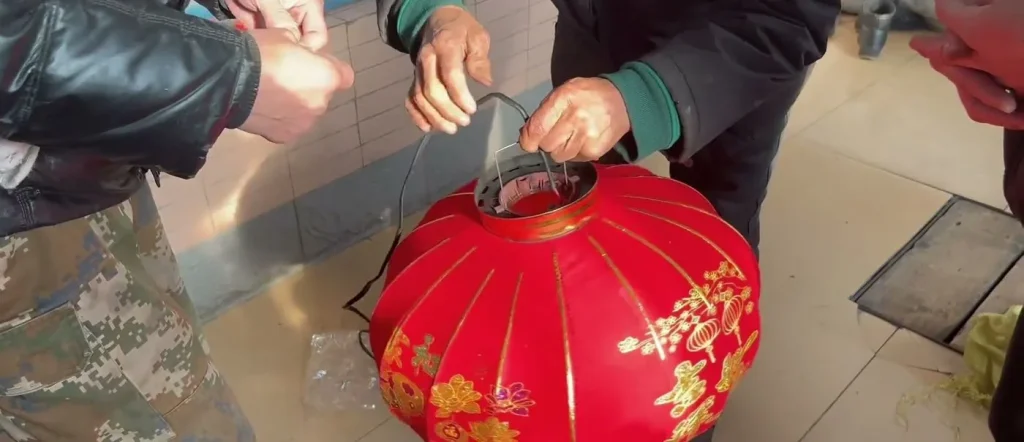
Next the lantern is tied to the top of a tall wooden pole, cord and all, so the plug can reach the house later. The job goes easier with two people, one holding the pole steady while the other ties the knot and checks that the lantern hangs straight.
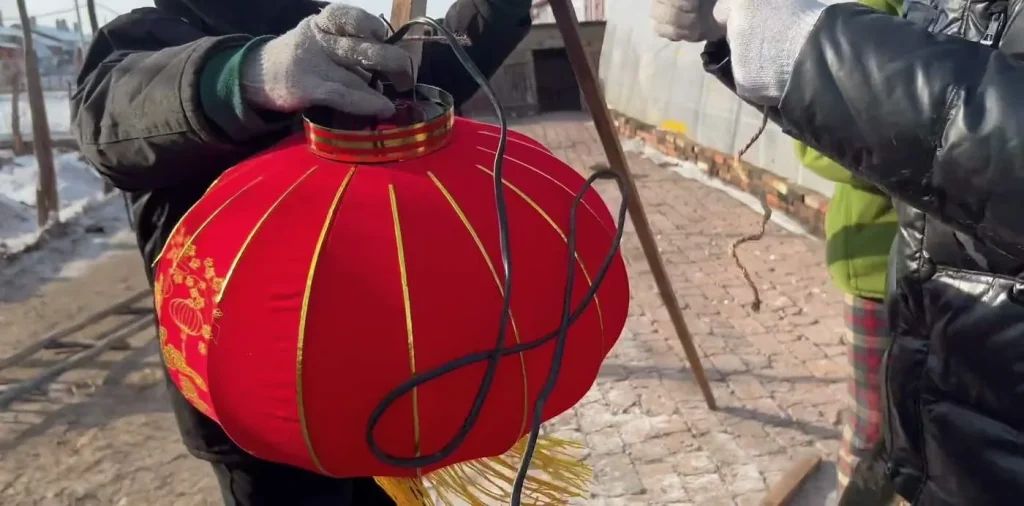
The poles are then stood up and fixed on each side of the courtyard gate. In a house with eaves, the lanterns hang from hooks under the roof edge instead, and no pole is needed.
Where red lanterns go: a pair at the front gate
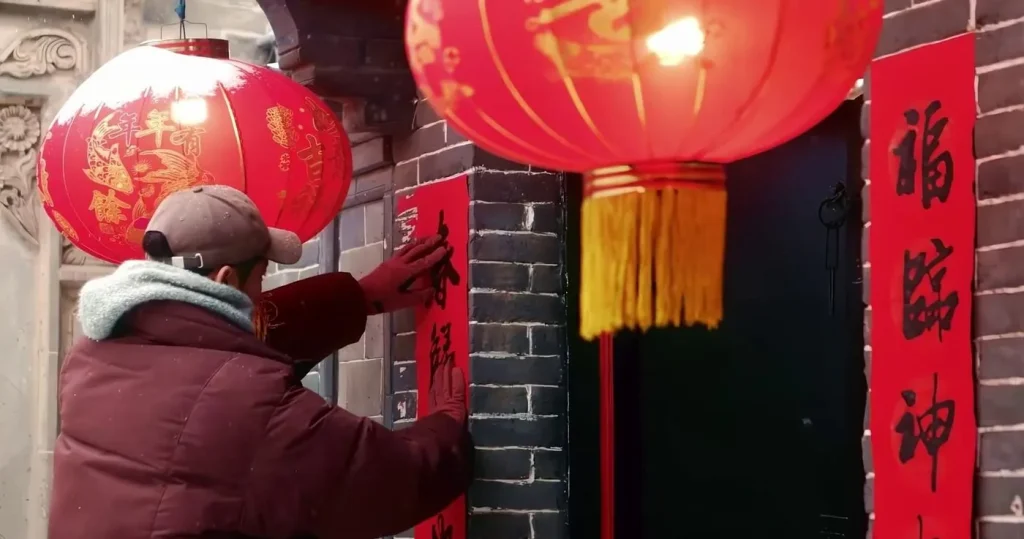
Once the poles are up, the result is the picture most people have of a Chinese New Year house: one red lantern on the left of the gate, one on the right.
Pairs matter because even numbers are lucky at New Year. The saying hao shi cheng shuang (好事成双) means “good things come in pairs,” and the same idea gives the door its two spring couplets, one on each side. A single lantern looks lopsided to most Chinese eyes, as if something were missing.
Two is the minimum. Bigger gates sometimes get four.

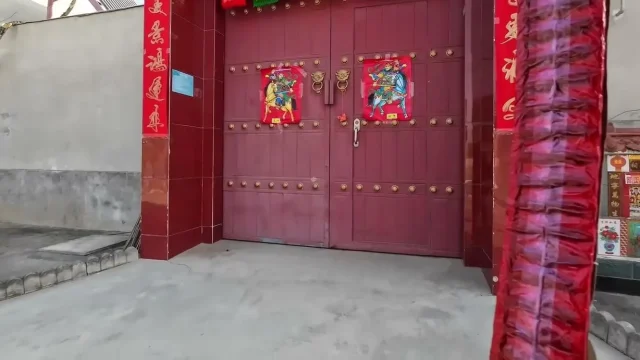
The gate is the right spot because it faces the road. Lanterns there greet visitors and neighbors, and they mark the line between the street and the home. The red lanterns and the couplets on the door go up around the same days and read as one set.
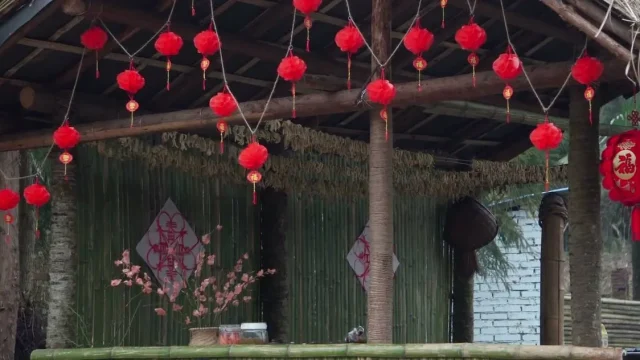
Where people live changes how the pair is hung, not the idea behind it. Northern farm courtyards often use tall poles because the gate stands apart from the house. In towns and in much of southern China, lanterns more often hang under the eaves or from the door frame. City apartments use the balcony or the space beside the front door, and Chinatowns abroad string rows of them across whole streets.
Lighting the red lanterns on New Year’s Eve
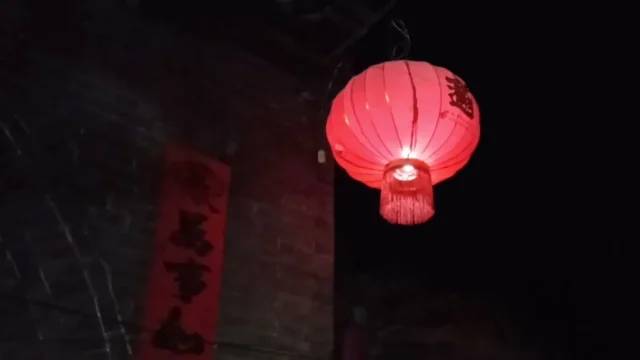
A pair at the gate is only half the custom. The other half happens after dark on New Year’s Eve, when the lanterns are switched on for the first time that year. In 2027 that’s the night of February 5.
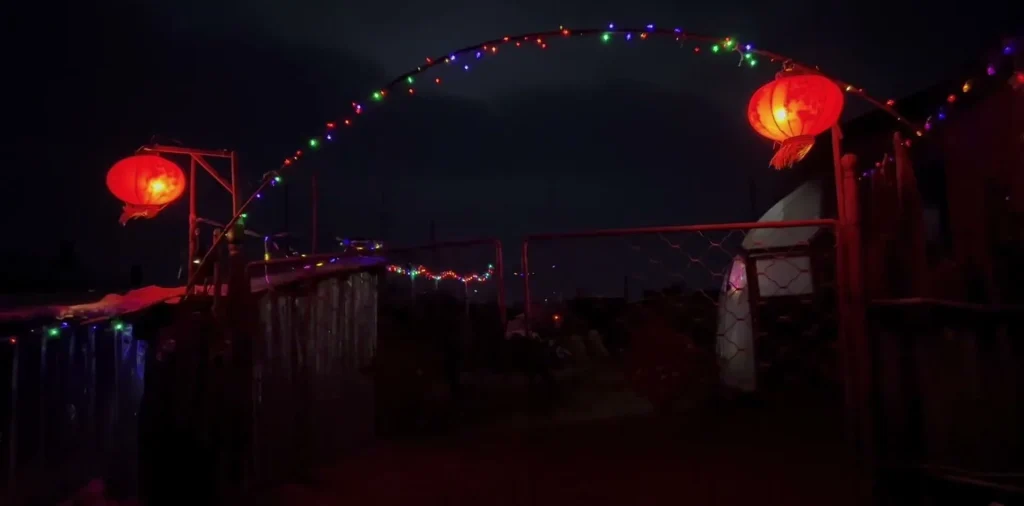
Many families leave them on all night. The Eve is the night for shousui (守岁), staying up to see the old year out, and lights burning through the house and at the gate belong to that wish for a bright year ahead. I like the idea that the house shouldn’t go dark while the year turns. The full order of that night, from the reunion dinner to midnight, is on the Chinese New Year’s Eve page.
After the Eve, most households switch the lanterns on each evening for the rest of the New Year season. In a village, you can tell from a distance which houses are celebrating just by counting the red lights along the road.
When red lanterns come down after Chinese New Year
The lanterns stay up until the New Year season ends, and that end is the Lantern Festival on the 15th day of the first lunar month. In 2027 the Lantern Festival falls on February 20, so February 21 or the days just after are the usual time to take the pair down.
Plenty of shops and restaurants leave theirs up for weeks, and some rural families keep the poles standing until the weather turns. Neither is a taboo. My own view is that a lantern faded by spring sun sends the opposite message from the one it went up with, so I’d take it down, wipe it, fold it flat and store it dry for next year.
Electric red lanterns and lanterns for a home outside China
The bulb holder in that family’s lantern shows how much the custom has changed. Door lanterns once held candles or oil lamps, and lighting them was a nightly job with a real fire risk inside a cloth or paper shell. Today most red lanterns sold for the New Year take a plug-in bulb, and many come with LED lights already fitted.
LED is the better choice for anything left on overnight. It runs cool, so it won’t scorch velvet or paper, and it uses little power through two weeks of evenings. For a lantern outdoors, check that the cord and bulb are rated for outdoor use.
I’d pick LED every time.
There’s also a practical difference in brightness. Traditionally a lantern gave a soft, dim glow, and that’s still the effect people expect, so a warm low-wattage bulb looks more authentic than a bright white one.
If you’re putting up red lanterns for Chinese New Year in the United States, the same rules work at a smaller scale. Hang two, not one, on each side of the front door or porch. Pick nylon or fabric lanterns for outside, since paper ones tear in the first rain, and save paper for indoors. More ideas for the rest of the house are on the main Lunar New Year page.
Written by

Daozhang MaMaoshan Taoist, Jintan, Jiangsu
Daozhang Ma is a Maoshan Taoist who has practiced for 22 years and is skilled at writing talismans and painting Taoist pictures. He runs Zodiac & Tradition.
About Daozhang Ma