Chinese New Year Crackers: What They’re Called, Where to Buy
By Daozhang MaMaoshan Taoist, Jintan, Jiangsu
In short
Chinese New Year crackers are firecrackers: strings of small red paper tubes, called bianpao (鞭炮) in Mandarin, braided together so that one lit fuse sets off the whole length. In a US store the same words can also get you a plastic door hanging, a pull cracker with a paper crown inside, or a bag of prawn crackers.
Here on Maoshan in Jiangsu, where I live, the first kind is the only one anyone means, the real thing that arrives as a heavy round coil. So the first job is working out which one you’re looking at. After that come the Chinese names, the inside of a coil, the numbers on the label, and the hanging kind you can safely keep at home.
Five things people call Chinese New Year crackers
Only one of these five explodes properly, and it’s the only one with any real history behind it.
| What it is | Does it bang? | Where you’ll meet it |
|---|---|---|
| Firecracker strings (bianpao) | Yes, loudly | Villages in China, licensed displays, Chinatown parades |
| Decorative firecracker hangings | No | Doorways, restaurants, Asian supermarkets, Amazon |
| Electronic firecracker strings | Only through a speaker | Apartments where real ones are banned |
| Lunar New Year pull crackers | One small snap | A party table, one per guest |
| Prawn crackers | No, you eat them | New Year snack tables in Malaysia and Singapore |
Real strings go off at midnight on Chinese New Year’s Eve and at a few other fixed moments, to frighten bad luck away from the new year. I’ve traced where that belief comes from, and where lighting them is legal, in my guide to why firecrackers go off at New Year. This page sticks to the object itself.
A pull cracker is the British Christmas cracker dressed in red and gold: a card tube two people tug apart, with a friction strip inside that gives a small snap. Williams Sonoma listed a Lunar New Year set of 12 in October 2026, each holding a party crown and a red envelope with a fortune and felt decorations. It’s a nice table favor, but I’ve never seen one at a New Year table here.
Prawn crackers are the only kind you eat. They turn up in tins and jars alongside the cookies in Malaysia and Singapore, and they have nothing to do with noise.
What are Chinese firecrackers called?
Chinese firecrackers are called bianpao (鞭炮) in Mandarin, and you’ll also hear baozhu (爆竹) and paozhang (炮仗). Bian means a whip, because a long string looks like one, and pao is a banger. Baozhu means “exploding bamboo,” left over from the days when people threw bamboo stalks on a fire.
The gunpowder version is usually traced to Meng Yuanlao’s 12th-century memoir of the Song capital, which describes a sudden noise like a thunderclap and calls the thing a baozhang (爆仗). Cracker itself is just a shorter English word for the same object, still common in British and South Asian English. I can’t tell you who first used it for the Chinese kind.
Four more Chinese words will help if you ever stand at a stall or read a box:
- Gua (挂) means “a hanging,” and it’s the word for counting one string.
- Pan (盘) means “a plate,” and it’s the word for a flat round coil.
- Xiang (响) means “a bang,” and strings are sold by how many they’re meant to hold.
- Dadihong (大地红) reads “red across the ground,” and it’s one of the commonest names on the box.
What’s inside a Chinese New Year firecracker coil
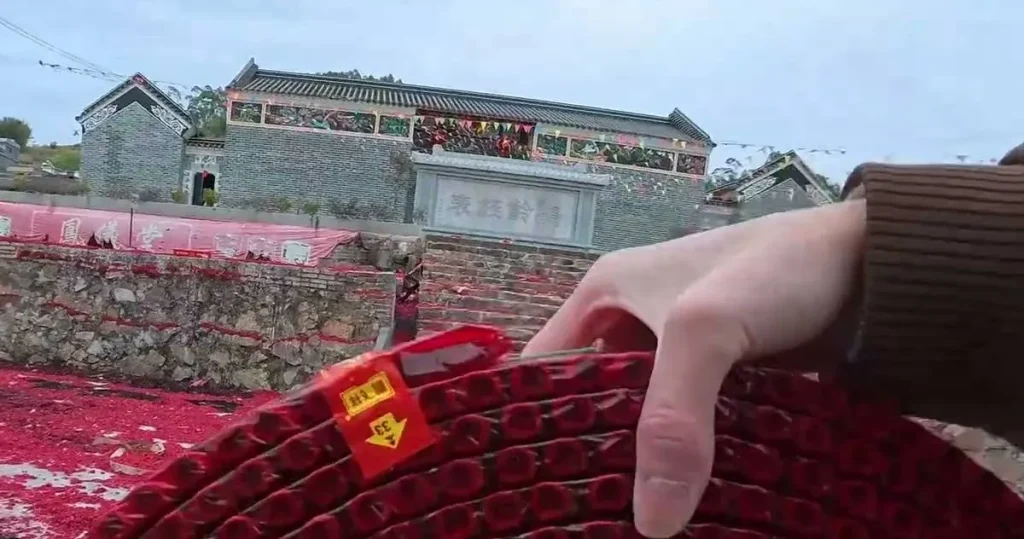
Of those shapes, the pan is the one that surprises people. A big coil arrives as a flat red disc sealed under a round printed cover. Going by a hand or a sandal beside one, the larger coils run roughly 1.5 to 2.5 feet across (45 to 75 cm), though that’s my estimate and sizes vary a lot.
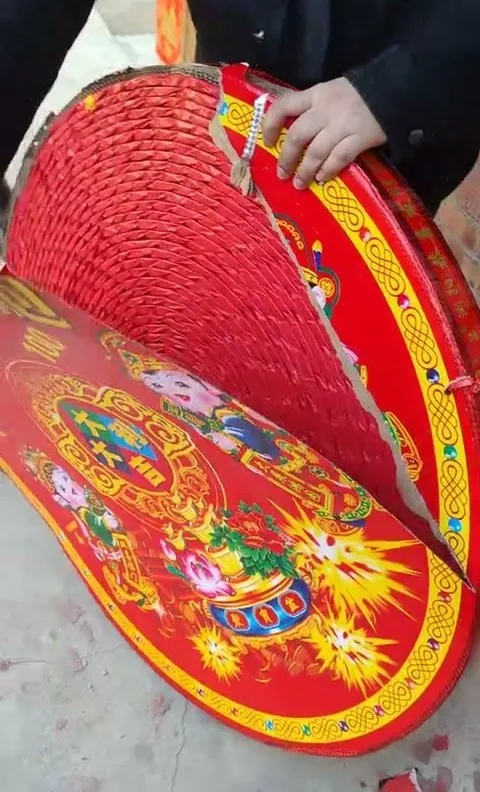
I like being the one who tears the cover back. The tubes underneath lie so tight that the disc looks like a woven mat, and that’s close to the truth. Each tube’s short fuse is braided in with its neighbors, and the braid then winds round and round on itself into one flat spiral.
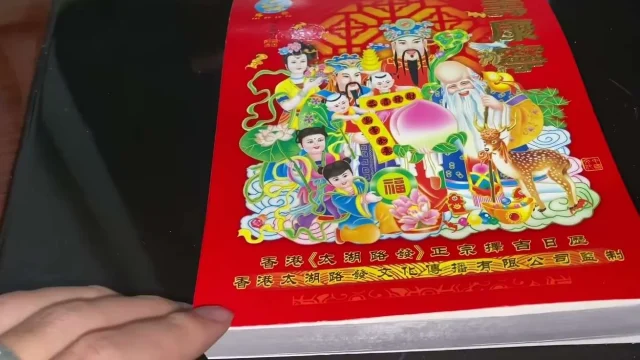
I paint Taoist pictures, so covers like this hold my eye longer than they should. This one has round-faced children, a blue and gold treasure bowl (jubaopen, 聚宝盆, the bowl of endless money in folk stories) full of flowers, and gold starbursts standing in for the bangs. Every inch of that art is a wish, and it gets ripped off before anyone finds a lighter.
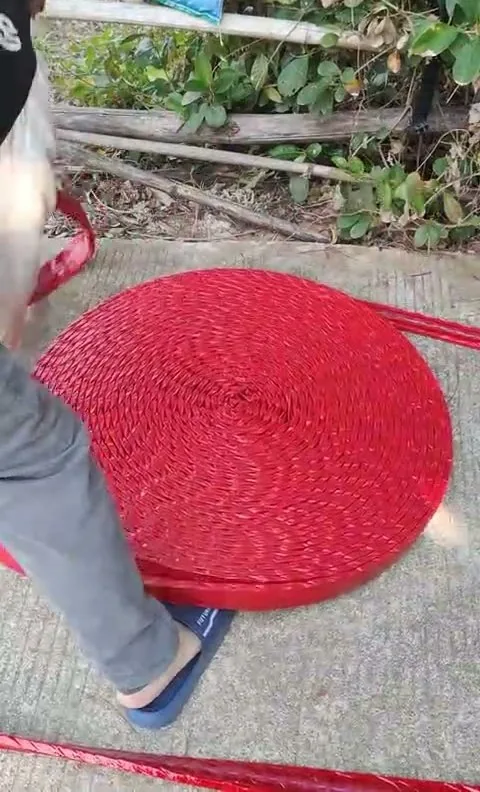
Nobody needs to unwind a coil in one go. I set the disc down flat, find the loose end on the outer edge and walk it away along the ground, so the coil feeds out behind me.
How to read a firecracker label: xiang, xing and dadihong
The number on the box is less honest than that neat coil suggests. In February 2010 the Huashang Morning Post looked at dadihong strings on a street stall in Shenyang. Strings marked “1,000 xiang” were mostly a few dozen tubes short, which is close enough.
Strings marked “1,000 xing” (型, “type”) held a little over 700. The pack had a line saying the name was a traditional term and not an actual count, so one small character cost the buyer more than 200 tubes.
That was one stall in one city, 16 years ago, so don’t treat it as a national rule. The advice from the same report still holds up: fold two strings and compare how thick they are, since a string folded eight layers deep beat one folded six.
The paper was also told that 50 missing tubes shortens the burn by about two seconds. By that rate, a full 1,000-tube string is over in roughly 40 seconds. Tube size changes the sound as well, because bigger tubes hold more powder, so the count tells you how long it lasts and not how loud it gets.
What a firecracker coil looks like once it’s laid out
Forty seconds doesn’t sound like much until you see how much string a stack of coils hides. Laid out in a yard, a few discs turn into a red tangle that can cover the whole floor, with spare coils still sitting among the loops.
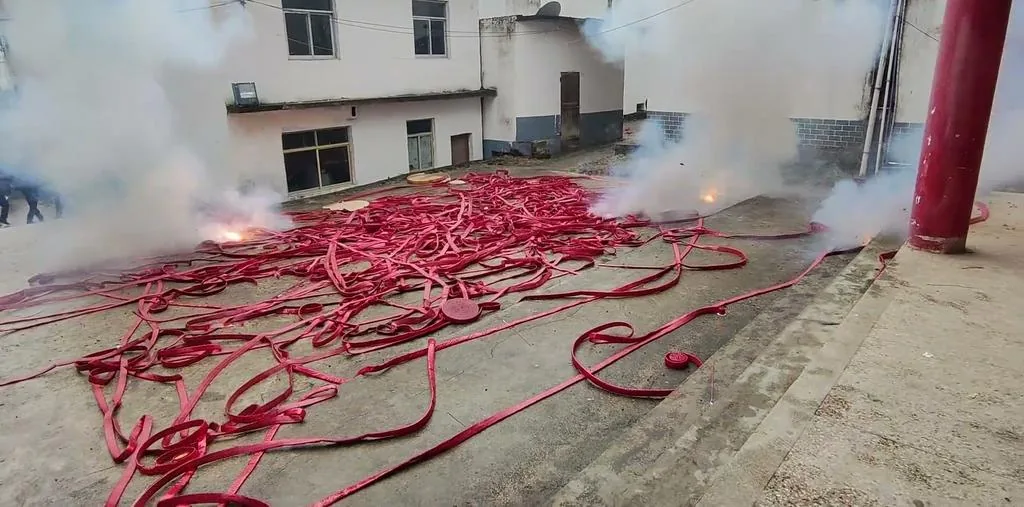
A string doesn’t need much to get going. A thin puff at the tip of the strand is all you see before the first bang.
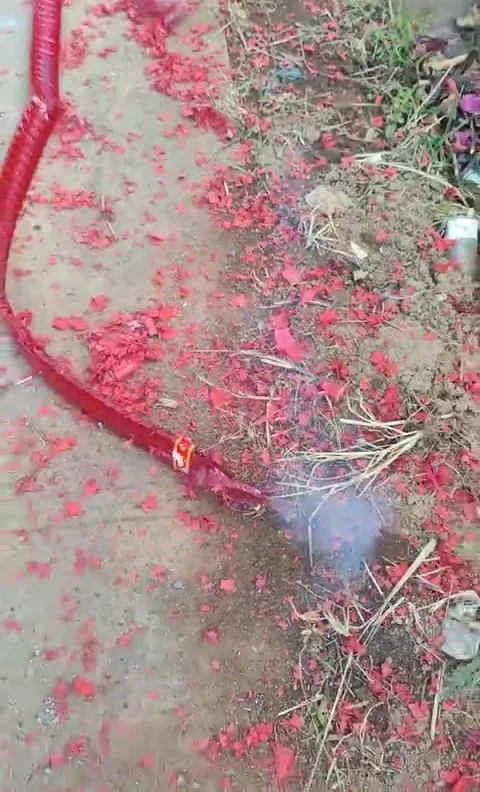
The last turns of a coil don’t always get pulled straight. I’ve watched them go off in a curled ring exactly where they lay, throwing grit and paper a long way for something so small, which is one reason I stay well back until it’s over.
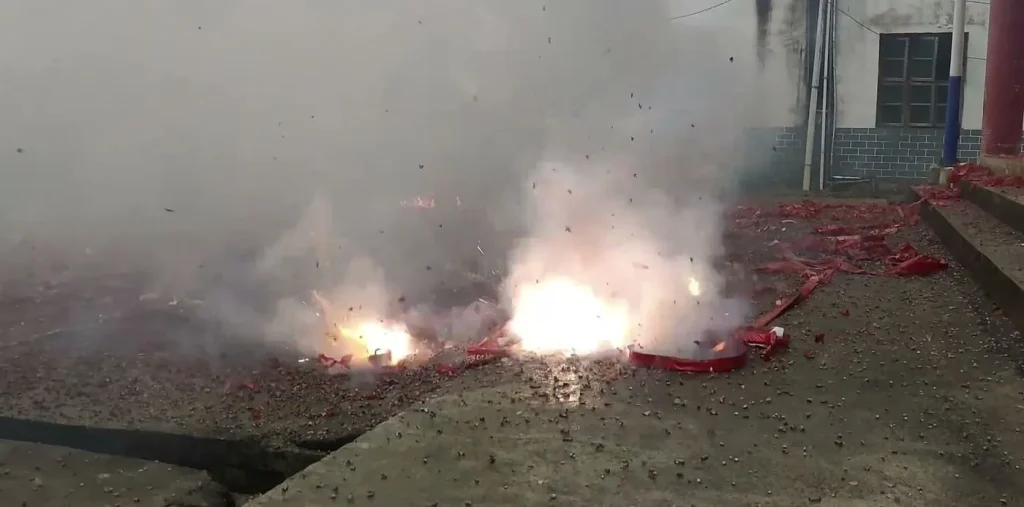
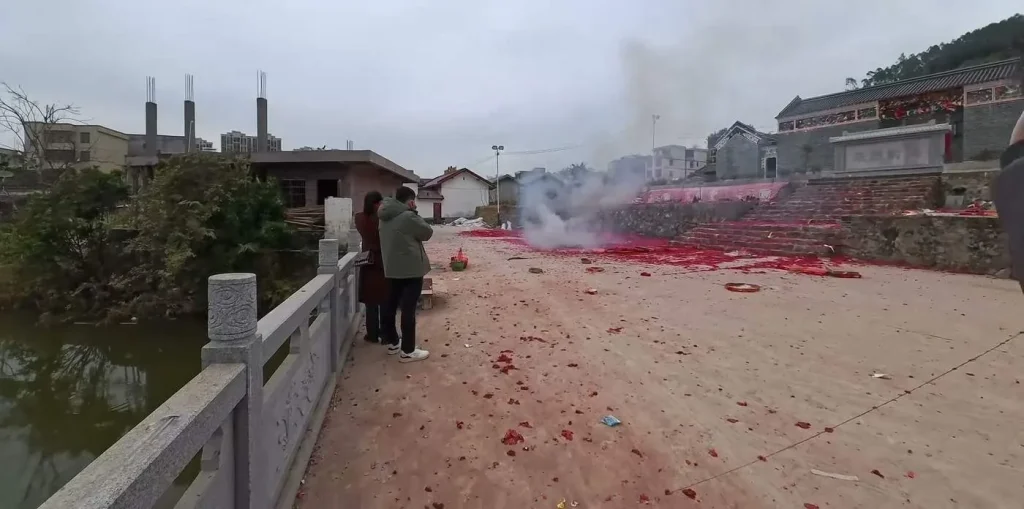
Then the name on the box makes sense. Dadihong promises red across the ground, and that’s what the buyer is really paying for, a road that looks well used on the first morning of the year. On New Year’s Day that paper often stays where it fell, because sweeping counts as pushing luck out the door.
Chinese New Year firecracker decorations for the home
For most readers in the US, the hanging kind is the one that matters. These are bunches of small red tubes in plastic, paper or felt, tied to a cord with a gold fu (福, “good fortune”) charm and a tassel. They carry the look of a string without any powder at all.
I hang a pair, one on each side of the door, after the couplets are up. Good things are meant to come in pairs at New Year, and a single string on one side always looks to me as if its partner fell off. The rest of the doorway, from couplets to door gods, is in my guide to Chinese New Year decorations.
A few things are worth checking before you buy or hang one:
- Make sure the listing says decoration or ornament, with no fuse and no powder.
- Pick plastic or felt for an outside door, because paper tubes go limp in the damp.
- Measure the door frame first, since long strings can drag on the step.
- Take them down when you like, though I keep mine up until the Lantern Festival on the 15th day.
Children can make their own in a few minutes. Cut a sheet of red letter paper into quarters, roll each piece into a narrow tube and tape it shut, then tie the tubes in pairs along a ribbon. Painted toilet paper tubes do the job too.
Where to buy Chinese New Year crackers
Hangings are the easy part. Asian supermarkets stock them in the weeks before the holiday, usually near the red envelopes, and Amazon sells them all year. Pull crackers come from kitchen and party stores.
Real strings are a different matter, because they can only come from a licensed seller where your state and city allow them, and I can’t tell you what’s allowed in your town. Most Americans who want the noise go to a Chinatown parade instead. You’ll find other customs like these on the Lunar New Year guide, and the rest of the site’s topics at Zodiac & Tradition.
If you only buy one thing, buy the hanging pair. The old saying is that noise chases bad luck off, and I’m happy to keep repeating it, but nobody can promise you that. What a red pair by the door does for certain is tell the street you’ve noticed the year has turned.
Written by

Daozhang MaMaoshan Taoist, Jintan, Jiangsu
Daozhang Ma is a Maoshan Taoist who has practiced for 22 years and is skilled at writing talismans and painting Taoist pictures. He runs Zodiac & Tradition.
About Daozhang Ma